


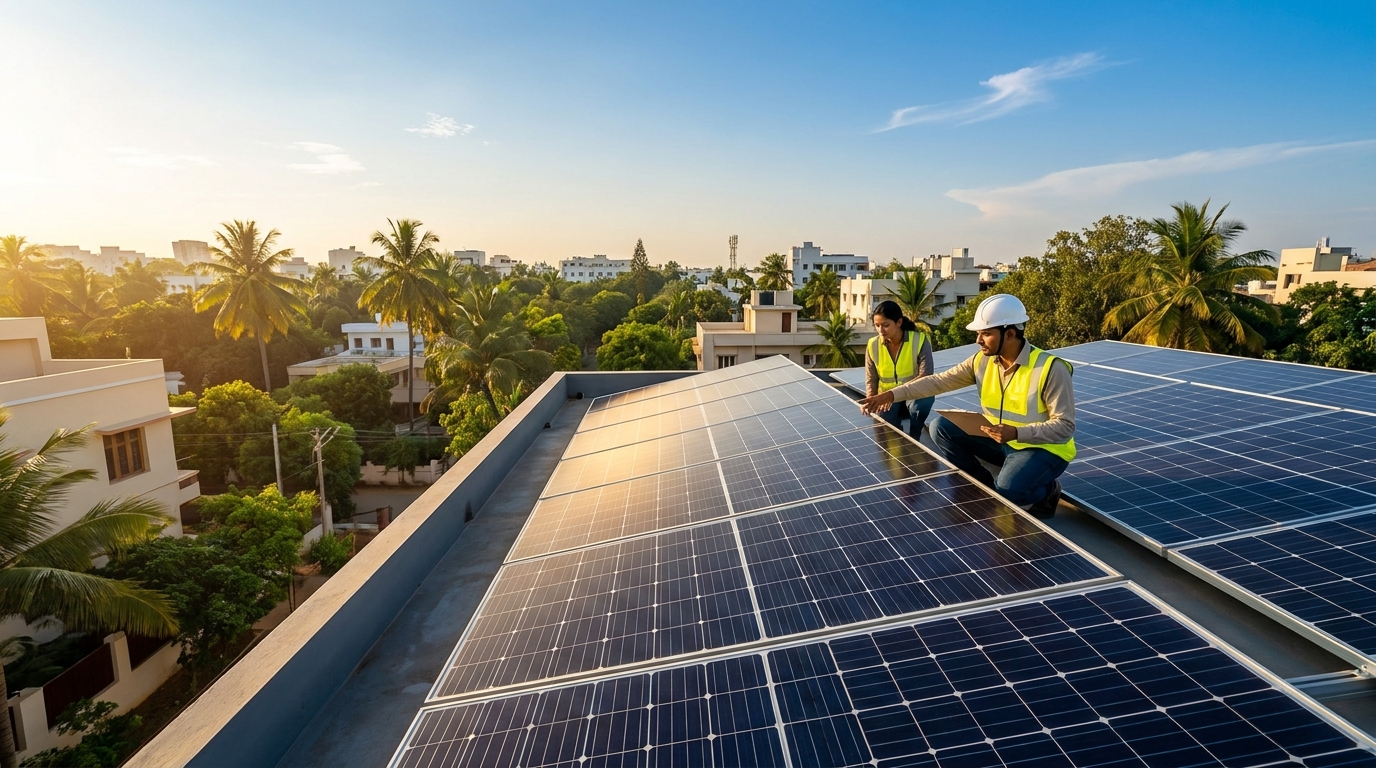
Buying solar in Gujarat has never been more popular — or more confusing. With hundreds of brands, dozens of installers, and government subsidy schemes adding another layer of complexity, how do you know you’re getting genuine solar quality and not just a low-cost system that will underperform within three years? The answer lies in certifications. International standards, Indian Bureau of Indian Standards (BIS) marks, and the government’s own Approved List of Models and Manufacturers (ALMM) exist precisely to protect buyers like you. This guide breaks down every certification that matters, explains what each one actually tests, and gives you a practical checklist to use before you sign any purchase agreement for a solar installation in Gujarat.
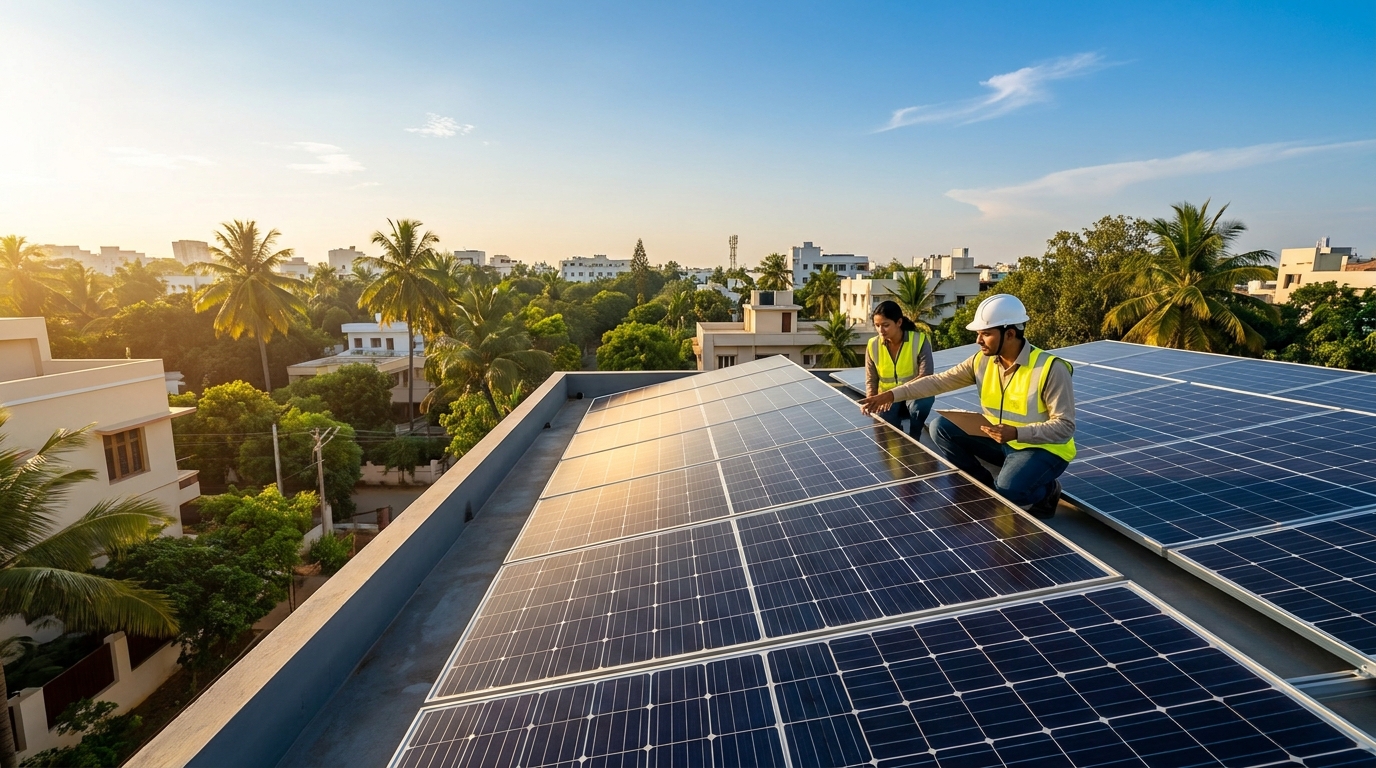
Why Solar Quality Certifications Matter More Than Price
It is tempting to compare solar quotes purely on price per watt. But solar quality is not visible to the naked eye. Two panels sitting side by side on a rooftop can look identical yet perform very differently over a 25-year lifespan. The difference often comes down to whether the manufacturer followed internationally recognized testing protocols and whether the product carries the certifications that prove it.
Gujarat’s climate is particularly demanding on solar equipment. Summers in Surat, Ahmedabad, and across the state push ambient temperatures well above 40°C, which accelerates cell degradation in lower-quality modules. Coastal areas face salt-laden air that corrodes inferior mounting structures and junction boxes. Monsoon humidity creates condensation risks inside inverters that lack proper ingress protection ratings. Certified equipment is tested against all of these stressors. Uncertified equipment is not.
There are also financial consequences. If you are claiming the PM Surya Ghar Muft Bijli Yojana subsidy or any state-level Gujarat solar subsidy, your system must use equipment from the government’s approved list. Install non-compliant panels and you could lose your subsidy entitlement entirely — a loss that can run into tens of thousands of rupees for a residential system. For commercial and industrial solar projects in Gujarat, non-certified equipment can also void insurance policies and create liability issues during grid interconnection approvals.
Understanding solar quality certifications is not just a technical exercise. It is a financial safeguard.
1. Understanding the Solar Quality Certification Landscape in India
India’s solar certification framework operates in three distinct tiers, and buyers need to understand all three to make informed decisions.
- International Standards (IEC): Set by the International Electrotechnical Commission, these define the baseline testing protocols that manufacturers worldwide must follow to prove their products meet minimum performance and safety thresholds.
- National Standards (BIS): The Bureau of Indian Standards adapts and enforces relevant IEC standards within India. BIS certification is now mandatory for solar modules and inverters sold in the Indian market.
- Government Approved Lists (ALMM): The Ministry of New and Renewable Energy (MNRE) maintains the Approved List of Models and Manufacturers. Only products on this list are eligible for use in government-subsidized or government-funded solar projects.
These three tiers are complementary, not interchangeable. A product can hold IEC certification but still fail BIS requirements. A product can be BIS-certified but not appear on the ALMM list. For a Gujarat homeowner or business owner seeking both performance assurance and subsidy eligibility, all three tiers matter. The Ministry of New and Renewable Energy (MNRE) oversees the policy framework that ties these standards together for grid-connected solar systems across India.
2. IEC Certifications: The International Solar Quality Benchmark
IEC certifications are the global language of solar quality. When a manufacturer claims their panel or inverter is “IEC certified,” they are saying an accredited third-party laboratory has tested the product against a specific IEC standard and it passed. Here are the key IEC standards every Gujarat buyer should know.
IEC 61215 — Crystalline Silicon Module Performance
This is the most important certification for solar panels. IEC 61215 tests modules for thermal cycling (simulating years of heating and cooling), humidity-freeze resistance, mechanical load (wind and snow pressure), and UV exposure. A panel that passes IEC 61215 has demonstrated it can maintain performance under real-world stress conditions. Most quality solar modules sold in India today carry this certification.
IEC 61730, Module Safety
Where IEC 61215 tests performance, IEC 61730 tests safety. It covers electrical insulation, fire resistance, and protection against electric shock. For rooftop solar installations in Gujarat where panels are installed close to living and working spaces, IEC 61730 is non-negotiable. Always verify both IEC 61215 and IEC 61730 on a panel’s datasheet.
IEC 62109, Solar Inverter Safety
This standard covers the safety of power converters used in photovoltaic systems, including both string inverters and microinverters. It tests for protection against electric shock, energy hazards, and mechanical hazards. A solar inverter without IEC 62109 certification should raise an immediate red flag.
IEC 62446, System Documentation and Commissioning
This standard is less about the equipment itself and more about the installation. IEC 62446 defines what documentation a properly commissioned solar system should include: string test results, insulation resistance measurements, and a system diagram. Asking your EPC contractor whether they follow IEC 62446 commissioning procedures is a quick way to gauge their professionalism.
To verify IEC certification, look for the certification body’s mark on the product datasheet (common bodies include TÜV Rheinland, Bureau Veritas, and UL). You can also request the test report directly from the supplier.
3. BIS Certification: India’s Mandatory Solar Quality Standard
The Bureau of Indian Standards (BIS) is India’s national standards body, and its certification is now a legal requirement for solar equipment sold in India. For Gujarat buyers, BIS certification is the minimum threshold for solar quality compliance in the domestic market.
BIS IS 14286, Solar Photovoltaic Modules
This Indian Standard aligns closely with IEC 61215 and IEC 61730 but is enforced under Indian law. Since 2022, solar modules sold in India must carry the BIS IS 14286 mark. Modules without this mark cannot legally be sold or installed in India. When reviewing a supplier’s product, look for the BIS Standard Mark (the ISI mark) on the module label or in the product documentation.
BIS IS 16221, Solar Inverters
This standard covers the performance and safety requirements for solar photovoltaic inverters in India. Like the module standard, BIS IS 16221 certification is mandatory for inverters used in grid-connected systems. It ensures the inverter meets India-specific grid requirements, including voltage and frequency tolerances defined by the Central Electricity Authority (CEA).
You can verify BIS certification for any product using the BIS Care portal at bis.gov.in, where you can search by product category and manufacturer name. This takes less than two minutes and can save you from a very costly mistake. Installing non-BIS certified equipment in a grid-connected system in Gujarat can result in DISCOM (distribution company) refusing to approve your net metering connection, which effectively makes your solar system useless for bill reduction.
4. ALMM: The Government’s Solar Quality Approved List

The Approved List of Models and Manufacturers (ALMM) is maintained by MNRE and represents the government’s own curated list of solar products that meet quality and domestic content requirements. For Gujarat homeowners and businesses applying for any government solar subsidy or participating in government-funded schemes, ALMM compliance is not optional, it is mandatory.
Why ALMM Listing Matters for Gujarat Buyers
Under the PM Surya Ghar Muft Bijli Yojana scheme, which provides subsidies for residential rooftop solar installations across India including Gujarat, only ALMM-listed solar modules can be used. The same applies to PM-KUSUM scheme installations for agricultural solar pumps and other MNRE-funded programs. If your installer proposes panels that are not on the ALMM list, your subsidy application will be rejected, regardless of how good the panels might otherwise be.
The ALMM list is divided into two parts: List I covers solar PV modules, and List II covers solar cells. MNRE has also been working on extending ALMM requirements to inverters, so it is worth checking the current status of inverter ALMM requirements at the time of your purchase. The list is updated periodically, so always verify against the current version.
How to Check the ALMM List
Visit the MNRE website and navigate to the ALMM section. You can search by manufacturer name or model number. Before finalizing any solar purchase in Gujarat, ask your supplier for the exact model number of the panels they propose to install, then verify that model appears on the current ALMM list. This single check can prevent subsidy rejection and ensure your system qualifies for all available government benefits.
For more context on how government schemes interact with your solar investment, our guide on Solar Payback Period Explained: Break-Even Timeline 2026 covers how subsidies affect your overall return on investment.
5. Certifications for Inverters and Balance-of-System Components
Solar panels and inverters get most of the attention when it comes to solar quality, but the balance-of-system (BOS) components, mounting structures, cables, junction boxes, earthing systems, account for a significant portion of a system’s long-term reliability. Failures in BOS components are a leading cause of solar system downtime in India.
Mounting Structures: IS 2062 Steel Standards
Solar mounting structures in Gujarat must withstand wind loads that can be significant, particularly in coastal districts like Surat, Bharuch, and Navsari. Quality mounting structures use IS 2062 grade steel with hot-dip galvanization for corrosion resistance. Ask your EPC contractor for the steel grade specification and galvanization thickness (typically 85 microns minimum for rooftop structures). Structures that use inferior steel or inadequate galvanization will corrode within five to seven years, creating both safety hazards and costly replacement expenses.
DC Cables and AC Wiring
Solar DC cables should carry TÜV or UL certification and be rated for at least 1000V DC with UV resistance. In Gujarat’s intense sunlight, non-UV-rated cables degrade rapidly, increasing resistance and reducing system output. AC wiring should comply with IS 694 standards. These are details that a quality EPC contractor will specify in their system design documentation without being asked.
Earthing and Lightning Protection
Proper earthing is critical for both safety and equipment protection. CEA (Measures Relating to Safety and Electric Supply) Regulations 2010 mandate specific earthing requirements for solar installations. In Gujarat, where thunderstorm activity is common during monsoon season, lightning protection should also be part of the system design. Ask your installer for the earthing design specification and verify it complies with IS 3043.
To understand how all these components fit together in a complete solar project, our detailed guide on What is Solar EPC? Complete Service Guide 2026 explains the full scope of engineering, procurement, and construction in a solar installation.
6. How to Vet a Solar EPC Supplier in Gujarat Using Certifications
Knowing which certifications to look for is only half the battle. The other half is knowing how to evaluate the EPC company that will actually design and install your system. A supplier who cannot readily produce certification documentation for the products they propose is a supplier you should walk away from.
Questions to Ask Your EPC Contractor
- Can you provide the IEC 61215 and IEC 61730 test reports for the panels you are proposing?
- Are the panels on the current MNRE ALMM list? What is the exact model number?
- Are the inverters BIS IS 16221 certified and CEA compliant for grid connection?
- What steel grade and galvanization specification do your mounting structures use?
- Is your company MNRE empanelled and registered with GEDA (Gujarat Energy Development Agency)?
- Will you provide IEC 62446-compliant commissioning documentation after installation?
Red Flags to Watch For
Be cautious of EPC suppliers who cannot immediately answer questions about certifications, who offer panels from brands not found on the ALMM list, or who provide quotes with vague product descriptions like “Tier 1 panels” without specifying the brand and model. “Tier 1” is a financial classification used by Bloomberg NEF to assess manufacturer bankability, it is not a quality certification. A panel can be from a Tier 1 manufacturer and still fail to meet BIS or ALMM requirements.
Also be wary of extremely low-priced quotes. Solar quality components have a cost floor. If a quote is significantly below market rates, it is almost certainly because corners are being cut on component quality, certification compliance, or installation workmanship.
Verifying EPC Credentials
In Gujarat, reputable solar EPC companies should be registered with GEDA and ideally empanelled with MNRE. GEDA registration is particularly important for accessing state-level subsidies and net metering approvals through Gujarat’s DISCOMs (DGVCL, MGVCL, PGVCL, UGVCL). Ask for the company’s GEDA registration number and verify it directly with the agency.
At Heaven Green Energy, every project uses ALMM-listed modules and BIS-certified inverters as a standard practice. Our team handles all GEDA registration, DISCOM approvals, and subsidy documentation on behalf of our clients, so you never have to navigate the certification maze alone. If you want to compare the leading panel brands available in Gujarat and their certification status, our post on Solar Brands Gujarat: Top Panel Manufacturers Compared 2026 provides a detailed breakdown.
7. Your Solar Quality Certification Checklist Before Signing
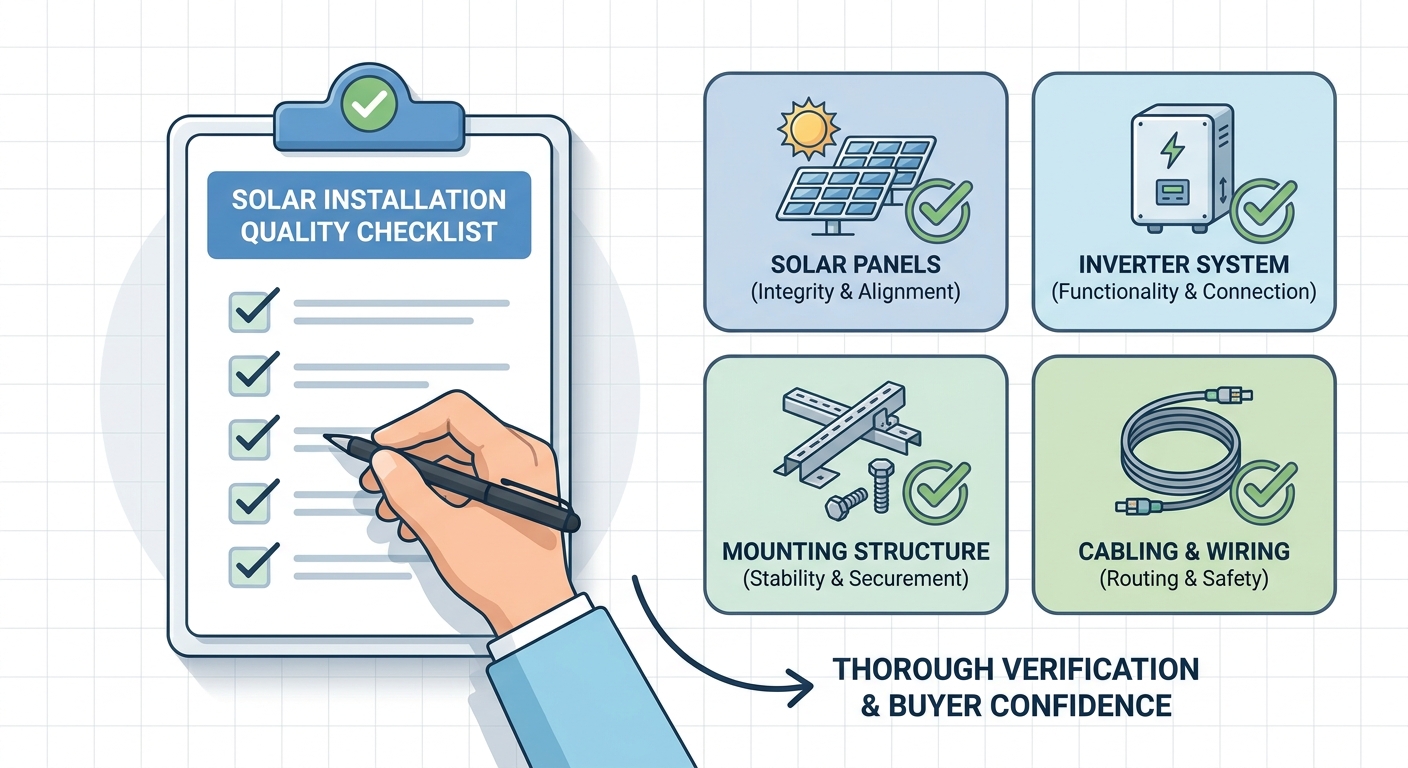
Use this checklist before signing any solar purchase agreement or EPC contract in Gujarat. A trustworthy supplier will be able to provide documentation for every item on this list without hesitation.
Solar Panel Checklist
- ☑ IEC 61215, Performance testing certification (request the test report)
- ☑ IEC 61730, Safety certification (request the test report)
- ☑ BIS IS 14286, Indian mandatory standard (verify the ISI mark on the module label)
- ☑ ALMM List I, Verify the exact model number on the current MNRE ALMM list
- ☑ Product Datasheet, Confirm the model number matches what is being installed
- ☑ Manufacturer Warranty, Minimum 10-year product warranty, 25-year linear performance warranty
Solar Inverter Checklist
- ☑ IEC 62109, Inverter safety certification
- ☑ BIS IS 16221, Indian mandatory standard for inverters
- ☑ CEA Compliance, Grid-tie compliance per Central Electricity Authority regulations
- ☑ IP Rating, Minimum IP65 for outdoor-mounted inverters in Gujarat’s climate
- ☑ Manufacturer Warranty, Minimum 5-year warranty (10 years preferred)
Balance-of-System Checklist
- ☑ Mounting Structures, IS 2062 steel with hot-dip galvanization (minimum 85 microns)
- ☑ DC Cables, TÜV or UL certified, UV-resistant, 1000V DC rated
- ☑ AC Wiring, IS 694 compliant
- ☑ Earthing System, IS 3043 compliant, CEA regulation compliant
- ☑ Junction Boxes, IP67 rated minimum
EPC Supplier Checklist
- ☑ GEDA Registration, Verify the registration number with GEDA directly
- ☑ MNRE Empanelment, Confirm the company is on the MNRE empanelled installer list
- ☑ Project References, Request references for at least three completed projects of similar size in Gujarat
- ☑ Commissioning Documentation, Confirm they will provide IEC 62446-compliant handover documents
- ☑ AMC / Maintenance Plan, Confirm post-installation maintenance support is available
Frequently Asked Questions About Solar Quality Certifications
Can I lose my solar subsidy if my panels are not ALMM listed?
Yes. Under PM Surya Ghar and other MNRE-funded schemes, using panels that are not on the current ALMM List I will result in your subsidy application being rejected. Always verify the exact model number on the ALMM portal before signing your purchase agreement. This is one of the most common and costly mistakes Gujarat solar buyers make.
Is IEC certification enough, or do I also need BIS?
Both are required. IEC certification proves the product meets international testing standards, but BIS certification is a legal requirement under Indian law for products sold in India. A product can hold IEC certification from a foreign lab but still not be BIS certified. For a grid-connected solar installation in Gujarat, you need both IEC and BIS certifications on your panels and inverters.
How do I verify if a solar panel brand is on the ALMM list?
Visit the MNRE website and navigate to the ALMM section. You can download the current approved list or search by manufacturer. Always use the exact model number from the product datasheet, not just the brand name, because ALMM approval is model-specific. A manufacturer may have some models approved and others not.
What happens if my installer uses non-certified components?
The consequences can be serious. Your DISCOM may refuse to approve net metering, meaning your system cannot export excess power to the grid. Your subsidy application will be rejected. Your system insurance may be void. In the worst case, non-certified electrical components can create safety hazards. Always insist on full certification documentation before installation begins.
Does solar quality certification affect my system’s warranty?
Directly, yes. Most reputable solar panel manufacturers require that their products be installed by certified installers using compliant BOS components for the product warranty to remain valid. If your system uses non-certified mounting structures or cables that damage the panels, the panel manufacturer may reject your warranty claim. Solar quality is a system-level concern, not just a panel-level one.
Are there specific certification requirements for industrial solar projects in Gujarat?
Industrial and commercial solar projects in Gujarat face additional requirements beyond residential systems. These include CEA compliance for high-capacity grid connections, specific DISCOM technical standards for HT (high tension) connections, and potentially CEIG (Chief Electrical Inspector to Government) approval for larger installations. A qualified solar EPC company with experience in industrial solar Gujarat projects will navigate these requirements as part of their service.
Make Solar Quality Your Non-Negotiable Standard
Choosing solar is one of the most significant energy investments a Gujarat homeowner or business will make. The panels on your roof or factory will be there for 25 years. The inverter will process thousands of units of electricity every year. The mounting structure will face Gujarat’s heat, humidity, and monsoon winds season after season. Solar quality certifications, IEC, BIS, and ALMM, are the only objective, third-party verified proof that the equipment you are buying has been tested to survive and perform through all of it.
Do not let a low-cost quote override the certification checklist above. The short-term savings from uncertified equipment are almost always outweighed by the long-term costs of underperformance, subsidy rejection, and premature replacement. Gujarat’s solar market has matured significantly, and buyers who understand certifications are the ones who get the best long-term value from their investment.
At Heaven Green Energy, we have been delivering certified, ALMM-compliant solar installations across Gujarat since 2017, from residential rooftops in Surat to large industrial solar projects across the state. Every system we design uses components that pass every item on the checklist above, and we handle all GEDA and DISCOM approvals so our clients can focus on the benefits, not the paperwork. If you have questions about certifications for your specific project or want to verify whether a quote you have received meets the standards outlined in this guide, our team is ready to help. Call us at +91 63904 05060 and speak directly with a solar quality expert who knows Gujarat’s regulatory landscape inside and out.
This blog post was written using thestacc.com