


Choosing the wrong solar capacity for your business is one of the most expensive mistakes you can make in Gujarat’s growing solar market. Install too little, and you’ll still pay high electricity bills. Install too much, and you’ve locked up capital in panels that sit idle — while potentially running into DISCOM compliance issues. Getting the sizing right from day one is the foundation of a profitable solar investment. This step-by-step guide walks Gujarat business owners through a proven methodology for calculating the ideal solar capacity for factories, warehouses, commercial offices, and more.
Why Getting Solar Capacity Right Matters for Gujarat Businesses
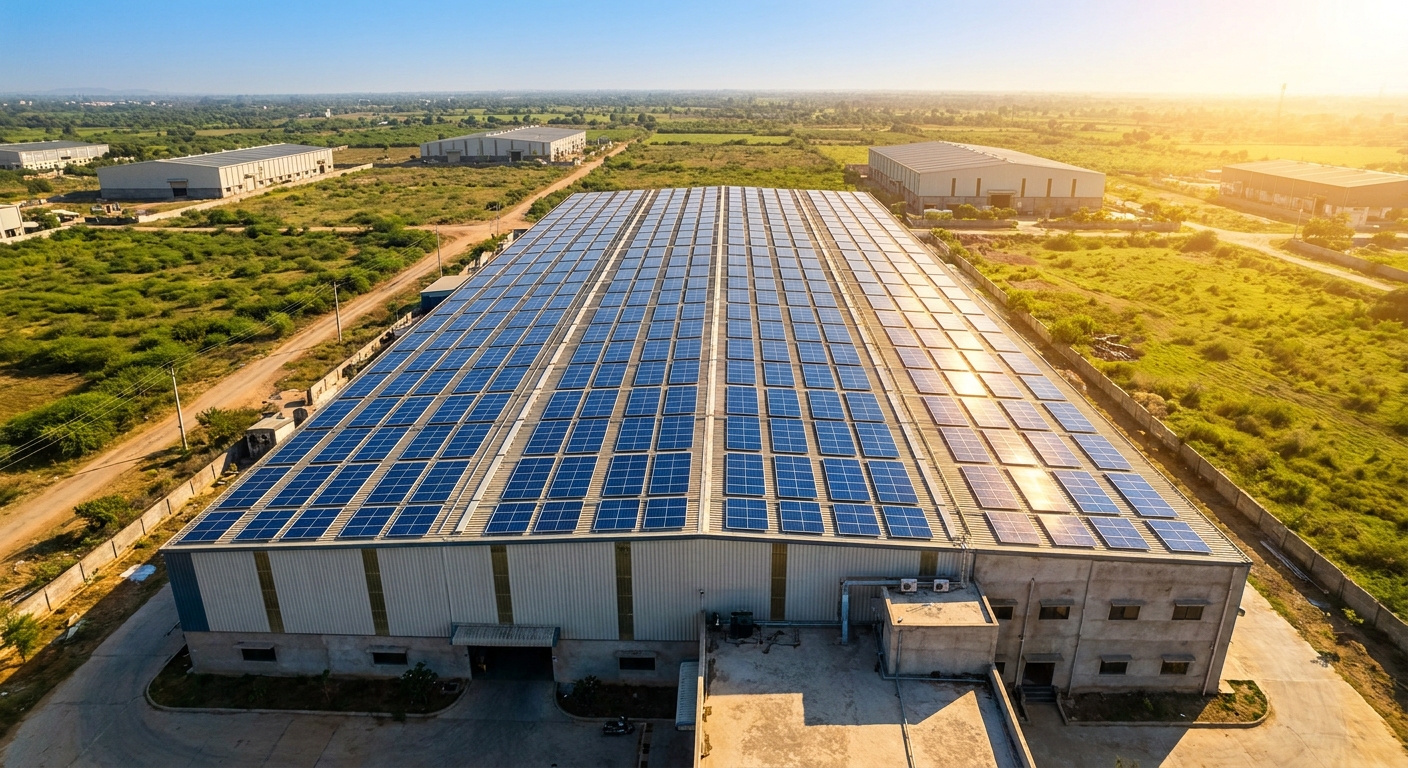
Solar capacity sizing is not a one-size-fits-all exercise. A 50 kW system that works perfectly for a mid-sized textile unit in Surat would be completely inadequate for a cold storage facility in Rajkot — and oversized for a small commercial office in Ahmedabad. The consequences of getting this wrong are real and measurable.
Undersizing means your solar system covers only a fraction of your electricity demand. You continue drawing heavily from the grid, your electricity bills stay high, and your solar ROI takes far longer to materialize. Oversizing, on the other hand, means you generate more power than you can consume or export under Gujarat DISCOM net metering limits. Excess capacity goes to waste, and your capital is tied up in equipment that doesn’t pay back.
There’s also a regulatory dimension. Gujarat’s DISCOMs — including DGVCL, MGVCL, PGVCL, and UGVCL, have specific rules about the maximum solar capacity allowed under net metering for commercial and industrial consumers. Exceeding your sanctioned load or net metering cap without proper approvals can result in penalties or forced disconnection. Proper solar capacity planning keeps you compliant from day one.
When sized correctly, a rooftop solar system in Gujarat can offset 70, 100% of your daytime electricity consumption, dramatically reduce your demand charges, and deliver a payback period of 4, 6 years for most commercial and industrial users. Learn more about how payback timelines work in our detailed guide on Solar Payback Period Explained: Break-Even Timeline 2026.
1. Start with a Thorough Energy Audit
The first step in calculating the right solar capacity for your business is understanding exactly how much energy you currently consume. This is what an energy audit does. Without this baseline, any sizing calculation is just guesswork.
How to Read Your Electricity Bills for Solar Sizing
Start by collecting your electricity bills for the past 12 months. Look for the following data points on each bill:
- Monthly units consumed (kWh): This is your total energy consumption for the billing period.
- Maximum demand (kVA or kW): Relevant for industrial and large commercial consumers on MD tariffs.
- Sanctioned load: The maximum load your DISCOM connection is approved for.
- Time-of-day consumption patterns: If your bill shows peak and off-peak units separately, this is valuable data.
Calculate your average monthly consumption across all 12 months, then divide by 30 to get your average daily consumption in kWh. This number is the starting point for your solar capacity calculation.
Identifying Load Patterns and Peak Demand Hours
Not all consumption hours are equal for solar. Solar panels generate power during daylight hours, roughly 6 AM to 6 PM in Gujarat, with peak generation between 10 AM and 3 PM. If your business operates primarily during these hours (as most factories, offices, and commercial establishments do), solar is an excellent match for your load profile. If you run night shifts or have significant after-hours consumption, you’ll need to factor in battery storage or grid dependency for those hours.
A professional energy audit by a qualified solar EPC company can go deeper, using data loggers to capture hour-by-hour consumption patterns, identifying energy-intensive equipment, and pinpointing opportunities to reduce load before sizing your solar system. Reducing wasteful consumption before sizing means you can install a smaller, more cost-effective system.
2. Perform a Demand Load Analysis
Once you have your consumption baseline, the next step is a detailed demand load analysis. This involves listing every electrical load in your facility and understanding how it contributes to your total energy demand.
Building Your Load List
Create a comprehensive inventory of all electrical equipment in your facility. For each item, note:
- Rated power (in watts or kilowatts)
- Number of units
- Average daily operating hours
- Daily energy consumption (kWh) = Power (kW) × Hours
Common loads for Gujarat industrial and commercial businesses include:
- Production machinery and motors
- Air conditioning and HVAC systems
- Lighting (factory floor, office, outdoor)
- Compressors and pumps
- Office equipment (computers, servers, printers)
- Elevators and material handling equipment
- Canteen and utility loads
Connected Load vs. Actual Demand Load
Your connected load is the sum of all equipment ratings, the theoretical maximum if everything ran simultaneously at full power. Your actual demand load is what you realistically draw at any given time, accounting for the fact that not all equipment runs at once or at full capacity. The ratio between the two is called the load factor.
For most industrial facilities in Gujarat, the load factor ranges from 0.6 to 0.8. This means if your connected load is 200 kW, your actual demand is typically 120, 160 kW. Your solar capacity should be sized to your actual demand load during daylight hours, not your connected load. Oversizing based on connected load is a common and costly mistake.
Also check your power factor. A low power factor (below 0.9) means your facility draws more apparent power (kVA) than it actually uses (kW). Improving power factor through capacitor banks before sizing your solar system can reduce the solar capacity you need and lower your DISCOM demand charges simultaneously.
3. Assess Your Roof Area and Shadow Constraints
Even if your energy audit says you need 500 kW of solar capacity, your rooftop may only physically accommodate 300 kW. Roof area and shadow analysis are critical constraints that must be evaluated before finalizing your solar capacity target.

Measuring Usable Rooftop Area
Not all of your roof area is usable for solar panels. You need to subtract space for:
- Water tanks, cooling towers, and HVAC units
- Staircase exits and maintenance walkways
- Fire safety clearances
- Structural weak points or expansion joints
As a practical rule of thumb for rooftop solar in Gujarat, you can install approximately 1 kW of solar capacity per 8, 10 square meters of usable roof area (using standard 400, 450 Wp monocrystalline panels). So a factory with 3,000 sq. meters of usable roof space could accommodate roughly 300, 375 kW of solar capacity.
Shadow Analysis: A Critical Step Often Overlooked
Shadows are the enemy of solar performance. Even partial shading on a small section of your solar array can significantly reduce the output of the entire string, depending on your inverter and panel configuration. Before finalizing your solar capacity plan, conduct a thorough shadow analysis covering:
- Adjacent buildings and structures
- Trees and vegetation
- Rooftop equipment (water tanks, chimneys, antennas)
- Seasonal shadow variation (shadows are longer in winter months)
Modern shadow analysis tools and software can model shadow patterns throughout the year for your specific location in Gujarat. A qualified solar EPC company in Gujarat will perform this analysis as part of the site survey. Panels in shaded zones should either be excluded from the layout or equipped with module-level power electronics (MLPEs) like microinverters or DC optimizers to minimize losses.
Panel Orientation and Tilt for Gujarat
Gujarat lies between approximately 20° and 24° North latitude. For fixed-tilt rooftop solar installations, the optimal tilt angle is typically 20, 25 degrees facing true south. This orientation maximizes annual energy yield. Flat rooftops (common in industrial buildings) use mounting structures to achieve this tilt. The tilt angle also affects the spacing between panel rows needed to avoid inter-row shading, which in turn affects how many panels fit on your roof.
4. Apply the Solar Capacity Formula
With your energy consumption data and roof constraints in hand, you can now apply the standard formula to calculate your required solar capacity.
The Core Solar Sizing Formula
System Size (kW) = Daily Energy Consumption (kWh) ÷ Peak Sun Hours × Efficiency Correction Factor
Let’s break down each component:
- Daily Energy Consumption (kWh): Your average daily consumption from the energy audit, but only the portion consumed during daylight hours (typically 60, 80% for daytime-operating businesses).
- Peak Sun Hours: Gujarat receives an average of 5.5 to 6 peak sun hours per day, making it one of India’s best states for solar energy generation. This figure represents the equivalent hours of full-intensity sunlight (1,000 W/m²) your location receives daily.
- Efficiency Correction Factor: Real-world solar systems lose some energy to inverter efficiency, wiring losses, soiling (dust on panels), temperature derating, and mismatch losses. A typical overall system efficiency for Gujarat conditions is 75, 80%. To correct for this, divide your raw calculation by 0.77 (using 77% as a midpoint).
Sample Calculation: Mid-Sized Textile Factory in Surat
Let’s walk through a real-world example:
- Monthly electricity consumption: 45,000 kWh
- Daily consumption: 45,000 ÷ 30 = 1,500 kWh/day
- Daytime consumption (70% of total): 1,500 × 0.70 = 1,050 kWh/day
- Peak sun hours in Surat: 5.8 hours/day
- Raw system size: 1,050 ÷ 5.8 = 181 kW
- Corrected for 77% efficiency: 181 ÷ 0.77 = 235 kW
This factory would need approximately a 235 kW solar capacity system to cover its daytime electricity needs. The next step is to verify this against the available roof area and DISCOM net metering limits.
Understanding the full scope of what goes into a solar installation, from engineering to procurement to commissioning, is equally important. Our guide on What is Solar EPC? Complete Service Guide 2026 covers the end-to-end process in detail.
5. Factor in DISCOM Rules and Solar Subsidy Eligibility
In Gujarat, your solar capacity is not just a technical decision, it’s also a regulatory one. Gujarat’s electricity distribution companies (DISCOMs) have specific rules that govern how large a rooftop solar system you can install and how much excess power you can export to the grid.
Net Metering Capacity Limits in Gujarat
Under Gujarat’s net metering regulations, the maximum solar capacity allowed under net metering is generally capped at your sanctioned load. For example, if your DISCOM connection has a sanctioned load of 200 kW, you cannot install more than 200 kW of solar capacity under net metering without special approvals. For systems above certain thresholds, net billing (rather than net metering) may apply, which changes the economics of oversizing.
Always verify the current net metering and net billing rules with your local DISCOM before finalizing your solar capacity. Rules can change, and your solar EPC partner should be up to date on the latest Gujarat Electricity Regulatory Commission (GERC) guidelines.
Solar Subsidy and Scheme Eligibility
The solar subsidy available under the PM Surya Ghar Muft Bijli Yojana (for residential consumers) and the PM-KUSUM scheme (for agricultural and rural consumers) are tied to specific capacity slabs. For commercial and industrial consumers, subsidies are generally not available, but accelerated depreciation benefits under the Income Tax Act can significantly improve your solar ROI.
The DREBP (Deen Dayal Upadhyaya Gram Jyoti Yojana Rural Electrification Benefit Program) and other Gujarat-specific schemes may have their own capacity eligibility criteria. Heaven Green Energy’s team has deep expertise in navigating these schemes and can help you identify which programs your business qualifies for based on your solar capacity and location.
6. Plan for Future Energy Growth
A solar system installed today should serve your business for 25 years. That means your solar capacity calculation must account for where your energy needs will be in 5, 10, and 15 years, not just today.
Why You Should Size 10, 20% Above Current Needs
Most growing businesses in Gujarat are adding new machinery, expanding production lines, or planning to install EV charging stations for their fleet. If you size your solar system purely for today’s consumption, you may find yourself needing a costly system expansion within just a few years. Sizing 10, 20% above your current calculated need is a prudent buffer that accommodates near-term growth without significant additional cost at the time of installation.
Modular Design for Scalability
A well-designed solar system uses a modular approach, the inverter capacity, mounting structure, and electrical infrastructure are designed to allow additional panels to be added later. This is especially important if your roof area is large but your current budget limits the initial installation. A good solar EPC company in Gujarat will design your system with future expansion in mind, even if you don’t install all the panels on day one.
When evaluating solar financing options, consider how the financing structure affects your ability to expand later. Some financing arrangements allow you to add capacity under the same agreement, while others require a new contract. Discuss this with your solar partner before signing.
Choosing the right solar panels and brands also plays a role in long-term performance. Our comparison of Solar Brands Gujarat: Top Panel Manufacturers Compared 2026 can help you select modules that offer the best long-term reliability for your system size.
Solar Capacity Sizing Examples for Common Gujarat Business Types
To make the solar capacity calculation more concrete, here are illustrative sizing examples for the most common business types in Gujarat. These are representative estimates based on typical load profiles, your actual requirements will vary based on your specific operations, working hours, and location.

Factory / Manufacturing Unit
- Typical monthly consumption: 30,000, 150,000 kWh
- Key loads: Production machinery, motors, compressors, lighting
- Daytime load share: 70, 85% (most factories operate day shifts)
- Recommended solar capacity range: 100 kW, 500 kW+
- Key consideration: High connected load but variable actual demand; power factor correction often needed before sizing
- Typical roof area available: 2,000, 10,000 sq. meters (usually sufficient for full solar capacity)
Warehouse / Cold Storage
- Typical monthly consumption: 15,000, 60,000 kWh
- Key loads: Refrigeration compressors, lighting, material handling equipment
- Daytime load share: 50, 65% (refrigeration runs 24/7, but solar offsets daytime portion)
- Recommended solar capacity range: 50 kW, 200 kW
- Key consideration: Large flat roofs are ideal for solar; cold storage benefits significantly from solar due to high daytime compressor loads in Gujarat’s hot climate
Commercial Office / IT Park
- Typical monthly consumption: 10,000, 40,000 kWh
- Key loads: Air conditioning, computers, servers, lighting
- Daytime load share: 85, 95% (offices operate almost entirely during solar generation hours)
- Recommended solar capacity range: 30 kW, 150 kW
- Key consideration: Excellent solar match due to high daytime load; AC load peaks align well with solar peak generation in Gujarat summers
Retail / Shopping Complex
- Typical monthly consumption: 20,000, 80,000 kWh
- Key loads: Air conditioning, lighting, escalators, food court equipment
- Daytime load share: 70, 80%
- Recommended solar capacity range: 75 kW, 300 kW
- Key consideration: Net metering allows export of excess solar power during low-footfall morning hours; high AC load in Gujarat summers makes solar particularly valuable
Frequently Asked Questions About Solar Capacity in Gujarat
What is the minimum solar capacity for commercial installations in Gujarat?
There is no strict minimum solar capacity for commercial rooftop installations in Gujarat, but most solar EPC companies recommend a minimum of 10 kW for commercial projects to make the economics viable. Below this threshold, the per-kW installation cost tends to be higher, and the payback period extends significantly. For industrial consumers, systems of 50 kW and above are most common.
Can I expand my solar capacity after the initial installation?
Yes, in most cases you can expand your solar capacity later, provided your roof has additional usable area, your inverter has headroom for more panels (or you add another inverter), and your DISCOM net metering approval allows for the expanded capacity. The key is to design your initial system with expansion in mind. Always discuss future scalability with your solar EPC partner before installation.
How does solar capacity affect my payback period?
A correctly sized solar system, one that matches your actual daytime consumption, will deliver the shortest payback period because nearly all the energy generated is consumed on-site at full retail tariff value. Oversized systems that export excess power receive a lower feed-in tariff, which reduces the effective return. Undersized systems leave high-tariff grid consumption in place, also extending payback. Optimal solar capacity sizing is directly linked to optimal solar ROI.
What happens if my solar system generates more power than I consume?
Under Gujarat’s net metering policy, excess solar power is exported to the grid and credited to your electricity account. These credits offset future grid consumption. However, the credit rate (feed-in tariff) is typically lower than the retail tariff you pay for grid power. This is why it’s generally better to size your solar capacity to match your consumption rather than to maximize generation. Your DISCOM will specify the applicable net metering or net billing terms based on your system size and consumer category.
Do I need a solar inverter sized to match my solar capacity?
Yes, your solar inverter must be appropriately sized to handle the DC output of your solar panels. As a general rule, the inverter capacity (in kW) should be 80, 100% of your total panel capacity (in kWp). Undersizing the inverter (called “clipping”) can limit your system’s output during peak generation hours. Your solar EPC team will specify the correct inverter size as part of the system design. For large industrial systems, string inverters or central inverters are typically used, while smaller commercial systems may use string inverters or hybrid inverters.
Is solar capacity planning different for ground-mounted vs. rooftop systems?
The energy consumption analysis is the same for both. However, ground-mounted systems are not constrained by roof area, so the sizing is driven primarily by your energy needs, budget, and available land. Ground-mounted industrial solar in Gujarat projects also have different DISCOM interconnection requirements and may be subject to different tariff structures. Heaven Green Energy specializes in both rooftop and ground-mounted solar EPC solutions across Gujarat.
Calculate Your Solar Capacity with Expert Guidance
Getting your solar capacity right is the single most important step in your solar journey as a Gujarat business owner. The methodology outlined in this guide, energy audit, load analysis, roof assessment, formula application, DISCOM compliance, and growth planning, gives you a solid framework to approach this decision with confidence. But every business is unique, and the variables involved in a precise solar capacity calculation require site-specific expertise.
Heaven Green Energy has helped hundreds of businesses across Gujarat, from textile factories in Surat to warehouses in Rajkot and commercial offices in Ahmedabad, design and install solar systems that are sized exactly right for their needs. Our team handles everything from the initial energy audit and solar capacity calculation to DISCOM approvals, installation, and long-term solar maintenance in Gujarat. We also help you navigate government schemes like PM-KUSUM and DREBP to maximize your financial benefits.
If you’re ready to find out the right solar capacity for your business, don’t leave it to guesswork. Call our solar experts today at +91 63904 05060, we’ll assess your energy needs, evaluate your site, and give you a detailed solar capacity recommendation with a clear ROI projection. Take the first step toward energy independence for your Gujarat business today.
This blog post was written using thestacc.com