


Gujarat has emerged as one of India’s leading states for solar energy adoption, and businesses across Surat, Ahmedabad, and Junagadh are increasingly turning to commercial solar installations to combat rising electricity costs. With industrial power tariffs climbing steadily and government policies strongly supporting renewable energy, commercial solar Gujarat installations have become not just an environmental choice, but a strategic business decision that directly impacts the bottom line.
For factory owners, warehouse operators, and commercial facility managers, the question is no longer whether to adopt solar energy, but how to implement it effectively. This comprehensive guide walks you through every aspect of commercial solar installation in Gujarat, from initial assessment to commissioning, helping you understand the complete process, timeline expectations, documentation requirements, and the substantial operational cost savings your business can achieve.
Why Commercial Solar Gujarat is Essential for Businesses in 2026
The business case for commercial solar Gujarat installations has never been stronger. Industrial electricity rates in Gujarat have increased by approximately 15-20% over the past three years, putting significant pressure on operational budgets. Manufacturing facilities, textile mills, and warehouses that consume thousands of units monthly are seeing electricity bills that represent a substantial portion of their operating expenses.
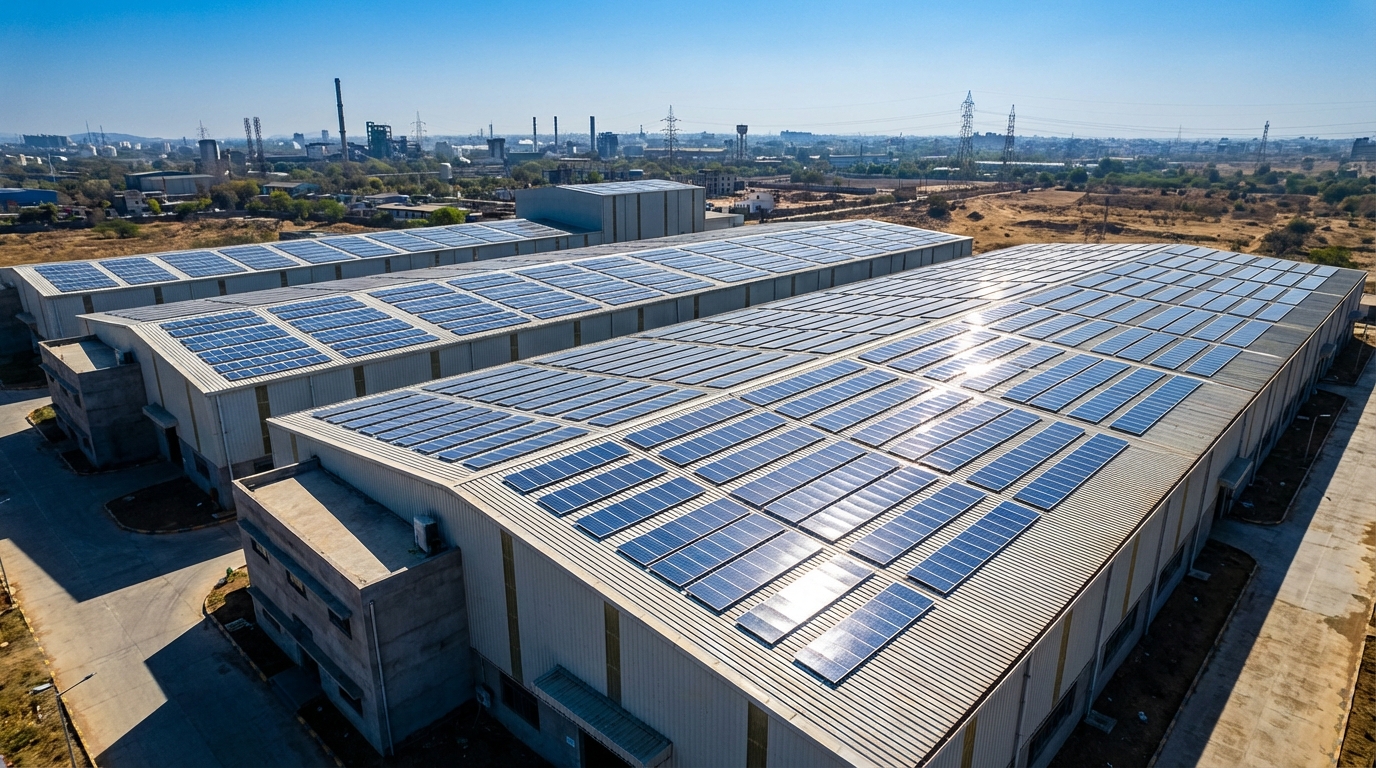
Beyond cost savings, Gujarat’s progressive solar policies make it an ideal location for commercial solar adoption. The state government has set ambitious renewable energy targets and offers streamlined approval processes through GUVNL (Gujarat Urja Vikas Nigam Limited). The net metering policy allows businesses to export excess solar power back to the grid, earning credits that offset consumption during non-solar hours.
Businesses in Surat’s textile industry have reported 30-40% reductions in electricity costs after installing rooftop solar systems. Similarly, warehouses in Ahmedabad and manufacturing units in Junagadh are achieving payback periods of just 4-5 years, after which they enjoy virtually free electricity for the remaining 20+ year lifespan of their solar systems.
Corporate sustainability goals are another driving factor. Many businesses are facing pressure from clients, investors, and regulatory bodies to reduce their carbon footprint. A commercial solar installation provides tangible proof of environmental commitment, often becoming a key differentiator in competitive markets. Companies can showcase their renewable energy usage in sustainability reports, marketing materials, and corporate communications.
Understanding Commercial Solar EPC Services in Gujarat
When businesses explore solar EPC Gujarat services, they’re looking at comprehensive turnkey solutions that handle every aspect of the solar project. EPC stands for Engineering, Procurement, and Construction, representing a complete end-to-end approach that removes the complexity of coordinating multiple vendors and contractors.
The engineering phase involves detailed site assessment, system design, and technical planning. EPC providers analyze your facility’s energy consumption patterns, roof structure, available space, and electrical infrastructure to design an optimal solar system. This includes shadow analysis to maximize panel efficiency, load calculations to ensure structural safety, and electrical design to integrate seamlessly with your existing power systems.
Procurement covers sourcing all necessary components including solar modules, inverters, mounting structures, cables, junction boxes, and safety equipment. Experienced solar companies Gujarat have established relationships with reputable manufacturers, ensuring you receive quality components with proper warranties. They handle logistics, customs clearance for imported components, and quality inspection before installation begins.
Construction encompasses the physical installation work, from mounting structure fabrication to panel installation, electrical wiring, inverter setup, and grid connection. Professional EPC providers employ trained technicians who follow safety protocols and industry best practices. They coordinate with local authorities for necessary approvals and ensure compliance with electrical safety standards.
Commercial solar installations differ significantly from residential projects in scale, complexity, and regulatory requirements. While a residential system might be 3-5 kW, commercial installations typically range from 50 kW to several megawatts. They require three-phase connections, higher voltage equipment, and more robust mounting structures to withstand industrial environments. The documentation and approval process is also more extensive, involving multiple stakeholders and regulatory bodies.
For more details on what EPC services include, read our guide on What is Solar EPC? Complete Service Guide 2026.
Complete Commercial Solar Installation Process
Understanding the solar installation Gujarat process helps businesses plan effectively and set realistic expectations. A typical commercial solar project follows a structured timeline spanning 3-6 months from initial consultation to final commissioning, depending on system size and complexity.
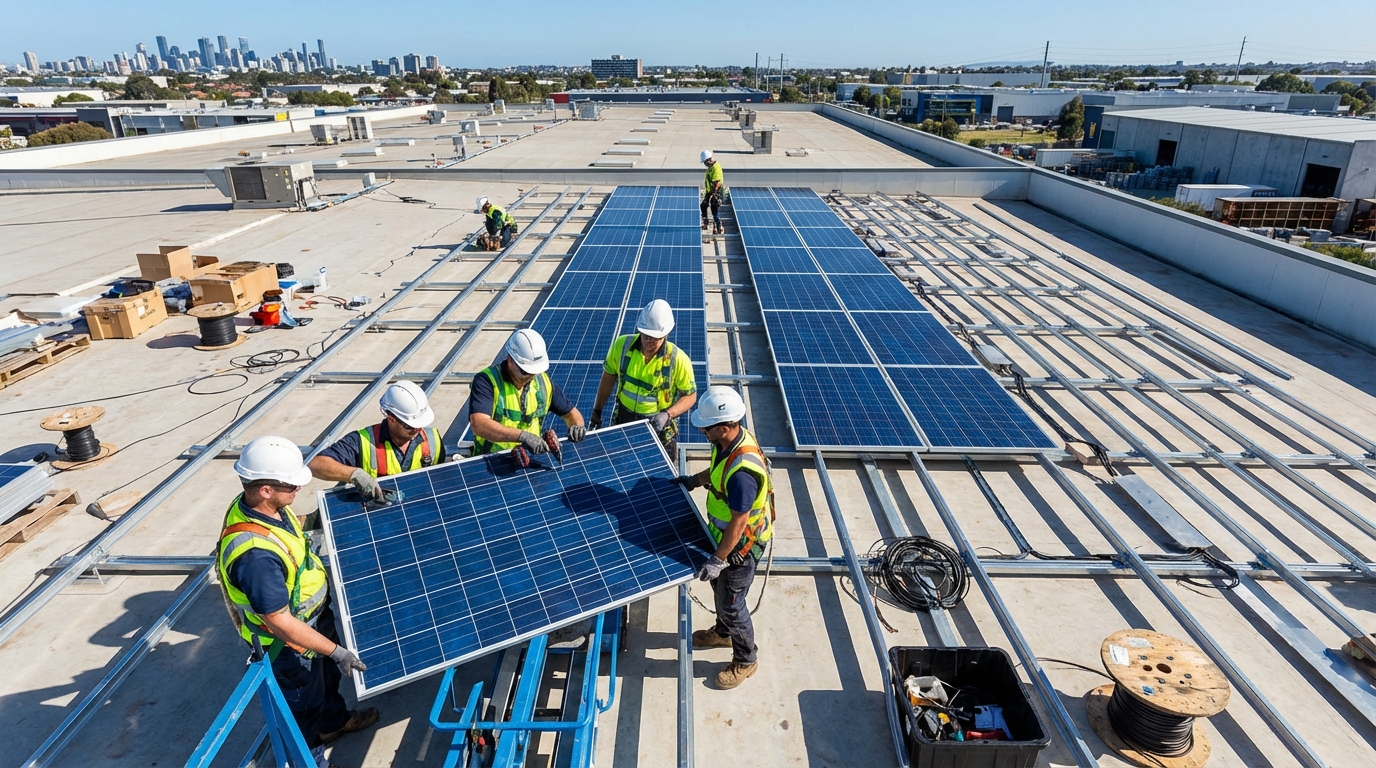
Phase 1: Site Assessment and System Design
The process begins with a comprehensive site assessment where solar engineers visit your facility to evaluate its solar potential. This involves measuring available roof space, assessing roof condition and structural integrity, and conducting a shadow analysis to identify any obstructions that might reduce panel efficiency.
A structural analysis is critical for commercial installations. Engineers calculate whether your roof can support the additional weight of solar panels, mounting structures, and equipment. For older buildings or those with lightweight roofing materials, structural reinforcement may be necessary. This assessment prevents future problems and ensures long-term system safety.
Energy consumption auditing forms the foundation of system sizing. The EPC provider analyzes your electricity bills from the past 12 months to understand consumption patterns, peak demand periods, and seasonal variations. For factories with shift operations, this analysis identifies opportunities to maximize self-consumption of solar power during production hours.
Based on this data, engineers design a solar system sized to meet your specific needs. The design considers your energy goals (whether you want to offset 50%, 75%, or 100% of consumption), available roof space, budget constraints, and future expansion plans. The output is a detailed proposal including system capacity, expected energy generation, component specifications, and financial projections.
Phase 2: Documentation and Approvals
Commercial solar installations in Gujarat require several approvals and documentation. The primary approval comes from GUVNL for grid connectivity and net metering. This involves submitting technical drawings, single-line diagrams, equipment specifications, and facility details.
Required documents typically include:
- Electricity bill copies showing your existing connection details and consumption history
- Property ownership documents or authorization letter if you’re leasing the facility
- Building plan approval from local municipal authorities
- Structural stability certificate from a licensed structural engineer
- Technical specifications of solar modules, inverters, and other equipment
- Single-line diagram showing electrical connections and safety systems
The net metering application process allows you to export excess solar power to the grid and receive credits. GUVNL has streamlined this process for commercial consumers, but it still requires careful documentation and follow-up. Experienced EPC providers handle this paperwork, liaising with utility officials and ensuring timely approvals.
Building permits may be required depending on your location and facility type. Some municipalities require approval for rooftop modifications, especially for structures visible from public areas or in heritage zones. Fire safety clearances are also necessary for large commercial installations.
Phase 3: Procurement and Installation
Once approvals are in place, the EPC provider procures all necessary components. For commercial projects, component selection significantly impacts long-term performance and returns. High-efficiency solar modules from reputable manufacturers may cost more upfront but generate more power over their lifetime, improving your solar ROI.
The choice between monocrystalline and polycrystalline panels depends on your space constraints and budget. Monocrystalline panels offer higher efficiency (18-22%) and perform better in high temperatures, making them ideal for Gujarat’s climate. Polycrystalline panels are more economical and suitable when roof space is abundant. To compare different options, check our article on Solar Brands Gujarat: Top Panel Manufacturers Compared 2026.
Solar inverter selection is equally critical. Commercial installations typically use string inverters or central inverters depending on system size. String inverters (50-100 kW capacity) are suitable for medium-sized installations and offer flexibility in system design. Central inverters (100 kW and above) are more economical for large installations but require careful planning to minimize losses from panel mismatch.
The physical installation begins with mounting structure fabrication and installation. For flat commercial roofs, structures are typically tilted at 15-20 degrees to optimize solar exposure while minimizing wind load. The structures must be properly anchored using either penetrating mounts (bolted through the roof with waterproofing) or non-penetrating ballasted systems that use weight to hold panels in place.
Panel installation follows, with technicians carefully positioning and securing each module. Electrical wiring connects panels in series and parallel configurations to achieve the desired voltage and current. All wiring is done using UV-resistant, weatherproof cables rated for outdoor use. Junction boxes, combiner boxes, and safety disconnects are installed at strategic points.
The inverter installation requires a well-ventilated location, typically in a dedicated electrical room or shaded outdoor area. Inverters generate heat during operation and need adequate cooling. The AC output from inverters is connected to your facility’s electrical panel through proper circuit breakers and safety devices.
Installation timelines vary by project size:
- 50-100 kW systems: 2-3 weeks of installation work
- 100-500 kW systems: 4-6 weeks of installation work
- 500 kW+ systems: 8-12 weeks or more depending on complexity
After installation, the system undergoes rigorous testing. This includes checking all electrical connections, verifying proper grounding, testing inverter functionality, and conducting insulation resistance tests. The EPC provider submits commissioning reports to GUVNL for final inspection and meter installation.
Commercial Solar Panel Cost and ROI in Gujarat
Understanding solar panel cost and return on investment is crucial for business decision-making. As of 2026, commercial solar installations in Gujarat typically cost between ₹40,000 to ₹55,000 per kW installed capacity, depending on system size, component quality, and site-specific factors.

Larger systems benefit from economies of scale. A 100 kW system might cost ₹50,000 per kW (₹50 lakhs total), while a 500 kW system could be as low as ₹42,000 per kW (₹2.1 crores total). This cost includes all components, installation labor, structural work, electrical integration, and commissioning.
Several factors influence the final solar panel cost:
- Roof type and condition: Flat roofs are easier and less expensive to work with than sloped or fragile roofs requiring special mounting solutions
- Component quality: Premium tier-1 solar modules and inverters cost 15-20% more but offer better warranties and performance
- System complexity: Multiple roof levels, shadow obstructions, or long cable runs increase installation costs
- Structural reinforcement: Older buildings may need roof strengthening, adding to project costs
- Grid connection distance: If your electrical panel is far from the installation site, additional cabling and conduit work increases costs
The solar ROI for commercial installations in Gujarat is compelling. A typical factory paying ₹8-10 per unit for industrial electricity can generate solar power at an effective cost of ₹2-3 per unit over the system’s lifetime. This represents a 60-70% reduction in electricity costs for the portion of consumption met by solar.
Consider a 200 kW commercial solar Gujarat installation on a manufacturing facility:
- Total investment: ₹90 lakhs (at ₹45,000 per kW)
- Annual generation: Approximately 3,00,000 units (assuming 1,500 units per kW per year in Gujarat)
- Annual savings: ₹24-27 lakhs (at ₹8-9 per unit avoided cost)
- Simple payback period: 3.5-4 years
- 25-year savings: ₹5-6 crores (accounting for electricity rate escalation)
These calculations don’t include additional benefits like accelerated depreciation (40% in the first year for businesses), which provides significant tax advantages. For detailed calculations on payback timelines, see our article on Solar Payback Period Explained: Break-Even Timeline 2026.
Solar Financing Options for Gujarat Businesses
Many businesses explore solar financing options to implement commercial solar without large upfront capital expenditure. Several financing models are available in Gujarat:
CAPEX (Capital Expenditure) Model: The business owns the solar system outright, making the full investment upfront. This model offers maximum long-term savings and allows you to claim depreciation benefits. It’s ideal for businesses with available capital and a long-term facility ownership perspective.
OPEX (Operational Expenditure) Model: A third-party investor installs and owns the solar system on your roof. You purchase the solar power generated at a predetermined rate (typically 15-20% lower than grid electricity). This model requires zero upfront investment and provides immediate savings, though total lifetime savings are lower than CAPEX.
Bank Loans and Green Financing: Many banks offer specialized loans for solar projects at attractive interest rates (8-10% per annum). These loans typically cover 70-80% of project cost with repayment tenures of 5-7 years. The monthly loan EMI is often lower than the electricity bill savings, making it cash-flow positive from day one.
Government schemes like PM-KUSUM provide subsidies for agricultural and rural industrial applications. While direct subsidies for commercial installations are limited, businesses can benefit from accelerated depreciation (40% in year one, 20% in subsequent years) which significantly improves project economics for profitable companies.
Choosing the Right Solar Components for Commercial Projects
Component selection directly impacts system performance, reliability, and long-term returns. For commercial solar Gujarat installations, durability and efficiency are paramount given the harsh summer conditions and long operational hours.
Solar modules should be chosen based on efficiency, temperature coefficient, and warranty terms. Monocrystalline panels with PERC (Passivated Emitter and Rear Cell) technology offer the best performance in Gujarat’s high-temperature environment. Look for panels with temperature coefficients below -0.40%/°C, meaning they lose less efficiency as temperatures rise.
Tier-1 manufacturers provide 25-year linear power warranties, guaranteeing at least 80-85% of rated capacity after 25 years. This long-term performance guarantee is crucial for commercial projects where ROI calculations depend on sustained generation over decades. Product warranties covering manufacturing defects should be at least 10-12 years.
For solar inverter selection, reliability is critical because inverter failure stops power generation entirely. String inverters from reputable manufacturers typically carry 5-10 year warranties with extended warranty options. Central inverters for large installations should have proven track records in Indian conditions with readily available service support.
Consider inverters with built-in monitoring systems that provide real-time performance data, fault alerts, and historical generation reports. This monitoring capability helps identify issues quickly and ensures optimal system performance throughout its lifetime.
Mounting structures must withstand Gujarat’s wind speeds and occasional extreme weather events. Hot-dip galvanized steel structures offer the best corrosion resistance for the 25+ year system lifespan. The structure design should account for wind loads as per IS 875 standards and include proper grounding for lightning protection.
Quality matters significantly in commercial installations. While cheaper components might reduce upfront costs by 10-15%, they often result in higher maintenance costs, lower generation, and shorter lifespans. The difference in total cost of ownership over 25 years can be substantial, making quality components a wise investment.
Solar Maintenance Gujarat: Keeping Your System Optimal
Regular solar maintenance Gujarat services ensure your commercial installation continues delivering optimal performance throughout its lifespan. Unlike residential systems, commercial installations require more structured maintenance programs due to their size and the financial impact of any downtime.
A comprehensive maintenance program includes:
Cleaning schedules: Gujarat’s climate means dust accumulation can reduce panel efficiency by 15-25% if left uncleaned. Commercial installations should be cleaned every 2-4 weeks during dry months and monthly during monsoon season. Professional cleaning services use deionized water and soft brushes to avoid scratching panel surfaces.
Performance monitoring: Daily monitoring of generation data helps identify issues quickly. Modern inverters provide cloud-based monitoring showing real-time power output, daily generation, and system health indicators. Significant deviations from expected generation warrant immediate investigation.
Preventive maintenance: Quarterly inspections should check all electrical connections for tightness and corrosion, inspect mounting structures for rust or damage, verify proper inverter operation, test safety disconnects and grounding systems, and check for any physical damage to panels or wiring.
Annual maintenance contracts (AMC): Many businesses opt for comprehensive AMC agreements with their EPC provider or specialized maintenance companies. These contracts typically include scheduled cleaning, preventive maintenance visits, performance monitoring, and priority response for breakdowns. AMC costs range from ₹5,000 to ₹15,000 per year per 100 kW of installed capacity.
Common issues in commercial installations include inverter faults (accounting for about 60% of system downtime), loose electrical connections causing power losses, panel soiling reducing generation, and occasional physical damage from extreme weather or roof work. Most issues can be prevented or quickly resolved with proper maintenance protocols.
Well-maintained commercial solar systems in Gujarat consistently achieve 75-85% capacity utilization factors, meaning they generate 75-85% of their theoretical maximum output when accounting for nighttime, weather variations, and system losses. Poor maintenance can reduce this to 60-70%, directly impacting your financial returns.
Industry-Specific Commercial Solar Solutions
Different industries have unique energy profiles and requirements that influence commercial solar Gujarat system design. Understanding these nuances helps optimize solar installations for maximum benefit.
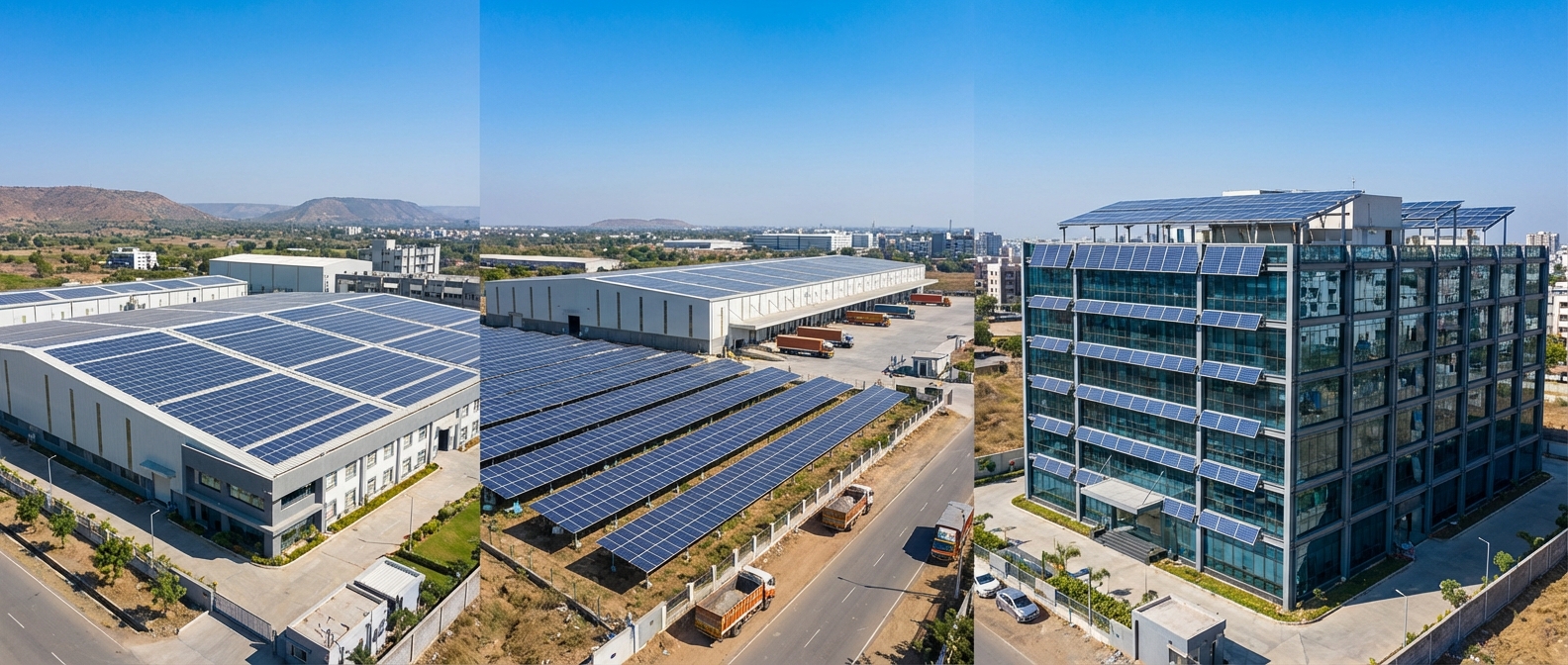
Manufacturing facilities and factories typically operate during daytime hours (8 AM to 6 PM), which aligns perfectly with solar generation. These facilities often have large roof areas and high energy consumption, making them ideal candidates for solar. A 500 kW system on a manufacturing unit can offset 40-60% of total electricity consumption, with higher percentages possible for single-shift operations.
Textile mills in Surat represent one of Gujarat’s largest industrial sectors. These facilities have extremely high power consumption from looms, dyeing units, and processing equipment. Solar installations on textile mills range from 200 kW to 2 MW, often utilizing both rooftop and ground-mounted systems. The consistent daytime operation of textile machinery ensures high self-consumption of solar power, maximizing savings.
Warehouses and logistics centers have excellent solar potential due to large, unobstructed roof areas. While their energy consumption is lower than manufacturing facilities, the available space often allows for oversized systems that can export significant power to the grid. Cold storage warehouses with 24/7 refrigeration loads benefit particularly from solar, as net metering allows them to offset nighttime consumption with daytime solar credits.
IT parks and office complexes in Ahmedabad have moderate energy consumption primarily from air conditioning, lighting, and computers. Solar systems sized at 30-50% of sanctioned load work well, providing substantial savings during peak business hours when both solar generation and office consumption are highest. These installations often become visible sustainability statements, enhancing corporate image.
Agricultural processing units including cold storage, food processing, and packaging facilities can leverage both rooftop solar Gujarat installations and ground-mounted systems. Many qualify for special agricultural tariffs and government schemes, improving project economics further. Processing units with seasonal operations should size systems based on average annual consumption rather than peak season demand.
Selecting Solar Companies Gujarat: What to Look For
Choosing the right partner for your commercial solar Gujarat project significantly impacts outcomes. The solar industry has grown rapidly, and not all providers have the experience and capabilities for complex commercial installations.
Look for solar companies Gujarat with proven commercial and industrial project experience. Residential solar expertise doesn’t automatically translate to commercial capabilities. Ask for references from similar-sized projects in your industry. Visit completed installations if possible to assess quality and speak with existing customers about their experience.
Local presence matters significantly for commercial projects. Companies with offices in Surat, Ahmedabad, or Junagadh can provide faster response times for maintenance and troubleshooting. They understand local regulations, have established relationships with GUVNL officials, and can navigate approval processes more efficiently.
Comprehensive solar EPC services from a single provider simplify project management and accountability. When one company handles engineering, procurement, construction, and commissioning, there’s clear responsibility for outcomes. Fragmented approaches with multiple vendors often lead to coordination issues and finger-pointing when problems arise.
Certifications and credentials indicate professionalism and technical competence. Look for companies with ISO certifications, empanelment with government agencies, and trained technical staff. Membership in industry associations like the National Solar Energy Federation of India (NSEFI) suggests commitment to industry standards.
Financial stability of your EPC provider matters for long-term support. Solar systems operate for 25+ years, and you’ll need ongoing support for warranty claims, maintenance, and troubleshooting. Choose established companies with track records spanning several years rather than new entrants who may not be around for the long term.
Transparency in pricing and proposals helps you make informed decisions. Detailed proposals should break down costs by component, clearly specify equipment brands and models, provide realistic generation estimates, and include all necessary approvals and documentation in the scope. Be wary of proposals that seem too good to be true or lack technical detail.
Frequently Asked Questions About Commercial Solar Gujarat
How long does commercial solar installation take?
The complete process from initial consultation to commissioning typically takes 3-6 months. This includes 2-4 weeks for site assessment and design, 4-8 weeks for approvals and documentation, 2-8 weeks for procurement and installation (depending on system size), and 2-4 weeks for testing, commissioning, and meter installation. Larger systems or complex sites may take longer.
What is the lifespan of commercial solar systems?
Solar panels carry 25-year performance warranties and typically continue generating power for 30+ years, though at gradually reduced efficiency. Inverters have shorter lifespans of 10-15 years and usually require replacement once during the system lifetime. Mounting structures and electrical components, when properly maintained, last the full system lifetime. Overall, you can expect 25-30 years of reliable power generation.
Can solar power my entire factory?
This depends on your roof space, energy consumption, and operational hours. Factories operating single daytime shifts can often offset 60-80% of consumption with rooftop solar. Multi-shift operations with 24/7 consumption typically offset 30-50% since solar only generates during daylight hours. Net metering helps by allowing you to export excess daytime generation and import power at night, using the grid as virtual storage.
What happens during monsoon season?
Solar panels continue generating power during monsoon, though at reduced levels due to cloud cover. Gujarat’s monsoon season (July-September) sees generation drop to 60-70% of summer levels. However, annual generation calculations account for seasonal variations. The good news is that monsoon rains naturally clean panels, improving efficiency once clear weather returns.
Is rooftop solar Gujarat suitable for all building types?
Most commercial buildings can support solar installations, but some require modifications. Buildings with asbestos roofing may need replacement or special mounting solutions. Very old structures might require roof reinforcement. Buildings with significant shading from nearby structures or trees may not be economically viable. A professional site assessment determines feasibility and identifies any necessary modifications.
Take the Next Step Toward Energy Independence
Commercial solar installations in Gujarat represent one of the most financially sound investments businesses can make in 2026. With electricity costs continuing to rise, government policies supporting renewable energy, and solar technology more reliable and affordable than ever, the business case is compelling across industries.
From textile mills in Surat to IT parks in Ahmedabad and manufacturing facilities in Junagadh, businesses are discovering that commercial solar Gujarat installations deliver consistent returns, reduce operational costs, and demonstrate environmental leadership. The comprehensive EPC approach ensures professional implementation from initial assessment through long-term maintenance, giving you peace of mind and optimal performance.
The key to success lies in partnering with experienced solar EPC Gujarat providers who understand commercial and industrial applications, use quality components, and provide ongoing support throughout your system’s lifetime. With proper planning, quality installation, and regular maintenance, your commercial solar system will generate clean, affordable power for decades.
Heaven Green Energy Limited has been helping businesses across Gujarat transition to solar energy since 2017, with offices in Surat, Ahmedabad, and Junagadh providing local support throughout your solar journey. Our team of experienced engineers and technicians has completed numerous commercial and industrial installations, delivering turnkey solutions that meet the unique needs of each business.
Ready to explore how commercial solar Gujarat can reduce your operational costs and support your sustainability goals? Have Any Questions? +91 63904 05060. Our solar experts will conduct a free site assessment, analyze your energy consumption, and provide a detailed proposal showing exactly how much you can save with a customized commercial solar installation designed specifically for your facility.
This blog post was written using thestacc.com