


As Gujarat continues to lead India’s renewable energy revolution, more homeowners and businesses are turning to solar power to reduce electricity costs and embrace sustainability. If you’re considering a solar installation in Gujarat, you’ve likely encountered the term solar EPC—but what does it really mean, and why is it crucial for your project’s success?
Solar EPC (Engineering, Procurement, and Construction) represents a comprehensive, turnkey approach to solar project implementation. Rather than coordinating multiple vendors for design, equipment, and installation, an EPC partner handles everything from initial site assessment to final commissioning. This guide walks you through the complete solar EPC process in Gujarat, helping you understand what to expect, how long it takes, and how to choose the right partner for your solar journey in 2026.
Understanding Solar EPC: The Foundation of Your Solar Journey
Solar EPC stands for Engineering, Procurement, and Construction—a project delivery method where a single contractor assumes responsibility for the entire solar installation process. This turnkey approach has become the industry standard for solar projects across Gujarat, from small residential rooftop systems to large-scale industrial installations.
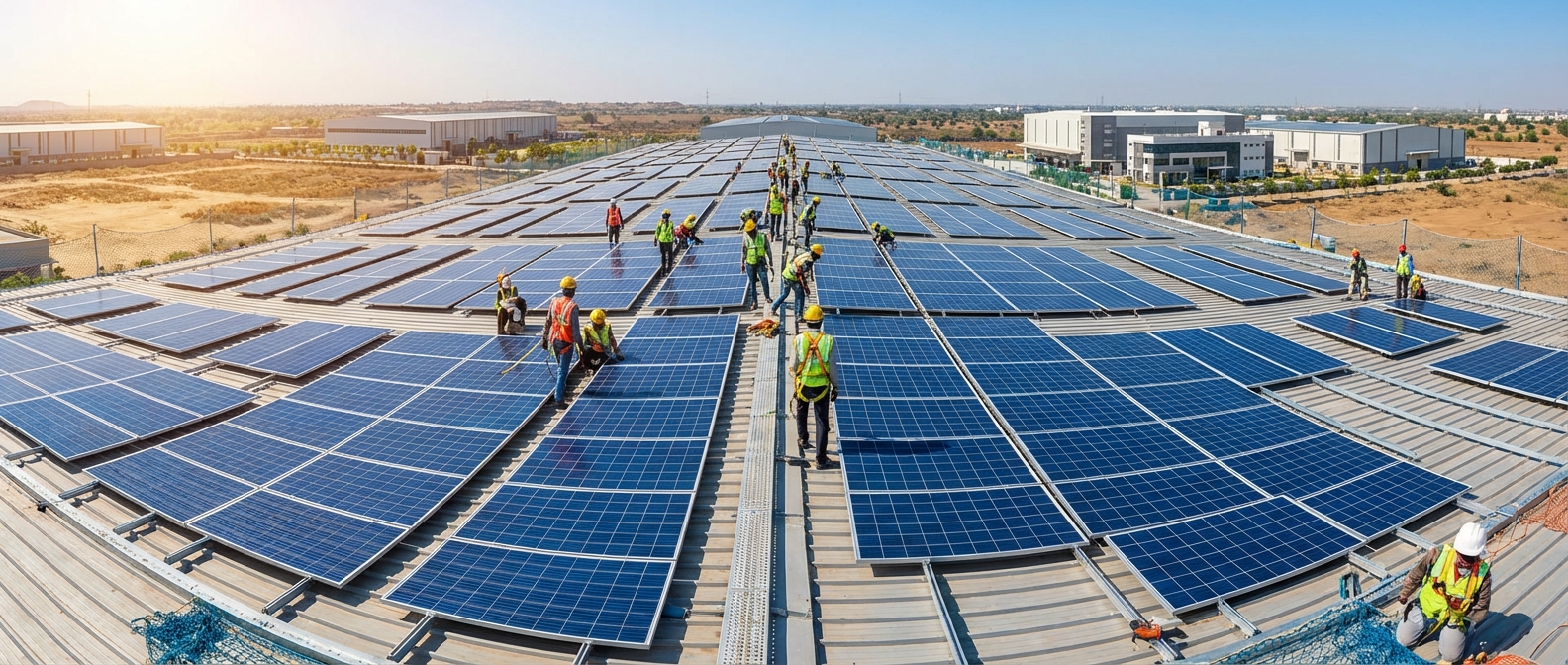
In a solar EPC model, your chosen partner manages three critical phases. The engineering phase involves site assessment, system design, and technical planning. The procurement phase covers sourcing quality solar modules, inverters, mounting structures, and all balance-of-system components. Finally, the construction phase encompasses installation, testing, grid connectivity, and commissioning.
Why has the EPC approach become so popular in Gujarat? The state’s ambitious renewable energy targets, favorable solar policies, and high solar irradiation levels make it ideal for solar projects. However, successful implementation requires navigating complex technical requirements, government approvals, and quality standards. A qualified solar EPC partner brings the expertise, resources, and accountability needed to deliver projects on time and within budget.
Turnkey solar EPC solutions offer several advantages over piecemeal approaches. You work with a single point of contact throughout the project, eliminating coordination headaches between multiple vendors. Your EPC partner assumes full responsibility for project outcomes, including performance guarantees and warranties. This integrated approach typically results in faster project completion, better quality control, and reduced overall costs compared to managing separate contractors.
The Complete Solar EPC Process: From Concept to Commissioning
Understanding the solar EPC process helps you set realistic expectations and prepare for each phase of your project. While specific timelines vary based on project size and complexity, the fundamental steps remain consistent across residential, commercial, and industrial installations in Gujarat.
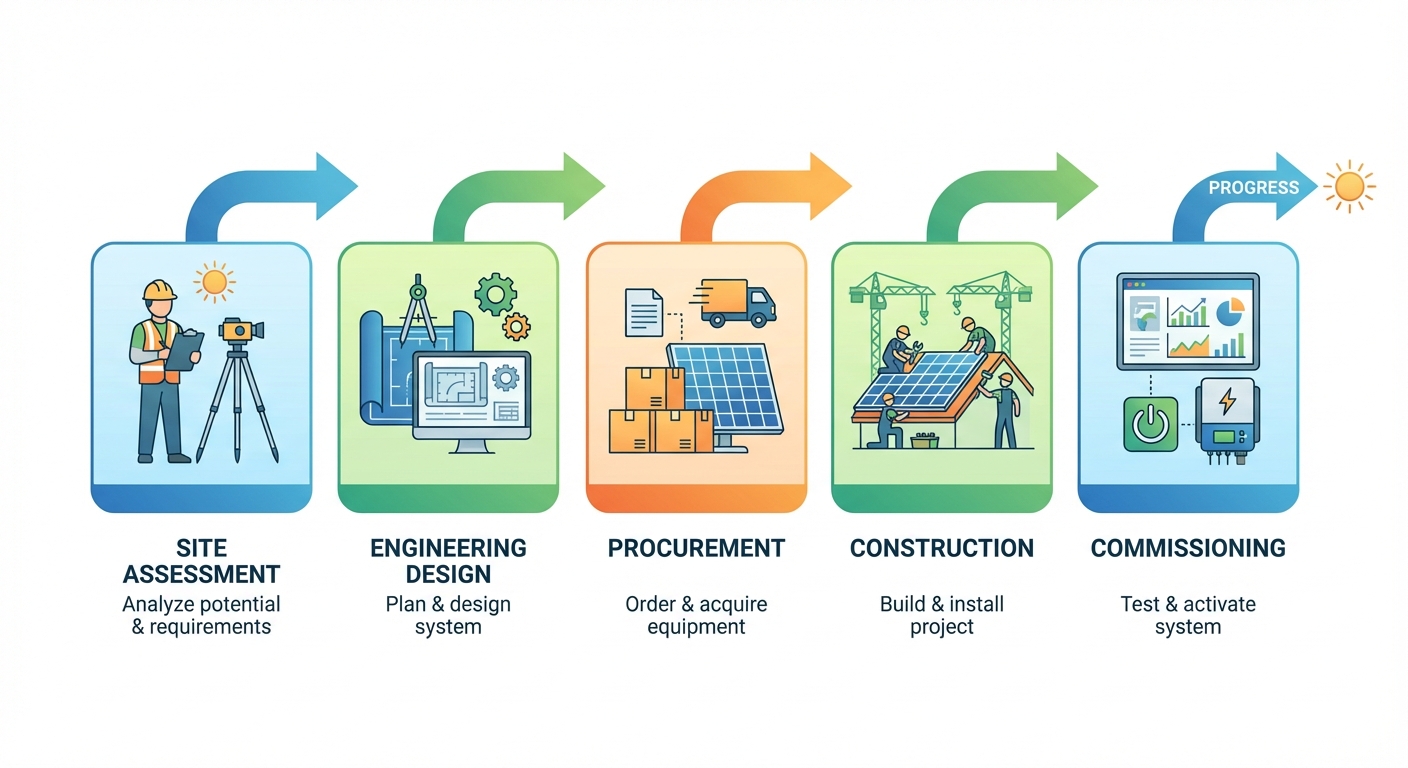
The journey begins with an initial consultation and site assessment. Your EPC partner visits your location to evaluate roof condition, available space, shading patterns, structural capacity, and electrical infrastructure. This assessment determines system feasibility and helps identify any site-specific challenges that need addressing. For commercial and industrial projects, energy consumption analysis helps optimize system sizing for maximum savings.
Following site assessment, the project moves into detailed planning and proposal development. Your EPC partner prepares a comprehensive proposal outlining system specifications, expected energy generation, project costs, return on investment calculations, and implementation timeline. This proposal serves as your roadmap for the entire project.
Engineering Phase: Designing Your Solar Power System
Once you approve the proposal, the engineering phase begins. This critical stage transforms your solar vision into detailed technical plans. Engineers conduct a thorough site survey using specialized tools to measure solar irradiation, analyze shading patterns throughout the year, and assess structural load-bearing capacity.
System design involves calculating optimal panel placement, determining the right inverter configuration, and planning electrical layouts. For rooftop solar installations in Gujarat, engineers must account for monsoon wind loads, high summer temperatures, and local building codes. The design phase also includes preparing detailed drawings for electrical connections, mounting structures, and cable routing.
Grid connectivity planning is another crucial engineering consideration. Your EPC partner coordinates with local electricity distribution companies (DISCOMs) to understand net metering requirements, grid connection specifications, and approval procedures. In Gujarat, this typically involves working with utilities like DGVCL, MGVCL, PGVCL, or UGVCL depending on your location.
Procurement: Sourcing Quality Solar Components
The procurement phase determines the long-term performance and reliability of your solar installation. Experienced solar EPC companies in Gujarat maintain relationships with reputable manufacturers and can source high-quality components at competitive prices.
Solar module selection is perhaps the most visible procurement decision. Your EPC partner should recommend panels from tier-1 manufacturers with proven track records, strong warranties, and appropriate certifications for the Indian market. In 2026, most quality installations in Gujarat use monocrystalline or polycrystalline panels with efficiencies ranging from 18% to 22%.
Inverter selection is equally important, as this component converts DC power from panels into usable AC electricity. String inverters work well for most residential and small commercial projects, while larger installations may benefit from central inverters or microinverter systems. Your EPC partner should specify inverters with appropriate capacity, efficiency ratings, and warranty coverage. To learn more about the complete range of services and components, check out our detailed guide on what solar EPC services include.
Beyond panels and inverters, procurement includes mounting structures (designed for Gujarat’s wind and weather conditions), DC and AC cables, junction boxes, earthing materials, lightning protection systems, and monitoring equipment. Quality EPC partners source components that meet Bureau of Indian Standards (BIS) requirements and carry appropriate certifications.
Construction: Installation and Implementation
The construction phase brings your solar project to life. Professional solar EPC contractors follow systematic installation procedures to ensure safety, quality, and performance.
Installation begins with site preparation, including setting up safety barriers, organizing materials, and preparing roof surfaces. For ground-mounted systems, this may involve land leveling and foundation work. Safety protocols are paramount—reputable EPC companies ensure workers use proper safety equipment and follow established procedures.
Mounting structure installation comes next. Structures must be securely anchored to withstand Gujarat’s monsoon winds while maintaining proper waterproofing. For rooftop installations, this typically involves using appropriate fasteners and sealants that don’t compromise roof integrity.
Panel installation follows a systematic approach, with modules carefully positioned, secured, and interconnected according to the design specifications. Proper cable management ensures neat, professional installations that facilitate future maintenance. Inverters and electrical equipment are installed in appropriate locations with adequate ventilation and protection from weather.
Throughout construction, quality EPC partners conduct regular inspections to verify workmanship, test electrical connections, and ensure compliance with design specifications. This attention to detail during installation prevents future performance issues and safety concerns.
What’s Included in Turnkey Solar EPC Solutions in Gujarat
When you choose a comprehensive solar EPC partner in Gujarat, you’re getting far more than just equipment installation. Turnkey solutions encompass a complete range of services designed to deliver a fully functional, grid-connected solar power system.
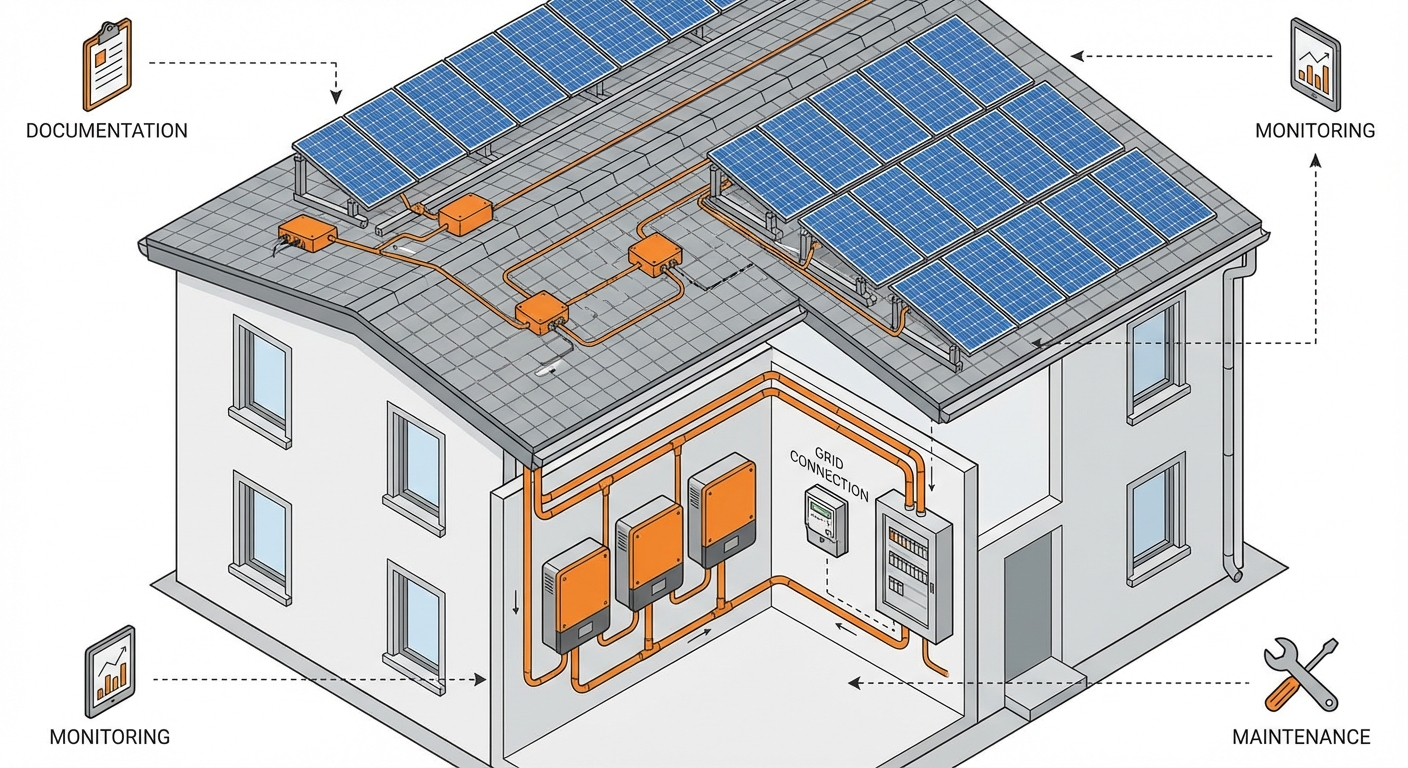
A complete solar EPC package typically includes all engineering services, from initial site assessment and feasibility studies to detailed design drawings and structural calculations. Your EPC partner handles all technical planning, ensuring your system is optimized for Gujarat’s climate and your specific energy needs.
Procurement services cover sourcing and delivery of all required components, including solar modules, inverters, mounting structures, cables, junction boxes, earthing materials, lightning protection, and monitoring systems. Quality EPC companies provide transparency about component brands and specifications, giving you confidence in your investment.
Installation and construction services encompass the complete physical implementation of your solar project. This includes site preparation, mounting structure installation, panel installation, electrical work, inverter setup, and all necessary testing. Professional EPC contractors ensure installations meet safety standards and building codes.
Documentation and approvals represent a significant value-add in turnkey solar EPC solutions. Your EPC partner handles applications for necessary permits, coordinates with local authorities, manages DISCOM approvals for grid connectivity, and assists with net metering applications. In Gujarat, this includes navigating the specific requirements of your local electricity distribution company.
For residential customers, assistance with government subsidy applications can provide substantial savings. Experienced EPC partners understand the documentation requirements for schemes like the PM-KUSUM program and state-level incentives, helping you maximize available benefits.
Grid connectivity and net metering setup are critical services included in comprehensive EPC packages. Your contractor coordinates with the local DISCOM, installs the net meter, completes all required testing, and ensures your system is properly connected and approved for operation.
Post-installation support typically includes system commissioning, performance testing, operator training, and handover documentation. Quality EPC partners provide comprehensive warranties covering equipment, installation workmanship, and performance guarantees. Many also offer ongoing maintenance and monitoring services to ensure optimal system performance throughout its lifetime.
Timeline Expectations: How Long Does Solar EPC Take?
One of the most common questions about solar EPC projects concerns timing. While every project is unique, understanding typical timelines helps you plan accordingly and set realistic expectations.
For residential rooftop solar installations (typically 1 kW to 10 kW), the complete solar EPC process in Gujarat usually takes 4 to 8 weeks from contract signing to commissioning. The initial site assessment and proposal development typically require 1 to 2 weeks. Engineering and design work takes another 1 to 2 weeks. Procurement of components usually requires 1 to 2 weeks, though this can vary based on component availability. The actual installation and construction phase for residential projects typically takes 3 to 5 days for the physical work, followed by testing and grid connectivity procedures that may add another 1 to 2 weeks.
Commercial and industrial solar projects (10 kW to 1 MW) generally require 8 to 16 weeks for complete implementation. These larger installations involve more complex engineering, longer procurement lead times for bulk components, extended construction periods, and more involved approval processes with DISCOMs and local authorities.
For large-scale ground-mounted solar parks (1 MW and above), the solar EPC timeline extends to 6 to 12 months or more. These projects involve land preparation, civil works, extensive electrical infrastructure, and comprehensive regulatory approvals that add significant time to the process.
Several factors can affect project timelines in Gujarat. DISCOM approval processes vary by region and can sometimes cause delays, particularly during peak application periods. Monsoon season (June through September) may slow construction activities, though experienced EPC partners plan around weather constraints. Component availability, particularly for specific brands or models, can impact procurement timelines. Site-specific challenges like structural reinforcement needs or complex electrical upgrades may extend construction periods.
Working with an experienced solar EPC partner in Gujarat helps minimize delays. Established companies understand local approval processes, maintain relationships with DISCOMs, keep adequate component inventory, and have the resources to manage multiple project phases simultaneously.
Quality Standards and Certifications in Solar EPC
Quality standards and certifications provide assurance that your solar EPC project meets established benchmarks for safety, performance, and reliability. Understanding these standards helps you evaluate EPC partners and component quality.
In India, the Bureau of Indian Standards (BIS) sets mandatory standards for solar components. Solar modules must comply with IS 14286 (IEC 61215) for crystalline silicon modules or IS 16169 (IEC 61646) for thin-film modules. Inverters must meet IS 16169 Part 1 and Part 2 standards. Reputable solar EPC companies in Gujarat only use BIS-certified components.
The Ministry of New and Renewable Energy (MNRE) provides guidelines and technical standards for solar installations in India. MNRE-approved models and manufacturers are listed on the ministry’s website, and many government subsidy schemes require using MNRE-approved components. Quality EPC partners stay current with MNRE guidelines and ensure compliance.
International certifications add another layer of quality assurance. The IEC (International Electrotechnical Commission) standards are globally recognized benchmarks for solar equipment. Look for components with IEC 61215 (module performance), IEC 61730 (module safety), and IEC 62109 (inverter safety) certifications.
ISO certifications indicate that manufacturers and EPC companies follow established quality management systems. ISO 9001 covers quality management, while ISO 14001 addresses environmental management. Solar EPC companies with these certifications demonstrate commitment to systematic quality processes.
For solar modules, tier-1 classification by independent research firms like Bloomberg New Energy Finance (BNEF) indicates manufacturers with strong financial stability, vertical integration, and proven track records. While not an official certification, tier-1 status provides confidence in long-term manufacturer viability and warranty support. For insights into quality brands available in Gujarat, explore our comparison of top solar panel manufacturers in Gujarat.
Installation quality standards are equally important. The Central Electricity Authority (CEA) provides technical standards for grid-connected solar systems. Professional solar EPC contractors follow the National Electrical Code and local building codes to ensure safe, compliant installations.
Performance guarantees and warranties reflect EPC confidence in quality. Standard warranties include 25-year performance warranties on solar modules (typically guaranteeing 80% output after 25 years), 5 to 10-year warranties on inverters, and 1 to 5-year workmanship warranties on installation. Some EPC companies offer additional performance guarantees, promising minimum energy generation levels.
Choosing the Right Solar EPC Partner in Gujarat
Selecting the right solar EPC partner is perhaps the most important decision in your solar journey. The quality of your EPC contractor directly impacts system performance, project timeline, long-term reliability, and overall return on investment.

Experience and track record should be your first consideration. Look for EPC companies with substantial experience in Gujarat’s solar market, particularly with projects similar to yours in size and type. Ask for references and case studies. Companies with hundreds or thousands of completed installations demonstrate proven capability. Established firms understand local conditions, DISCOM procedures, and Gujarat-specific challenges.
Technical expertise and certifications indicate professional capability. Quality solar EPC partners employ qualified engineers, certified electricians, and trained installation teams. Look for companies with relevant industry certifications and memberships in professional organizations. Technical expertise should extend beyond installation to include system design, performance optimization, and troubleshooting.
Component quality and brand partnerships significantly impact long-term system performance. Reputable EPC companies partner with tier-1 manufacturers and use only certified, warrantied components. Be wary of partners who push unknown brands or can’t provide clear information about component specifications and certifications. Transparency about equipment sourcing indicates integrity and confidence.
After-sales support and maintenance services distinguish excellent EPC partners from mediocre ones. Solar systems require minimal maintenance but benefit from periodic cleaning, inspections, and monitoring. Ask potential partners about their post-installation support, monitoring services, maintenance packages, and response times for issues. Companies that stand behind their work offer comprehensive warranties and accessible customer service.
Financial stability and project portfolio provide insight into company viability. Solar systems are long-term investments, and you want an EPC partner who will be around to honor warranties and provide support for years to come. Review the company’s project portfolio, financial standing, and business history. Established companies with diverse project portfolios demonstrate stability and capability.
Customer reviews and references offer real-world perspectives on EPC performance. Ask for references from recent customers with similar projects. Check online reviews and ratings. Contact past customers to ask about their experience with project execution, communication, problem-solving, and post-installation support. Consistent positive feedback indicates reliable service.
Proposal quality and transparency reveal professionalism and attention to detail. A comprehensive proposal should include detailed system specifications, clear pricing breakdowns, realistic timeline estimates, warranty information, and performance projections. Vague proposals or reluctance to provide detailed information are red flags.
Local presence and accessibility matter, especially for ongoing support. Solar EPC companies with offices and service teams in Gujarat can respond quickly to issues and provide better ongoing support than distant providers. Local presence also indicates commitment to the Gujarat market and understanding of regional conditions.
Solar EPC Costs and ROI in Gujarat 2026
Understanding the cost structure and return on investment for solar EPC projects helps you make informed decisions and set appropriate budgets. While specific costs vary based on project size, component quality, and site conditions, general patterns provide useful guidance.
Solar EPC costs in Gujarat typically include several components. Equipment costs (solar modules, inverters, mounting structures, and balance of system components) usually represent 60% to 70% of total project cost. Installation and labor costs account for 15% to 20%. Engineering, design, and project management typically add 5% to 10%. Documentation, approvals, and grid connectivity contribute another 5% to 10%.
Several factors affect solar EPC pricing in Gujarat. System size significantly impacts per-watt costs, with larger installations benefiting from economies of scale. Component quality and brand selection influence pricing, tier-1 components cost more upfront but typically deliver better long-term performance and reliability. Site complexity affects installation costs, with challenging roofs or locations requiring additional labor and materials. Grid connectivity requirements vary by location and can impact overall project costs.
Government subsidies and incentives can substantially reduce net project costs for eligible installations. The Central Government’s subsidy scheme for residential rooftop solar provides financial support for systems up to 10 kW. Gujarat also offers various state-level incentives and accelerated depreciation benefits for commercial and industrial installations. Experienced solar EPC partners help you identify and access available incentives.
Return on investment for solar projects in Gujarat is generally attractive due to high electricity rates, excellent solar irradiation, and available incentives. Most residential installations achieve payback periods of 4 to 6 years, while commercial and industrial projects often see payback in 3 to 5 years. After payback, solar systems continue generating free electricity for 20 to 25 years, delivering substantial lifetime savings.
Expected ROI varies based on several factors including system size and cost, current electricity rates and consumption patterns, solar irradiation at your location, available subsidies and incentives, and system performance and maintenance. To understand the financial timeline in detail, read our comprehensive guide on solar payback periods and break-even analysis.
Financing options make solar more accessible for many customers. Banks and financial institutions offer solar loans with competitive interest rates. Some solar EPC companies provide in-house financing or partnerships with lenders. For commercial and industrial customers, power purchase agreements (PPAs) and operational expenditure (OPEX) models allow solar adoption without upfront capital investment.
Common Challenges in Solar EPC Projects and How to Avoid Them
While solar EPC projects in Gujarat generally proceed smoothly with experienced partners, understanding common challenges helps you anticipate and avoid potential issues.
Site-related challenges can complicate installations. Insufficient roof space, excessive shading from nearby structures or trees, weak roof structures requiring reinforcement, and complex roof geometries all present obstacles. Thorough site assessment during the planning phase identifies these issues early, allowing for appropriate solutions or alternative approaches.
Grid connectivity delays sometimes extend project timelines. DISCOM approval processes can be slow, particularly during peak periods. Net metering applications require specific documentation and inspections. Technical requirements for grid interconnection vary by location. Working with experienced solar EPC partners who understand local DISCOM procedures and maintain good relationships with utility companies helps minimize these delays.
Component quality issues can undermine long-term system performance. Using substandard panels or inverters may save money initially but typically leads to poor performance, frequent failures, and shortened system life. Insist on tier-1 components with proper certifications and warranties. Verify that your EPC partner sources equipment from authorized distributors, not gray market suppliers.
Installation errors impact both safety and performance. Poor workmanship can lead to water leakage, electrical hazards, suboptimal panel positioning, and inadequate cable management. Choose solar EPC contractors with proven installation expertise, trained teams, and systematic quality control processes. Request to see examples of completed installations and check references.
Documentation and approval bottlenecks can delay project completion. Missing or incorrect paperwork, incomplete applications, and lack of required certifications all cause delays. Professional EPC partners handle all documentation systematically, ensuring applications are complete and accurate the first time.
How do experienced solar EPC partners mitigate these risks? They conduct thorough site assessments before committing to project specifications. They maintain relationships with DISCOMs and understand local approval processes. They source only quality, certified components from reputable suppliers. They employ trained installation teams and implement systematic quality control. They manage documentation proactively and follow up on approvals. They communicate transparently with customers about potential challenges and solutions.
Frequently Asked Questions About Solar EPC in Gujarat
What is the difference between solar EPC and regular installation?
Solar EPC (Engineering, Procurement, and Construction) is a comprehensive, turnkey approach where a single contractor handles all aspects of your solar project, from design and component sourcing to installation and commissioning. Regular installation typically refers to just the physical installation work, requiring you to separately arrange for system design, component procurement, approvals, and grid connectivity. The EPC approach provides single-point accountability, better coordination, and typically faster project completion.
How do I know if my roof is suitable for solar?
Roof suitability depends on several factors. Your roof should have adequate unshaded area (typically 100 square feet per kW of solar capacity), face south or west for optimal sun exposure, have sufficient structural strength to support panel weight (typically 15-20 kg per square meter), and be in good condition without immediate repair needs. A professional solar EPC partner conducts a detailed site assessment to evaluate these factors and recommend appropriate solutions.
What warranties come with solar EPC projects?
Comprehensive solar EPC projects typically include multiple warranties. Solar modules come with 25-year performance warranties (guaranteeing 80% output after 25 years) and 10-year product warranties. Inverters typically carry 5 to 10-year warranties. Your EPC contractor should provide workmanship warranties covering installation quality for 1 to 5 years. Some EPC companies also offer performance guarantees, promising minimum energy generation levels.
Can I expand my solar system later?
Yes, solar systems can often be expanded, though several factors affect feasibility. You need adequate additional roof space, electrical infrastructure with capacity for expansion, and an inverter with sufficient capacity or the ability to add another inverter. When planning your initial installation, discuss future expansion possibilities with your solar EPC partner. They can design the system with expansion in mind, making future additions easier and more cost-effective.
What maintenance is required after installation?
Solar systems require minimal but important maintenance. Panels should be cleaned periodically (typically every 2-3 months in Gujarat, more frequently in dusty areas) to maintain optimal performance. Annual inspections should check electrical connections, mounting structure integrity, and inverter operation. Monitoring systems should be reviewed regularly to ensure expected performance. Many solar EPC companies offer maintenance packages that handle these tasks, ensuring your system operates at peak efficiency throughout its lifetime.
Taking the Next Step: Your Solar EPC Journey in Gujarat
Understanding solar EPC services empowers you to make informed decisions about your renewable energy investment. From the comprehensive engineering and design phase through quality component procurement to professional construction and commissioning, the EPC approach delivers turnkey solar solutions that maximize performance and minimize hassle.
Gujarat’s favorable solar policies, excellent irradiation levels, and growing ecosystem of experienced solar EPC providers make 2026 an ideal time to invest in solar energy. Whether you’re a homeowner looking to reduce electricity bills, a business seeking to lower operational costs, or an industrial facility planning large-scale solar implementation, choosing the right solar EPC partner is crucial to project success.
The key to a successful solar project lies in partnering with an experienced, reputable solar EPC company that brings technical expertise, quality components, professional installation, and comprehensive support. Take time to evaluate potential partners based on their track record, technical capabilities, component quality, customer references, and after-sales support.
Ready to start your solar EPC journey in Gujarat? Heaven Green Energy Limited brings years of experience, thousands of successful installations, and comprehensive turnkey solutions to residential, commercial, and industrial customers across Gujarat. From initial consultation through system commissioning and beyond, our team handles every aspect of your solar project with professionalism and expertise.
Don’t let high electricity costs continue draining your budget. Discover how solar EPC services can transform your energy future with clean, affordable power. Have any questions about solar EPC in Gujarat? Our expert team is ready to help you understand your options and develop a customized solar solution. Call us at +91 63904 05060 to schedule your free site assessment and take the first step toward energy independence today.
This blog post was written using thestacc.com