


Gujarat has emerged as India’s solar powerhouse, with industrial facilities across Surat, Ahmedabad, Vapi, and other manufacturing hubs increasingly adopting industrial solar Gujarat solutions to combat rising electricity costs and meet sustainability goals. For factory owners and warehouse operators, transitioning to solar energy represents not just an environmental commitment but a strategic business decision that can reduce operational expenses by 30-50% while ensuring energy security for decades to come.
This comprehensive guide walks you through every aspect of implementing industrial solar systems in Gujarat—from initial site assessment and load analysis to government incentives, financial planning, and real-world case studies from Gujarat’s thriving industrial corridors. Whether you operate a textile mill in Surat, a chemical processing plant in Vapi, or a logistics warehouse in Ahmedabad, this guide provides the actionable insights you need to make informed decisions about your solar investment.
Why Gujarat’s Industrial Sector is Leading India’s Solar Revolution
Gujarat’s industrial landscape consumes approximately 40% of the state’s total electricity, making energy costs one of the most significant operational expenses for manufacturers. With commercial and industrial electricity tariffs ranging from ₹6 to ₹9 per unit across different industrial areas, the financial burden on manufacturing operations continues to escalate year after year.
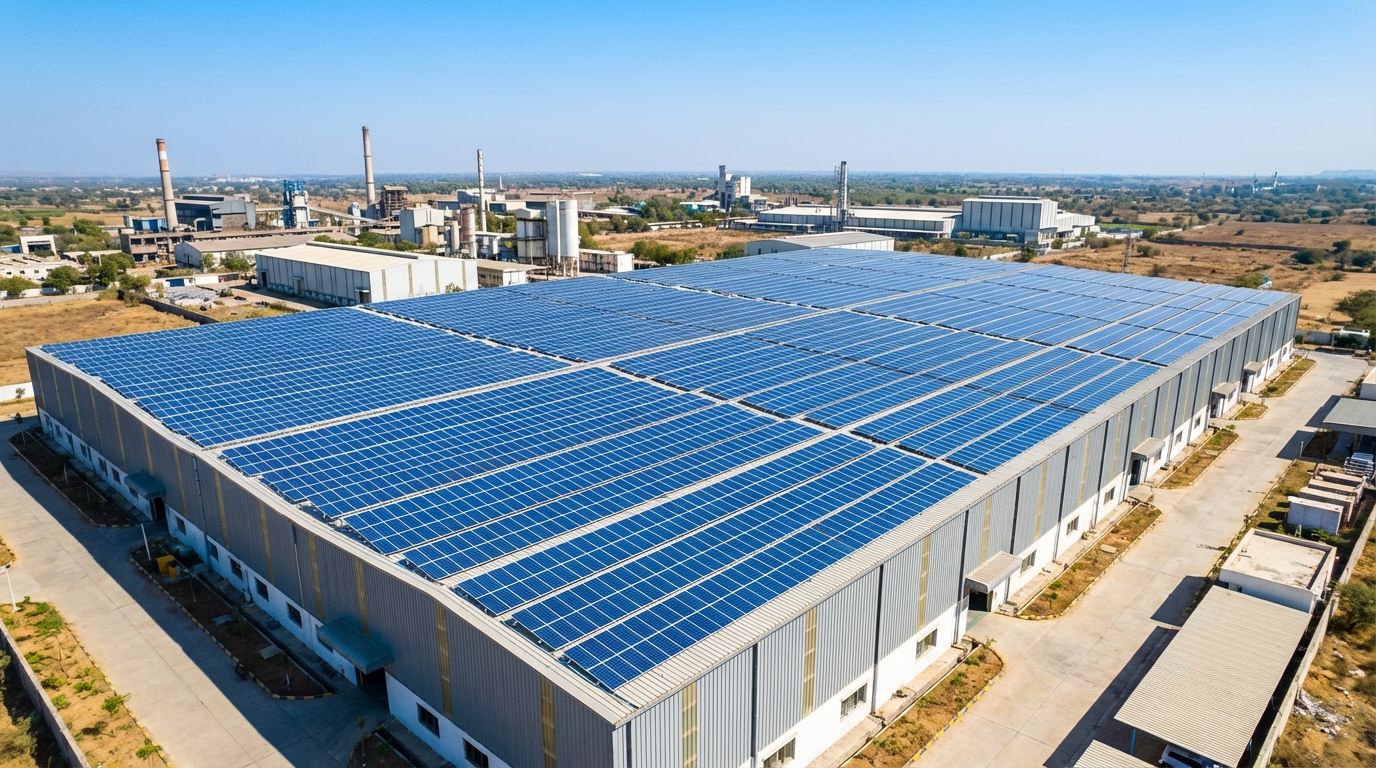
The state government has recognized this challenge and positioned Gujarat as India’s most progressive state for industrial solar installations. The Gujarat Solar Power Policy 2021 offers streamlined approvals, attractive net metering provisions, and dedicated support for industrial consumers looking to transition to renewable energy. This policy framework has catalyzed remarkable growth—Gujarat now hosts over 12,000 MW of installed solar capacity, with industrial and commercial installations accounting for a substantial portion.
Success stories from Gujarat’s industrial hubs demonstrate the transformative potential:
- Surat’s textile and diamond processing industries have installed over 500 MW of rooftop solar capacity, with individual facilities ranging from 100 kW to 5 MW
- Vapi’s chemical and pharmaceutical manufacturing units have embraced solar to reduce dependence on expensive grid power and diesel generators
- Ahmedabad’s warehousing and logistics sector has leveraged vast roof spaces for solar installations, achieving energy independence during daylight hours
- Rajkot’s engineering and automotive component manufacturers have integrated solar with their existing electrical infrastructure to optimize energy costs
Beyond cost savings, industrial solar adoption in Gujarat addresses critical business imperatives. Manufacturing facilities face increasing pressure from domestic and international clients to demonstrate environmental responsibility. Solar installations contribute directly to ESG (Environmental, Social, and Governance) metrics, helping Gujarat’s industries maintain competitive advantages in global markets where sustainability credentials increasingly influence procurement decisions.
The financial comparison is compelling: while grid electricity costs continue rising at 5-8% annually, solar energy costs remain fixed for 25+ years after installation. A typical industrial facility in Gujarat paying ₹7 per unit for grid electricity can generate solar power at an effective cost of ₹2.5-3.5 per unit over the system’s lifetime, representing savings of 50-60% on electricity expenses.
Understanding Industrial Solar Requirements: Load Analysis & Capacity Planning
Accurate load analysis forms the foundation of successful industrial solar Gujarat projects. Unlike residential installations where consumption patterns are relatively predictable, industrial facilities exhibit complex energy profiles that require sophisticated analysis to optimize solar system design.
The first step involves comprehensive consumption pattern analysis:
- Peak load identification: Determine maximum power demand during production hours, typically occurring during daytime shifts when machinery operates at full capacity
- Base load assessment: Calculate continuous power requirements for essential equipment, lighting, HVAC systems, and auxiliary operations
- Seasonal variations: Account for production cycles, seasonal manufacturing patterns, and how consumption varies across different months
- Time-of-day analysis: Map hourly consumption to understand when solar generation can offset maximum grid dependency
Industrial facilities in Gujarat typically operate on three-phase power systems with sanctioned loads ranging from 100 kW to several megawatts. Solar system sizing must account for these specifications while considering the following technical parameters:
For a manufacturing unit consuming 10,000 units monthly with peak demand of 150 kW during daytime operations, a properly sized solar installation of 120-150 kW capacity can offset 60-80% of daytime consumption. The sizing calculation considers Gujarat’s average solar irradiation of 5.5-6.0 kWh/m²/day, panel efficiency ratings, inverter losses, and seasonal performance variations.
Critical considerations for industrial capacity planning include:
- Sanctioned load limitations: Net metering regulations in Gujarat typically allow solar installations up to 100% of sanctioned load, though this varies by utility and consumer category
- Roof space availability: Industrial solar panels require approximately 100 square feet per kW of installed capacity, meaning a 500 kW system needs roughly 50,000 square feet of unobstructed roof space
- Future expansion plans: Design systems with scalability in mind, allowing for capacity additions as production increases or additional facilities come online
- Grid export considerations: Determine whether excess generation will be exported to the grid under net metering or if system sizing should match consumption to minimize export
For industries operating continuous processes or running night shifts, energy storage integration becomes relevant. While battery storage adds significant upfront costs, facilities with 24/7 operations can benefit from storing daytime solar generation for evening use, reducing dependence on expensive grid power during peak tariff hours. However, most Gujarat industrial installations currently operate without storage, relying on net metering arrangements to bank excess daytime generation against nighttime consumption.
Site Assessment for Industrial Solar Installations
A thorough site assessment distinguishes successful industrial solar installations from problematic projects. Industrial facilities present unique challenges and opportunities that require specialized evaluation beyond standard residential assessments.
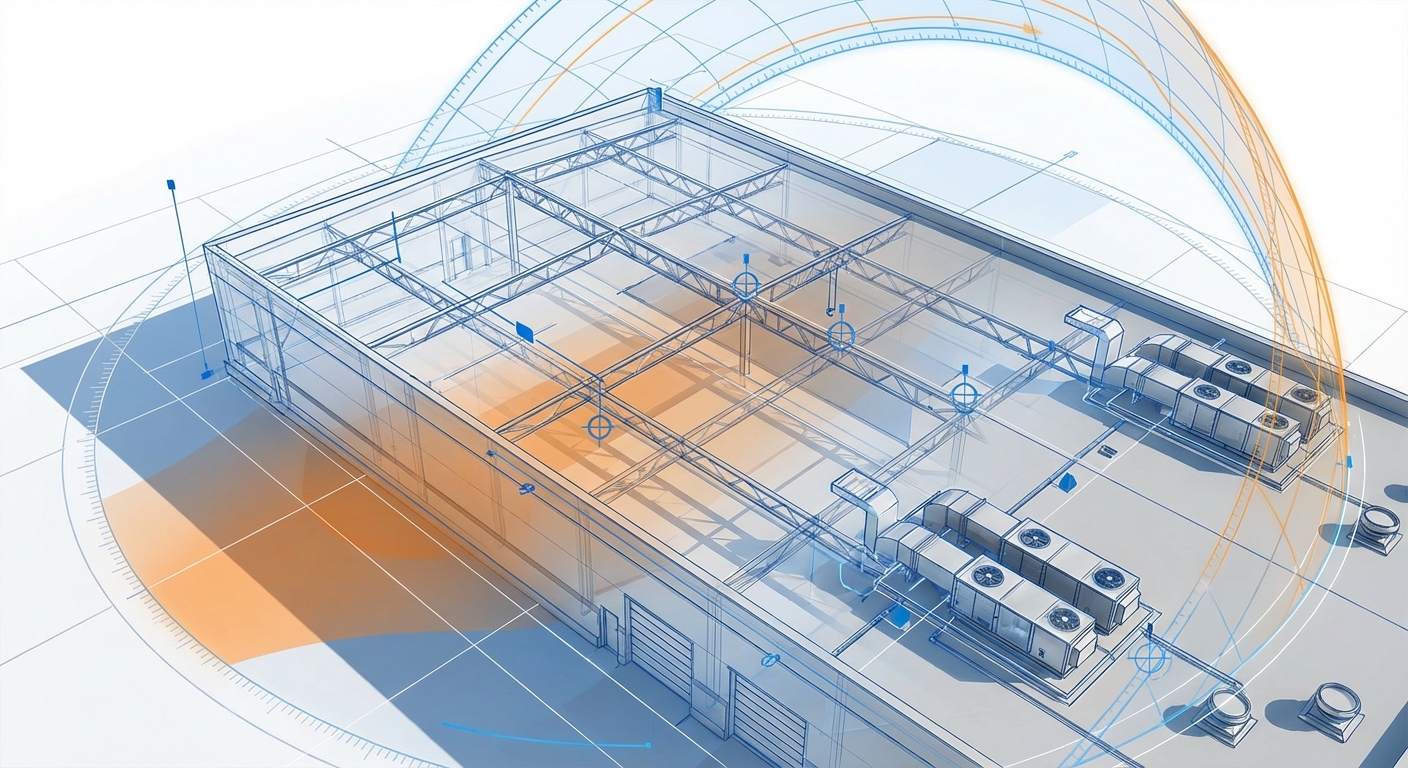
Structural integrity assessment is paramount for industrial rooftops:
Industrial buildings in Gujarat range from decades-old structures with asbestos or metal sheet roofing to modern pre-engineered buildings (PEB) with designed load capacities. Solar installations add approximately 15-20 kg per square meter of additional load, including panels, mounting structures, and wind load considerations. A qualified structural engineer must evaluate:
- Existing roof load-bearing capacity and structural member conditions
- Roof material type and suitability for solar mounting systems
- Waterproofing integrity and potential penetration points
- Wind load calculations based on Gujarat’s coastal and inland wind patterns
- Seismic considerations per local building codes
Many industrial facilities in Surat and Vapi have older roofing that requires reinforcement or replacement before solar installation. This presents an opportunity to upgrade roofing infrastructure while implementing solar, though it adds to project costs and timelines.
Space optimization strategies maximize solar generation potential:
Industrial facilities often have roof-mounted equipment, skylights, ventilation systems, and access pathways that create obstacles for solar panel placement. Professional solar EPC Gujarat companies employ advanced design software to optimize panel layout, accounting for:
- Obstructions and required clearances around HVAC equipment, chimneys, and roof penetrations
- Maintenance access pathways for both solar systems and existing roof equipment
- Fire safety clearances and emergency access requirements
- Optimal tilt angles (typically 15-20 degrees in Gujarat) versus available space trade-offs
- Row spacing to minimize inter-row shading while maximizing capacity
For facilities with insufficient or unsuitable roof space, ground-mounted solar installations offer an alternative. Industrial units with adjacent land parcels can develop ground-mounted arrays, which often provide easier installation, better maintenance access, and optimal panel orientation. However, ground-mounted systems consume valuable land that might otherwise serve operational or expansion purposes.
Shadow analysis and optimal panel placement:
Industrial environments present complex shading scenarios from adjacent buildings, chimneys, water tanks, and surrounding structures. Advanced shadow analysis using software tools models sun paths throughout the year to identify shading patterns and optimize panel placement. Even partial shading on a few panels can significantly impact overall system performance if not properly addressed through string design and optimizer technology.
The electrical infrastructure evaluation examines existing electrical systems, transformer capacity, available space for inverters and electrical equipment, cable routing pathways, and grid interconnection points. Industrial facilities typically have robust electrical infrastructure, but solar integration requires careful planning to ensure seamless operation with existing systems, DG sets, and power factor correction equipment.
Industrial-Specific Installation Considerations
Installing solar systems on operational industrial facilities demands specialized approaches that minimize production disruption while maintaining stringent safety standards. Unlike residential or greenfield installations, industrial solar projects must accommodate ongoing manufacturing operations, worker safety, and complex facility logistics.
Minimizing production disruption during installation:
Most industrial solar installations in Gujarat are executed in phases to avoid impacting production schedules. A typical 500 kW installation might be divided into 4-5 phases, with work concentrated during weekends, night shifts, or planned maintenance shutdowns. This phased approach allows:
- Continuous manufacturing operations with minimal interruption
- Staged electrical integration that doesn’t require complete facility shutdowns
- Flexibility to adjust installation schedules around production priorities
- Risk mitigation by testing each phase before proceeding to the next
Experienced solar EPC services providers coordinate closely with facility management to develop installation schedules that align with production calendars, ensuring that critical manufacturing periods remain unaffected.
Safety protocols for industrial environments:
Industrial facilities present heightened safety risks compared to residential installations. Comprehensive safety protocols must address:
- Hot work permits for welding and cutting operations on metal roofs
- Confined space entry procedures for electrical rooms and equipment areas
- Fall protection systems for workers operating at heights on large industrial roofs
- Lockout/tagout procedures when integrating with existing electrical systems
- Coordination with facility safety officers and compliance with plant safety regulations
- Personal protective equipment requirements specific to industrial environments
Reputable solar installation companies maintain rigorous safety standards, provide comprehensive worker training, and carry appropriate insurance coverage for industrial projects.
Heavy-duty mounting structures and industrial-grade components:
Industrial solar installations require robust mounting structures engineered for Gujarat’s environmental conditions, including monsoon winds, coastal salt exposure in areas like Vapi, and industrial atmospheric conditions. Industrial-grade solar inverters must handle high power capacities, provide three-phase output, and integrate with existing electrical infrastructure including automatic power factor correction panels and DG synchronization systems.
Component selection for industrial installations prioritizes:
- High-efficiency solar modules: Monocrystalline panels from tier-1 manufacturers offering 20-22% efficiency to maximize generation from available space
- String or central inverters: Industrial-scale inverters (50 kW to 1 MW+) with proven reliability and service networks in Gujarat
- Galvanized mounting structures: Hot-dip galvanized steel structures designed for 25+ year lifespan in industrial environments
- Industrial-grade cabling: UV-resistant, fire-retardant cables rated for outdoor industrial applications
- Surge protection devices: Comprehensive lightning and surge protection given the investment value and critical nature of industrial operations
Integration with existing electrical systems:
Industrial facilities have complex electrical architectures including multiple transformers, power distribution panels, DG sets, and power quality equipment. Solar system integration must ensure:
- Seamless synchronization with grid power and automatic changeover systems
- Compatibility with existing DG sets, allowing solar to reduce diesel consumption during daytime
- Proper metering arrangements for net metering or gross metering configurations
- Integration with building management systems (BMS) where applicable
- Compliance with utility interconnection requirements and protection relay settings
Monitoring systems for industrial solar plants:
Industrial installations require sophisticated monitoring beyond basic residential systems. Advanced monitoring platforms provide real-time visibility into system performance, generation patterns, and potential issues. Features include string-level monitoring, inverter performance tracking, weather station integration, automated alerts for underperformance, and detailed analytics for energy management. These systems enable facility managers to optimize energy consumption patterns, validate solar ROI projections, and ensure maximum system uptime.
Government Incentives and Subsidies for Industrial Solar in Gujarat
Gujarat offers one of India’s most favorable policy environments for industrial solar installations, with multiple incentive mechanisms that significantly improve project economics and accelerate payback periods.
Gujarat Solar Power Policy benefits for industries:
The state’s solar policy provides streamlined approvals, simplified net metering procedures, and dedicated support for industrial consumers. Key provisions include:
- Single-window clearance for solar installations up to 1 MW capacity
- Simplified net metering application process with defined timelines for utility approvals
- Banking of excess generation for up to 12 months under net metering arrangements
- Exemption from electricity duty on solar generation for captive consumption
- Priority grid connectivity for solar installations
Accelerated depreciation benefits under Income Tax Act:
Industrial solar installations qualify for accelerated depreciation under the Income Tax Act, allowing businesses to claim 40% depreciation in the first year of operation. This tax benefit significantly improves project economics for profitable enterprises, effectively reducing the net investment by the tax savings generated. For a ₹3 crore solar installation, accelerated depreciation can generate tax savings of approximately ₹35-40 lakhs in the first year for companies in the highest tax bracket.
Net metering and gross metering options:
Gujarat’s net metering regulations allow industrial consumers to install solar systems up to 100% of their sanctioned load (or contract demand). Under net metering:
- Excess solar generation is exported to the grid and credited against future consumption
- Billing is done on a net basis, with consumers paying only for net grid consumption
- Banking period extends up to 12 months, allowing seasonal adjustments
- No separate metering charges for solar installations under net metering
Alternatively, gross metering arrangements allow facilities to sell all solar generation to the utility at predetermined rates, though this is less common for industrial installations where captive consumption provides better economics.
DREBP scheme applicability for industrial rooftops:
While the Decentralized Renewable Energy Based Power (DREBP) scheme primarily targets residential and institutional consumers, certain industrial facilities may qualify for benefits under specific categories. The scheme provides capital subsidies for rooftop solar Gujarat installations, though eligibility criteria and subsidy quantum vary based on consumer category and installation capacity.
GST benefits and tax incentives:
Solar equipment and installation services attract 5% GST, significantly lower than the standard 18% rate for most industrial equipment. Additionally, input tax credit on solar investments can be claimed, further improving project economics. Some industrial areas and special economic zones offer additional tax incentives for renewable energy adoption as part of their sustainability initiatives.
Documentation and application process:
Accessing these incentives requires proper documentation and timely applications. Essential steps include:
- Net metering application to the local electricity distribution company with technical details and single-line diagrams
- Structural stability certificate from a chartered engineer
- Electrical safety certificates and compliance documentation
- Subsidy applications (where applicable) with required supporting documents
- Interconnection agreements and metering arrangements
Experienced solar EPC Gujarat companies like Heaven Green Energy handle these administrative requirements, ensuring compliance with all regulatory requirements and maximizing available incentives for their industrial clients.
Financial Analysis: ROI and Payback Period for Industrial Solar
Understanding the financial implications of industrial solar Gujarat investments is crucial for decision-making. While upfront costs are substantial, the long-term economics strongly favor solar adoption for most industrial facilities.
Typical investment costs for industrial solar installations:
As of 2026, industrial solar installation costs in Gujarat range from ₹40,000 to ₹55,000 per kW for turnkey projects, depending on system size, component quality, roof complexity, and site-specific factors. A 500 kW installation typically costs ₹2.0-2.5 crores, while larger 1 MW+ systems benefit from economies of scale with costs toward the lower end of the range.
Cost components include:
- Solar modules: 35-40% of total project cost, with tier-1 brands commanding premium pricing
- Inverters and electrical equipment: 15-20% of project cost
- Mounting structures: 12-15% of project cost
- Installation labor and engineering: 15-18% of project cost
- Cabling, protection devices, and accessories: 8-10% of project cost
- Approvals, commissioning, and documentation: 5-7% of project cost
Calculating energy savings and ROI for manufacturing units:
A typical 500 kW industrial solar installation in Gujarat generates approximately 750,000-800,000 units annually, considering average solar irradiation and system performance factors. At an average industrial electricity tariff of ₹7 per unit, this translates to annual savings of ₹52-56 lakhs.
The ROI calculation must account for:
- Annual energy savings based on current and projected electricity tariffs
- Tax benefits from accelerated depreciation
- Avoided costs of diesel generator operation (where applicable)
- Annual maintenance costs (typically 0.5-1% of project cost)
- Performance degradation (approximately 0.5% annually for quality modules)
- Financing costs if the project is debt-funded
Payback period expectations for different industrial scales:
For equity-funded projects with accelerated depreciation benefits, typical solar payback periods in Gujarat range from 3.5 to 5 years for industrial installations. Smaller installations (100-250 kW) tend toward the higher end due to higher per-kW costs, while larger installations (500 kW+) achieve faster payback through economies of scale and better pricing.
A 500 kW installation costing ₹2.25 crores with annual savings of ₹54 lakhs and first-year tax benefits of ₹35 lakhs achieves payback in approximately 4 years, after which the system generates pure savings for the remaining 21+ years of its operational life.
Solar financing options for industries:
Multiple solar financing options enable industrial facilities to adopt solar without significant upfront capital deployment:
- Bank loans: Nationalized and private banks offer dedicated solar loans at 9-11% interest rates with tenures up to 10 years
- NBFC financing: Non-banking financial companies provide flexible financing structures tailored to industrial cash flows
- Lease financing: Equipment leasing arrangements where the financing company owns the system and the industry pays monthly lease rentals
- Power Purchase Agreements (PPA): Third-party ownership models where investors install and own the system, selling power to the industry at predetermined rates
OPEX vs. CAPEX models for industrial solar:
The CAPEX (capital expenditure) model involves the industry owning the solar system, providing maximum long-term savings and tax benefits but requiring upfront investment. The OPEX (operational expenditure) model through PPAs eliminates upfront costs, with the industry paying only for solar power consumed at rates typically 10-20% below grid tariffs. While OPEX models reduce financial barriers, CAPEX models deliver superior long-term economics for industries with available capital or financing access.
Long-term financial benefits and electricity cost hedging:
Beyond immediate savings, industrial solar provides crucial protection against electricity tariff escalations. With grid tariffs historically increasing 5-8% annually, solar installations lock in energy costs for 25+ years, providing predictable operating expenses and insulation from future tariff shocks. This cost certainty is increasingly valuable for industries operating on thin margins or facing intense competition.
Case Studies: Successful Industrial Solar Implementations in Gujarat
Real-world implementations across Gujarat’s industrial landscape demonstrate the practical benefits and diverse applications of industrial solar solutions.
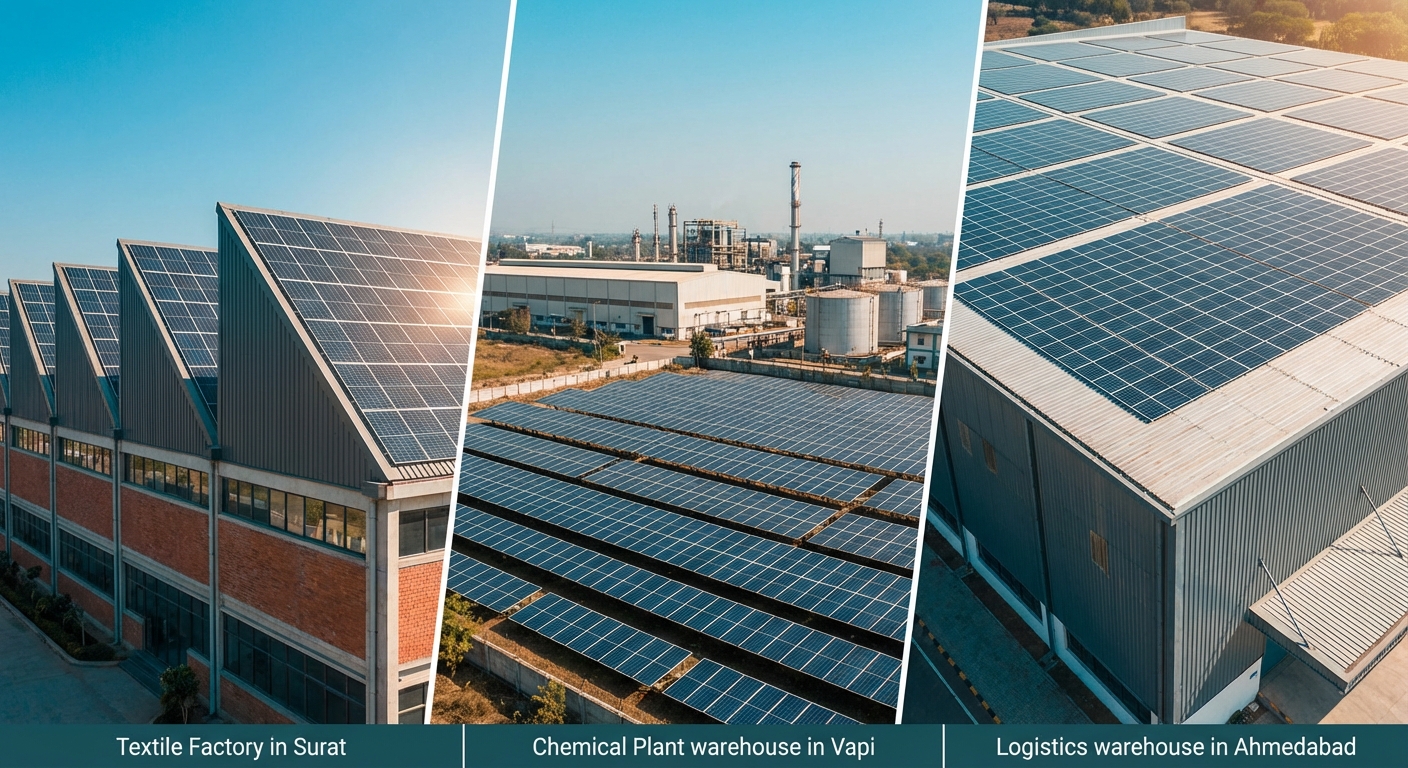
Textile Manufacturing Unit in Surat:
A mid-sized textile processing facility in Surat’s Pandesara industrial area installed a 750 kW rooftop solar system to offset its substantial daytime power consumption. The facility operates two shifts with peak consumption during daylight hours when dyeing and processing equipment runs at full capacity.
Project specifications:
- Installed capacity: 750 kW across 75,000 square feet of factory rooftop
- Annual generation: Approximately 1.1 million units
- Investment: ₹3.2 crores (turnkey installation)
- Annual savings: ₹77 lakhs at ₹7 per unit tariff
- Payback period: 4.2 years including tax benefits
The installation required careful coordination with production schedules, with work executed during Sunday shutdowns over a 10-week period. The facility’s metal sheet roofing required reinforcement in certain sections to accommodate solar loads. Post-installation, the system offsets approximately 65% of daytime consumption, significantly reducing electricity bills and improving the facility’s environmental credentials with international buyers increasingly demanding sustainable manufacturing practices.
Chemical Processing Plant in Vapi:
A chemical manufacturing facility in Vapi’s GIDC industrial estate implemented a hybrid approach combining 500 kW rooftop solar with 300 kW ground-mounted installation to meet its energy requirements while accommodating complex roof structures with multiple process equipment installations.
Implementation approach:
- Rooftop installation on warehouse and administrative buildings: 500 kW
- Ground-mounted array on adjacent land parcel: 300 kW
- Total capacity: 800 kW generating 1.2 million units annually
- Integration with existing DG sets for seamless power management
- Advanced monitoring system integrated with plant SCADA
The project addressed unique challenges including corrosive atmospheric conditions requiring specialized anti-corrosion coatings on mounting structures and enhanced sealing for electrical components. The ground-mounted section utilized fixed-tilt structures optimized for Gujarat’s latitude, while rooftop sections employed ballasted mounting systems to avoid roof penetrations on the chemical processing building.
Results after 18 months of operation show 98.5% system uptime, annual savings exceeding ₹84 lakhs, and successful integration with the facility’s power management systems allowing optimized load distribution between solar, grid, and DG sources.
Warehouse Facility in Ahmedabad:
A modern logistics and warehousing facility in Ahmedabad’s Sanand industrial area leveraged its expansive 1.2 lakh square feet roof space for a 1.2 MW solar installation, one of the largest single-roof industrial installations in the region.
Space optimization approach:
- Pre-engineered building with designed solar load capacity
- Optimal panel layout maximizing capacity while maintaining access pathways
- 1.2 MW installation generating 1.8 million units annually
- Near-complete daytime energy independence
- Excess generation exported under net metering during low-occupancy periods
The facility’s modern construction and purpose-built design for solar integration enabled rapid installation completed in just 12 weeks. The warehouse operates primarily during daytime hours, creating excellent alignment between solar generation and consumption patterns. The installation achieves approximately 85% self-consumption with excess generation banked for evening operations and climate control systems.
Key learnings and best practices from real installations:
- Early structural assessment prevents costly mid-project modifications
- Phased installation approaches minimize operational disruption for running facilities
- Quality components from established solar brands Gujarat deliver superior long-term performance
- Comprehensive monitoring systems enable proactive maintenance and performance optimization
- Professional solar EPC services providers add value through experience with industrial-specific challenges
Maintenance and Operations for Industrial Solar Systems
Proper maintenance ensures industrial solar installations deliver expected performance throughout their 25+ year operational life. Industrial environments present unique maintenance considerations requiring systematic approaches.
Preventive maintenance schedules for industrial solar plants:
Comprehensive maintenance programs for industrial solar Gujarat installations typically include:
- Monthly inspections: Visual inspection of panels, mounting structures, and electrical connections; monitoring system data review for performance anomalies
- Quarterly maintenance: Detailed inspection of inverters and electrical equipment; torque checking of critical connections; vegetation management for ground-mounted systems
- Semi-annual servicing: Comprehensive system testing including insulation resistance, earth continuity, and string performance verification
- Annual maintenance: Complete system audit, thermal imaging of electrical connections, inverter servicing, and performance benchmarking against design expectations
Cleaning protocols for optimal performance:
Industrial environments in Gujarat, particularly in areas like Vapi and Surat, expose solar panels to dust, industrial emissions, and atmospheric pollutants that can significantly impact performance. Regular cleaning is essential:
- Cleaning frequency: Every 2-4 weeks depending on location and atmospheric conditions
- Water-based cleaning using deionized or soft water to prevent mineral deposits
- Specialized cleaning equipment for large industrial installations including automated cleaning systems for mega-installations
- Timing: Early morning cleaning to avoid thermal shock and maximize same-day generation recovery
Proper cleaning can restore 15-25% generation loss caused by soiling, making it one of the most cost-effective maintenance activities. Many industrial facilities contract specialized solar maintenance Gujarat service providers for regular cleaning and upkeep.
Remote monitoring and performance tracking:
Modern industrial solar installations employ sophisticated monitoring platforms providing real-time visibility into system performance. These systems enable:
- String-level performance monitoring to identify underperforming sections
- Automated alerts for system faults, inverter issues, or grid disconnections
- Performance benchmarking against expected generation based on weather conditions
- Energy analytics showing consumption patterns and solar offset percentages
- Mobile app access for facility managers to monitor systems remotely
Warranty coverage for industrial-grade components:
Quality industrial solar installations come with comprehensive solar warranty coverage:
- Solar module warranties: 25-year linear performance warranty (typically 80-85% output after 25 years) plus 10-12 year product warranty
- Inverter warranties: 5-10 year standard warranty with extended warranty options available
- Mounting structure warranties: 10-25 year structural warranty against corrosion and failure
- Installation workmanship warranty: 5-10 year warranty covering installation quality and waterproofing
Reputable solar companies Gujarat like Heaven Green Energy stand behind their installations with comprehensive warranty coverage and responsive service support throughout the system lifetime.
Troubleshooting common issues in industrial environments:
Industrial solar systems may encounter specific issues requiring prompt attention:
- Inverter faults due to grid voltage fluctuations common in industrial areas
- Accelerated soiling from industrial emissions requiring increased cleaning frequency
- Shading from new constructions or equipment installations affecting performance
- Electrical connection issues from vibrations in facilities with heavy machinery
- Communication failures in monitoring systems due to industrial electromagnetic interference
Experienced maintenance teams quickly diagnose and resolve these issues, minimizing downtime and generation losses.
Annual maintenance costs and considerations:
Industrial solar maintenance typically costs 0.5-1% of the initial project investment annually, covering cleaning, inspections, minor repairs, and monitoring system subscriptions. For a ₹2.5 crore installation, annual maintenance costs range from ₹1.25-2.5 lakhs—a small fraction of the annual savings generated. Comprehensive Annual Maintenance Contracts (AMCs) from professional service providers ensure consistent system performance and protect the long-term investment value.
Choosing the Right Solar EPC Partner in Gujarat
Selecting the right solar EPC Gujarat partner is perhaps the most critical decision in your industrial solar journey. The EPC (Engineering, Procurement, and Construction) company you choose will determine system quality, installation professionalism, and long-term support—all factors that directly impact your investment returns.
Key criteria for selecting industrial solar EPC companies:
- Industrial project experience: Verify the company’s track record with industrial installations similar to your facility in scale and complexity
- Technical expertise: Assess engineering capabilities, in-house design resources, and understanding of industrial electrical systems
- Financial stability: Ensure the company has the financial strength to honor long-term warranties and commitments
- Local presence: Gujarat-based companies with local offices provide better ongoing support and faster response times
- Certifications and credentials: Look for ISO certifications, empanelment with government agencies, and industry recognitions
Experience with large-scale industrial projects:
Industrial solar installations demand specialized expertise beyond residential or small commercial projects. Your EPC partner should demonstrate:
- Portfolio of completed industrial projects with verifiable references
- Understanding of industrial safety protocols and compliance requirements
- Capability to handle complex electrical integration with existing industrial infrastructure
- Experience navigating utility approvals and industrial consumer regulations
- Project management skills to coordinate installations around production schedules
Quality of components and brands offered:
Component quality directly impacts system performance and longevity. Leading EPC companies partner with tier-1 solar module manufacturers and reputable solar inverter brands, offering:
- Bankable solar modules from manufacturers with proven track records and financial stability
- Industrial-grade inverters from established brands with service networks in Gujarat
- Quality mounting structures engineered for local environmental conditions
- Genuine components with proper warranties and certifications
- Transparency in component specifications and sourcing
Post-installation support and maintenance services:
Your relationship with the EPC company extends well beyond installation. Evaluate their post-installation support including:
- Availability of maintenance services and AMC options
- Response times for service calls and issue resolution
- Monitoring system support and performance optimization services
- Warranty claim processing and component replacement procedures
- Technical support availability and communication channels
Heaven Green Energy’s industrial solar expertise and presence:
Heaven Green Energy Limited has established itself as a trusted partner for industrial solar installations across Gujarat since 2017. With headquarters in Surat and branch offices in Ahmedabad and Junagadh, the company provides comprehensive solar EPC services tailored to industrial requirements:
- Extensive experience with industrial installations across Gujarat’s manufacturing hubs including Surat, Ahmedabad, Vapi, and Rajkot
- Complete turnkey EPC solutions handling all aspects from design and engineering to installation and commissioning
- Partnership with leading solar component manufacturers ensuring quality and reliability
- In-house technical team with expertise in industrial electrical systems and complex integrations
- Comprehensive post-installation support including maintenance services and performance monitoring
- Track record of over 10,000 installations demonstrating proven execution capabilities
- Recognition as one of the top EPC companies in Gujarat with strong financial stability
The company’s local presence across Gujarat ensures responsive support and understanding of regional industrial requirements, regulatory environments, and utility procedures. For industrial facility owners seeking a reliable partner for their solar journey, Heaven Green Energy offers the combination of technical expertise, quality commitment, and long-term support essential for successful industrial solar implementations.
Implementation Roadmap: From Planning to Commissioning
Understanding the implementation timeline and process helps industrial facility owners plan their solar projects effectively and set realistic expectations for project completion.
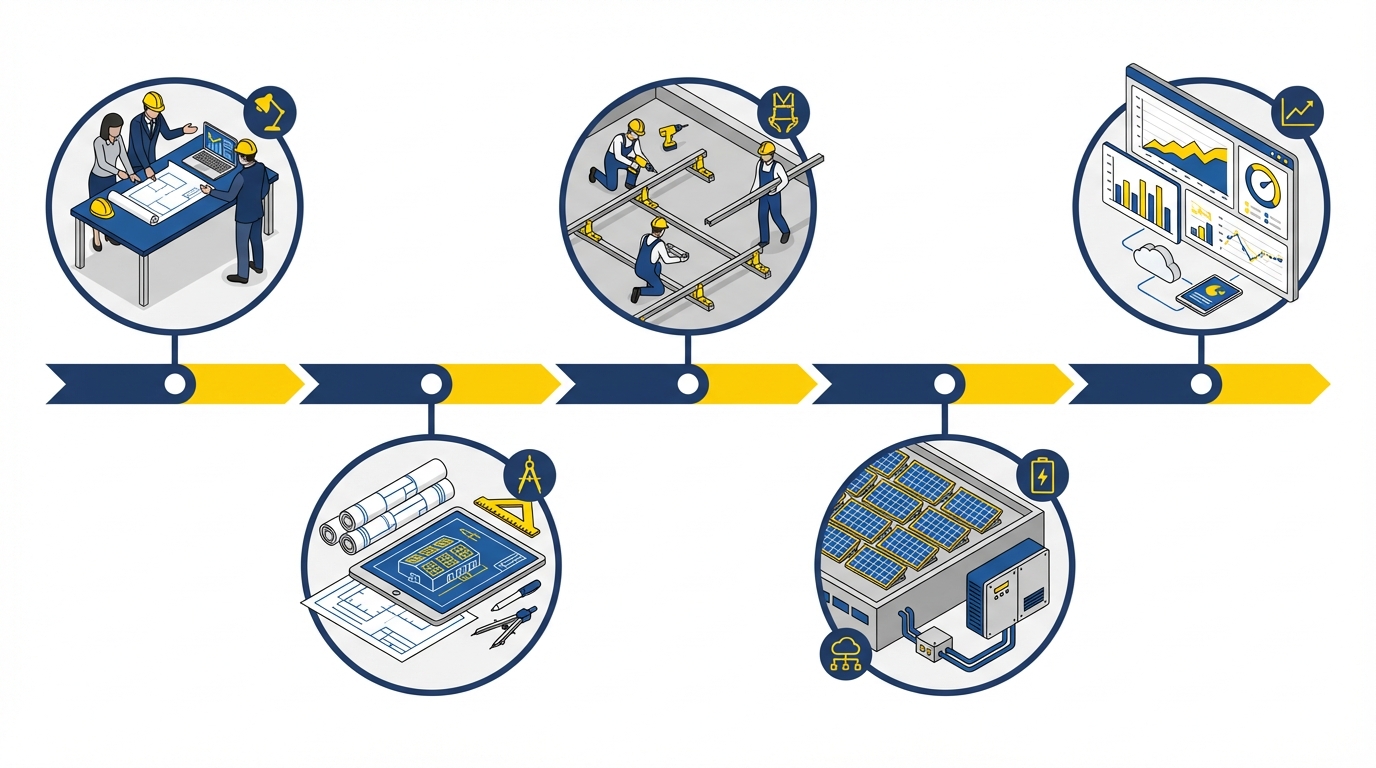
Step-by-step timeline for industrial solar projects:
A typical 500 kW industrial solar installation in Gujarat follows this timeline:
- Weeks 1-2: Initial consultation, site assessment, and feasibility study
- Weeks 3-4: Detailed design, engineering, and proposal finalization
- Weeks 5-6: Contract execution, approvals initiation, and procurement
- Weeks 7-14: Installation and construction (may extend based on phasing requirements)
- Weeks 15-16: Testing, commissioning, and utility interconnection
- Week 17: Final handover and system activation
Larger installations or complex projects may require extended timelines, while smaller installations can be completed more quickly. The critical path typically involves utility approvals and structural preparations rather than actual installation work.
Initial consultation and feasibility study:
The process begins with comprehensive consultation where the EPC company:
- Understands your facility’s energy consumption patterns and business objectives
- Conducts preliminary site assessment evaluating roof conditions and available space
- Reviews electricity bills and consumption data to size the system appropriately
- Discusses budget parameters and financing options
- Provides preliminary feasibility assessment and ballpark investment estimates
This initial phase is typically completed within 1-2 weeks and involves no commitment, allowing you to evaluate options before proceeding.
Design and engineering phase:
Once you decide to proceed, detailed engineering begins:
- Comprehensive site survey including structural assessment, electrical infrastructure evaluation, and detailed measurements
- 3D modeling and shadow analysis to optimize panel layout
- Electrical system design including string configuration, inverter sizing, and cable routing
- Structural engineering for mounting systems and load calculations
- Preparation of detailed drawings, single-line diagrams, and technical specifications
- Financial modeling showing investment, savings, ROI, and payback calculations
This phase typically requires 2-3 weeks and results in a comprehensive proposal with technical specifications, financial projections, and implementation plan.
Approvals and permissions required:
Parallel to design finalization, the approval process begins:
- Net metering application: Submitted to the local electricity distribution company (DGVCL, UGVCL, MGVCL, or PGVCL depending on location)
- Structural stability certificate: Obtained from chartered structural engineer certifying roof load-bearing capacity
- Electrical safety approvals: As required by local regulations and utility requirements
- Factory/facility approvals: Internal approvals from facility management and safety departments
- Fire safety clearances: Where required based on facility type and local regulations
Experienced EPC companies handle these administrative requirements, though approval timelines depend on utility responsiveness and can range from 2-6 weeks.
Installation and commissioning process:
With approvals in place and materials procured, installation begins:
- Site preparation: Setting up safety systems, material staging areas, and access arrangements
- Mounting structure installation: Fabrication and installation of panel mounting structures
- Panel installation: Mounting and connecting solar panels in designed configuration
- Electrical work: Installing inverters, running cables, and integrating with existing electrical systems
- Testing and commissioning: Comprehensive testing of all system components and performance verification
- Utility interconnection: Final meter installation and grid synchronization
Installation duration varies with project size and complexity, typically ranging from 6-12 weeks for industrial installations. Phased approaches extend this timeline but minimize operational disruption.
Post-commissioning support and optimization:
After system activation, the EPC company provides:
- Training for facility personnel on system operation and monitoring
- Performance monitoring during initial weeks to ensure optimal operation
- Documentation handover including warranties, operation manuals, and as-built drawings
- Ongoing support through maintenance contracts and technical assistance
- Performance optimization based on actual generation and consumption patterns
This comprehensive implementation approach ensures your industrial solar installation delivers expected performance and returns throughout its operational lifetime.
Taking the Next Step Toward Energy Independence
Industrial solar installations in Gujarat represent a strategic investment that delivers compelling financial returns while positioning your facility for a sustainable future. With electricity costs continuing to rise and solar technology costs stabilizing, the economic case for industrial solar has never been stronger.
The industrial facilities across Surat, Ahmedabad, Vapi, and other Gujarat manufacturing hubs that have already made the transition are reaping substantial benefits—reduced operating costs, improved sustainability credentials, and protection against future energy price volatility. Whether you operate a textile mill, chemical plant, engineering workshop, or warehousing facility, industrial solar Gujarat solutions can be tailored to your specific requirements and operational patterns.
Success in industrial solar implementation depends on three critical factors: thorough planning and assessment, quality components and installation, and selection of an experienced EPC partner who understands industrial requirements. The investment you make today will generate returns for 25+ years, making partner selection and system quality paramount considerations.
Heaven Green Energy Limited brings nearly a decade of experience in Gujarat’s solar sector, with proven expertise in industrial installations across the state’s manufacturing landscape. From initial feasibility assessment through design, installation, and long-term support, the company provides comprehensive solutions that address the unique challenges of industrial solar implementations.
Ready to explore how industrial solar can transform your facility’s energy economics? The first step is a no-obligation consultation to assess your facility’s solar potential, understand your energy requirements, and develop a customized solution that aligns with your business objectives.
Have Any Questions? +91 63904 05060
Contact Heaven Green Energy’s industrial solar specialists to schedule a site assessment and receive a detailed feasibility study for your facility. With offices in Surat, Ahmedabad, and Junagadh, the team is positioned to serve industrial clients across Gujarat with responsive, professional service backed by technical expertise and proven execution capabilities.
The transition to solar energy is not just an environmental decision—it’s a strategic business move that improves your bottom line while securing energy independence for decades to come. Take the first step today toward reducing your facility’s energy costs and joining Gujarat’s industrial solar revolution.