


When planning a solar energy system for your home or business in Gujarat, most people focus on panels and inverters. But there’s a critical component that often gets overlooked: solar cables. These specialized wires are the lifeline of your solar installation, safely carrying the electricity generated by your panels to your inverter and ultimately to your property. Choosing the wrong cables or cutting corners on quality can lead to energy losses, safety hazards, and even system failure.
In this comprehensive FAQ guide, we’ll answer the most common questions about solar cables and wiring systems. Whether you’re a homeowner considering rooftop solar in Gujarat or a business owner planning a commercial installation, understanding solar cables will help you make informed decisions and ensure your system operates safely and efficiently for decades to come.
Understanding Solar Cables: The Foundation of Safe Solar Systems
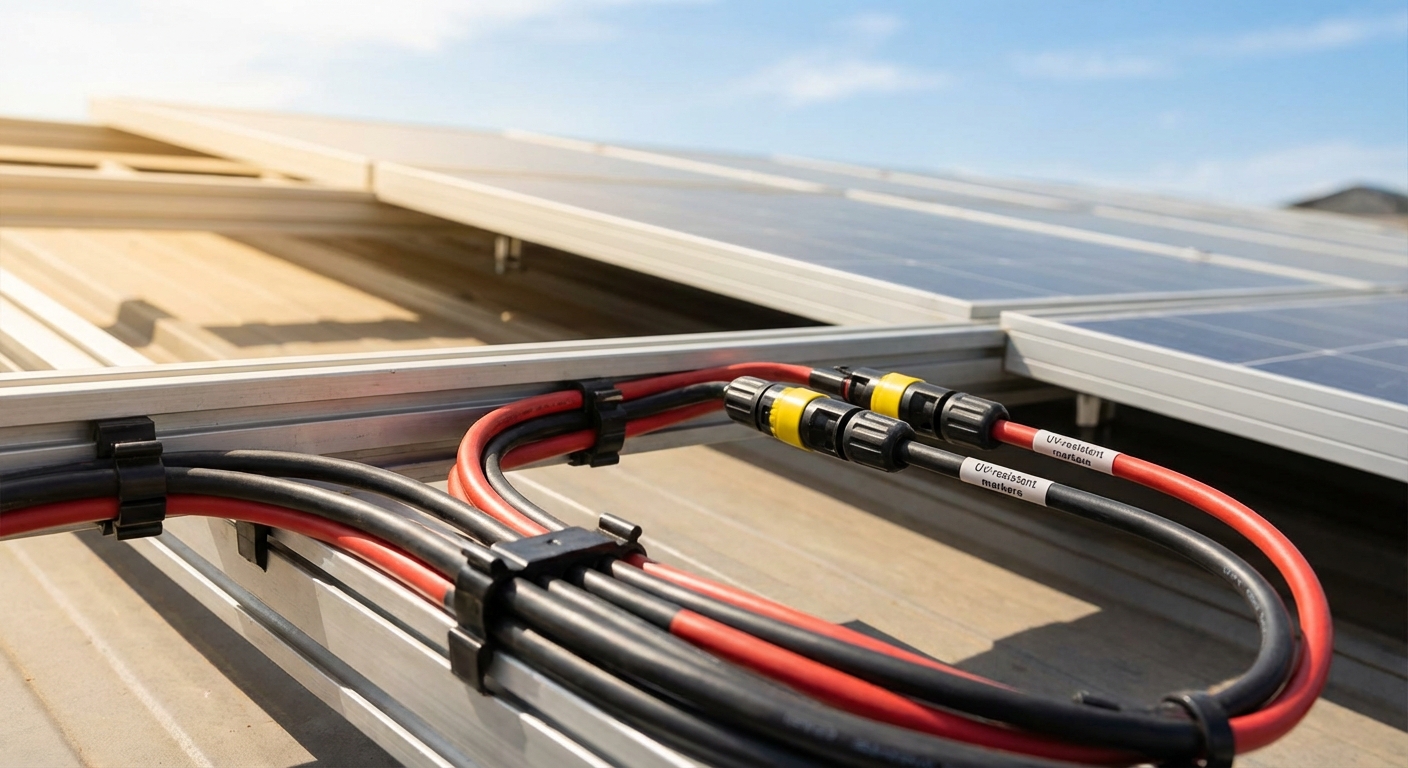
Solar cables are specialized electrical conductors designed specifically for photovoltaic (PV) systems. Unlike standard household electrical wiring, solar cables must withstand extreme conditions including intense UV radiation, temperature fluctuations, moisture, and outdoor exposure for 25 years or more.
The primary function of solar cables is to transmit the direct current (DC) electricity generated by your solar panels to the inverter, where it’s converted to alternating current (AC) for use in your home or business. This seemingly simple task requires cables engineered to very specific standards.
In Gujarat’s climate, where temperatures can soar above 45°C in summer and the monsoon brings heavy rainfall, solar cables face particularly demanding conditions. The intense sunlight that makes Gujarat ideal for solar energy also subjects cables to relentless UV exposure. This is why professional solar EPC companies like Heaven Green Energy prioritize cable quality in every installation across Surat, Ahmedabad, and Junagadh.
Poor cable selection has serious consequences. Undersized cables create resistance that converts valuable electricity into waste heat, reducing your system’s efficiency and your return on investment. Substandard insulation can crack under UV exposure, leading to short circuits, fire hazards, or complete system failure. When you consider that your solar investment is designed to last 25+ years, the cables connecting everything together deserve careful attention.
The Role of Cables in System Performance
Solar cables impact your system in three critical ways:
- Energy Efficiency: Properly sized cables minimize voltage drop and resistance losses, ensuring maximum energy reaches your inverter
- Safety: Quality insulation and proper installation prevent electrical faults, fires, and shock hazards
- Longevity: Weather-resistant cables maintain performance throughout your system’s 25-year lifespan
Understanding these fundamentals helps explain why professional solar EPC services include detailed cable specifications in their project designs rather than treating cables as an afterthought.
What Types of Solar Cables Are Used in Solar Installations?
Not all solar cables are created equal. Different parts of your solar system require different cable types, each engineered for specific applications and conditions.
DC Solar Cables (PV Wire)
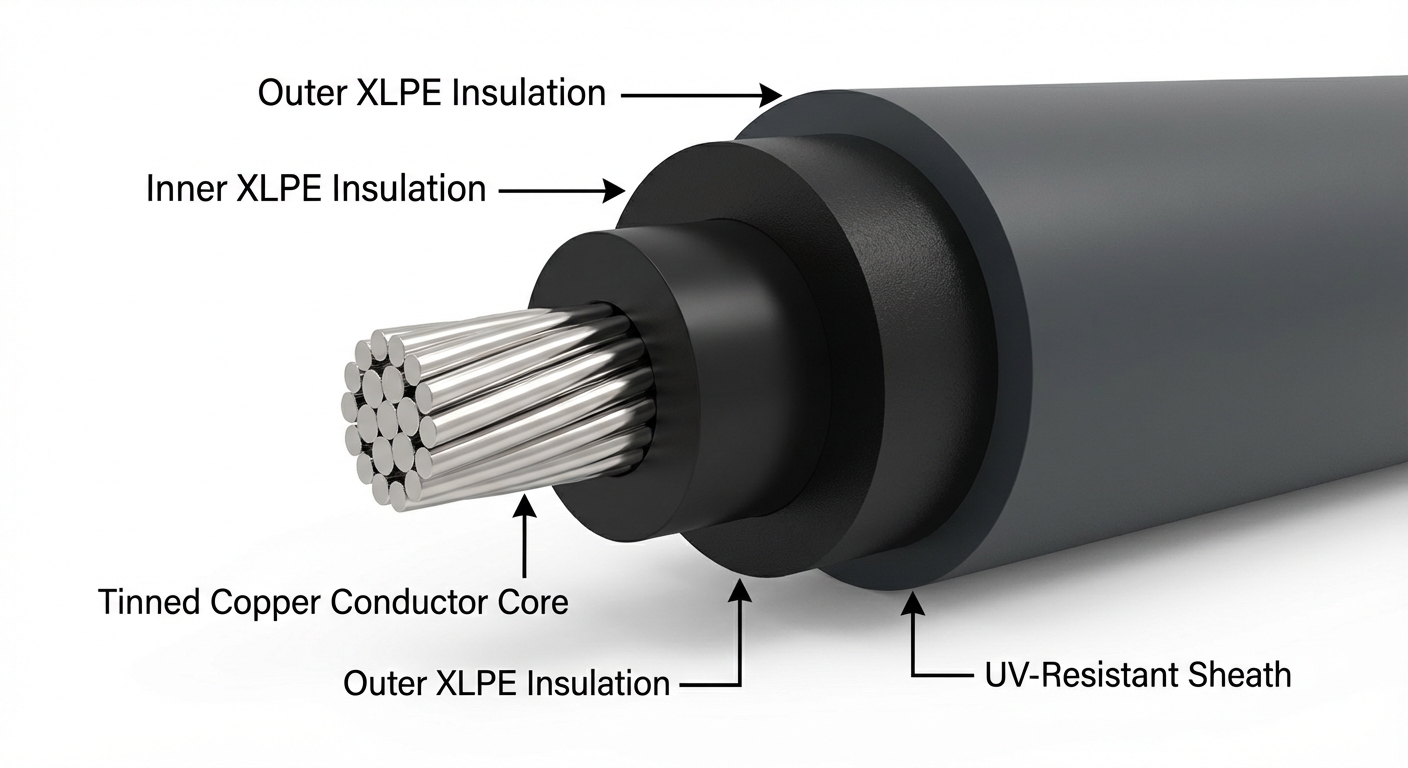
DC solar cables, often called PV wire, connect your solar panels to each other and to the inverter. These are the most critical cables in your system because they carry high-voltage DC electricity and face direct outdoor exposure. Quality DC solar cables feature:
- Tinned copper conductors that resist corrosion
- Cross-linked polyethylene (XLPE) or electron beam cross-linked insulation
- UV-resistant outer jacket rated for decades of sun exposure
- Temperature ratings typically from -40°C to +90°C or higher
- Flame retardant and halogen-free materials for safety
In India, quality DC solar cables should meet IS 694:1990 standards or international equivalents like EN 50618 or UL 4703. These cables typically come in black (negative) and red (positive) colors for easy polarity identification.
AC Solar Cables
AC cables connect your inverter to your home’s electrical panel or the grid connection point. Since these cables are typically installed in conduit or indoors, they don’t require the same extreme UV resistance as DC cables. However, they must handle the AC current output from your inverter and comply with standard electrical codes.
For residential installations, AC cables are usually standard armored or PVC-insulated cables meeting IS 1554 specifications. Commercial and industrial projects may require larger gauge cables or specialized configurations depending on system size.
Single-Core vs Multi-Core Cables
Solar installations predominantly use single-core cables, where each conductor has its own insulation and jacket. This design offers several advantages:
- Better heat dissipation since conductors aren’t bundled together
- Easier routing around obstacles on rooftops
- Simpler replacement if one cable is damaged
- Industry-standard MC4 connectors work with single-core cables
Multi-core cables (multiple conductors in one jacket) are occasionally used for AC connections or in specialized ground-mounted installations, but single-core remains the standard for rooftop solar projects throughout Gujarat.
How Do I Choose the Right Solar Cable Size?
Cable sizing is one of the most critical technical decisions in solar system design. Get it wrong, and you’ll lose energy to resistance, create safety hazards, or violate electrical codes. The right solar cables size depends on several factors working together.
Key Factors in Cable Sizing
Professional solar designers consider these variables when specifying cable sizes:
- Current (Amperage): The amount of electricity flowing through the cable, determined by your panel specifications and system configuration
- Cable Length: Longer cable runs require larger conductors to prevent voltage drop
- Voltage Drop Limits: Industry best practice limits voltage drop to 3% or less between panels and inverter
- Ambient Temperature: Gujarat’s high temperatures require derating cable capacity
- Installation Method: Cables in conduit heat up more than cables in open air
Common Cable Sizes for Different Applications
While every system requires custom calculations, these are typical cable sizes for Gujarat installations:
Residential Rooftop Systems (1-10 kW):
- DC cables: 4mm² to 6mm² for panel strings
- Main DC cables to inverter: 6mm² to 10mm²
- AC cables from inverter: 4mm² to 6mm²
Commercial Systems (10-100 kW):
- DC cables: 6mm² to 10mm² for panel strings
- Main DC cables: 10mm² to 16mm²
- AC cables: 10mm² to 25mm² depending on distance
Industrial and Ground-Mounted Systems (100+ kW):
- DC cables: 10mm² to 25mm² or larger
- Main DC runs: 25mm² to 50mm²
- AC cables: 25mm² to 95mm² or larger
The Voltage Drop Calculation
Voltage drop is the enemy of solar system efficiency. When cables are too small or too long, resistance causes voltage to decrease as electricity travels from panels to inverter. A 3% voltage drop means you’re losing 3% of your generated energy as heat in the cables.
Professional EPC companies use specialized software to calculate exact voltage drop for each cable run. The basic formula considers conductor resistance, current, and cable length. For a typical residential installation with 30 meters of cable run, upgrading from 4mm² to 6mm² cable might cost ₹2,000 more but save thousands in energy production over the system’s lifetime.
This is one reason why working with experienced solar installers matters. Heaven Green Energy’s engineering team performs detailed cable sizing calculations for every project, ensuring optimal performance while meeting all safety codes. This attention to detail contributes to the superior solar ROI that properly designed systems deliver.
What Safety Standards and Certifications Should Solar Cables Meet?
Safety standards exist for good reason. Solar systems operate at high voltages and currents, often in exposed outdoor locations. The right certifications ensure your solar cables have been tested to withstand these demanding conditions without creating hazards.
Indian Standards for Solar Cables
In India, solar cables should comply with relevant Bureau of Indian Standards (BIS) specifications:
- IS 694:1990: Specification for PVC insulated cables for working voltages up to 1100V
- IS 1554: Standards for PVC insulated cables for working voltages up to and including 1100V
- IS 9968: Specifications for cross-linked polyethylene insulated cables
Quality solar cable manufacturers in India obtain BIS certification marks, indicating their products have been tested and meet these standards. Always verify that cables carry proper BIS markings before purchase.
International Certifications
Many premium solar cables used in Gujarat installations also carry international certifications that indicate even higher quality standards:
- TUV Rheinland 2Pfg 1169/08.2007: European standard specifically for solar cables, testing UV resistance, ozone resistance, and extreme temperature performance
- UL 4703: American standard for photovoltaic wire, ensuring fire resistance and electrical safety
- IEC 62930: International standard for cables for photovoltaic systems
- EN 50618: European standard for cables for photovoltaic systems
Cables meeting these international standards typically cost 20-30% more than basic cables, but they offer superior performance and longevity. For a 25-year investment, this premium is well justified.
Fire Resistance and Flame Retardant Properties
Solar cables must resist flame propagation to prevent fires from spreading. Look for cables that meet flame retardant standards such as:
- IEC 60332-1: Test for vertical flame propagation for a single insulated wire or cable
- Halogen-free specifications (LSZH – Low Smoke Zero Halogen) that don’t emit toxic fumes if they do burn
In commercial and industrial installations, fire safety becomes even more critical. Building codes may require specific flame ratings for cables installed in certain locations.
UV and Weather Resistance for Gujarat’s Climate
Gujarat’s intense sunlight and monsoon rains demand cables with exceptional weather resistance. Quality solar cables feature:
- UV stabilizers in the outer jacket that prevent degradation from years of sun exposure
- Water-resistant insulation that maintains integrity during monsoon season
- Ozone resistance to prevent cracking in high-temperature conditions
- Temperature ratings that accommodate Gujarat’s 15°C to 48°C range
Cables without proper UV resistance will show visible cracking and degradation within 3-5 years, while quality cables maintain flexibility and insulation integrity for 25+ years. When Heaven Green Energy installs systems across Gujarat, we specify cables proven to withstand local climate conditions, backed by manufacturer warranties and our own installation experience.
How Can I Identify Quality Solar Cables?
Not all cables labeled as “solar cables” actually meet the standards required for safe, long-term operation. Learning to identify quality cables protects your investment and your safety. Here’s what to look for when evaluating solar cables for your project.
Visual Inspection Indicators
Quality cables reveal themselves through careful visual examination:
- Markings: Premium cables have clear, permanent markings every meter showing manufacturer name, cable specifications, voltage rating, and certification marks (BIS, TUV, UL, etc.)
- Jacket Quality: The outer insulation should feel smooth and uniform with consistent thickness. Rough texture, visible seams, or thin spots indicate poor manufacturing
- Flexibility: Quality cables remain flexible even in cold conditions. Stiff, rigid cables suggest inferior insulation materials
- Color Consistency: The black or red color should be uniform throughout. Fading or color variations suggest inadequate UV stabilizers
Conductor Material and Quality
The conductor is the heart of any cable. For solar applications, look for:
- Tinned Copper: Quality solar cables use tinned (coated with tin) copper conductors. The tin coating prevents oxidation and corrosion, especially important in humid coastal areas of Gujarat. When you strip the insulation, the conductor should have a silvery appearance, not the reddish color of bare copper
- Conductor Purity: Premium cables use 99.9% pure copper. Lower purity copper has higher resistance, reducing efficiency
- Stranding: Solar cables use finely stranded conductors (many thin wires twisted together) rather than solid conductors. This provides flexibility for routing and better resistance to vibration and thermal cycling
A simple test: quality 4mm² cable should contain approximately 56 strands of 0.3mm wire. Count the strands in a cross-section. Fewer, thicker strands indicate lower quality.
Insulation Quality and Thickness
The insulation protects the conductor and provides safety. Quality indicators include:
- Insulation Thickness: Measure the insulation thickness with calipers. For 4mm² cable, insulation should be at least 0.7mm thick. Thinner insulation may not provide adequate protection
- Material Type: Premium solar cables use XLPE (cross-linked polyethylene) or electron beam cross-linked insulation. These materials maintain properties across wide temperature ranges and resist UV degradation better than standard PVC
- Double Insulation: Many quality solar cables feature double insulation layers for extra protection
Certification Marks and Documentation
Legitimate quality cables come with proper documentation:
- Test certificates from recognized laboratories (TUV, UL, BIS testing labs)
- Manufacturer’s technical datasheets with complete specifications
- Warranty documentation (quality cables typically carry 25-year warranties)
- Batch numbers for traceability
Red Flags That Indicate Substandard Cables
Avoid cables showing these warning signs:
- No visible certification marks or manufacturer identification
- Price significantly below market rates (quality copper and insulation have real costs)
- Inconsistent conductor strand count or diameter
- Thin or uneven insulation thickness
- Bare copper conductors instead of tinned copper
- Seller unable to provide test certificates or technical documentation
- Packaging without proper labeling or specifications
When Heaven Green Energy sources cables for installations, we work directly with reputable manufacturers and verify certifications for every batch. This quality control ensures that every system we install, from residential rooftops to large ground-mounted projects, uses cables that will perform safely for decades. Our relationships with trusted suppliers also allow us to offer competitive pricing on genuine quality products.
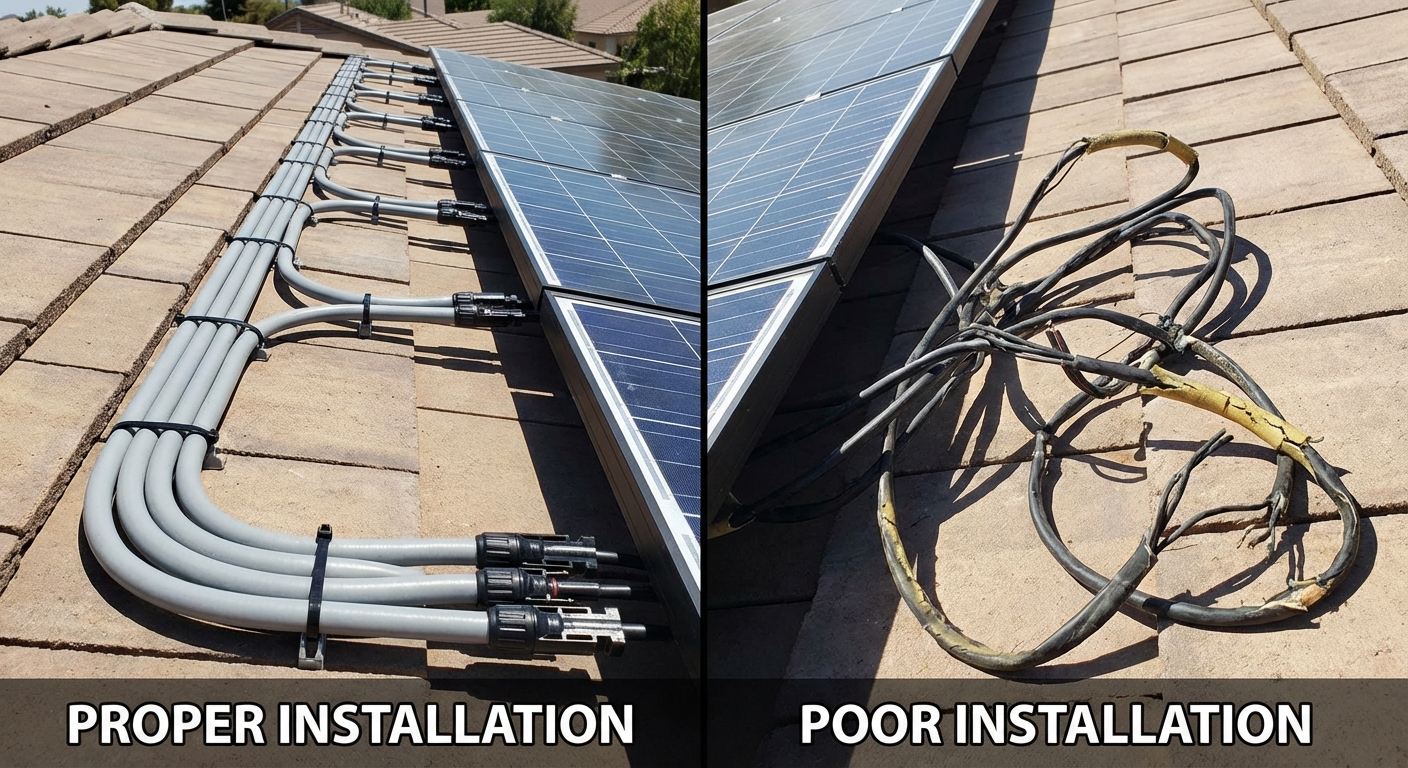
What Are the Most Common Solar Cable Installation Mistakes?
Even quality solar cables will underperform or fail if installed incorrectly. Understanding common mistakes helps you recognize proper installation practices and avoid problems that could compromise your system’s safety and efficiency.
Undersizing Cables
The most frequent and costly mistake is using cables that are too small for the current they must carry. This happens when installers try to cut costs or fail to properly calculate voltage drop for long cable runs.
Consequences of undersized cables include:
- Excessive voltage drop reducing system output by 5-10% or more
- Cable overheating that accelerates insulation degradation
- Potential fire hazards from overheated conductors
- Voided equipment warranties if manufacturer specifications aren’t met
- Failed electrical inspections
Professional solar EPC companies perform detailed calculations to ensure proper cable sizing. The small additional cost of correctly sized cables pays for itself many times over through improved energy production and system longevity.
Poor Connector Crimping and Termination
Solar systems use MC4 connectors to join cables between panels and to the inverter. These connectors must be properly crimped to create secure, low-resistance connections. Common termination mistakes include:
- Using pliers instead of proper crimping tools, creating weak connections
- Incorrect crimp depth that doesn’t fully compress the connector
- Mixing connector brands (MC4 connectors from different manufacturers may not be compatible)
- Failing to properly seat the cable in the connector before crimping
- Not using proper cable glands and strain relief
Poor connections create high-resistance points that heat up, waste energy, and can eventually fail completely. They’re also a common source of arc faults that can start fires. Quality installations use calibrated crimping tools and verify each connection.
Inadequate Cable Protection from UV and Weather
Even UV-resistant solar cables benefit from proper protection:
- Exposed cable runs: Cables should be secured to mounting structures with UV-resistant cable clips, not left hanging loose where they can be damaged by wind or abrasion
- Roof penetrations: Any point where cables enter the building must be properly sealed to prevent water intrusion
- Conduit protection: In areas where cables might be damaged (near walkways, edges, etc.), they should be run in conduit
- Sharp edges: Cable routes must avoid sharp metal edges that can cut through insulation over time due to thermal expansion and wind movement
In Gujarat’s climate, proper cable management is especially important. The combination of intense UV, high temperatures, monsoon rains, and occasional dust storms can stress cables. Professional installations account for these environmental factors.
Mixing Cable Types and Improper Routing
Other common installation errors include:
- Mixing DC and AC cables: DC and AC cables should be routed separately to avoid electromagnetic interference
- Excessive cable length: Using unnecessarily long cable runs increases voltage drop and costs. Optimal system design minimizes cable distances
- Sharp bends: Bending cables too sharply can damage conductors and insulation. Maintain minimum bend radius (typically 4x cable diameter)
- Cable bundling: Bundling too many cables together prevents heat dissipation and requires derating the current capacity
- No labeling: Cables should be labeled at both ends for troubleshooting and future maintenance
How Professional EPC Services Prevent These Errors
Working with experienced solar EPC providers like Heaven Green Energy eliminates these installation mistakes. Professional installations include:
- Detailed engineering drawings showing exact cable routes and specifications
- Proper tools and equipment for cable preparation and termination
- Trained technicians who follow industry best practices
- Quality control inspections at multiple stages
- Testing and commissioning to verify all connections before system activation
- Documentation of cable specifications and routing for future reference
With over 10,000 installations across Gujarat, Heaven Green Energy’s technical teams have refined installation procedures to ensure every cable connection meets the highest standards. This expertise is part of what makes us one of the top solar EPC companies in the region. Learn more about our comprehensive solar EPC services and how proper installation practices protect your investment.
How Long Do Solar Cables Last and What Affects Their Durability?
One of the most important questions about solar cables is longevity. Your solar panels are warranted for 25 years, and your inverter for 5-10 years. But what about the cables connecting everything together?
Expected Lifespan of Quality Solar Cables
Premium solar cables designed to international standards (TUV, UL, IEC) are engineered for a 25-year service life matching your solar panels. This longevity requires:
- UV-stabilized insulation that resists degradation from decades of sun exposure
- Temperature-resistant materials that maintain properties from -40°C to +90°C
- Moisture-resistant construction that prevents water ingress
- Tinned copper conductors that resist corrosion
However, this 25-year lifespan assumes proper installation and reasonable environmental conditions. Cables that are undersized, poorly installed, or exposed to extreme conditions may fail much sooner.
Environmental Factors in Gujarat
Gujarat’s climate presents specific challenges for solar cable durability:
Intense UV Radiation: Gujarat receives some of India’s highest solar irradiation levels, which is excellent for energy production but harsh on cable insulation. UV radiation breaks down polymer chains in insulation materials, causing them to become brittle and crack. Quality cables with proper UV stabilizers resist this degradation.
High Temperatures: Summer temperatures regularly exceed 45°C, and cables on dark rooftops can reach 70-80°C. These temperatures accelerate chemical degradation of insulation and increase conductor resistance. Cables must be rated for these temperature extremes.
Monsoon Moisture: Gujarat’s monsoon season brings heavy rainfall and high humidity. Water ingress into cable connections or damaged insulation can cause short circuits and corrosion. Proper sealing and water-resistant cable construction are essential.
Dust and Pollution: Airborne dust and industrial pollution can accumulate on cables and connections, potentially creating tracking paths for electrical leakage. Regular cleaning and proper cable routing minimize this risk.
Coastal Salt Air: In coastal areas like Surat, salt-laden air accelerates corrosion. Tinned copper conductors and sealed connections are especially important in these locations.
UV Degradation and Prevention
UV degradation is the primary threat to solar cable longevity. Signs of UV damage include:
- Visible cracking or crazing of the outer jacket
- Discoloration or fading of cable color
- Brittleness (cable doesn’t flex smoothly)
- Chalky residue on the cable surface
Prevention strategies include:
- Using cables specifically rated for outdoor solar applications with UV stabilizers
- Protecting cables with conduit in high-exposure areas
- Proper cable routing that minimizes direct sun exposure where possible
- Using cable clips and supports that don’t create stress points
Maintenance Practices to Extend Cable Life
While quality solar cables require minimal maintenance, these practices help ensure maximum longevity:
- Annual Visual Inspections: Check cables for visible damage, cracking, or discoloration during routine system maintenance
- Connection Checks: Verify that MC4 connectors remain fully seated and show no signs of overheating or corrosion
- Thermal Imaging: Professional maintenance includes thermal imaging to identify hot spots indicating poor connections or undersized cables
- Cleaning: Remove accumulated dust and debris from cables and connections
- Vegetation Control: Keep plants and trees trimmed away from cables to prevent abrasion and moisture retention
Heaven Green Energy includes cable inspection as part of our solar maintenance services throughout Gujarat. Regular professional maintenance catches small issues before they become major problems, protecting your system’s performance and safety.
When to Replace Cables in Existing Systems
Cable replacement becomes necessary when:
- Visible insulation damage (cracks, exposed conductors, severe discoloration)
- Thermal imaging reveals hot spots indicating high resistance
- System monitoring shows unexplained performance drops suggesting voltage drop issues
- Connections show signs of overheating or corrosion
- Cables were undersized in the original installation
If you have an older solar system with degraded cables, replacement is a worthwhile investment. New cables restore system efficiency and eliminate safety hazards. The cost of cable replacement is modest compared to the value of improved energy production and peace of mind.
Why Is Proper Cable Selection Critical for Solar System Performance?
By now, you understand that solar cables are far more than simple wires. They’re engineered components that significantly impact your solar system’s efficiency, safety, and return on investment. Let’s examine why proper cable selection deserves serious attention.
Impact on Energy Efficiency and System ROI
Cable losses directly reduce your solar system’s energy production. Consider a typical 5 kW residential system in Gujarat:
With properly sized cables (3% voltage drop or less), the system produces approximately 7,500 kWh annually. With undersized cables causing 6% voltage drop, annual production drops to about 7,050 kWh. That’s 450 kWh lost every year.
At Gujarat’s average electricity rate of ₹7 per kWh, those cable losses cost ₹3,150 annually. Over 25 years, that’s ₹78,750 in lost savings, not accounting for electricity rate increases. The difference in cable cost between proper and undersized cables? Perhaps ₹3,000-5,000 initially.
This calculation doesn’t even include the reduced lifespan and increased maintenance costs of undersized cables. Proper cable selection pays for itself many times over through improved system performance and faster payback periods.
Safety Implications
Safety is paramount in any electrical installation, but solar systems present unique challenges:
- High DC Voltages: Solar arrays can produce 600-1000V DC, which is more dangerous than household AC and can sustain arcs
- Outdoor Exposure: Cables face weather, UV, and physical damage risks
- Fire Hazards: Undersized cables or poor connections can overheat and ignite
- Shock Hazards: Damaged insulation can expose live conductors
Quality cables with proper certifications have been tested to ensure they won’t create these hazards under normal operating conditions. Substandard cables may work initially but degrade quickly, creating dangerous situations.
In commercial and industrial installations, safety becomes even more critical. A cable failure that causes a fire could result in property damage, business interruption, liability issues, and even injuries. The modest cost of quality cables is insignificant compared to these potential consequences.
Warranty Considerations and Manufacturer Requirements
Most solar equipment manufacturers specify minimum cable requirements in their installation manuals. Using cables that don’t meet these specifications can void your equipment warranties.
For example, inverter manufacturers typically specify:
- Minimum cable sizes based on distance and current
- Maximum voltage drop limits
- Required cable certifications (TUV, UL, etc.)
- Proper connector types and installation methods
If your inverter fails and the manufacturer discovers that improper cables were used, they may deny warranty coverage. This could cost thousands in replacement equipment. Using specified cables protects your warranty coverage.
Similarly, solar panel manufacturers may require specific cable types and installation methods. Professional EPC companies ensure all components meet manufacturer specifications to preserve warranty coverage.
Long-Term Cost Savings from Quality Cable Investment
The total cost of ownership calculation clearly favors quality cables:
Initial Cost Difference: Quality certified solar cables cost approximately 30-50% more than basic cables. For a typical 5 kW residential system, this might mean ₹8,000 for quality cables versus ₹5,000 for basic cables, a difference of ₹3,000.
Energy Production Gains: Properly sized quality cables improve energy production by 3-5%, worth ₹5,000-8,000 over 25 years.
Avoided Replacement Costs: Quality cables last 25+ years, while substandard cables may need replacement after 10-15 years, costing ₹5,000-8,000 plus labor.
Reduced Maintenance: Quality cables require minimal maintenance, while degraded cables need more frequent inspections and repairs.
Safety and Liability: The value of avoiding fire hazards, electrical faults, and potential liability is difficult to quantify but substantial.
The total 25-year benefit of quality cables easily exceeds ₹15,000-20,000 compared to the ₹3,000 initial cost difference. This represents a 500-600% return on the cable quality investment alone.
How Heaven Green Energy Ensures Proper Cable Selection
At Heaven Green Energy, cable selection is an integral part of our engineering process for every project across Gujarat:
- Detailed System Design: Our engineers calculate exact cable requirements based on system size, layout, and environmental conditions
- Quality Sourcing: We work with reputable manufacturers and verify certifications for all cables
- Proper Sizing: Cable sizes are calculated to ensure voltage drop remains under 3% for optimal efficiency
- Climate Considerations: We specify cables rated for Gujarat’s temperature extremes and UV exposure
- Professional Installation: Our trained technicians use proper tools and techniques for cable routing and termination
- Quality Control: Multiple inspection points ensure cables meet specifications and are properly installed
- Documentation: Complete cable specifications and routing diagrams are provided for future reference
This comprehensive approach to cable selection and installation is one reason Heaven Green Energy has completed over 10,000 successful solar installations. We understand that every component matters, and we never compromise on quality for short-term cost savings.
Whether you’re planning a residential rooftop system, a commercial installation, or a large ground-mounted solar park, our team ensures your project uses the right cables for optimal performance, safety, and longevity. We also offer a complete range of quality solar products including modules, inverters, and all necessary accessories.
Solar Cables FAQ: Quick Answers to Your Top Questions
Let’s address some additional common questions about solar cables that homeowners and businesses in Gujarat frequently ask.
Can I Use Regular Electrical Cables for Solar Installations?
No, standard household electrical cables are not suitable for solar DC connections. Regular cables lack the UV resistance, temperature rating, and weather protection required for outdoor solar applications. They will degrade quickly when exposed to sunlight and weather, creating safety hazards and system failures.
Standard electrical cables can be used for AC connections between the inverter and your electrical panel, provided they meet electrical code requirements for size and type. However, all DC connections from panels to inverter must use proper solar-rated cables.
What’s the Difference Between Solar DC Cable Colors?
Solar DC cables typically come in two colors:
- Red cables: Used for positive (+) DC connections
- Black cables: Used for negative (-) DC connections
This color coding helps installers maintain correct polarity throughout the system and makes troubleshooting easier. Some systems also use blue cables for negative connections. The color itself doesn’t affect electrical performance, but consistent color coding is important for safety and maintenance.
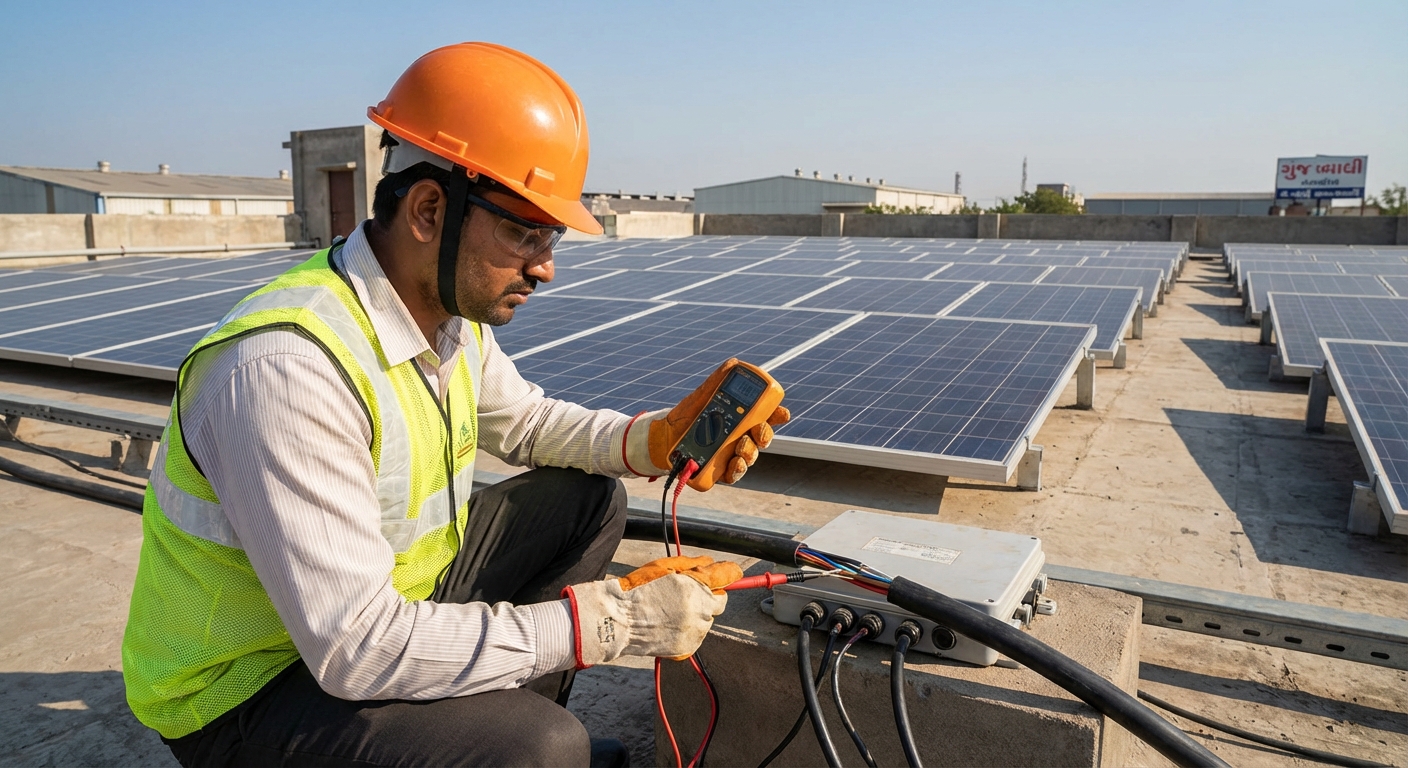
Always verify polarity with a multimeter rather than relying solely on cable color, as mistakes can happen during installation.
Do I Need Different Cables for Rooftop vs Ground-Mounted Systems?
The fundamental cable requirements are the same for both rooftop and ground-mounted systems, they must be UV-resistant, properly sized, and certified for solar applications. However, there are some practical differences:
Rooftop Systems:
- Typically use shorter cable runs, reducing voltage drop concerns
- Cables are exposed to maximum UV and temperature extremes on dark rooftops
- Cable routing must account for roof penetrations and weatherproofing
- May require conduit protection in areas with foot traffic
Ground-Mounted Systems:
- Often involve longer cable runs requiring larger conductor sizes
- Cables may be buried in trenches, requiring direct burial rated cables or conduit
- Lower UV exposure if cables are shaded by panels or buried
- May require additional protection from rodents and physical damage
Professional system design accounts for these differences and specifies appropriate cables for each application.
How Do I Calculate Voltage Drop in Solar Cables?
Voltage drop calculation requires knowing the cable length, conductor size, current, and conductor resistance. The basic formula is:
Voltage Drop = 2 × Length × Current × Resistance
Where:
- Length is one-way cable distance in meters
- Current is the maximum current in amperes
- Resistance is the conductor resistance per meter (from cable specifications)
- The factor of 2 accounts for both positive and negative conductors
For example, a 30-meter cable run carrying 20 amps using 6mm² copper cable (resistance 0.00315 Ω/m):
Voltage Drop = 2 × 30 × 20 × 0.00315 = 3.78 volts
For a 48V system, this represents 7.9% voltage drop, which is too high. Upgrading to 10mm² cable (resistance 0.00189 Ω/m) reduces voltage drop to 2.27 volts or 4.7%, which is better but still above the 3% target.
Professional solar designers use specialized software that accounts for temperature derating, installation method, and other factors to ensure accurate calculations. This is why working with experienced EPC providers is valuable, they have the tools and expertise to optimize cable sizing.
Are Expensive Solar Cables Worth the Investment?
Absolutely. The price difference between quality certified solar cables and basic cables is modest compared to the total system cost, but the performance and safety benefits are substantial.
Consider that cables represent only 2-3% of total system cost. Spending an extra 1% on quality cables provides:
- 3-5% improvement in energy production over system lifetime
- 25-year lifespan versus 10-15 years for substandard cables
- Maintained equipment warranties
- Reduced fire and safety risks
- Lower maintenance requirements
- Better resale value for your property
The return on investment for quality cables is among the highest of any system component. This is not an area where cost-cutting makes financial sense.
What Cable Accessories Do I Need for a Complete Installation?
A complete solar cable installation requires several accessories beyond the cables themselves:
- MC4 Connectors: Industry-standard connectors for joining cables between panels and to the inverter
- Cable Clips and Ties: UV-resistant clips to secure cables to mounting rails and structures
- Cable Glands: Weatherproof glands for cable entry into junction boxes and inverters
- Conduit: PVC or metal conduit for protecting cables in exposed areas
- Junction Boxes: Weatherproof boxes for cable connections and transitions
- Cable Labels: UV-resistant labels for identifying cables
- Heat Shrink Tubing: For additional protection at connection points
- Crimping Tools: Proper tools for installing MC4 connectors
Professional installations include all necessary accessories as part of the complete system. When Heaven Green Energy provides a project quote, it includes all cables, connectors, and accessories required for a complete, code-compliant installation.
Making the Right Choice for Your Solar Investment
Understanding solar cables and their critical role in system performance empowers you to make informed decisions about your solar investment. Whether you’re planning a residential rooftop system in Surat, a commercial installation in Ahmedabad, or an industrial solar project in Junagadh, the cables connecting your system deserve careful attention.
Quality solar cables that meet international standards, are properly sized for your application, and are professionally installed will deliver 25+ years of safe, efficient operation. The modest additional investment in quality cables pays for itself many times over through improved energy production, reduced maintenance, and peace of mind.
Conversely, cutting corners on cable quality or installation is false economy. Substandard cables waste energy, create safety hazards, void equipment warranties, and require premature replacement. The few thousand rupees saved initially can cost tens of thousands over your system’s lifetime.
At Heaven Green Energy, we’ve completed over 10,000 solar installations across Gujarat, and we’ve learned that attention to every detail, including cable selection and installation, separates good solar systems from great ones. Our engineering team specifies the right cables for each project’s unique requirements, and our trained technicians install them to the highest standards.
When you choose Heaven Green Energy for your solar project, you’re choosing a partner committed to quality, safety, and long-term performance. We don’t compromise on components like cables because we know they’re essential to your system’s success. Our comprehensive EPC services cover every aspect of your solar installation, from initial design through commissioning and ongoing maintenance.
Ready to discuss your solar project and ensure it’s built with quality components throughout? Our team is here to answer your questions and provide expert guidance on solar cables, system design, and everything else you need for a successful solar installation in Gujarat.
Have questions about solar cables or planning a solar installation? Contact Heaven Green Energy today. Call us at +91 63904 05060 to speak with our solar experts. We’ll help you understand exactly what your project needs and provide a detailed proposal that includes quality cables and professional installation. Let’s build a solar system that delivers optimal performance and safety for decades to come.
This blog post was written using thestacc.com