


If you’ve invested in solar panels or are considering making the switch to solar energy in Gujarat, understanding solar net metering is essential to maximizing your returns. Solar net metering is a billing mechanism that allows you to sell excess electricity generated by your solar panels back to the grid, earning credits that offset your future electricity consumption. This comprehensive guide answers all your questions about how solar net metering works, eligibility requirements, the application process, and how you can optimize your solar investment in 2026.
For homeowners and businesses across Gujarat, solar net metering transforms your rooftop solar system from a simple energy-saving tool into a revenue-generating asset. Whether you’re in Surat, Ahmedabad, or Junagadh, understanding the net metering process helps you make informed decisions about system sizing, equipment selection, and energy management strategies.
What is Solar Net Metering and How Does It Work?
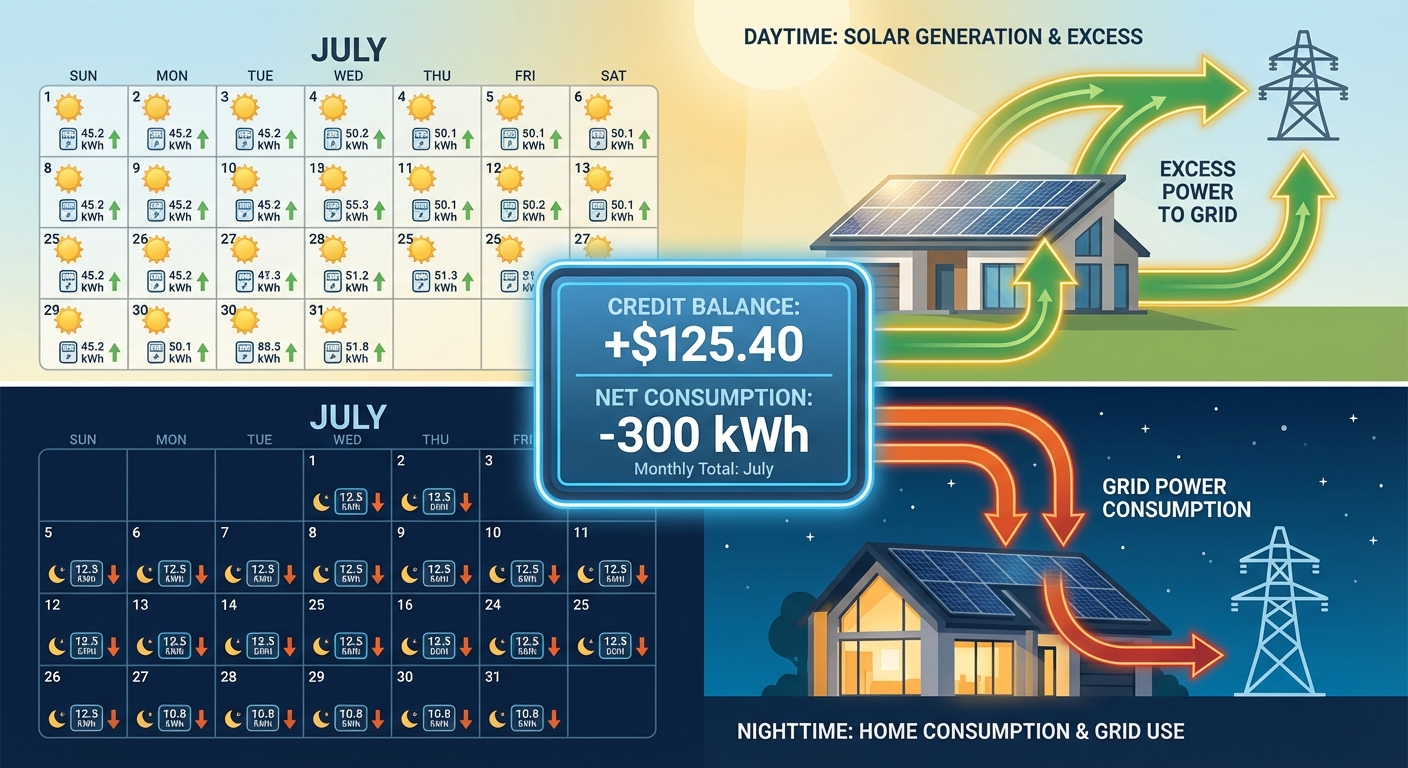
Solar net metering is a billing arrangement between solar system owners and electricity distribution companies (discoms) that allows you to receive credits for the excess solar power you generate and export to the grid. When your solar panels produce more electricity than your home or business consumes, the surplus energy flows back into the utility grid through a bidirectional meter.

The bidirectional meter is the heart of the solar net metering system. Unlike traditional electricity meters that only measure consumption, a net metering meter tracks both the electricity you draw from the grid and the excess solar power you export. This two-way measurement creates an accurate accounting of your net energy consumption.
Here’s how the process works in practice:
- Daytime Generation: When the sun is shining, your solar panels generate electricity. Your home or business uses what it needs immediately, and any excess power automatically flows back to the grid.
- Credit Accumulation: For every unit (kWh) of excess electricity you export, you receive an energy credit at the same rate you would pay for consuming grid electricity.
- Nighttime Consumption: When your solar panels aren’t generating power (at night or during cloudy weather), you draw electricity from the grid as usual.
- Net Billing: At the end of your billing cycle, the discom calculates your net consumption by subtracting the units you exported from the units you imported. You only pay for the net electricity consumed.
For Gujarat residents and businesses, solar net metering offers significant financial benefits. The state’s abundant sunshine and supportive regulatory framework make it an ideal location for maximizing solar returns. By participating in net metering, you can reduce your electricity bills by 70-90% and achieve faster payback on your solar investment.
Who is Eligible for Solar Net Metering in Gujarat?
Understanding eligibility criteria is the first step toward implementing solar net metering for your property. In Gujarat, the Gujarat Urja Vikas Nigam Limited (GUVNL) and local distribution companies have established clear guidelines for net metering participation.
Residential Eligibility
Homeowners in Gujarat can apply for solar net metering if they meet these requirements:
- You must own the property or have written consent from the property owner
- Your solar system capacity should not exceed your sanctioned load or 1 MW, whichever is lower
- The solar installation must comply with Central Electricity Authority (CEA) technical standards
- Your property must have an active electricity connection with the local discom
- The solar system must be installed by a registered solar EPC company with proper certifications
Commercial and Industrial Eligibility
Businesses, factories, and industrial facilities have similar eligibility requirements with some additional considerations:
- System capacity limits typically range up to 1 MW for most commercial establishments
- Industrial consumers may be eligible for higher capacity limits based on their sanctioned load
- Three-phase connections are standard for commercial and industrial solar net metering
- Additional safety and grid protection equipment may be required for larger installations
- Compliance with state pollution control and building regulations is mandatory
Grid Connectivity Requirements: Your property must be connected to the distribution network with adequate infrastructure to support bidirectional power flow. In most urban and semi-urban areas of Gujarat, the grid infrastructure is well-developed and ready for solar net metering integration. Rural areas may require additional assessment by the local discom.
The GUVNL has made solar net metering increasingly accessible in 2026, with streamlined approval processes and expanded capacity limits. Whether you’re a homeowner looking to reduce electricity bills or an industrial facility seeking to lower operational costs, the eligibility criteria are designed to encourage widespread solar adoption across Gujarat.
How Does the Solar Net Metering Billing Process Work?
Understanding the solar net metering billing process helps you track your savings and optimize your energy consumption patterns. The billing mechanism is designed to be transparent and straightforward, ensuring you receive fair credit for the solar power you generate.
Monthly Billing Cycle
Your solar net metering billing follows a monthly cycle, similar to your regular electricity bill. However, the calculation method differs significantly:
Import Units: These are the units of electricity you consume from the grid when your solar panels aren’t generating enough power to meet your needs. This typically happens at night, during early morning hours, or on cloudy days.
Export Units: These are the units of excess solar electricity your system sends back to the grid. This usually occurs during peak sunshine hours when your solar generation exceeds your immediate consumption.
Net Consumption: At the end of the billing period, the discom calculates your net consumption using this formula: Net Consumption = Import Units – Export Units. You are billed only for the net units consumed.
Credit Calculation and Application
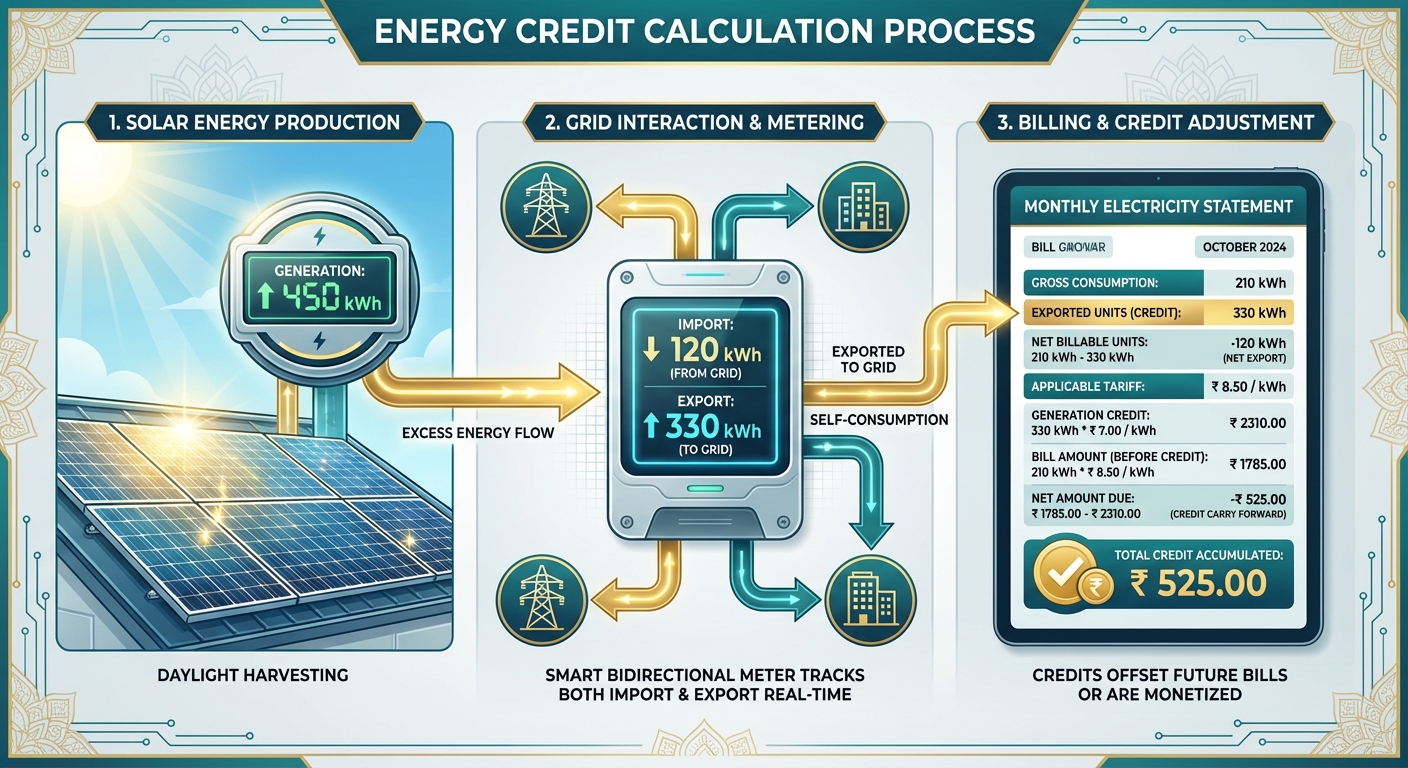
In Gujarat’s solar net metering system, credits are calculated on a unit-for-unit basis. For every kilowatt-hour (kWh) you export to the grid, you receive a credit equivalent to one kWh of consumption. This credit is valued at the same retail tariff rate you pay for grid electricity, making it a highly favorable arrangement for solar system owners.
The credits are automatically applied to your monthly bill. If you generate more than you consume in a particular month, the excess credits typically carry forward to the next billing cycle. This carryforward provision is especially beneficial during high-generation months when your solar system produces surplus energy.
Annual Settlement Process
At the end of the financial year or a 12-month settlement period, any remaining accumulated credits are reconciled. The settlement process varies by discom, but generally follows these principles:
- If you have consumed more than you generated over the year, you pay for the net consumption at applicable tariff rates
- If you have generated more than you consumed, the treatment of excess credits depends on your discom’s policy
- Some discoms may compensate excess generation at a predetermined rate, while others may allow limited carryforward to the next year
- The settlement ensures a fair accounting of your annual energy balance
Reading Your Net Metering Bill
Your solar net metering bill will include several key components:
- Previous and current meter readings for both import and export
- Total units imported from the grid during the billing period
- Total units exported to the grid during the billing period
- Net consumption (import minus export)
- Applicable tariff charges for net consumption
- Fixed charges (which apply regardless of net consumption)
- Taxes and duties as per state regulations
Most discoms in Gujarat have modernized their billing systems to clearly display solar net metering information, making it easy for consumers to track their solar savings and energy patterns.
What is the Application Process for Net Metering?
Applying for solar net metering in Gujarat involves a systematic process that ensures your solar installation meets all technical and regulatory requirements. Working with an experienced solar EPC company can significantly streamline this process and ensure timely approval.
Step-by-Step Application Procedure
Step 1: System Design and Feasibility Assessment
Before applying for net metering, conduct a thorough assessment of your energy consumption patterns and available rooftop space. A professional solar EPC provider will analyze your electricity bills, evaluate your roof structure, and design a system optimized for your needs. This preliminary step ensures your proposed system capacity aligns with your consumption and eligibility criteria.
Step 2: Submit Net Metering Application
Submit your net metering application to your local electricity distribution company. In Gujarat, this can often be done online through the discom’s portal or in person at their office. The application requires basic information about your property, existing electricity connection, and proposed solar system specifications.
Step 3: Provide Required Documentation
Along with your application, you’ll need to submit several documents:
- Copy of your electricity bill and connection details
- Property ownership documents or consent letter from the owner
- Technical specifications of the proposed solar system (modules, inverters, capacity)
- Single-line diagram (SLD) of the solar installation
- Structural stability certificate for rooftop installations
- Electrical safety and compliance certificates
- Registration certificate of your solar EPC contractor
Step 4: Technical Feasibility Approval
The discom will review your application and conduct a technical feasibility study. This assessment evaluates whether the local grid infrastructure can support bidirectional power flow from your location. In most established areas of Gujarat, this approval is straightforward and takes 7-15 days.
Step 5: Install the Solar System
Once you receive technical feasibility approval, proceed with the solar installation. Your solar EPC company will handle the complete installation, including mounting structures, solar panels, inverters, and all electrical connections. The installation must comply with all approved specifications and safety standards.
Step 6: Net Metering Inspection
After installation, the discom will conduct an inspection to verify that your solar system meets all technical and safety requirements. The inspection covers proper grounding, isolation mechanisms, grid protection devices, and overall system quality. Any deficiencies identified must be corrected before final approval.
Step 7: Bidirectional Meter Installation
Upon successful inspection, the discom will replace your existing electricity meter with a bidirectional net meter. This meter installation is typically completed within 7-10 days of inspection approval. The new meter will track both your consumption from the grid and your export to the grid.
Step 8: Net Metering Agreement and Commissioning
Finally, you’ll sign a net metering agreement with the discom that outlines the terms and conditions of your participation in the net metering program. Once the agreement is executed and the system is commissioned, you can start generating solar power and earning credits for excess generation.
Timeline and Approval Process
The entire solar net metering application and approval process in Gujarat typically takes 30-60 days from application submission to final commissioning. However, this timeline can vary based on several factors:
- Completeness and accuracy of your application documents
- Local discom workload and processing capacity
- Technical complexity of your installation
- Grid infrastructure availability in your area
- Efficiency of your solar EPC contractor in coordinating with authorities
Experienced solar companies in Gujarat have established relationships with local discoms and understand the approval process thoroughly, which can significantly reduce delays and ensure smooth implementation.
How Are Net Metering Credits Calculated?
Understanding how solar net metering credits are calculated helps you maximize the financial benefits of your solar investment. The credit calculation system in Gujarat is designed to be fair and transparent, rewarding solar system owners for their contribution to clean energy generation.
Unit-for-Unit Credit System
Gujarat follows a gross metering or net metering approach where credits are calculated on a unit-for-unit basis. This means that for every kilowatt-hour (kWh) of electricity you export to the grid, you receive a credit for one kWh of consumption. This is one of the most favorable credit systems for solar consumers because the credit value equals the retail electricity rate you would otherwise pay.
For example, if your retail electricity tariff is ₹7 per unit and you export 100 units to the grid, you receive credits worth ₹700. These credits can then offset 100 units of future consumption at the same ₹7 per unit rate.
Time-of-Day Considerations
In most residential and small commercial solar net metering arrangements in Gujarat, credits are calculated at a flat rate regardless of the time of day you export or import electricity. This simplifies the billing process and makes it easier for consumers to understand their savings.
However, some large commercial and industrial consumers may be subject to time-of-day (TOD) tariffs, where electricity rates vary based on peak, off-peak, and normal hours. In such cases, the credit value for exported electricity may also vary based on when the export occurs. It’s important to understand your specific tariff structure when evaluating your solar net metering benefits.
Credit Valuation and Rates
The value of your solar net metering credits is directly tied to your electricity tariff slab. In Gujarat, residential electricity tariffs are structured in slabs based on monthly consumption:
- Lower consumption slabs have lower per-unit rates
- Higher consumption slabs have progressively higher per-unit rates
- Commercial and industrial tariffs are typically higher than residential rates
This slab structure means that solar net metering is particularly beneficial for high-consumption households and businesses. By reducing your net consumption through solar generation, you not only save on the units consumed but may also move to a lower tariff slab, compounding your savings.
Carryforward Rules and Expiration
When you generate more solar electricity than you consume in a billing month, the excess credits typically carry forward to subsequent months. This carryforward provision is crucial for maximizing your solar investment returns, especially considering seasonal variations in solar generation and consumption patterns.
Key carryforward rules in Gujarat:
- Monthly excess credits automatically roll over to the next billing cycle
- Credits can accumulate over multiple months within the settlement period
- At the end of the annual settlement period (usually 12 months), any remaining excess credits are reconciled
- The treatment of year-end excess credits varies by discom policy
- Some discoms may compensate excess annual generation at a predetermined rate, while others may reset the credit balance
Maximizing Your Credit Earnings
To optimize your solar net metering credits and maximize returns, consider these strategies:
Right-Size Your System: Design your solar system capacity to match your annual electricity consumption rather than oversizing significantly. While generating excess power provides credits, the year-end settlement may not fully compensate for large annual surpluses at retail rates.
Optimize Consumption Patterns: Where possible, shift high-energy activities to daytime hours when your solar panels are generating power. This maximizes self-consumption and reduces your reliance on grid electricity during expensive evening peak hours.
Monitor Generation and Consumption: Use solar monitoring systems to track your generation patterns and consumption trends. This data helps you identify opportunities to improve energy efficiency and maximize credit accumulation.
Plan for Seasonal Variations: Gujarat experiences seasonal variations in solar generation, with higher output during summer months and lower output during monsoon. Understanding these patterns helps you manage your energy consumption and credit utilization throughout the year.
By understanding the credit calculation mechanism and implementing smart energy management practices, you can significantly enhance the financial returns from your solar investment. Many Gujarat homeowners and businesses report electricity bill savings of 70-90% through effective solar net metering participation.
What Are the Key Policy Updates for Solar Net Metering in 2026?
The solar net metering landscape in Gujarat continues to evolve with new policies and regulations designed to promote renewable energy adoption while ensuring grid stability. Staying informed about these policy updates helps you make strategic decisions about your solar investment.
Recent Regulatory Changes in Gujarat
In 2026, Gujarat has maintained its position as one of India’s most solar-friendly states with several progressive policy measures:
Streamlined Approval Process: The Gujarat Electricity Regulatory Commission (GERC) has further simplified the net metering application and approval process, reducing bureaucratic delays. Online application portals now offer end-to-end tracking, and approval timelines have been standardized across all discoms in the state.
Expanded Capacity Limits: The capacity limits for solar net metering have been revised to encourage larger installations. Residential consumers can now install systems up to their sanctioned load or 1 MW, whichever is lower, while commercial and industrial consumers have access to higher capacity limits based on their consumption patterns.
Virtual Net Metering Provisions: Some areas in Gujarat are piloting virtual net metering programs that allow consumers to install solar systems at locations different from their consumption point. This is particularly beneficial for apartment complexes and businesses with multiple locations.
Updated Tariff Structures
Electricity tariffs in Gujarat are periodically revised by GERC to reflect the cost of power supply and policy objectives. In 2026, the tariff structure continues to favor solar adoption:
- Retail tariff rates remain higher than solar generation costs, ensuring attractive payback periods for solar investments
- Fixed charges and demand charges apply regardless of net consumption, which should be factored into your solar ROI calculations
- Time-of-day tariffs for large consumers create opportunities for strategic energy management
- Cross-subsidy surcharges and additional charges are clearly defined in net metering agreements
Government Incentives and Subsidies
Gujarat offers several incentive programs to promote solar adoption alongside net metering:
Central Government Subsidies: Residential consumers can access subsidies under the national rooftop solar program, which provides financial support for solar installations up to certain capacity limits. These subsidies can reduce your upfront investment by 20-40%, significantly improving your solar payback period.
State-Level Incentives: Gujarat offers additional incentives for solar adoption, including accelerated depreciation benefits for commercial and industrial installations, exemptions from certain electricity duties, and priority grid connectivity for solar projects.
PM-KUSUM Integration: The Pradhan Mantri Kisan Urja Suraksha evam Utthaan Mahabhiyaan (PM-KUSUM) scheme continues to support agricultural solar installations with net metering provisions. Farmers can install solar pumps and ground-mounted systems with net metering benefits, reducing their agricultural electricity costs.
Grid Integration and Technical Standards
As solar adoption increases, Gujarat has updated technical standards to ensure grid stability and safety:
- Enhanced grid protection requirements for solar inverters, including anti-islanding protection and voltage/frequency ride-through capabilities
- Mandatory use of certified equipment that meets Bureau of Indian Standards (BIS) specifications
- Regular maintenance and safety inspection requirements for net-metered solar systems
- Smart meter integration for better monitoring and management of distributed solar generation
Future Outlook for Net Metering Policies
Looking ahead, Gujarat’s solar net metering policies are expected to continue evolving in response to increasing solar penetration and grid management needs. Potential future developments include:
- Introduction of dynamic net metering tariffs that reflect real-time grid conditions
- Enhanced integration with battery storage systems for better energy management
- Expansion of group net metering and community solar programs
- Increased focus on solar quality standards and performance monitoring
- Alignment with national renewable energy targets and carbon reduction commitments
For consumers considering solar investments in 2026, the policy environment in Gujarat remains highly favorable. The combination of supportive net metering regulations, attractive subsidies, and high electricity tariffs creates compelling economics for solar adoption across residential, commercial, and industrial segments.
How Can You Maximize Returns from Solar Net Metering?
Maximizing your returns from solar net metering requires strategic planning, quality equipment selection, and ongoing system optimization. By implementing best practices, you can significantly enhance your solar investment’s financial performance and achieve faster payback.

Optimal System Sizing for Your Consumption
The foundation of maximizing solar net metering returns is proper system sizing. Your solar installation should be designed to match your annual electricity consumption patterns rather than simply maximizing rooftop coverage.
Analyze Your Consumption Data: Review at least 12 months of electricity bills to understand your consumption patterns, seasonal variations, and peak usage periods. This analysis helps determine the ideal system capacity that will maximize self-consumption and credit utilization without excessive annual surplus.
Account for Future Growth: Consider anticipated changes in your electricity consumption, such as adding new appliances, expanding business operations, or purchasing an electric vehicle. Building in 10-20% capacity buffer can accommodate future growth without requiring system expansion.
Balance Cost and Returns: While larger systems generate more electricity, they also require higher upfront investment. Work with your solar EPC provider to identify the optimal system size that delivers the best return on investment based on your specific consumption profile and available budget.
Energy Consumption Pattern Optimization
Smart energy management can significantly enhance your solar net metering benefits:
Shift Loads to Daytime: Whenever possible, schedule energy-intensive activities during peak solar generation hours (10 AM to 4 PM). This includes running washing machines, dishwashers, water heaters, and industrial equipment during daytime to maximize self-consumption.
Reduce Evening Peak Consumption: Evening hours (6 PM to 10 PM) typically see peak electricity demand and higher tariff rates for some consumers. By reducing consumption during these hours and relying on daytime solar generation, you can maximize your net metering savings.
Implement Energy Efficiency Measures: Combine your solar installation with energy efficiency improvements such as LED lighting, efficient air conditioning, and insulation. Lower overall consumption means your solar system can offset a larger percentage of your electricity needs.
Quality Equipment Selection
The performance and longevity of your solar system directly impact your net metering returns. Investing in quality equipment ensures maximum generation and minimal maintenance costs over the system’s 25-year lifespan.
Choose Reliable Solar Modules: Select solar panels from reputable manufacturers with proven track records and strong warranties. High-efficiency modules may cost more upfront but generate more electricity per square meter, maximizing your limited rooftop space. Consider top solar brands available in Gujarat that offer the best combination of efficiency, durability, and warranty coverage.
Invest in Quality Inverters: The solar inverter is the heart of your system, converting DC power from panels to AC power for your home or business. Choose inverters with high efficiency ratings (above 97%), robust warranty coverage, and proven reliability in Gujarat’s climate conditions.
Ensure Proper Installation: Work with experienced and certified solar EPC companies that follow industry best practices for installation. Proper mounting, wiring, earthing, and safety measures ensure optimal system performance and longevity.
Regular Maintenance for Maximum Generation
Consistent maintenance is essential for sustaining peak solar generation and maximizing your net metering credits:
- Panel Cleaning: Dust, bird droppings, and pollution can reduce solar panel efficiency by 15-25%. Regular cleaning (monthly during dry seasons, bi-monthly during monsoon) maintains optimal generation levels.
- Performance Monitoring: Install monitoring systems that track real-time generation, consumption, and system health. Early detection of performance issues prevents prolonged generation losses.
- Annual Inspections: Conduct comprehensive annual inspections covering electrical connections, mounting structure integrity, inverter performance, and safety systems. Professional maintenance services identify and address potential issues before they impact generation.
- Vegetation Management: Trim trees and vegetation that may cast shadows on your solar panels, especially as they grow over time. Even partial shading can significantly reduce system output.
Monitoring and Tracking Your Solar ROI
Systematic tracking of your solar system’s performance and financial returns helps you optimize operations and validate your investment decision:
Track Key Metrics: Monitor daily generation, monthly export/import units, credit accumulation, and net electricity costs. Compare actual performance against projected values to identify any underperformance issues.
Calculate Actual Savings: Regularly calculate your actual electricity bill savings by comparing current bills with pre-solar consumption costs. Factor in any fixed charges and taxes that apply regardless of net consumption.
Assess Payback Progress: Track your cumulative savings against your initial investment to monitor payback progress. Most well-designed solar systems in Gujarat achieve payback within 4-6 years, after which they generate essentially free electricity for the remaining system life.
Document System Performance: Maintain records of generation data, maintenance activities, and any issues encountered. This documentation is valuable for warranty claims, system troubleshooting, and demonstrating solar benefits to others.
By implementing these optimization strategies, Gujarat homeowners and businesses can maximize their solar net metering returns, achieving electricity bill savings of 70-90% and payback periods of 4-6 years. The combination of abundant sunshine, supportive policies, and quality solar solutions makes Gujarat an ideal location for solar investments in 2026.
Common Solar Net Metering Questions Answered
As you consider solar net metering for your home or business, you likely have specific questions about how the system works in practice. Here are answers to the most frequently asked questions about solar net metering in Gujarat.
What happens during power outages?
Standard grid-tied solar systems with net metering automatically shut down during power outages for safety reasons. This anti-islanding protection prevents your solar system from feeding electricity into the grid while utility workers are repairing lines, which could create dangerous conditions.
If you want backup power during outages, you have two options: install a hybrid solar system with battery storage, or add a separate backup inverter with islanding capability. Battery-based systems can provide power to critical loads during outages while maintaining net metering benefits when the grid is operational.
Can I upgrade my system later?
Yes, you can upgrade your solar system capacity after initial installation, but you’ll need to follow the proper procedures. System upgrades require submitting a revised net metering application to your discom, providing updated technical specifications, and potentially replacing your net meter if the capacity increase is significant.
However, it’s generally more cost-effective to install the optimal system size from the beginning rather than upgrading later. System expansions involve additional approval processes, potential structural modifications, and may not integrate seamlessly with existing equipment. Proper initial sizing based on your long-term consumption needs is the best approach.
How long does net metering approval take?
In Gujarat, the complete solar net metering approval process typically takes 30-60 days from application submission to final commissioning. This timeline includes technical feasibility approval (7-15 days), system installation (7-21 days depending on system size), inspection scheduling (7-14 days), and net meter installation (7-10 days).
Working with an experienced solar EPC company can significantly reduce this timeline. Established companies have streamlined processes, maintain good relationships with local discoms, and ensure all documentation is complete and accurate, minimizing delays and back-and-forth communications.
What if I generate more than I consume annually?
If your solar system generates more electricity than you consume over the annual settlement period, the treatment of excess credits depends on your discom’s specific policy. In most cases in Gujarat, excess annual generation beyond your consumption may be compensated at a predetermined rate, which is typically lower than the retail tariff rate.
This is why proper system sizing is crucial. While generating surplus power provides some benefit, the year-end settlement may not fully compensate for large annual excesses at retail rates. Design your system to match your annual consumption for optimal financial returns.
Do I need special insurance?
While not legally mandatory, obtaining insurance for your solar system is highly recommended. Solar installations represent significant investments (typically ₹50,000 to ₹5,00,000 or more depending on system size), and insurance protects against various risks including fire, theft, natural disasters, and equipment failure.
Many solar EPC companies offer insurance packages as part of their turnkey solutions, or can recommend appropriate coverage options. Insurance premiums are relatively modest (typically 0.5-1% of system value annually) and provide valuable peace of mind for your long-term investment.
How does net metering affect solar payback period?
Solar net metering significantly improves your solar payback period by ensuring you receive full retail value for every unit of excess electricity you generate. Without net metering, excess generation would be wasted or compensated at much lower rates, extending your payback period considerably.
In Gujarat, well-designed solar systems with net metering typically achieve payback within 4-6 years for residential installations and 3-5 years for commercial and industrial installations. After payback, your solar system continues generating essentially free electricity for the remaining 20+ years of its operational life, delivering substantial long-term returns.
The combination of high electricity tariffs, abundant sunshine, government subsidies, and favorable net metering policies makes Gujarat one of the most attractive markets for solar investments in India. By understanding the net metering process and implementing best practices, you can maximize your solar returns and contribute to a cleaner energy future.
Start Your Solar Net Metering Journey Today
Solar net metering transforms your rooftop into a revenue-generating asset while reducing your carbon footprint and electricity costs. Whether you’re a homeowner looking to cut electricity bills or a business seeking to reduce operational expenses, solar net metering offers compelling financial and environmental benefits in Gujarat’s favorable policy environment.
The key to maximizing your solar net metering returns lies in proper planning, quality equipment selection, and working with experienced professionals who understand the local regulatory landscape. From initial system design and net metering application to installation, commissioning, and ongoing maintenance, every step requires expertise and attention to detail.
Heaven Green Energy Limited has been helping homeowners and businesses across Gujarat harness solar power since 2017. With over 10,000 installations and recognition as one of the top solar EPC companies in Gujarat, we provide end-to-end solar solutions including system design, net metering application support, quality equipment supply, professional installation, and comprehensive maintenance services.
Our team understands the nuances of solar net metering regulations in Gujarat and works closely with local discoms to ensure smooth approval processes and timely commissioning. We help you navigate every step of your solar journey, from initial feasibility assessment to long-term performance optimization, ensuring you achieve maximum returns from your solar investment.
Ready to start saving with solar net metering? Our solar experts are here to answer your questions, assess your property’s solar potential, and design a customized solution that maximizes your electricity bill savings. Have Any Questions? +91 63904 05060
Take the first step toward energy independence and substantial electricity savings. Contact Heaven Green Energy today to schedule your free solar consultation and discover how solar net metering can transform your energy costs in 2026 and beyond.
This blog post was written using thestacc.com