


Understanding Solar Savings: What You Need to Know
If you’re considering solar energy for your home or business in Gujarat, the most important question on your mind is likely: “How much money will I actually save?” The answer to calculating your solar savings isn’t just a simple number—it’s a comprehensive understanding of your energy consumption, system design, electricity rates, and long-term financial benefits.
Solar savings represent the difference between what you currently pay for grid electricity and what you’ll pay after installing a solar energy system. For homeowners and businesses across Gujarat, these savings can be substantial. With electricity rates continuing to rise and solar technology becoming more affordable, 2026 presents an ideal time to evaluate the financial benefits of going solar.
Gujarat enjoys some of India’s best solar irradiation levels, with an average of 5.5 to 6.0 peak sun hours daily. This natural advantage means solar panels installed in Surat, Ahmedabad, or Junagadh generate more electricity compared to many other regions, directly translating to higher solar savings. Heaven Green Energy Limited has completed over 10,000 installations across Gujarat since 2017, helping residential, commercial, and industrial customers reduce their electricity bills significantly.
Net metering policies in Gujarat allow you to export excess solar energy back to the grid, earning credits that offset your electricity consumption during non-solar hours. This mechanism is crucial for maximizing your solar savings and achieving faster payback periods. Understanding how to calculate these savings accurately will help you make an informed investment decision.
1. Calculate Your Current Electricity Consumption
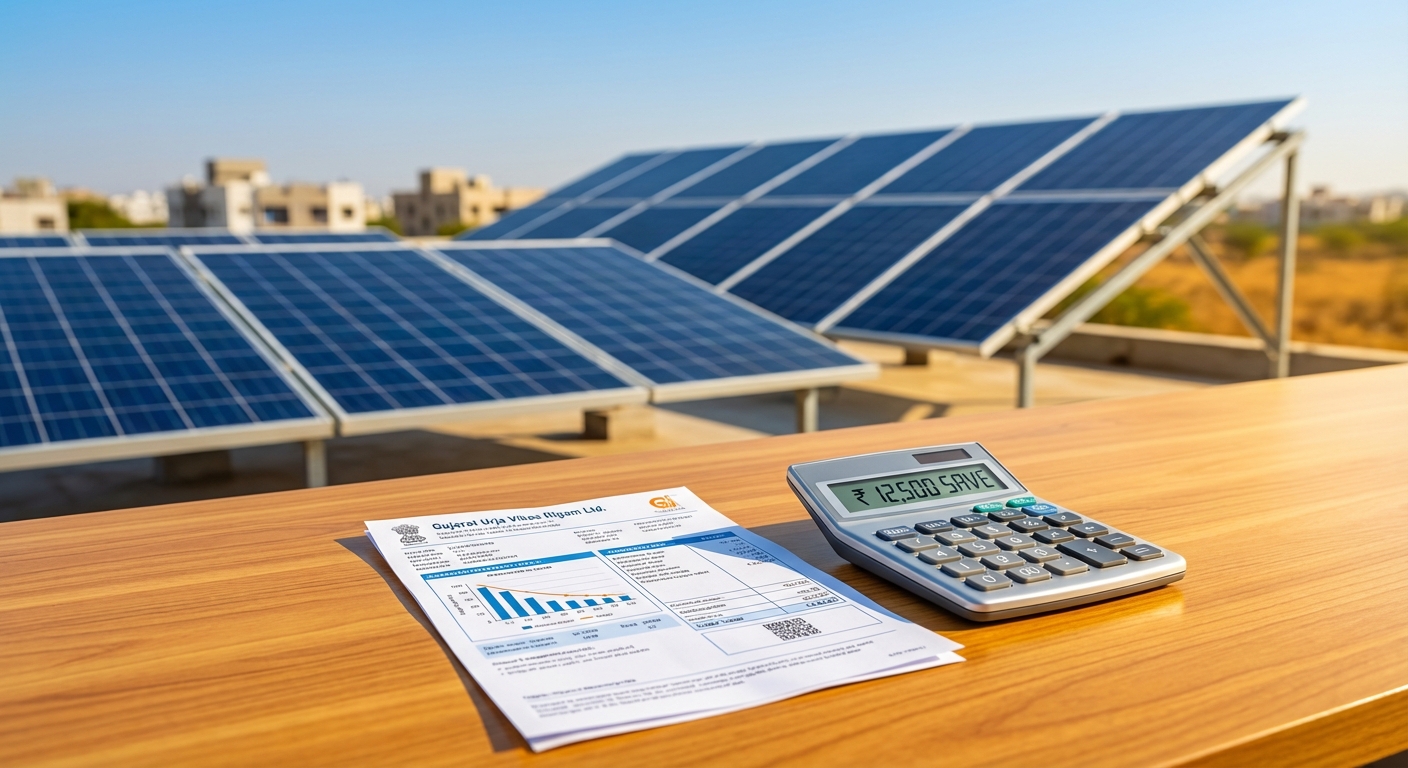
The foundation of calculating your solar savings starts with understanding exactly how much electricity you consume. Your monthly electricity bill contains all the information you need to begin this assessment.
Look for the “units consumed” section on your Gujarat electricity bill, which shows your consumption in kilowatt-hours (kWh). For residential properties in Gujarat, average monthly consumption typically ranges from 200 kWh for smaller homes to 800 kWh or more for larger properties with air conditioning. Commercial establishments often consume 1,500 to 5,000 kWh monthly, while industrial facilities may use 10,000 kWh or significantly more.
Track your consumption over at least six months to identify patterns. Gujarat’s climate creates seasonal variations—summer months (March through June) typically show higher consumption due to cooling needs, while winter months see reduced usage. This seasonal pattern affects how you’ll calculate your annual solar savings.
Here’s what to document from your electricity bills:
- Monthly units consumed (kWh) for the past 12 months
- Peak consumption months to understand your maximum demand
- Average daily consumption calculated by dividing monthly units by 30
- Load pattern—whether consumption is primarily daytime or evening
- Connected load in kilowatts, which indicates your sanctioned capacity
For businesses, understanding your consumption pattern is especially important. If your operations run primarily during daylight hours, you’ll achieve higher solar savings through direct self-consumption rather than relying on net metering credits. Industrial facilities with 24/7 operations can still benefit significantly, but the calculation methodology differs slightly.
2. Determine Your Solar System Size Requirements
Once you understand your electricity consumption, the next step in calculating solar savings is determining the appropriate system size. The goal is to match your solar system capacity to your energy needs without significant oversizing, which would increase upfront costs without proportional benefits.
Solar system size is measured in kilowatts (kW) of installed capacity. A general rule of thumb for Gujarat: a 1 kW solar system generates approximately 4.5 to 5.0 units (kWh) of electricity daily, or about 135 to 150 units monthly. This generation estimate accounts for Gujarat’s excellent solar irradiation and typical system efficiency.
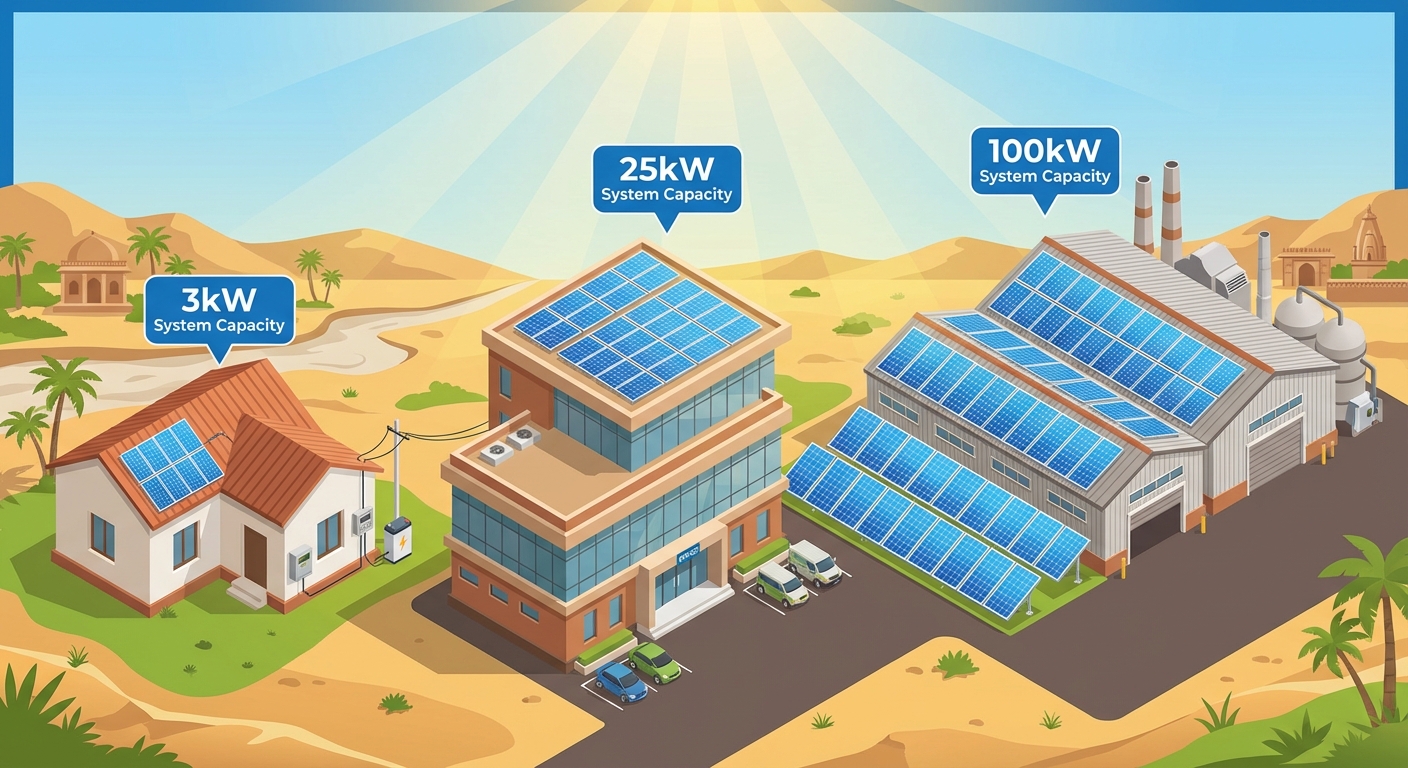
Here are typical system sizes for different property types:
Residential Solar System Sizes
- 3 kW system: Suitable for homes consuming 400-450 units monthly, generates approximately 13-15 units daily
- 5 kW system: Ideal for homes consuming 650-750 units monthly, generates approximately 22-25 units daily
- 10 kW system: For larger homes consuming 1,300-1,500 units monthly, generates approximately 45-50 units daily
Commercial and Industrial Solar Systems
Commercial establishments typically require 25 kW to 100 kW systems, while industrial facilities often install 100 kW to several megawatts. Heaven Green Energy specializes in turnkey solar EPC solutions for large-scale projects, handling everything from design to commissioning.
When determining system size, consider your roof space availability. In Gujarat, a 1 kW solar system requires approximately 100 square feet of shadow-free roof area. South-facing roofs with minimal shading provide optimal generation, directly impacting your solar savings potential.
It’s important not to oversize your system beyond your sanctioned load or consumption needs. While larger systems generate more electricity, Gujarat’s net metering policies have specific guidelines about system sizing relative to your sanctioned load. Working with experienced EPC providers ensures your system is optimally sized for maximum solar savings.
3. Factor in Electricity Rates and Tariff Structure
Understanding your current electricity rates is crucial for calculating accurate solar savings. Gujarat’s electricity tariff structure varies based on consumer category, consumption slabs, and time of use.
As of 2026, residential electricity rates in Gujarat typically range from ₹3.50 to ₹7.50 per unit, depending on consumption slabs. The tariff structure is progressive, higher consumption results in higher per-unit rates. This progressive structure means solar installations provide greater savings for higher-consumption households.
Commercial and industrial tariff rates are generally higher, ranging from ₹6.00 to ₹9.50 per unit, making solar savings even more attractive for businesses. Industrial consumers often face additional demand charges based on their maximum demand, which solar installations can help reduce.
Here’s why electricity rates matter for your solar savings calculation:
- Current rate baseline: Your savings equal the units generated multiplied by your current electricity rate
- Rate escalation: Electricity rates typically increase 5-7% annually, while solar generation costs remain fixed after installation
- Slab benefits: Solar energy reduces your grid consumption, potentially moving you to lower tariff slabs
- Peak rate avoidance: For time-of-day tariffs, solar generation during peak hours provides maximum savings
Consider this example: If you currently pay ₹6.00 per unit and install a 5 kW system generating 700 units monthly, your immediate monthly solar savings would be approximately ₹4,200. Over 25 years, accounting for 6% annual electricity rate increases, your cumulative savings would exceed ₹25 lakhs.
The widening gap between rising grid electricity costs and fixed solar costs is what makes solar energy such a compelling financial investment. Every year, your solar savings increase as grid rates climb while your solar system continues generating at the same cost.
4. Calculate Solar Energy Generation Potential
Accurately estimating how much electricity your solar system will generate is essential for calculating realistic solar savings. Generation depends on several factors, with location being paramount, and Gujarat offers excellent conditions.
Gujarat receives an average of 5.5 to 6.0 peak sun hours daily, among the highest in India. This means a 1 kW solar system in Gujarat generates approximately 4.5 to 5.0 units (kWh) daily, or 1,600 to 1,800 units annually. These figures account for real-world conditions including panel efficiency, inverter losses, temperature effects, and soiling.
Generation varies seasonally in Gujarat. Summer months (March to June) provide peak generation with longer days and intense sunlight, while monsoon months (July to September) see reduced generation due to cloud cover. Winter months offer moderate generation with shorter days but cooler temperatures that improve panel efficiency.
Factors Affecting Your Solar Generation
- Panel orientation: South-facing panels generate maximum electricity in Gujarat; east-west orientations reduce generation by 10-15%
- Tilt angle: Optimal tilt for Gujarat is 20-23 degrees, matching the latitude for year-round performance
- Shading: Even partial shading can significantly reduce generation; shadow-free installation is critical
- Panel quality: High-efficiency panels from reputable solar brands maintain better performance over time
- Soiling losses: Dust accumulation in Gujarat’s climate can reduce generation by 5-8% without regular cleaning
Heaven Green Energy conducts detailed site assessments using solar design software to provide accurate generation estimates for your specific location. These assessments consider your roof characteristics, local weather patterns, and shading analysis to calculate precise solar savings potential.
For a 5 kW residential system in Surat with optimal conditions, you can expect annual generation of approximately 8,000 to 8,500 units. A 50 kW commercial system in Ahmedabad would generate approximately 80,000 to 85,000 units annually. These generation figures form the basis of your solar savings calculations.
5. Account for Net Metering and Grid Benefits
Net metering is a critical component of maximizing your solar savings in Gujarat. This policy allows you to export excess solar energy to the grid when your generation exceeds consumption, earning credits that offset your electricity bills during non-solar hours.
Here’s how net metering works in Gujarat: When your solar system generates more electricity than you’re consuming, the excess flows to the grid and your meter runs backward (or records export separately with bi-directional meters). These exported units are credited to your account at the same rate you pay for grid electricity, providing full value for your solar generation.
Net metering is especially valuable for residential consumers whose peak consumption often occurs in the evening when solar generation has stopped. The credits earned during daytime generation offset evening consumption, allowing you to achieve high solar savings even without battery storage.
Maximizing Net Metering Benefits
To optimize your solar savings through net metering, consider these strategies:
- Self-consumption optimization: Running high-consumption appliances during solar hours maximizes direct savings
- System sizing: Size your system to match annual consumption rather than peak monthly demand
- Load shifting: Schedule washing machines, water heaters, and other flexible loads during daytime
- Monitoring: Track generation and consumption patterns to identify optimization opportunities
For commercial and industrial consumers, self-consumption rates are typically higher due to daytime operations. A factory running during business hours might achieve 70-80% self-consumption, with only 20-30% exported to the grid. This high self-consumption translates to immediate solar savings without relying on net metering credits.
Gujarat’s net metering policies are among the most favorable in India, with straightforward application processes and clear guidelines. Heaven Green Energy handles all net metering applications and approvals as part of our comprehensive EPC services, ensuring you can start realizing solar savings without administrative hassles.
6. Include Solar Subsidies and Incentives
Government subsidies and incentives significantly enhance your solar savings by reducing upfront investment costs and improving return on investment. Understanding available schemes is essential for accurate financial calculations.
As of 2026, the Central Government continues to offer subsidies for residential rooftop solar installations under the national solar program. Residential consumers can receive subsidies of ₹14,588 per kW for systems up to 3 kW, and ₹7,294 per kW for additional capacity between 3 kW and 10 kW. For a 5 kW residential system, this translates to approximately ₹58,352 in direct subsidy, substantially reducing your payback period.
Key Solar Incentive Programs in Gujarat
- Residential rooftop subsidy: Central government subsidy reducing upfront costs by 20-40% for eligible systems
- PM-KUSUM scheme: Subsidies for agricultural solar pumps and grid-connected agricultural solar systems
- Accelerated depreciation: Commercial and industrial consumers can claim 40% depreciation in the first year, providing significant tax benefits
- GST benefits: Solar systems attract 5% GST, lower than many other capital investments
- State incentives: Gujarat periodically announces additional incentives for solar adoption
For agricultural consumers, the PM-KUSUM scheme offers substantial support. Component B of the scheme provides 60% subsidy (30% from central government, 30% from state government) for grid-connected solar systems, with farmers contributing only 10% and the remaining 30% available through financing. Heaven Green Energy has extensive experience implementing PM-KUSUM projects across Gujarat.
Commercial and industrial consumers benefit primarily through accelerated depreciation rather than direct subsidies. A business installing a 100 kW solar system can claim depreciation benefits worth several lakhs in the first year, improving cash flow and enhancing overall solar savings.
When calculating your solar savings, subtract applicable subsidies from your total system cost to determine your actual investment. This reduced investment amount is what you’ll use for payback period and return on investment calculations. To learn more about how subsidies affect your financial returns, explore our guide on solar payback periods.
7. Calculate Your Monthly and Annual Solar Savings
Now that you understand all the components, let’s walk through the actual calculation of your solar savings. This step-by-step methodology will help you estimate both immediate and long-term financial benefits.
Solar Savings Calculation Formula
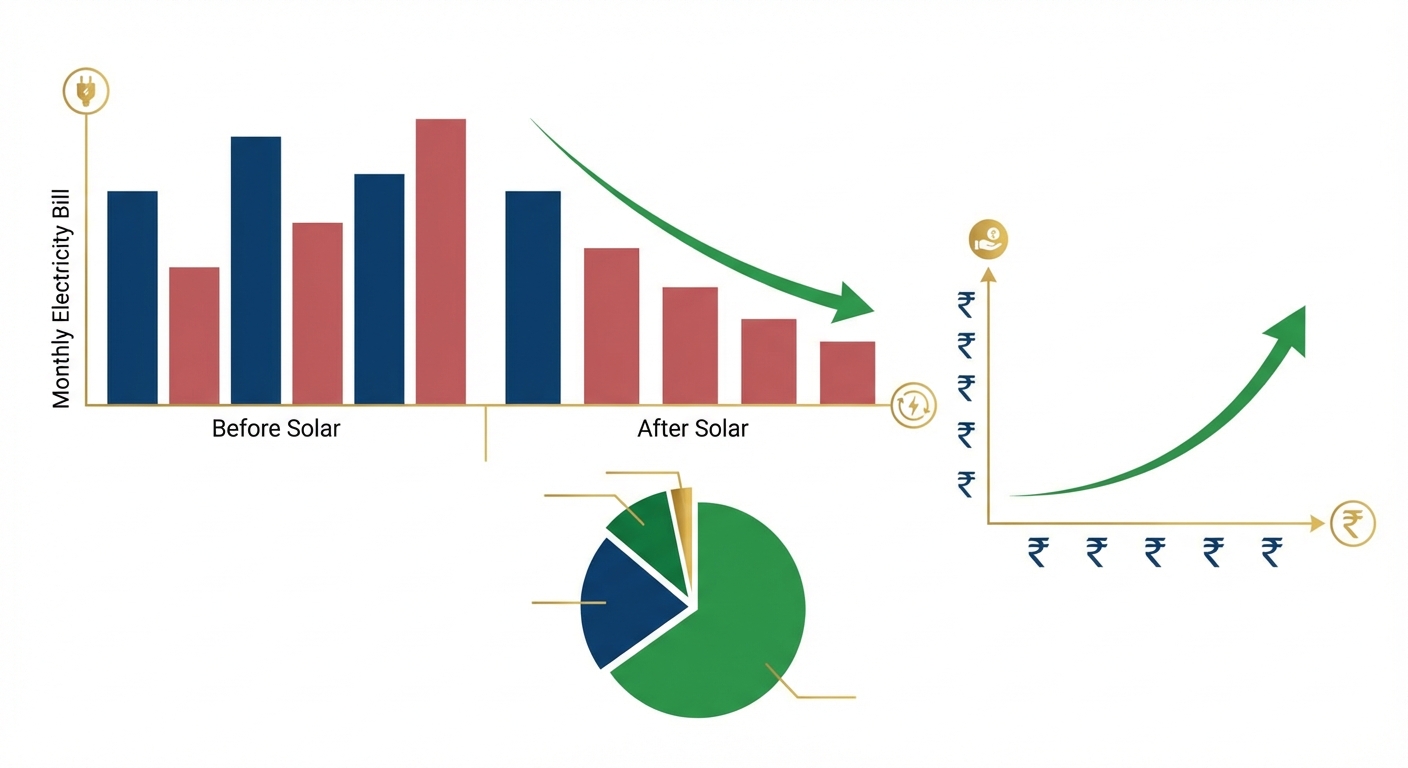
The basic formula for calculating monthly solar savings is:
Monthly Solar Savings = (Solar Units Generated × Electricity Rate) – Monthly System Cost
For systems purchased outright without financing, the monthly system cost after the initial investment is minimal (primarily maintenance). For financed systems, include your monthly loan payment in the calculation.
Real Example: 5 kW Residential System in Surat
Let’s calculate solar savings for a typical residential installation:
- System size: 5 kW rooftop solar system
- System cost: ₹2,50,000 (before subsidy)
- Subsidy received: ₹58,352
- Net investment: ₹1,91,648
- Monthly generation: 700 units (average across the year)
- Current electricity rate: ₹6.00 per unit (average)
- Self-consumption: 60% (420 units used directly, 280 units exported)
Monthly solar savings calculation:
Direct savings from self-consumption: 420 units × ₹6.00 = ₹2,520
Net metering credits: 280 units × ₹6.00 = ₹1,680
Total monthly solar savings: ₹4,200
Annual solar savings: ₹50,400
With a net investment of ₹1,91,648 and annual savings of ₹50,400, the simple payback period is approximately 3.8 years. After this point, the system generates pure savings for the remaining 20+ years of its operational life.
Real Example: 50 kW Commercial System in Ahmedabad
For a commercial installation, the numbers scale significantly:
- System size: 50 kW rooftop solar system
- System cost: ₹22,00,000 (no subsidy for commercial)
- Monthly generation: 7,000 units (average)
- Commercial electricity rate: ₹8.00 per unit (average)
- Self-consumption: 75% (5,250 units used directly, 1,750 units exported)
Monthly solar savings calculation:
Direct savings from self-consumption: 5,250 units × ₹8.00 = ₹42,000
Net metering credits: 1,750 units × ₹8.00 = ₹14,000
Total monthly solar savings: ₹56,000
Annual solar savings: ₹6,72,000
For this commercial system, the payback period is approximately 3.3 years. Additionally, the business benefits from accelerated depreciation tax advantages, further improving the financial returns.
25-Year Lifetime Solar Savings Projection
Solar panels typically come with 25-year performance warranties, and systems often operate effectively for 30+ years. To calculate lifetime solar savings, account for:
- Annual electricity rate increases: Typically 5-7% per year
- Panel degradation: Approximately 0.5% annual reduction in generation
- Inverter replacement: One replacement around year 12-15 (₹40,000-₹80,000 depending on size)
- Maintenance costs: Approximately ₹3,000-₹5,000 annually for residential systems
For the 5 kW residential system example above, 25-year cumulative solar savings would exceed ₹28 lakhs, accounting for rising electricity rates and system maintenance. The commercial 50 kW system would generate cumulative savings exceeding ₹3.5 crores over the same period.
These calculations demonstrate why solar energy represents one of the most attractive financial investments available to Gujarat homeowners and businesses in 2026.
Factors That Impact Your Solar Savings
While the calculations above provide a framework, several factors can significantly influence your actual solar savings. Understanding these variables helps you optimize your investment and set realistic expectations.
System Quality and Component Selection
The quality of solar panels, inverters, and mounting structures directly affects both generation and longevity. Premium components may cost 10-15% more upfront but deliver 15-20% better performance over the system’s lifetime. High-efficiency panels maintain better output in Gujarat’s hot climate, while quality inverters ensure minimal conversion losses.
Heaven Green Energy partners with leading solar brands to ensure optimal performance and reliability. We offer solar modules, inverters, and complete system packages that balance cost-effectiveness with long-term solar savings potential.
Installation Quality and Maintenance
Professional installation is critical for maximizing solar savings. Poor installation can result in shading issues, suboptimal tilt angles, electrical losses, and safety concerns. Working with experienced EPC providers ensures your system is designed and installed for maximum generation.
Regular maintenance preserves your solar savings over time. In Gujarat’s dusty climate, panel cleaning every 2-3 weeks during dry months can improve generation by 5-8%. Annual system inspections identify potential issues before they impact performance. Heaven Green Energy provides comprehensive maintenance services across Gujarat to protect your investment.
Consumption Pattern Optimization
Your electricity consumption patterns significantly affect solar savings. Households and businesses that shift high-consumption activities to solar hours achieve better returns through direct self-consumption rather than relying on net metering.
Simple changes like running washing machines, dishwashers, and water heaters during midday can increase self-consumption from 50% to 70%, directly improving your solar savings. For businesses, aligning production schedules with solar generation hours maximizes financial benefits.
Panel Degradation and Long-Term Performance
Solar panels gradually lose efficiency over time, typically degrading at 0.5% annually for quality modules. This means a system generating 700 units monthly in year one will generate approximately 665 units monthly in year 25. While this affects long-term solar savings, the impact is modest compared to rising electricity rates.
Quality panels with strong warranties minimize degradation concerns. Heaven Green Energy installs panels with 25-year performance warranties, ensuring predictable generation and solar savings throughout the system’s life.
Real Solar Savings Examples from Gujarat
Real-world case studies provide the most compelling evidence of solar savings potential. Here are actual examples from Heaven Green Energy installations across Gujarat.
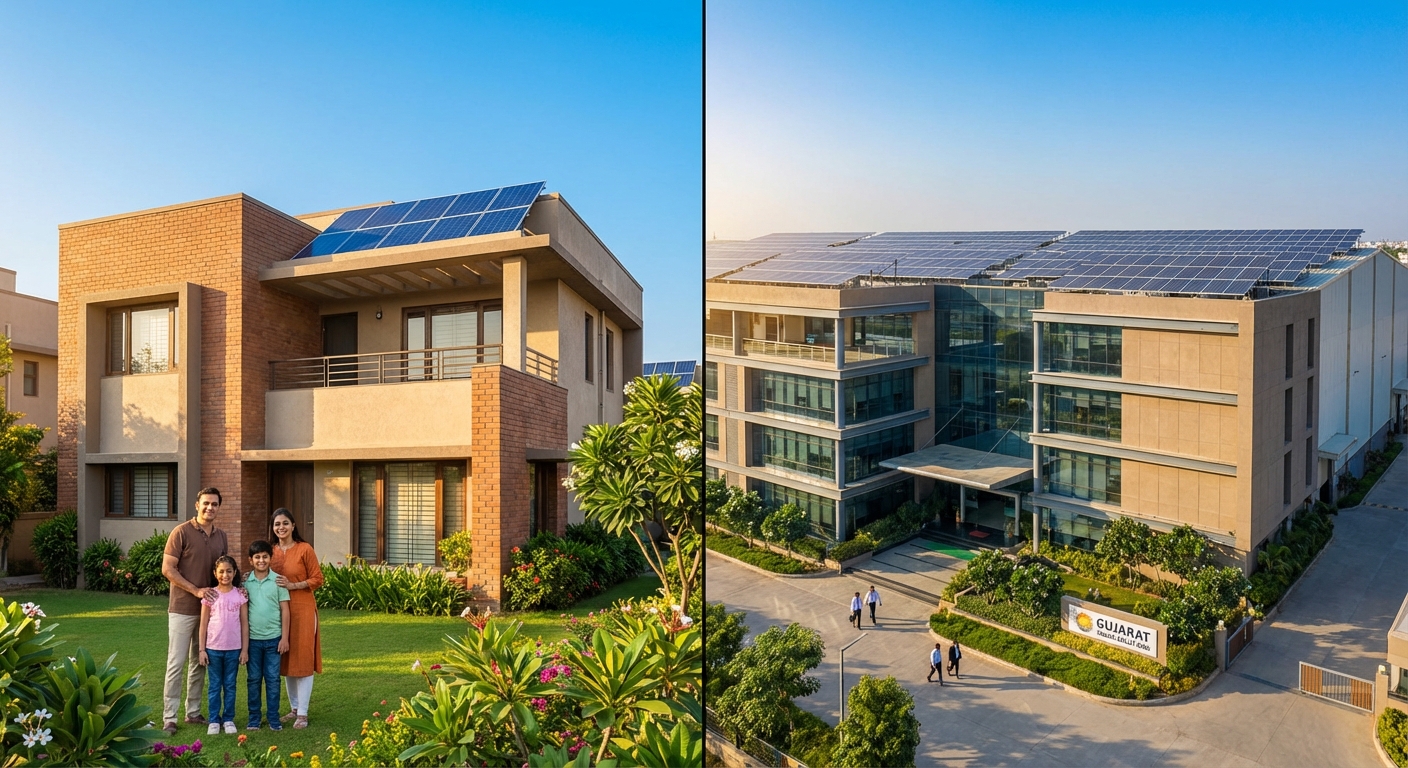
Residential Case Study: Surat Homeowner
A residential customer in Surat installed a 7 kW system in early 2024. Their pre-solar monthly electricity bills averaged ₹6,800, consuming approximately 950 units monthly. After installation:
- System generates: 980 units monthly (average)
- Post-solar electricity bill: ₹450 monthly (fixed charges and minimal grid consumption)
- Monthly solar savings: ₹6,350
- Annual solar savings: ₹76,200
- System cost (after subsidy): ₹2,68,000
- Payback period: 3.5 years
This homeowner is on track to save over ₹32 lakhs over 25 years, with the system already paid for itself by 2027. The family reports satisfaction not just with financial savings but also with energy independence during grid outages.
Commercial Case Study: Ahmedabad Manufacturing Unit
A small manufacturing unit in Ahmedabad installed a 75 kW solar system in 2023. Their pre-solar monthly electricity costs averaged ₹1,15,000, with consumption of approximately 13,500 units monthly. Post-installation results:
- System generates: 10,500 units monthly (average)
- Self-consumption rate: 82% (operations run during daylight hours)
- Post-solar electricity bill: ₹32,000 monthly
- Monthly solar savings: ₹83,000
- Annual solar savings: ₹9,96,000
- System cost: ₹33,00,000
- Payback period: 3.3 years
Additionally, this business claimed accelerated depreciation benefits worth approximately ₹13 lakhs in the first year, further improving their return on investment. The predictable energy costs have helped them better manage operational budgets and improve competitiveness.
Industrial Case Study: Junagadh Processing Facility
A food processing facility in Junagadh installed a 250 kW ground-mounted solar system in 2022. This large-scale installation demonstrates solar savings potential for industrial consumers:
- System generates: 35,000 units monthly (average)
- Pre-solar monthly electricity cost: ₹3,85,000
- Post-solar monthly electricity cost: ₹1,12,000
- Monthly solar savings: ₹2,73,000
- Annual solar savings: ₹32,76,000
- System cost: ₹1,10,00,000
- Payback period: 3.4 years
This facility is projected to save over ₹14 crores over 25 years. The solar installation has also improved their sustainability credentials, helping them meet corporate environmental goals and appeal to environmentally conscious customers.
These real examples demonstrate that solar savings are not theoretical, they’re tangible, measurable, and substantial across all consumer categories in Gujarat.
Maximizing Your Solar Savings: Expert Tips
To ensure you achieve the maximum possible solar savings, follow these expert recommendations from Heaven Green Energy’s decade of experience in Gujarat’s solar market.
Choose Quality Components and Reputable Brands
While budget systems may seem attractive, quality components deliver superior long-term solar savings. Invest in Tier 1 solar panels with strong performance warranties, reliable inverters from established manufacturers, and corrosion-resistant mounting structures suitable for Gujarat’s coastal climate. The 10-15% premium for quality components typically returns 20-30% better lifetime value.
Right-Size Your System
Avoid both undersizing and oversizing. An undersized system leaves solar savings potential unrealized, while an oversized system increases upfront costs without proportional benefits due to net metering limitations. Professional site assessment and consumption analysis ensure optimal sizing for maximum solar savings.
Prioritize Professional Installation
Installation quality affects generation, safety, and longevity. Work with experienced EPC providers who understand Gujarat’s specific conditions, from monsoon waterproofing to dust mitigation strategies. Heaven Green Energy’s certified installation teams ensure every system is optimized for maximum performance and solar savings.
Implement Regular Maintenance
Maintenance directly protects your solar savings. Establish a cleaning schedule appropriate for your location, more frequent during dry, dusty periods. Annual professional inspections identify issues early, preventing generation losses. Budget approximately ₹3,000-₹5,000 annually for residential maintenance, which is minimal compared to the solar savings protected.
Optimize Your Consumption Patterns
Maximize self-consumption by shifting flexible loads to solar hours. Program water heaters to run during midday, schedule washing machines and dishwashers for afternoon operation, and run pool pumps during peak solar generation. These simple changes can improve your solar savings by 15-20% through increased direct consumption.
Monitor System Performance
Modern inverters and monitoring systems provide real-time generation data. Regular monitoring helps you identify performance issues quickly and verify that you’re achieving expected solar savings. Many systems offer smartphone apps that let you track generation, consumption, and savings from anywhere.
Plan for Long-Term Ownership
Solar systems deliver maximum savings over 25+ years. While payback typically occurs in 3-5 years, the subsequent 20+ years generate pure savings. Maintain your system properly, plan for inverter replacement around year 12-15, and enjoy decades of reduced electricity costs.
Start Calculating Your Solar Savings Today
Understanding your potential solar savings is the first step toward energy independence and long-term financial benefits. As we’ve explored throughout this comprehensive guide, calculating solar savings involves understanding your consumption, determining appropriate system size, factoring in electricity rates and generation potential, accounting for net metering benefits, and including available subsidies.
For homeowners and businesses across Gujarat, 2026 presents an ideal time to invest in solar energy. Electricity rates continue rising while solar technology costs have stabilized, creating a widening savings gap that makes solar increasingly attractive. Government subsidies and favorable net metering policies further enhance the financial proposition.
The real-world examples from Surat, Ahmedabad, and Junagadh demonstrate that solar savings are substantial and achievable across all consumer categories. Whether you’re a homeowner looking to reduce monthly bills by ₹4,000-₹6,000, a commercial establishment seeking ₹50,000-₹80,000 in monthly savings, or an industrial facility targeting lakhs in monthly cost reduction, solar energy delivers measurable financial returns.
Heaven Green Energy Limited has helped thousands of Gujarat customers realize their solar savings potential since 2017. As one of the top three EPC companies in Gujarat, we provide comprehensive turnkey solutions, from initial site assessment and accurate savings calculations through system design, installation, net metering approvals, and ongoing maintenance. Our expertise ensures you achieve the maximum possible solar savings from your investment.
The calculation methodology outlined in this guide provides a framework for estimating your solar savings, but every property is unique. Factors like roof characteristics, shading conditions, consumption patterns, and specific electricity tariffs all influence your actual savings potential. Professional assessment ensures accurate projections tailored to your specific situation.
Don’t let another month of high electricity bills pass without exploring your solar savings potential. The sooner you install solar, the sooner you start saving, and every month of delay represents lost savings that you’ll never recover. With payback periods of just 3-5 years and system lifespans exceeding 25 years, solar energy represents one of the most attractive investments available in 2026.
Ready to calculate your exact solar savings and take the first step toward energy independence? Heaven Green Energy offers free site assessments and detailed savings projections for residential, commercial, and industrial properties across Gujarat. Our team will analyze your electricity consumption, evaluate your property, and provide accurate calculations of your monthly and lifetime solar savings potential.
Contact Heaven Green Energy today to discover how much you can save with solar. Have any questions? Call us at +91 63904 05060 to speak with our solar experts. Whether you’re in Surat, Ahmedabad, Junagadh, or anywhere across Gujarat, we’re ready to help you start your solar savings journey. With over 10,000 successful installations and comprehensive EPC services, we’ll ensure your solar system delivers maximum savings for decades to come.
Your solar savings calculator for 2026 starts with a single call. Let’s calculate your savings potential and design a system that transforms your electricity bills into long-term financial benefits.
This blog post was written using thestacc.com