


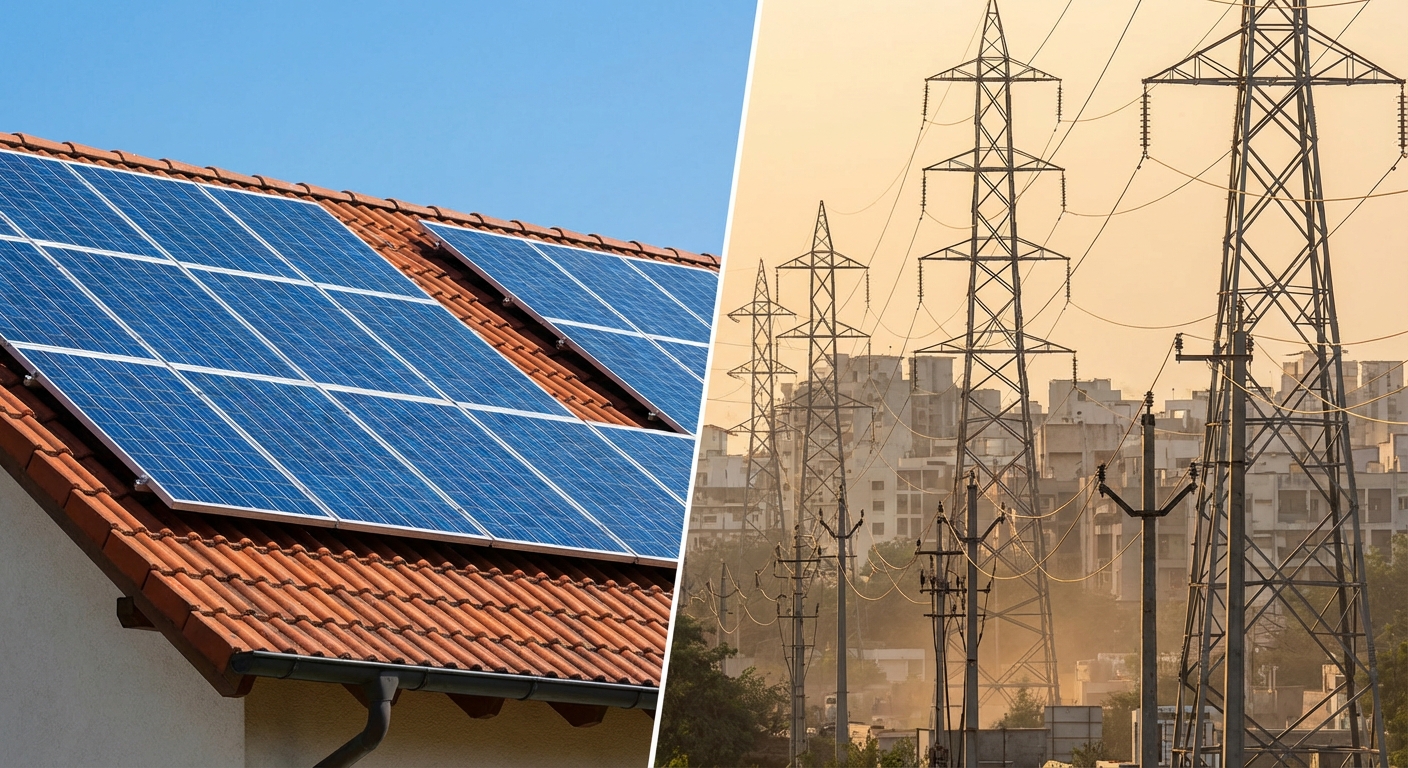
The energy landscape in Gujarat is undergoing a dramatic transformation in 2026. As electricity tariffs continue their upward climb and solar technology becomes increasingly affordable, homeowners and businesses across Surat, Ahmedabad, Junagadh, and beyond face a critical question: should they stick with traditional grid electricity or make the switch to solar energy? This comprehensive comparison examines the solar vs grid debate from every angle, providing you with real numbers, case studies, and actionable insights to make the right decision for your situation.
Gujarat has emerged as a solar powerhouse in India, with abundant sunshine averaging 300+ sunny days annually and progressive government policies supporting renewable energy adoption. Yet many residents and business owners remain uncertain about whether solar truly delivers on its promise of cost savings and energy independence. This guide cuts through the confusion with detailed cost comparisons, ROI calculations, and real-world examples from Gujarat installations.
Understanding the Solar vs Grid Electricity Debate in Gujarat
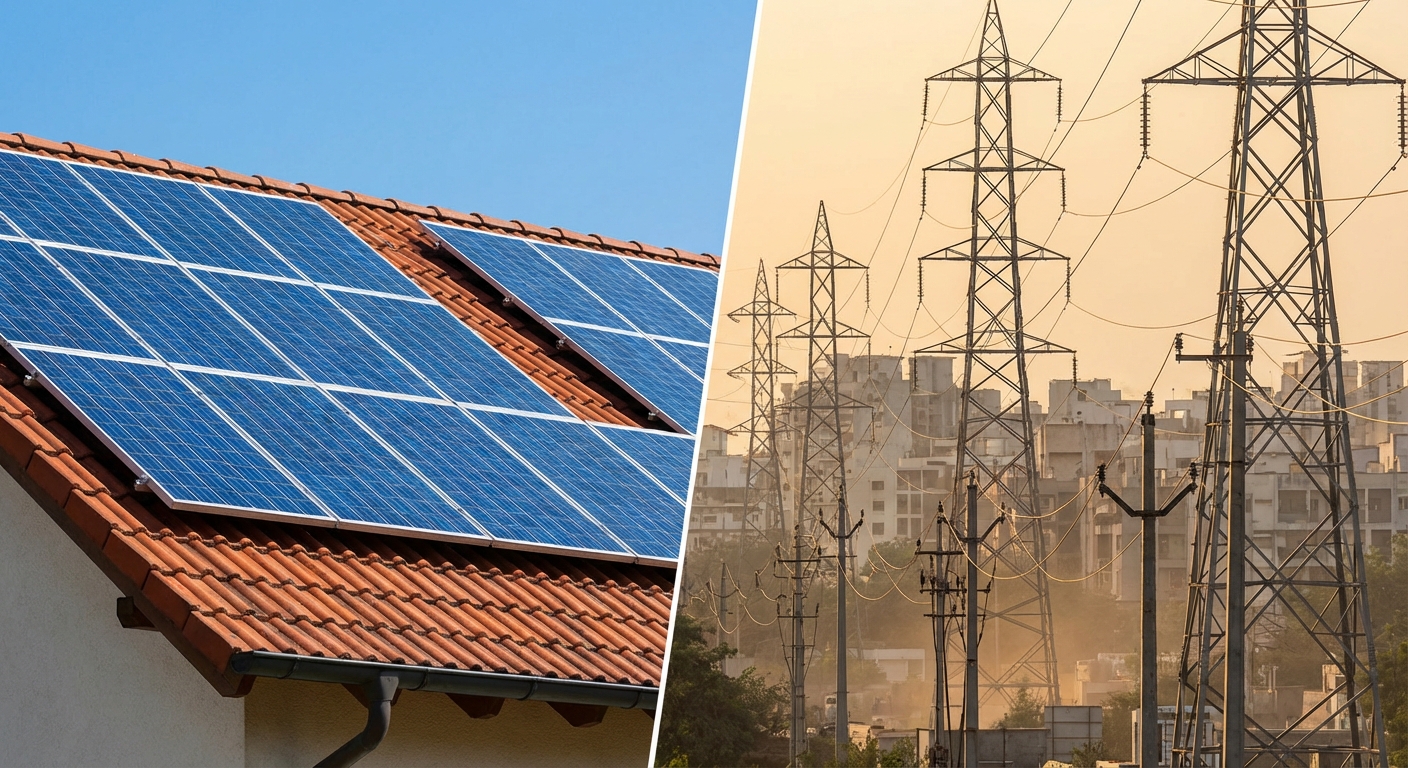
The solar vs grid conversation has intensified in Gujarat as electricity costs have risen steadily over the past five years. Residential consumers who once paid modest monthly bills now face charges that can exceed ₹3,000-5,000 for average households, while commercial and industrial users grapple with bills running into lakhs of rupees. Meanwhile, solar panel costs have dropped by nearly 60% since 2016, making rooftop solar installations more accessible than ever.
Several factors are driving Gujarat residents to reconsider their energy sources in 2026. First, the Gujarat Urja Vikas Nigam Limited (GUVNL) has implemented multiple tariff revisions, with electricity rates increasing by approximately 8-12% annually for most consumer categories. Second, solar technology has matured significantly, with modern panels offering 25-year performance warranties and inverters lasting 10-15 years with minimal maintenance. Third, government initiatives like the PM-KUSUM scheme and state subsidies have reduced the upfront investment barrier for residential and agricultural solar installations.
This comparison will examine upfront costs, long-term savings projections, reliability considerations, environmental impact, and real-world case studies from Gujarat. Whether you’re a homeowner in Surat looking to reduce your monthly electricity bill, a commercial business owner in Ahmedabad seeking to lower operational costs, or an industrial facility manager in Junagadh exploring energy independence, this guide provides the data you need to make an informed decision about solar vs grid electricity.
Grid Electricity in Gujarat: Current Costs and Tariff Structure 2026
Understanding the true cost of grid electricity requires looking beyond the per-unit rate to examine the complete tariff structure. In 2026, GUVNL’s tariff rates vary significantly based on consumer category and consumption levels, creating a complex pricing landscape that often surprises consumers when they receive their monthly bills.
Residential Tariff Rates
For residential consumers in Gujarat, the tariff structure operates on a slab-based system. Households consuming 0-50 units per month pay approximately ₹3.50-4.00 per unit, while those consuming 51-100 units pay around ₹4.50-5.00 per unit. The rates increase progressively, with consumers using 101-150 units paying ₹5.50-6.00 per unit, and those exceeding 150 units paying ₹6.50-7.50 per unit or higher. A typical middle-class household consuming 300 units monthly can expect a bill of approximately ₹2,000-2,500, not including additional charges.
Commercial and Industrial Tariff Rates
Commercial establishments face steeper rates, typically ranging from ₹7.00-9.00 per unit depending on consumption and connection type. Industrial consumers, particularly those with high-tension connections, pay rates between ₹6.00-8.50 per unit, though this varies based on time-of-day usage and contracted demand. For a small commercial business consuming 1,000 units monthly, the electricity bill can easily reach ₹8,000-10,000, while industrial facilities consuming 10,000+ units monthly face bills exceeding ₹70,000-85,000.
Hidden Costs and Additional Charges
The per-unit rate tells only part of the story. Gujarat electricity bills include several additional components that significantly increase the final amount. Fixed charges based on sanctioned load add ₹20-50 per kW per month for residential consumers and ₹100-200 per kW for commercial users. Fuel adjustment charges fluctuate monthly based on the cost of coal and other fuels used by power plants, typically adding ₹0.50-1.50 per unit. Electricity duty and other taxes can add another 10-15% to the total bill amount.
Tariff Escalation Trends
Historical data reveals a concerning trend for grid electricity consumers. Between 2021 and 2026, average electricity tariffs in Gujarat have increased by approximately 40-50% across all consumer categories. This translates to an annual escalation rate of 8-10%, significantly outpacing general inflation. If this trend continues, a household currently paying ₹2,500 monthly could see their bill rise to ₹3,600-4,000 by 2031, assuming consumption remains constant.
Reliability Considerations
While Gujarat’s grid infrastructure has improved considerably, reliability varies by location. Urban areas like Ahmedabad and Surat generally experience fewer outages, with most consumers facing 2-5 power cuts monthly lasting 30 minutes to 2 hours. Rural and semi-urban areas, including parts of Junagadh and other districts, may experience more frequent interruptions, particularly during monsoon season and peak summer months when demand strains the grid capacity.
Solar Energy Costs in Gujarat: Complete Investment Breakdown
The economics of solar vs grid electricity begin with understanding the upfront investment required for a solar installation. While grid electricity requires no initial capital expenditure, solar systems demand a significant one-time investment that pays dividends over decades. In 2026, solar panel costs in Gujarat have reached historic lows, making the technology more accessible than ever for residential and commercial consumers.
Residential Solar Installation Costs
For residential rooftop solar installations in Gujarat, the current market rate ranges from ₹45,000-60,000 per kilowatt (kW) for complete turnkey systems. A typical 3kW system suitable for a household consuming 300-400 units monthly costs approximately ₹1,35,000-1,80,000, while a larger 5kW system for higher consumption households runs ₹2,25,000-3,00,000. These prices include all components, installation, and commissioning, representing a complete plug-and-play solution.
Component Cost Breakdown
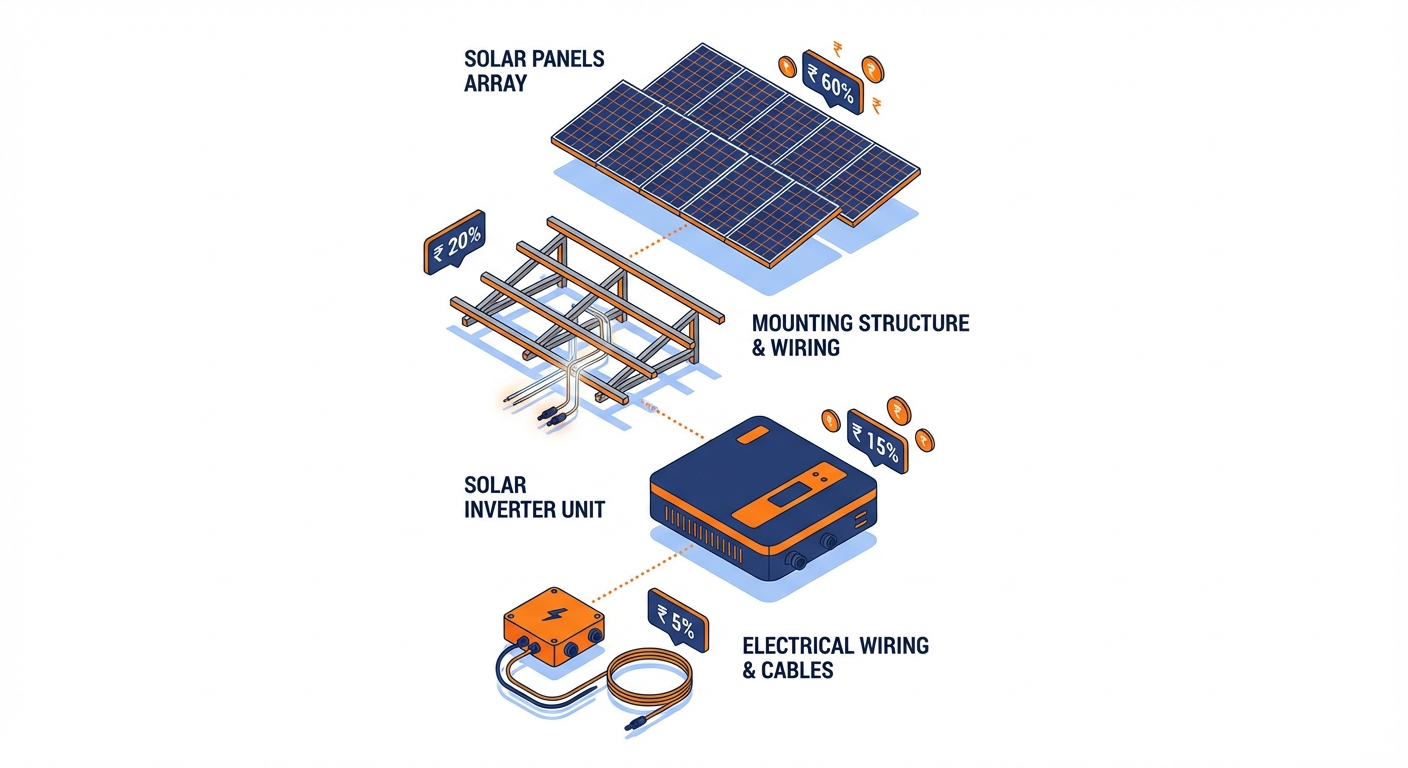
Understanding where your investment goes helps evaluate the quality and value of different solar offerings. Solar panels typically account for 40-45% of the total system cost, with high-efficiency monocrystalline panels commanding premium prices compared to polycrystalline alternatives. Solar inverters represent 15-20% of costs, with string inverters being more affordable than microinverters but offering less flexibility. Mounting structures and balance of system components (wiring, cables, junction boxes, earthing) account for 15-20%, while installation labor and commissioning make up the remaining 20-25%.
Commercial and Industrial Solar Costs
Larger commercial and industrial solar installations benefit from economies of scale, with per-kilowatt costs dropping significantly. A 50kW commercial rooftop system typically costs ₹40,000-50,000 per kW (₹20-25 lakhs total), while a 500kW industrial installation can achieve rates of ₹35,000-45,000 per kW (₹1.75-2.25 crores total). Ground-mounted solar parks for large-scale projects can achieve even lower per-kilowatt costs of ₹30,000-40,000 per kW when developed through experienced solar EPC services.
Government Subsidies and Financial Incentives
The Central Government’s solar subsidy scheme significantly reduces the effective cost for residential consumers. Under the current program, households installing systems up to 3kW receive a subsidy of ₹14,588 per kW (approximately ₹43,764 for a 3kW system), while systems between 3-10kW receive ₹14,588 per kW for the first 3kW and ₹7,294 per kW for additional capacity. This means a 5kW system receives approximately ₹58,352 in subsidy, reducing the effective cost from ₹2,50,000 to approximately ₹1,91,648.
The PM-KUSUM scheme provides additional benefits for agricultural consumers and farmers, offering subsidies up to 60% of the project cost for solar pumps and grid-connected agricultural solar installations. Commercial and industrial consumers, while not eligible for direct subsidies, can benefit from accelerated depreciation (40% in the first year) and various state-level incentives that improve project economics.
Solar Financing Options
Recognizing that upfront costs remain a barrier for many consumers, several financing options have emerged in Gujarat’s solar market. Banks and non-banking financial companies (NBFCs) offer solar loans with interest rates ranging from 9-12% per annum and tenures up to 10 years. Many solar EPC companies, including established providers in Gujarat, facilitate financing arrangements that allow consumers to go solar with minimal upfront payment, paying monthly installments that are often lower than their previous electricity bills.
Solar vs Grid: Long-Term Cost Comparison and ROI Analysis
The true financial picture of solar vs grid electricity emerges only when examining costs over the 25-year lifespan of a solar system. While grid electricity requires no upfront investment, its cumulative cost over decades far exceeds the one-time solar investment for most consumers in Gujarat.
25-Year Cost Projection: Residential Example
Consider a typical Gujarat household consuming 300 units monthly, currently paying approximately ₹2,200 per month (₹26,400 annually) for grid electricity. Assuming a conservative 8% annual tariff escalation, this household will spend approximately ₹20.5 lakhs on electricity over 25 years. In contrast, a 3kW solar system costing ₹1,50,000 (after subsidy) that meets 80-90% of their electricity needs will save approximately ₹18-19 lakhs over the same period, even after accounting for inverter replacement (₹25,000-30,000 after 10-12 years) and minimal maintenance costs (₹3,000-5,000 annually).
Payback Period Calculations
The solar payback period in Gujarat varies based on system size, electricity consumption patterns, and tariff rates, but most residential installations achieve payback within 4-6 years. A 5kW residential system costing ₹2,50,000 (₹1,91,648 after subsidy) that saves ₹3,500 monthly on electricity bills will recover its investment in approximately 4.5 years. Commercial installations with higher electricity rates and no subsidy typically see payback periods of 5-7 years, while industrial installations benefit from even faster returns of 4-6 years due to higher consumption and favorable net metering arrangements. For detailed calculations on your specific situation, explore our guide on solar payback periods and break-even timelines.
Net Metering Benefits
Gujarat’s net metering policy significantly enhances solar economics by allowing consumers to export excess solar generation to the grid and receive credits against future consumption. During peak generation hours (10 AM to 4 PM), solar systems typically produce more electricity than the household or business consumes. This excess generation is fed into the grid, and the consumer receives a credit at the applicable tariff rate. During evening and night hours when solar generation ceases, consumers draw from the grid, with their net metering credits offsetting these charges. This arrangement effectively uses the grid as a virtual battery, eliminating the need for expensive physical battery storage for most applications.
Impact of Tariff Escalation on Savings
One of the most compelling arguments in the solar vs grid debate is the protection solar provides against future tariff increases. While grid electricity costs rise 8-10% annually, solar electricity costs remain fixed after the initial investment. This creates an expanding savings gap over time. In year one, a solar system might save ₹30,000 annually, but by year 10, with compounding tariff increases, the same system saves ₹60,000-70,000 annually. By year 20, annual savings can exceed ₹1,20,000-1,50,000, demonstrating how solar becomes increasingly valuable over time.
Maintenance Costs and System Lifespan
Solar systems require minimal maintenance compared to other energy infrastructure. Annual maintenance typically involves cleaning panels 3-4 times (₹1,000-2,000 per cleaning for residential systems), inspecting electrical connections, and monitoring system performance. Most solar panels carry 25-year performance warranties guaranteeing at least 80% output after 25 years, while inverters typically last 10-15 years before requiring replacement. Total maintenance costs over 25 years typically amount to ₹75,000-1,25,000 for residential systems, a fraction of the cumulative savings generated.
Real-World Case Studies: Gujarat Solar vs Grid Comparisons
Theory and projections provide valuable insights, but real-world examples from actual Gujarat installations demonstrate the practical reality of solar vs grid economics. These case studies represent typical installations across residential, commercial, and industrial segments, showing actual costs, savings, and payback periods.
Case Study 1: Residential Installation in Surat – 5kW System
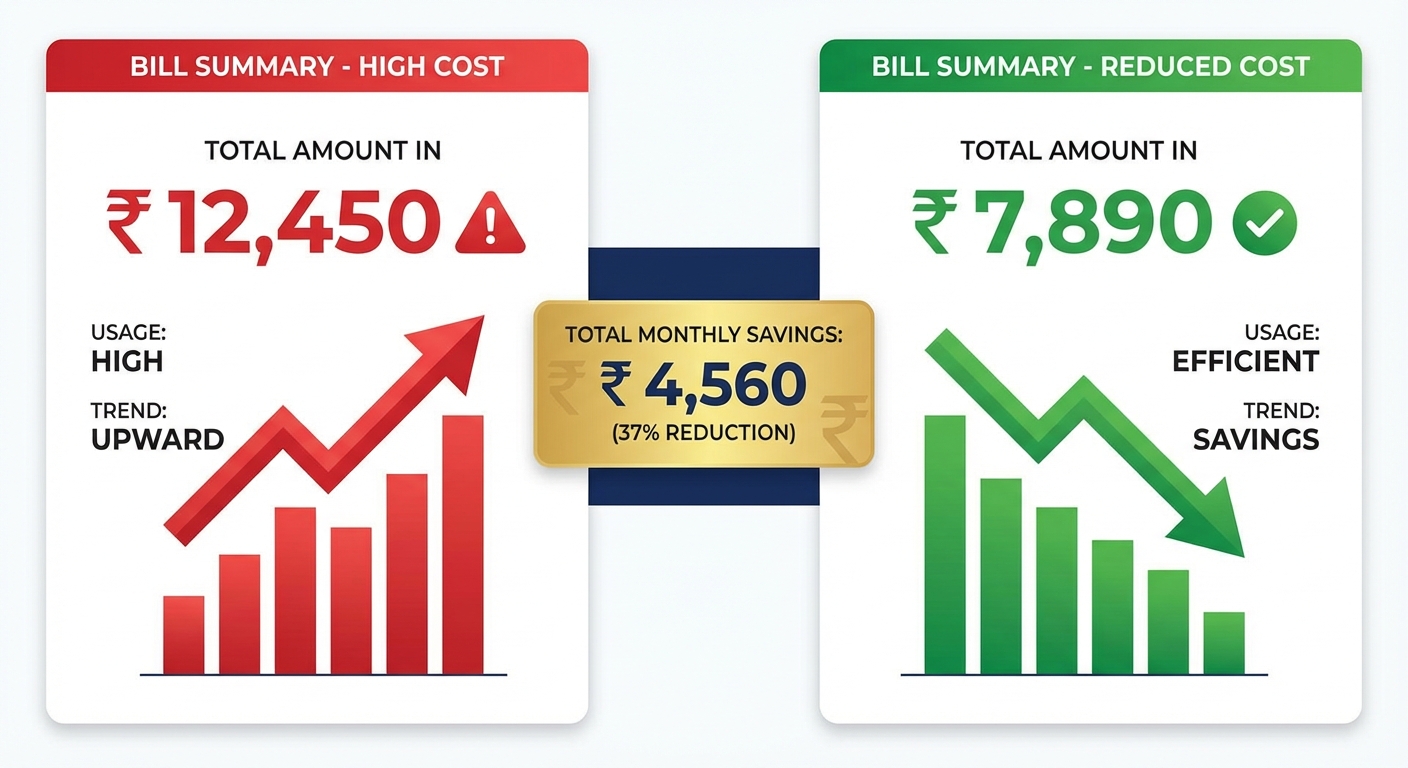
A homeowner in Surat’s Adajan area installed a 5kW rooftop solar system in January 2024 to address monthly electricity bills averaging ₹3,800-4,200. The system cost ₹2,60,000, with a government subsidy of ₹58,352 reducing the effective investment to ₹2,01,648. The installation included high-efficiency monocrystalline panels from a reputable manufacturer, a 5kW string inverter, and a complete mounting structure suitable for the sloped tile roof.
Over the first 18 months of operation, the system has generated an average of 650-700 units monthly, covering approximately 85% of the household’s electricity consumption. Monthly electricity bills have dropped from ₹3,800-4,200 to just ₹600-900 (primarily fixed charges and minimal grid consumption during monsoon months). This represents monthly savings of ₹3,000-3,500, or approximately ₹40,000 annually. At this rate, the system will achieve complete payback in 5 years, after which the homeowner will enjoy essentially free electricity for the remaining 20+ year system lifespan.
Case Study 2: Commercial Business in Ahmedabad – 50kW System
A textile manufacturing unit in Ahmedabad’s Narol industrial area installed a 50kW rooftop solar system in mid-2023 to combat rising electricity costs that were impacting profit margins. The business was consuming approximately 6,000-7,000 units monthly, with electricity bills ranging from ₹48,000-58,000 depending on seasonal production variations. The solar installation cost ₹24 lakhs (₹48,000 per kW) for a complete turnkey system.
The 50kW system generates approximately 6,500-7,000 units monthly during peak months (March-October) and 4,500-5,500 units during winter and monsoon months (November-February). This has reduced grid electricity consumption by 70-80%, bringing monthly bills down to ₹12,000-18,000. The business saves approximately ₹35,000-40,000 monthly, translating to annual savings of ₹4.5-5 lakhs. The system is on track to achieve payback in 4.8-5.3 years, with the added benefit of claiming accelerated depreciation that improved first-year cash flow significantly.
Case Study 3: Industrial Facility in Junagadh – 500kW System
A large-scale food processing facility in Junagadh installed a 500kW ground-mounted solar system in early 2023 as part of a comprehensive energy cost reduction strategy. The facility’s electricity consumption averaged 65,000-75,000 units monthly, with bills exceeding ₹5.5-6.5 lakhs monthly. The solar installation, developed through a professional solar EPC provider, cost ₹2.1 crores (₹42,000 per kW) including all civil works, grid connectivity, and commissioning.
The 500kW system generates approximately 65,000-70,000 units monthly during peak production months, effectively meeting 90-95% of the facility’s daytime electricity needs. Monthly electricity bills have dropped to ₹1.2-1.8 lakhs, representing savings of ₹4-4.8 lakhs monthly or ₹52-55 lakhs annually. At this savings rate, the system will achieve payback in approximately 3.8-4 years. Beyond the financial benefits, the facility has significantly reduced its carbon footprint and enhanced its sustainability credentials, which has proven valuable in securing contracts with environmentally conscious buyers.
Key Takeaways from Case Studies
These real-world examples demonstrate several consistent patterns in the solar vs grid comparison. First, payback periods across all segments fall within the 4-6 year range, with larger commercial and industrial installations achieving faster returns due to higher electricity rates and greater consumption. Second, solar systems consistently deliver 70-90% electricity bill reduction, with the remaining grid consumption covering nighttime usage and seasonal generation variations. Third, the financial benefits accelerate over time as grid tariffs continue rising while solar costs remain fixed, creating an expanding value gap that makes early adoption increasingly advantageous.
Reliability and Performance: Solar vs Grid Electricity
Financial considerations dominate most solar vs grid discussions, but reliability and performance are equally critical factors, particularly for businesses where power interruptions directly impact operations and revenue. Understanding how solar and grid electricity compare on reliability metrics helps consumers make informed decisions based on their specific needs and risk tolerance.
Grid Power Reliability in Gujarat
Gujarat’s electricity grid has improved substantially over the past decade, with the state achieving near-universal electrification and reducing transmission losses. However, reliability varies significantly by location and consumer category. Urban areas like Ahmedabad, Surat, and Vadodara typically experience high reliability, with most consumers facing fewer than 5 outages monthly, each lasting 30 minutes to 2 hours. Industrial areas often receive priority supply with minimal interruptions.
Rural and semi-urban areas experience more frequent disruptions, particularly during monsoon season when lightning strikes and fallen trees damage distribution infrastructure. Agricultural consumers face scheduled power cuts during peak demand periods, with supply often limited to specific hours. Even in well-served urban areas, voltage fluctuations remain common, potentially damaging sensitive electronic equipment and requiring voltage stabilizers for protection.
Solar System Performance and Reliability
Solar systems deliver highly predictable performance in Gujarat’s sunny climate, with modern panels and inverters achieving 98-99% uptime when properly installed and maintained. The primary variable affecting solar generation is weather, with output dropping 40-60% on heavily overcast days and ceasing entirely at night. However, Gujarat’s climate provides excellent solar conditions, with 300+ sunny days annually and peak generation months (March-October) delivering consistent high output.
Monsoon season (July-September) presents the most challenging period for solar generation, with output typically dropping 30-40% compared to peak months due to cloud cover and reduced sunlight intensity. However, even during monsoon, solar systems continue generating significant electricity during daylight hours, typically covering 50-70% of daytime consumption. Winter months (November-February) see slightly reduced generation due to shorter days and lower sun angles, but output remains strong during daylight hours.
Battery Backup Options for Uninterrupted Power
For consumers requiring uninterrupted power supply, hybrid solar systems combining panels, inverters, and battery storage provide the ultimate reliability solution. These systems automatically switch between solar generation, battery power, and grid electricity based on availability and demand, ensuring continuous power regardless of grid status or weather conditions. Battery costs have decreased significantly, with lithium-ion systems now available at ₹8,000-12,000 per kWh of storage capacity.
A typical residential hybrid system might include 5-10 kWh of battery storage (₹50,000-1,20,000), providing 4-8 hours of backup power for essential loads. Commercial and industrial facilities often install larger battery banks (50-200 kWh) to protect critical operations during grid outages. While batteries add upfront cost, they eliminate the need for diesel generators, which require ongoing fuel costs, maintenance, and produce noise and emissions.
Hybrid Solutions: Combining Solar and Grid Optimally
Most solar installations in Gujarat operate as grid-connected systems without batteries, using the grid as a virtual battery through net metering. This hybrid approach provides the best of both worlds: solar generation reduces electricity costs during the day, while grid connection ensures power availability at night and during low-generation periods. The grid effectively serves as unlimited backup capacity without the cost and maintenance requirements of physical batteries.
For businesses with critical operations, a hybrid system with limited battery backup for essential loads provides an optimal balance. The solar system and grid handle normal operations, while batteries provide short-term backup for critical equipment during outages. This approach costs significantly less than full battery backup while protecting against the most common reliability issues.
Environmental Impact: Solar vs Grid Energy in Gujarat
While financial considerations drive most solar vs grid decisions, environmental impact increasingly influences consumer choices, particularly for businesses focused on sustainability and corporate social responsibility. Understanding the environmental implications of energy choices helps consumers align their decisions with broader environmental goals and regulatory requirements.
Carbon Footprint of Grid Electricity
Gujarat’s electricity grid relies heavily on coal-fired thermal power plants, which account for approximately 60-65% of the state’s generation capacity. Natural gas contributes another 20-25%, while renewable sources including solar, wind, and hydro make up the remaining 15-20%. This generation mix results in significant carbon emissions, with grid electricity in Gujarat producing approximately 0.7-0.8 kg of CO2 per unit consumed.
A typical household consuming 300 units monthly from the grid generates approximately 210-240 kg of CO2 emissions monthly, or 2.5-2.9 tonnes annually. A commercial business consuming 6,000 units monthly produces approximately 4.2-4.8 tonnes of CO2 monthly, or 50-58 tonnes annually. An industrial facility consuming 75,000 units monthly generates approximately 52-60 tonnes of CO2 monthly, or 630-720 tonnes annually. These emissions contribute to climate change, air pollution, and associated health impacts.
Environmental Benefits of Solar Energy
Solar energy produces zero direct emissions during operation, making it one of the cleanest energy sources available. While solar panel manufacturing does involve energy consumption and emissions, lifecycle analyses show that solar panels generate 10-20 times more clean energy over their lifespan than the energy required for their production. A typical solar panel “pays back” its manufacturing energy within 1-2 years of operation, then continues producing clean energy for 25+ years.
A 5kW residential solar system generating 7,000-8,000 units annually prevents approximately 5-6 tonnes of CO2 emissions each year compared to grid electricity. Over its 25-year lifespan, this single residential system prevents 125-150 tonnes of CO2 emissions, equivalent to planting approximately 6,000-7,500 trees or removing 25-30 cars from the road for a year. A 500kW industrial solar system prevents approximately 500-600 tonnes of CO2 annually, or 12,500-15,000 tonnes over its lifespan.
Contribution to Gujarat’s Renewable Energy Targets
Gujarat has set ambitious renewable energy targets, aiming to achieve 50% of its electricity generation from renewable sources by 2030. Every solar installation, whether residential, commercial, or industrial, contributes to this goal and helps reduce the state’s dependence on fossil fuels. As of 2026, Gujarat has installed approximately 12,000-14,000 MW of solar capacity, making it one of India’s leading solar states.
Distributed rooftop solar installations play a crucial role in achieving these targets, as they reduce transmission losses, improve grid stability, and democratize energy production. When thousands of homes and businesses generate their own clean electricity, the cumulative impact significantly reduces the state’s carbon footprint and energy import dependence.
Corporate Sustainability and ESG Benefits
For businesses, solar adoption delivers important environmental, social, and governance (ESG) benefits that extend beyond direct cost savings. Many corporations now face pressure from investors, customers, and regulators to reduce their carbon footprint and demonstrate environmental responsibility. Solar installations provide tangible evidence of sustainability commitment, helping businesses meet ESG reporting requirements, qualify for green certifications, and appeal to environmentally conscious customers.
Several Gujarat businesses have leveraged their solar installations to secure contracts with multinational corporations that require suppliers to meet specific sustainability criteria. The ability to demonstrate renewable energy usage and carbon footprint reduction has become a competitive advantage in many industries, making solar adoption not just an environmental choice but a strategic business decision.
Making the Right Choice: Solar vs Grid Decision Framework
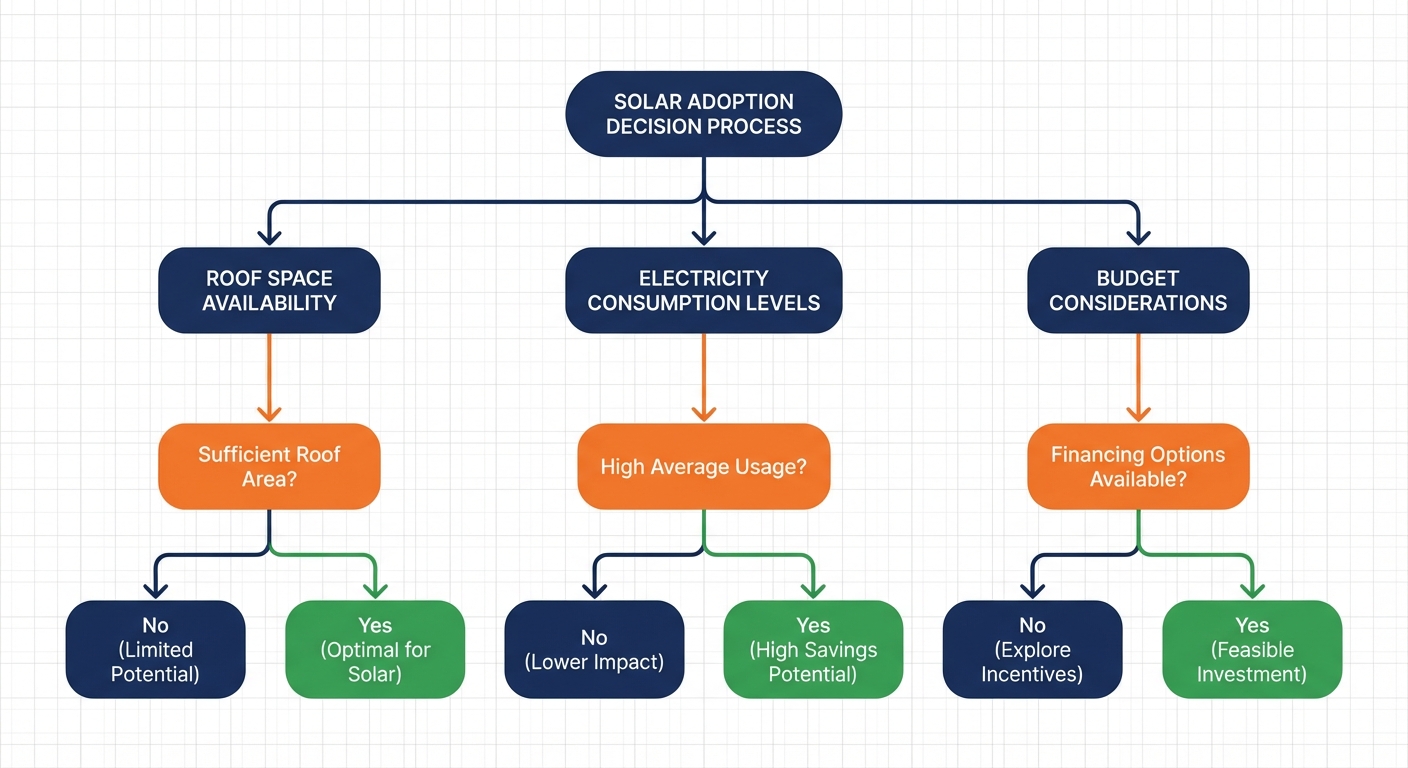
After examining costs, savings, reliability, and environmental impact, the question remains: which option is right for your specific situation? The solar vs grid decision depends on multiple factors unique to each consumer, including electricity consumption patterns, available roof space, budget constraints, and long-term plans. This decision framework helps you evaluate your situation and make an informed choice.
When Solar Makes Financial Sense
Solar delivers the strongest financial returns for consumers with high electricity consumption and high tariff rates. If your monthly electricity bill exceeds ₹2,000 for residential properties or ₹8,000 for commercial establishments, solar likely offers compelling economics with payback periods under 6 years. Industrial consumers with monthly bills exceeding ₹50,000 almost always benefit from solar, often achieving payback in 4-5 years or less.
Solar also makes sense if you plan to remain in your current property for at least 5-7 years, allowing you to recover your investment and begin enjoying free electricity. If you’re planning to relocate within 2-3 years, solar may not provide sufficient time to achieve payback, though it can increase property value and appeal to environmentally conscious buyers.
Consumers facing frequent power cuts or voltage fluctuations benefit from solar, particularly when combined with battery backup. The reliability and power quality improvements often justify the investment even beyond pure cost savings, especially for businesses where power interruptions impact operations and revenue.
Key Factors to Consider
Roof space availability is the first practical consideration. Solar panels require approximately 100 square feet per kilowatt of capacity, so a 5kW system needs about 500 square feet of unshaded roof space. The roof should be structurally sound, relatively new (not requiring replacement within 5-10 years), and free from significant shading by trees, buildings, or other obstructions. South-facing roofs provide optimal generation, though east and west-facing installations also perform well in Gujarat’s climate.
Electricity consumption patterns significantly impact solar economics. Consumers with high daytime consumption (when solar generates) benefit most from solar, as they consume the electricity directly rather than exporting it to the grid. Businesses operating primarily during daylight hours achieve the best returns, while residential consumers with high evening consumption may see slightly lower savings due to greater grid dependence during non-generation hours.
Budget and financing availability determine whether solar is immediately accessible. While the long-term economics are compelling, the upfront investment remains a barrier for some consumers. Fortunately, solar loans and financing options have made solar accessible even for consumers who cannot pay the full amount upfront. Monthly loan payments often equal or fall below previous electricity bills, allowing consumers to go solar with neutral or positive cash flow from day one.
Hybrid Approach: Combining Solar and Grid Optimally
For most Gujarat consumers, the optimal solution isn’t choosing between solar and grid but rather combining them strategically. A grid-connected solar system with net metering provides the best of both worlds: solar generation reduces electricity costs during the day, while grid connection ensures power availability at night and during low-generation periods without expensive battery storage.
This hybrid approach allows you to size your solar system based on available roof space and budget rather than trying to achieve 100% energy independence. Even a system that covers 60-70% of your electricity needs delivers substantial savings and environmental benefits while maintaining the convenience and reliability of grid connection for backup power.
Getting Started with Solar Installation in Gujarat
If you’ve decided solar makes sense for your situation, the next step is selecting the right components and installation partner. Panel quality varies significantly, with tier-1 manufacturers offering superior performance, warranties, and long-term reliability compared to budget alternatives. Our comprehensive guide to solar brands in Gujarat compares leading manufacturers to help you make an informed choice.
Choosing an experienced solar EPC partner is equally critical. A professional installation ensures optimal system design, proper electrical integration, efficient permitting and net metering approval, and reliable long-term performance. Look for companies with proven track records in Gujarat, proper licensing and certifications, comprehensive warranties covering both products and workmanship, and transparent pricing without hidden costs.
Heaven Green Energy Limited has completed 10,000+ solar installations across Gujarat since 2017, serving residential, commercial, and industrial clients in Surat, Ahmedabad, Junagadh, and throughout the state. Our turnkey EPC solutions handle every aspect of your solar project, from initial site assessment and system design through installation, commissioning, and ongoing support. We work with leading solar brands to ensure quality and reliability while offering competitive pricing and flexible financing options.
Frequently Asked Questions About Solar vs Grid in Gujarat
Is solar cheaper than grid electricity in Gujarat?
Yes, solar is significantly cheaper than grid electricity over the long term for most Gujarat consumers. While solar requires an upfront investment of ₹45,000-60,000 per kW, it generates electricity at an effective cost of ₹2.00-3.00 per unit over its 25-year lifespan when you account for the initial investment and minimal maintenance costs. In contrast, grid electricity currently costs ₹4.00-7.50 per unit for residential consumers and ₹6.00-9.00 per unit for commercial users, with rates increasing 8-10% annually. Most solar installations in Gujarat achieve payback within 4-6 years, after which you enjoy essentially free electricity for the remaining 20+ years.
What is the payback period for solar in Gujarat?
Solar payback periods in Gujarat typically range from 4-6 years depending on system size, electricity consumption, and tariff rates. Residential systems with government subsidies often achieve payback in 4.5-5.5 years, while commercial installations see payback in 5-7 years. Industrial installations with high consumption and favorable electricity rates can achieve payback in 4-5 years or less. After payback, the system continues generating free electricity for 20+ additional years, delivering substantial cumulative savings. Factors that accelerate payback include high electricity consumption, high tariff rates, optimal system sizing, and quality components that maximize generation.
Can I completely disconnect from the grid with solar?
While technically possible, completely disconnecting from the grid (going “off-grid”) is rarely the most cost-effective or practical solution in Gujarat. Off-grid systems require substantial battery storage to provide power during nighttime and low-generation periods, adding ₹3-6 lakhs or more to system costs for residential installations. Most consumers benefit more from grid-connected systems with net metering, which use the grid as a virtual battery without the cost and maintenance of physical batteries. This approach provides reliable power 24/7 while maximizing financial returns. Off-grid systems make sense primarily in remote locations where grid connection is unavailable or prohibitively expensive.
What happens during cloudy days or monsoon season?
Solar systems continue generating electricity during cloudy days and monsoon season, though at reduced output compared to sunny conditions. On heavily overcast days, generation typically drops to 40-60% of clear-day output, while light cloud cover reduces generation by only 10-20%. During Gujarat’s monsoon season (July-September), monthly generation typically decreases 30-40% compared to peak months, but systems still produce significant electricity during daylight hours. Grid-connected systems automatically draw additional power from the grid when solar generation is insufficient, ensuring uninterrupted electricity supply regardless of weather. Your net metering arrangement credits excess generation during sunny months against higher grid consumption during monsoon, balancing out over the year.
How do net metering and subsidies work in Gujarat?
Net metering allows solar system owners to export excess generation to the grid and receive credits against future consumption at the applicable tariff rate. When your solar system produces more electricity than you’re consuming (typically during midday hours), the excess flows to the grid and your meter runs backward, creating a credit. When you consume more than you generate (evenings, nights, cloudy days), you draw from the grid and use your accumulated credits. The utility bills you only for net consumption (total consumption minus total generation) each month. Government subsidies for residential solar currently provide ₹14,588 per kW for systems up to 3kW, and ₹14,588 per kW for the first 3kW plus ₹7,294 per kW for additional capacity up to 10kW. These subsidies are applied directly to reduce your system cost, with the solar installer handling the subsidy application process.
Take Control of Your Energy Costs with Solar
The solar vs grid comparison reveals a clear winner for most Gujarat consumers: solar energy delivers superior long-term economics, greater energy independence, improved reliability, and substantial environmental benefits compared to continued grid dependence. With solar panel costs at historic lows, government subsidies reducing upfront investment, and electricity tariffs continuing their upward climb, 2026 represents an optimal time to make the switch to solar energy.
Whether you’re a homeowner in Surat looking to reduce monthly electricity bills, a commercial business in Ahmedabad seeking to lower operational costs, or an industrial facility in Junagadh exploring energy independence, solar offers a proven path to significant savings and sustainability. The real-world case studies demonstrate that solar consistently delivers on its promises, with payback periods of 4-6 years and cumulative savings reaching lakhs of rupees over system lifespans.
The decision to go solar is ultimately about taking control of your energy future. Grid electricity prices will continue rising, but solar costs remain fixed after your initial investment. Every month you delay is another month of paying inflated grid tariffs instead of enjoying free solar electricity. The question isn’t whether to go solar, but when—and the answer for most Gujarat consumers is now.
Ready to explore how much you can save with solar? Heaven Green Energy Limited offers free site assessments and customized solar proposals for residential, commercial, and industrial properties throughout Gujarat. Our experienced team will evaluate your electricity consumption, roof space, and budget to design an optimal solar solution that maximizes your savings and ROI. With 10,000+ successful installations since 2017 and comprehensive turnkey EPC services, we handle every aspect of your solar project from design through commissioning and beyond. Have any questions? Call us at +91 63904 05060 to speak with a solar expert and take the first step toward energy independence and substantial long-term savings with solar vs grid electricity in Gujarat.
This blog post was written using thestacc.com