


Choosing the right solar company can make the difference between a seamless, profitable solar investment and years of frustration. With Gujarat leading India’s renewable energy revolution and solar adoption accelerating across residential, commercial, and industrial sectors, the market is filled with options—from national giants to specialized regional players. This comprehensive comparison of solar companies in Gujarat will help you navigate the landscape, understand what truly matters, and select a solar partner that aligns with your specific needs and budget.
Whether you’re a homeowner looking to slash electricity bills, a business owner seeking to reduce operational costs, or an industrial facility planning a large-scale solar park, this guide provides the detailed analysis you need to make an informed decision in 2026.
Understanding Gujarat’s Solar Energy Landscape in 2026
Gujarat has consistently maintained its position as one of India’s solar energy powerhouses, with installed solar capacity exceeding 10,000 MW and ambitious targets for further expansion. The state’s geographical advantages—abundant sunshine averaging 5-6 peak sun hours daily, vast land availability, and progressive government policies—create an ideal environment for solar energy adoption.
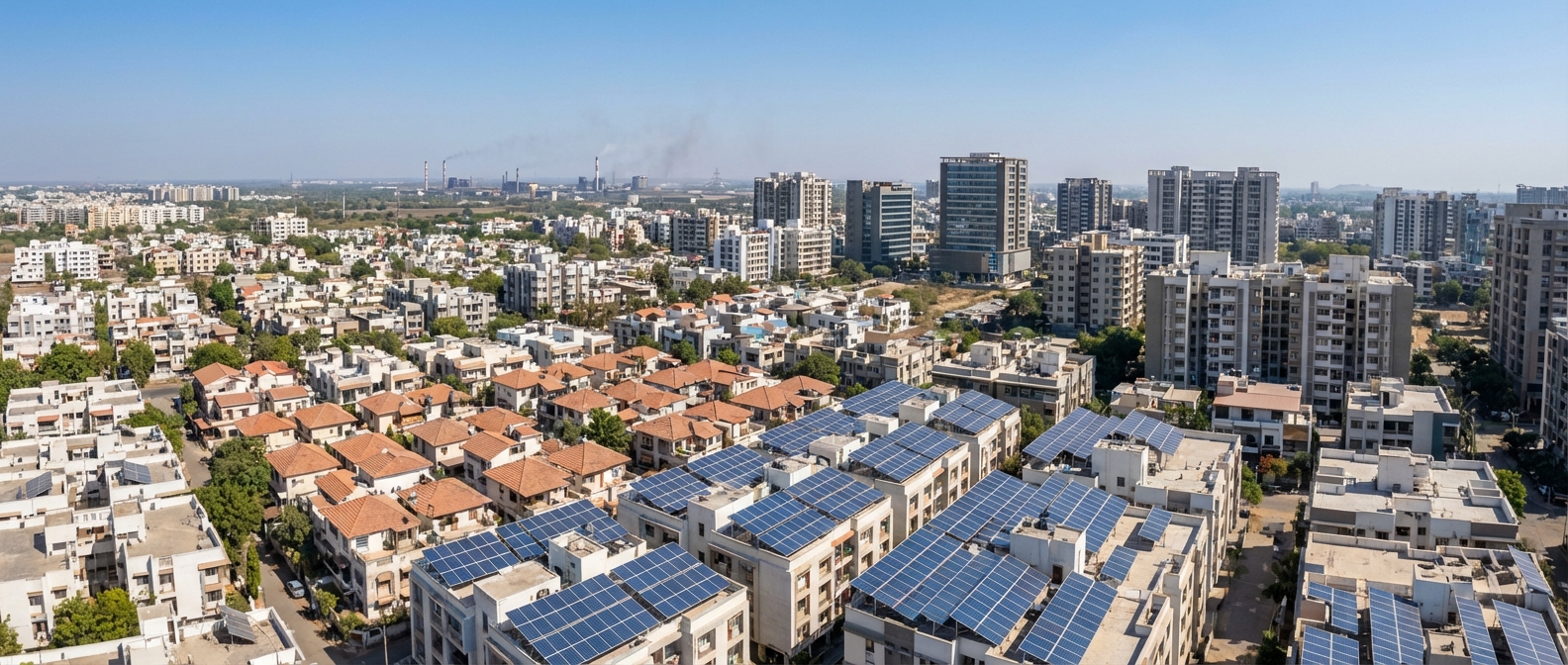
In 2026, several factors are driving unprecedented growth in Gujarat’s solar market. The state government’s continued support through schemes like the Gujarat Solar Power Policy provides attractive incentives for both grid-connected and off-grid installations. The PM-KUSUM scheme has opened opportunities for agricultural solar applications, while the DREBP (Distributed Renewable Energy Based Power) program makes rooftop solar more accessible to homeowners through substantial subsidies.
The competitive electricity tariff structure in Gujarat, combined with rising conventional power costs, has shortened solar payback periods to 4-6 years for most installations. Industrial consumers facing high electricity demand charges are particularly motivated to invest in solar solutions, while residential adoption is accelerating as awareness grows and financing options become more flexible.
This thriving market has attracted numerous solar companies in Gujarat, ranging from established national brands to agile regional specialists. Understanding the differences between these players is crucial for making the right choice.
Key Factors to Evaluate When Comparing Solar Companies in Gujarat
Before diving into specific company comparisons, it’s essential to understand the evaluation criteria that should guide your decision. Not all solar companies offer the same value proposition, and what works for a residential installation may not be ideal for an industrial project.
EPC Capabilities and Project Execution Experience
The quality of solar EPC services (Engineering, Procurement, and Construction) directly impacts system performance and longevity. Look for companies with proven track records in projects similar to yours. A company excelling in residential rooftop installations may lack experience with complex industrial ground-mounted systems requiring specialized engineering.
Key indicators include the number of completed projects, total installed capacity, project complexity handled, and adherence to timelines. Companies offering turnkey solutions manage everything from site assessment and design to procurement, installation, commissioning, and grid connectivity—reducing coordination headaches for clients.
Product Quality and Brand Partnerships
The solar modules, inverters, and mounting structures used in your installation determine system efficiency, durability, and maintenance requirements. Top-tier companies partner with reputable international and domestic brands, offering products with proven performance records and robust testing certifications.
Inquire about the specific brands and models proposed for your project. Tier-1 solar panel manufacturers typically offer better efficiency ratings (18-22% for monocrystalline modules), superior low-light performance, and more reliable long-term degradation rates. Similarly, solar inverter quality affects system uptime and monitoring capabilities.
Warranty Terms and After-Sales Service
A comprehensive solar warranty package should include three components: product warranty (typically 10-12 years for panels, 5-10 years for inverters), performance warranty (usually 25 years guaranteeing 80-85% output), and workmanship warranty (covering installation quality for 5-10 years).
Equally important is the company’s commitment to solar maintenance in Gujarat. Does the company have local service teams? What’s their typical response time for issues? Are preventive maintenance packages available? A company with strong local presence can address problems quickly, minimizing downtime and production losses.
Government Subsidy Scheme Expertise
Navigating solar subsidy programs like PM-KUSUM and DREBP requires specialized knowledge of documentation, approval processes, and compliance requirements. Companies experienced in government scheme implementation can significantly accelerate subsidy disbursement and ensure you receive all eligible benefits.
This expertise is particularly valuable for residential customers seeking rooftop subsidies and agricultural/industrial clients pursuing PM-KUSUM benefits. The wrong partner can result in delayed approvals, rejected applications, or missed subsidy opportunities.
Pricing Transparency and Financing Options
Understanding solar panel cost structures in Gujarat requires looking beyond the per-watt price. Comprehensive quotes should detail equipment costs, installation charges, grid connectivity fees, and any additional expenses. Be wary of companies offering suspiciously low quotes that may compromise on quality or hide costs.
Flexible solar financing options—including bank loans, NBFC partnerships, and OPEX models—can make solar more accessible. Companies with established financing relationships can often secure better terms for clients.
Customer Reviews and Track Record
Real customer experiences provide invaluable insights into a company’s reliability, communication, and problem-solving abilities. Look for patterns in reviews: Do customers praise responsiveness? Are there recurring complaints about delays or service quality? How does the company handle issues post-installation?
Request references from completed projects similar to yours and, if possible, visit operational installations to assess quality firsthand.
Leading Solar Installation Companies Operating in Gujarat
The Gujarat solar market features a mix of national players with pan-India operations and regional specialists with deep local expertise. Each category offers distinct advantages depending on your project requirements, budget, and priorities.
National companies typically bring brand recognition, standardized processes, extensive resources, and proven track records across diverse geographies. Regional companies often provide more personalized service, faster response times, better understanding of local regulations and conditions, and competitive pricing due to lower overhead.
Let’s examine the leading solar companies in Gujarat across both categories, analyzing their strengths, service models, and ideal customer profiles.
Heaven Green Energy: Regional Expertise with Comprehensive Solutions
Established in 2017 and headquartered in Surat, Heaven Green Energy Limited has rapidly grown to become one of the top solar EPC companies in Gujarat. With branch offices in Ahmedabad and Junagadh, the company maintains a strong regional presence that enables personalized service and quick response times across the state.
Heaven Green Energy’s core strength lies in its comprehensive approach to solar installation in Gujarat. The company offers complete turnkey EPC solutions spanning residential rooftop systems, commercial and industrial installations, and large-scale ground-mounted solar parks. This versatility allows them to handle projects of varying complexity with equal proficiency.
A key differentiator is Heaven Green Energy’s dual focus on both EPC services and solar product sales. The company supplies a complete range of solar equipment including modules, inverters, mounting structures, wires, cables, and accessories. This integrated model ensures better quality control, competitive pricing, and streamlined project execution.
The company has developed particular expertise in implementing government schemes, including PM-KUSUM for agricultural and industrial applications and DREBP for residential rooftop installations. Their experience navigating subsidy documentation and approval processes helps clients maximize financial benefits and accelerate project timelines.
With over 10,000 installations completed and recognition as one of the top 3 EPC companies in Gujarat, Heaven Green Energy combines the agility and personalized attention of a regional player with the technical capabilities and scale of larger competitors. Their local market knowledge proves particularly valuable for clients seeking customized solutions that account for Gujarat-specific conditions, regulations, and opportunities.
The company’s customer-focused approach emphasizes reliability and ongoing support, with local service teams available for maintenance and troubleshooting. This commitment to after-sales service addresses a common pain point where some larger companies struggle with responsiveness once installation is complete.
Tata Power Solar: National Brand with Established Presence
Tata Power Solar, part of the Tata Power group, represents one of India’s most recognized names in solar energy. With operations spanning the entire country, the company brings significant brand credibility, extensive resources, and decades of experience in the power sector.
The company’s standardized processes and quality control systems ensure consistent execution across projects. Tata Power Solar offers a comprehensive product portfolio including their own manufactured solar modules alongside EPC services for residential, commercial, and utility-scale installations.
In Gujarat, Tata Power Solar operates through regional offices and authorized channel partners. Their nationwide service network provides reassurance for customers concerned about long-term support, though response times may vary depending on local resource availability.
Warranty offerings from Tata Power Solar are typically robust, backed by the financial strength of the Tata Group. The company’s brand recognition can also facilitate easier financing approvals from banks and financial institutions.
However, the company’s large-scale operations and standardized approach may offer less flexibility for customized solutions compared to regional specialists. Pricing tends to reflect the premium associated with the Tata brand, which may be higher than regional alternatives offering comparable technical specifications.
Waaree Energies: Manufacturing Strength and Pan-India EPC
Waaree Energies stands out for its vertical integration, operating as both one of India’s largest solar module manufacturers and a significant EPC service provider. This manufacturing foundation gives Waaree strong control over product quality and supply chain reliability.
The company’s Gujarat operations benefit from its manufacturing facilities and established distribution network in the state. Waaree offers a complete range of solar solutions from residential rooftop systems to large utility-scale projects, with particular strength in commercial and industrial installations.
Waaree’s product portfolio includes high-efficiency monocrystalline and polycrystalline modules with competitive pricing due to their manufacturing scale. The company also provides inverters, mounting structures, and balance-of-system components, enabling integrated project delivery.
As a pan-India player, Waaree brings substantial project execution experience and financial stability. Their EPC capabilities span design, engineering, procurement, installation, and commissioning, with dedicated project management teams for larger installations.
The company’s focus on manufacturing and large-scale projects means that smaller residential installations may receive less personalized attention compared to companies specializing in that segment. Service responsiveness can vary depending on project size and location within Gujarat.
Vikram Solar: Manufacturing Focus with EPC Services
Vikram Solar has built its reputation primarily as a solar module manufacturer, with EPC services complementing its core manufacturing business. The company produces high-quality solar panels with strong efficiency ratings and reliability records.
In Gujarat, Vikram Solar’s presence is primarily through its manufacturing output and selective EPC projects, often partnering with local installers for smaller installations. The company’s strength lies in product quality and technology, with continuous investment in research and development.
For customers prioritizing module quality and efficiency, Vikram Solar panels represent a strong option. However, the company’s EPC service model in Gujarat may be less comprehensive than competitors focused primarily on installation and project execution.
The company’s warranty terms for modules are competitive, backed by their manufacturing expertise. However, installation warranty and after-sales service depend significantly on the local EPC partner executing the project, which can create variability in customer experience.
Detailed Comparison: Pricing, Warranties, and Service Quality

Understanding how solar companies in Gujarat compare across critical dimensions helps narrow your options based on what matters most for your specific situation.
Pricing Structure Analysis
Solar installation pricing in Gujarat in 2026 varies significantly based on system size, component quality, installation complexity, and company positioning. For residential rooftop systems (3-10 kW), expect pricing ranging from ₹45,000 to ₹65,000 per kW installed, before subsidies.
National brands like Tata Power Solar typically position at the higher end of this range, reflecting brand premium and standardized quality assurance. Regional specialists like Heaven Green Energy often offer more competitive pricing while maintaining quality standards, with costs typically 10-15% lower than national brands for comparable specifications.
For commercial and industrial solar in Gujarat (100 kW to multi-MW scale), economies of scale reduce per-watt costs significantly. Pricing for these larger systems ranges from ₹35,000 to ₹50,000 per kW, with variations based on ground-mounted versus rooftop installation, structural requirements, and grid connectivity complexity.
Companies with manufacturing capabilities like Waaree and Vikram Solar may offer competitive equipment pricing, though total project costs depend on their EPC service model and local execution capabilities.
When comparing quotes, ensure you’re evaluating equivalent specifications: module efficiency and brand, inverter type and capacity, mounting structure quality, cable specifications, and included services like grid connectivity, net metering setup, and commissioning support.
Warranty Comparison
Warranty terms represent a critical differentiator, as solar systems are long-term investments requiring 25+ years of reliable operation. Here’s how leading companies typically structure warranties:
Product Warranties: Most companies offer 10-12 years for solar modules and 5-10 years for inverters, reflecting manufacturer standards. Heaven Green Energy, Tata Power Solar, and Waaree all provide competitive product warranties aligned with the brands they install. The key difference lies in warranty servicing—companies with strong local presence like Heaven Green Energy can typically respond faster to warranty claims.
Performance Warranties: Standard across the industry is a 25-year performance warranty guaranteeing 80-85% of rated output at year 25, with specific degradation curves (typically 2-3% first year, 0.5-0.7% annually thereafter). All major companies offer similar performance guarantees, as these are largely determined by module manufacturers.
Workmanship Warranties: This is where significant differences emerge. Installation quality warranties covering mounting, electrical work, and system integration range from 2-10 years. Companies with strong EPC focus like Heaven Green Energy typically offer 5-10 year workmanship warranties, while companies relying on channel partners may offer shorter terms or variable coverage depending on the installer.
Always verify who honors the warranty—the company you contract with or a third-party manufacturer/installer—and confirm local service availability for warranty claims.
Service Quality and Responsiveness
Post-installation service quality often determines long-term satisfaction more than initial installation quality. Key service dimensions include:
Preventive Maintenance: Regular cleaning, inspection, and performance monitoring extend system life and optimize output. Heaven Green Energy and other regional specialists typically offer more accessible maintenance packages with local service teams. National companies may provide maintenance through channel partners, creating potential coordination challenges.
Troubleshooting and Repairs: When issues arise, response time matters. Companies with dedicated Gujarat service teams—like Heaven Green Energy with offices in Surat, Ahmedabad, and Junagadh—can typically respond within 24-48 hours. Larger companies may take longer depending on regional resource allocation.
Monitoring and Support: Modern solar installations include monitoring systems tracking real-time performance. Companies offering proactive monitoring with automated alerts and remote diagnostics provide superior service quality, identifying and addressing issues before they significantly impact production.
Customer Communication: Accessibility of customer service, clarity of communication, and willingness to address concerns vary significantly. Regional companies often provide more direct access to decision-makers, while larger organizations may route customers through call centers and ticketing systems.
Government Scheme Expertise: PM-KUSUM and DREBP Implementation

Government subsidy schemes can reduce solar installation costs by 30-60% for eligible customers, making scheme expertise a valuable differentiator among solar companies in Gujarat.
PM-KUSUM Scheme Implementation
The Pradhan Mantri Kisan Urja Suraksha evam Utthaan Mahabhiyan (PM-KUSUM) scheme aims to add 30,800 MW of solar capacity through three components: ground-mounted solar plants, standalone solar pumps, and grid-connected solar pumps. In Gujarat, this scheme has opened significant opportunities for agricultural and industrial solar applications.
Companies with proven PM-KUSUM expertise understand the complex documentation requirements, approval workflows involving multiple government departments, technical specifications mandated by the scheme, and disbursement processes for subsidies.
Heaven Green Energy has developed particular strength in PM-KUSUM implementation, leveraging their Gujarat-focused operations to navigate state-specific procedures efficiently. Their experience helps clients avoid common pitfalls like incomplete documentation, non-compliant technical specifications, or missed deadlines that can delay or jeopardize subsidy approval.
National companies like Tata Power Solar and Waaree also handle PM-KUSUM projects, though their processes may be more standardized and less adapted to Gujarat-specific nuances. For large-scale PM-KUSUM projects, their extensive resources and experience with government schemes across multiple states can be advantageous.
DREBP Rooftop Solar Subsidy
The Distributed Renewable Energy Based Power (DREBP) program, also known as the rooftop solar subsidy scheme, provides financial support for residential and institutional rooftop installations. In 2026, subsidies of ₹14,588 per kW (for systems up to 3 kW) and ₹7,294 per kW (for additional capacity up to 10 kW) make residential solar significantly more affordable.
Successful DREBP implementation requires coordination with state nodal agencies, compliance with technical standards for grid connectivity, proper net metering setup, and accurate subsidy claim documentation.
Regional specialists like Heaven Green Energy, with extensive residential installation experience in Gujarat, typically excel at DREBP implementation. Their familiarity with local electricity distribution companies (DISCOMs), established relationships with approval authorities, and experience with Gujarat-specific procedures accelerate the subsidy process.
When evaluating companies for residential rooftop solar in Gujarat, specifically ask about their DREBP track record: How many subsidy applications have they processed? What’s their typical approval timeline? Do they handle all documentation and coordination, or does the customer need to manage parts of the process?
Impact on Solar ROI
Effective government scheme implementation directly impacts solar ROI and payback periods. A residential 5 kW system costing approximately ₹2.5 lakh can receive subsidies of ₹65,000-70,000 under DREBP, reducing net investment to ₹1.8-1.85 lakh. This subsidy acceleration shortens payback periods from 6-7 years to 4-5 years, significantly improving investment returns.
Similarly, PM-KUSUM subsidies for agricultural and industrial applications can reduce project costs by 30-40%, making solar economically attractive even for customers with lower electricity tariffs.
Choosing a company with proven subsidy scheme expertise ensures you capture these benefits efficiently, avoiding delays and complications that can erode the financial advantages.
Customer Reviews and Track Records in Gujarat
Real-world performance and customer satisfaction provide crucial insights beyond marketing claims and technical specifications. Here’s what customer feedback reveals about leading solar companies in Gujarat:
Installation Volume and Project Portfolio
Heaven Green Energy’s claim of 10,000+ installations across Gujarat demonstrates substantial market penetration and execution capability. Their portfolio spans residential, commercial, industrial, and ground-mounted projects, indicating versatility across project types and scales.
Tata Power Solar and Waaree Energies have completed numerous large-scale projects in Gujarat, with particular strength in commercial and utility installations. Their national portfolios include thousands of installations, though Gujarat-specific numbers may be lower than regional specialists.
When evaluating track records, prioritize companies with substantial experience in your specific project category. A company excelling in utility-scale projects may have limited residential expertise, and vice versa.
Common Customer Feedback Themes
Analysis of customer reviews and testimonials reveals consistent patterns:
Regional Specialists (Heaven Green Energy): Customers frequently praise personalized service, quick response times, and hands-on support throughout the installation process. The ability to speak directly with decision-makers and receive customized solutions emerges as a key satisfaction driver. Some customers note that brand recognition is lower compared to national players, though this rarely impacts actual service quality.
National Brands (Tata Power Solar): Brand trust and perceived reliability drive initial selection for many customers. Standardized processes and quality control receive positive feedback. However, some customers report challenges with responsiveness for smaller projects and difficulty reaching local service teams for post-installation support. Pricing is occasionally cited as higher than alternatives.
Manufacturing-Focused Companies (Waaree, Vikram Solar): Product quality and module performance receive consistent praise. However, customer experience with EPC services varies significantly depending on whether the company directly executes the project or works through channel partners. Service quality can be inconsistent across different regions and project sizes.
Issue Resolution and Long-Term Support
How companies handle problems separates exceptional service from merely adequate. Customer feedback indicates that regional specialists with dedicated Gujarat teams typically resolve issues faster, often within 24-48 hours for urgent problems.
National companies with established service networks can also provide reliable support, though response times may extend to 3-5 days depending on resource availability and project priority. Companies relying heavily on channel partners for service may experience more variability in issue resolution.
For solar maintenance in Gujarat, proximity matters. Companies with local service teams can conduct regular preventive maintenance more efficiently and respond quickly when performance issues arise, minimizing production losses.
How to Choose the Right Solar Company for Your Needs

With a clear understanding of the leading solar companies in Gujarat and their respective strengths, you can now apply a structured approach to selecting the right partner for your specific situation.
Match Company Strengths to Your Project Type
For Residential Rooftop Solar (1-10 kW): Prioritize companies with strong residential expertise, proven DREBP subsidy implementation, accessible customer service, and local maintenance support. Regional specialists like Heaven Green Energy often excel in this segment, offering personalized attention and competitive pricing. National brands provide brand reassurance but may charge premium pricing.
For Commercial Solar (10-100 kW): Look for companies with commercial project experience, understanding of business electricity consumption patterns, flexible financing options, and reliable maintenance services that minimize downtime. Both regional specialists and national players can serve this segment effectively—evaluate based on specific proposals and references.
For Industrial Solar (100 kW – Multi-MW): Prioritize companies with proven large-scale EPC capabilities, engineering expertise for complex installations, project management experience, and financial stability to complete substantial projects. Companies like Heaven Green Energy with dedicated industrial solar expertise, along with national players like Waaree and Tata Power Solar, should be evaluated based on their specific industrial project portfolios.
For Ground-Mounted Solar Parks: Seek companies with turnkey ground solar EPC experience, land assessment capabilities, grid connectivity expertise, and proven ability to manage large-scale procurement and construction. Heaven Green Energy’s specialization in ground-mounted solar parks positions them strongly in this category, while national companies bring additional resources for very large projects.
Essential Questions to Ask Potential Solar Partners
Before making your final decision, obtain clear answers to these critical questions:
- Project Experience: How many projects similar to mine have you completed in Gujarat? Can you provide references I can contact?
- Equipment Specifications: What specific brands and models of panels, inverters, and other components will you use? What are their efficiency ratings and warranty terms?
- Pricing Transparency: Can you provide a detailed breakdown of all costs, including equipment, installation, grid connectivity, and any additional fees?
- Timeline: What is the realistic timeline from contract signing to system commissioning? What factors might cause delays?
- Subsidy Support: Will you handle all government subsidy documentation and coordination? What is your typical subsidy approval timeline?
- Warranty Coverage: What exactly is covered under product, performance, and workmanship warranties? Who services warranty claims, and what is the typical response time?
- Maintenance Services: Do you offer preventive maintenance packages? Where are your service teams located? What is your typical response time for issues?
- Monitoring System: What monitoring capabilities are included? Can I track system performance in real-time? Do you provide proactive monitoring and alerts?
- Financing Options: What financing partnerships do you have? Can you help arrange solar loans or other financing?
- Performance Guarantees: Do you provide any guarantees about system performance or electricity generation?
Red Flags to Watch For
Be cautious of companies exhibiting these warning signs:
- Unwillingness to provide detailed equipment specifications or itemized pricing
- Pressure tactics or limited-time offers requiring immediate decisions
- Unrealistic performance projections or payback period claims
- Lack of verifiable references or completed project examples
- Vague warranty terms or unclear service commitments
- No local presence or service capability in Gujarat
- Significantly lower pricing than competitors without clear explanation
- Poor communication or difficulty reaching company representatives
- Negative patterns in online reviews, particularly regarding service and support
The Importance of Site Assessment and Customized Proposals
Reputable solar companies conduct thorough site assessments before providing proposals. This assessment should evaluate roof condition and orientation, shading analysis throughout the year, electrical infrastructure and panel capacity, structural load-bearing capacity, and available space for equipment installation.
Proposals based on generic assumptions rather than site-specific analysis often lead to disappointing results. A customized design optimizes system performance for your specific conditions, ensuring realistic production estimates and appropriate equipment selection.
Companies offering detailed, site-specific proposals demonstrate professionalism and technical competence. Generic, one-size-fits-all quotes suggest less rigorous engineering and potential performance shortfalls.
Evaluating Financing and ROI Projections
Carefully review financial projections provided by solar companies. Realistic solar ROI calculations should include accurate equipment and installation costs, realistic electricity generation estimates based on site assessment, current and projected electricity tariffs, applicable subsidies and tax benefits, maintenance costs over system lifetime, and degradation factors affecting long-term performance.
Be skeptical of projections showing unrealistically short solar payback periods (under 3 years for residential systems) or exaggerated savings. Conservative estimates from reputable companies typically show 4-6 year payback for residential systems and 3-5 years for commercial/industrial installations in Gujarat, depending on electricity consumption patterns and tariff structures.
For solar financing, compare interest rates and terms from multiple sources. Companies with established banking relationships may secure better rates than you could obtain independently, improving overall project economics.
Checking Credentials and Certifications
Verify that potential solar partners hold relevant credentials:
- Registration with state nodal agencies for subsidy scheme implementation
- Empanelment with Gujarat Energy Development Agency (GEDA) if applicable
- ISO certifications for quality management
- Electrical contractor licenses and relevant technical certifications
- Insurance coverage for installation work and liability
- Membership in industry associations like National Solar Energy Federation of India (NSEFI)
These credentials indicate professionalism, compliance with standards, and commitment to quality.
Making Your Final Decision: A Practical Checklist
Use this step-by-step checklist to systematically evaluate and compare your options:
Step 1: Define Your Requirements
- Determine your project type (residential, commercial, industrial, ground-mounted)
- Establish your budget range and financing preferences
- Identify your priorities (lowest cost, premium quality, fastest installation, best service, etc.)
- Clarify your timeline expectations
Step 2: Research and Shortlist
- Identify 3-5 companies matching your project type and priorities
- Review their websites, project portfolios, and customer testimonials
- Verify their Gujarat presence and service capabilities
- Check online reviews and ratings from multiple sources
Step 3: Request Detailed Proposals
- Contact shortlisted companies for site assessments
- Request comprehensive proposals with itemized pricing
- Ensure proposals include equipment specifications, warranties, timelines, and payment terms
- Ask for subsidy eligibility assessment and support details
Step 4: Compare Proposals Systematically
- Create a comparison spreadsheet with all key factors
- Normalize pricing to per-watt costs for fair comparison
- Evaluate equipment quality and specifications across proposals
- Compare warranty terms and service commitments
- Assess timeline feasibility and payment structures
- Calculate net costs after subsidies for each option
Step 5: Verify References and Credentials
- Contact provided references and ask about their experience
- Visit completed installations if possible
- Verify company credentials and certifications
- Check for any complaints or legal issues
Step 6: Clarify Contract Terms
- Review contract carefully before signing
- Ensure all verbal commitments are documented in writing
- Clarify payment milestones and conditions
- Understand warranty claim processes and service commitments
- Verify cancellation terms and dispute resolution mechanisms
- Confirm subsidy handling and responsibility allocation
Step 7: Make Your Decision
- Select the company offering the best overall value for your priorities
- Remember that lowest price doesn’t always mean best value
- Consider long-term service and support, not just installation cost
- Trust your instincts about company professionalism and communication
Frequently Asked Questions About Solar Companies in Gujarat
Which solar company is best for residential installations in Gujarat?
The “best” company depends on your specific priorities. For personalized service, local expertise, and competitive pricing, regional specialists like Heaven Green Energy excel with proven residential experience and strong DREBP subsidy implementation. For brand recognition and standardized processes, national companies like Tata Power Solar offer reassurance. Evaluate based on your priorities: service quality, pricing, brand preference, and subsidy support needs.
How much does solar installation cost in Gujarat in 2026?
Residential rooftop solar systems (3-10 kW) typically cost ₹45,000-65,000 per kW before subsidies, depending on component quality and company. Commercial and industrial systems (100 kW+) benefit from economies of scale, ranging from ₹35,000-50,000 per kW. After DREBP subsidies, residential systems can see net costs reduced by ₹14,588 per kW (up to 3 kW) and ₹7,294 per kW (3-10 kW), significantly improving affordability. Always request detailed, itemized quotes for accurate pricing specific to your project.
What warranties should I expect from solar companies?
Comprehensive solar warranties should include three components: (1) Product warranty of 10-12 years for panels and 5-10 years for inverters, (2) Performance warranty of 25 years guaranteeing 80-85% output at year 25, and (3) Workmanship warranty of 5-10 years covering installation quality. Verify who honors each warranty component and confirm local service availability for warranty claims. Companies with strong Gujarat presence typically provide faster warranty service.
How long does solar installation take?
Timeline varies by project size and complexity. Residential rooftop systems (3-10 kW) typically take 2-4 weeks from contract signing to commissioning, including approvals and grid connectivity. Commercial installations (10-100 kW) require 4-8 weeks, while large industrial or ground-mounted projects may take 3-6 months. Subsidy applications can add 2-4 weeks to timelines. Companies with established relationships with local authorities and DISCOMs often achieve faster approvals.
Can solar companies help with government subsidy applications?
Yes, reputable solar companies should handle government subsidy applications as part of their service. For residential DREBP subsidies and PM-KUSUM schemes, experienced companies manage all documentation, coordinate with nodal agencies, ensure technical compliance, and track subsidy disbursement. Companies with proven subsidy expertise like Heaven Green Energy can significantly accelerate approval timelines and maximize your subsidy benefits. Always clarify subsidy support scope before signing contracts.
What is the typical ROI for solar installations in Gujarat?
Solar ROI in Gujarat is highly attractive due to abundant sunshine and favorable electricity tariffs. Residential systems typically achieve 4-6 year payback periods after subsidies, with 25+ year system life providing 15-20 years of free electricity. Commercial and industrial installations often see 3-5 year payback due to higher electricity consumption and tariffs. Actual ROI depends on system size, electricity consumption patterns, tariff structure, subsidy benefits, and financing terms. Conservative projections from reputable companies provide realistic expectations.
Conclusion: Making the Right Choice for Your Solar Investment
Selecting among the many solar companies in Gujarat requires balancing multiple factors: technical capabilities, pricing, service quality, warranty terms, and alignment with your specific project needs. While national brands offer recognition and standardized processes, regional specialists provide personalized service, local expertise, and often more competitive pricing.
Heaven Green Energy exemplifies the strengths of a Gujarat-focused solar company—comprehensive EPC capabilities spanning residential to industrial projects, proven government scheme expertise for maximizing subsidies, local presence in Surat, Ahmedabad, and Junagadh enabling responsive service, and competitive pricing without compromising quality. With over 10,000 installations and recognition as a top EPC company in Gujarat, they combine regional agility with substantial scale and experience.
Whether you choose a regional specialist or national brand, prioritize companies demonstrating technical competence through detailed site assessments and customized proposals, transparent pricing with itemized quotes, comprehensive warranties backed by local service capability, proven track records in your project category, and strong communication and customer support.
The solar investment you make today will impact your energy costs and environmental footprint for 25+ years. Taking time to thoroughly evaluate your options, ask the right questions, and select a partner aligned with your needs ensures a successful solar journey from installation through decades of clean energy production.
Ready to explore your solar options with a trusted Gujarat-based partner? Have Any Questions? +91 63904 05060 to discuss your project with Heaven Green Energy’s solar experts. Their team can assess your site, explain subsidy eligibility, provide detailed proposals, and guide you through every step of your solar installation journey.
Gujarat’s solar future is bright, and with the right company partner, your solar investment will deliver reliable returns, energy independence, and environmental benefits for decades to come.