


Installing a solar energy system in Gujarat is an excellent investment that can significantly reduce your electricity bills while contributing to a cleaner environment. However, before you can start generating clean energy, you need to navigate the solar permits Gujarat approval process. Understanding the documentation requirements, regulatory procedures, and timeline expectations is crucial for a hassle-free installation experience across cities like Surat, Ahmedabad, and Junagadh.
This comprehensive guide walks you through every step of obtaining solar permits Gujarat, from GEDA registration to net metering approvals, ensuring your solar project moves forward smoothly and legally. Whether you’re planning a residential rooftop installation or a large-scale commercial project, proper permits protect your investment and guarantee seamless grid connectivity.

Understanding Solar Permits Gujarat: Why Documentation Matters
The solar permits Gujarat process exists to ensure safety, quality, and proper integration with the electrical grid. Every solar installation in Gujarat must comply with state regulations set by the Gujarat Energy Development Agency (GEDA), Gujarat Urja Vikas Nigam Limited (GUVNL), and local municipal corporations. These permits serve multiple critical purposes that directly benefit you as a solar system owner.
First, proper permits ensure your solar installation meets structural safety standards. Rooftop solar systems add weight to your building, and municipal approvals verify that your structure can safely support the panels, mounting systems, and equipment. This protects both your property and the people who use it.
Second, permits enable legal grid connectivity and net metering. Without proper approvals from your electricity distribution company, you cannot connect your solar system to the grid or benefit from net metering, which allows you to export excess solar power and receive credits on your electricity bill. This is where the financial benefits of solar truly materialize.
Third, documentation ensures you remain eligible for government subsidies and incentives. Programs like the PM-KUSUM scheme and residential rooftop solar subsidies require complete permit documentation. Missing or incorrect permits can disqualify you from receiving thousands of rupees in financial support.
The regulatory landscape in Gujarat involves several key authorities. GEDA oversees renewable energy development and maintains empanelment lists of approved vendors and installers. GUVNL and its distribution companies (DGVCL, MGVCL, UGVCL, PGVCL) handle grid connectivity and net metering. Municipal corporations in Surat, Ahmedabad, Junagadh, and other cities manage building permissions and structural approvals. Understanding how these bodies interact is essential for navigating solar permits Gujarat successfully.
1. GEDA Registration and Approval Process
The Gujarat Energy Development Agency serves as the nodal agency for renewable energy initiatives in the state. For solar installations seeking subsidies or participating in government schemes, GEDA registration is typically the first step in obtaining solar permits Gujarat. Even for non-subsidized projects, working with GEDA-empaneled vendors ensures quality and compliance.
The GEDA registration process begins with visiting the official GEDA portal. For residential consumers applying for rooftop solar subsidies, you must create an account and submit an online application. The application requires basic details including your electricity consumer number, property ownership documents, and sanctioned load information from your electricity bill.
Required documents for GEDA approval include a copy of your electricity bill showing your consumer number and sanctioned load, proof of property ownership such as a property tax receipt or title deed, a recent passport-size photograph, and your Aadhaar card for identity verification. For commercial and industrial projects, additional documents like GST registration and company incorporation certificates may be necessary.
The timeline for GEDA clearance typically ranges from seven to fifteen days for straightforward residential applications. However, this can extend to three to four weeks for larger commercial or industrial projects requiring additional technical scrutiny. Once approved, GEDA issues a registration number that you will reference throughout the subsequent permit stages.
For solar EPC companies and installers, GEDA empanelment is crucial. This process involves demonstrating technical capability, financial stability, and past project experience. Empaneled vendors appear on GEDA’s approved list, which gives consumers confidence in their credibility. When selecting an installation partner, always verify their GEDA empanelment status to ensure smooth processing of your solar permits Gujarat. Learn more about choosing the right partner in our guide on what is solar EPC and complete service offerings.
2. Net Metering Application for Solar Permits Gujarat
Net metering is the mechanism that allows your solar system to feed excess electricity back into the grid, effectively running your meter backward when your panels produce more power than you consume. This is one of the most valuable benefits of rooftop solar, and obtaining net metering approval is a critical component of solar permits Gujarat.
The net metering application process in Gujarat is managed by GUVNL and its four distribution companies based on your location. Dakshin Gujarat Vij Company Limited (DGVCL) serves southern Gujarat including Surat, Madhya Gujarat Vij Company Limited (MGVCL) covers central regions, Uttar Gujarat Vij Company Limited (UGVCL) handles northern areas including Ahmedabad, and Paschim Gujarat Vij Company Limited (PGVCL) serves western Gujarat including Junagadh.
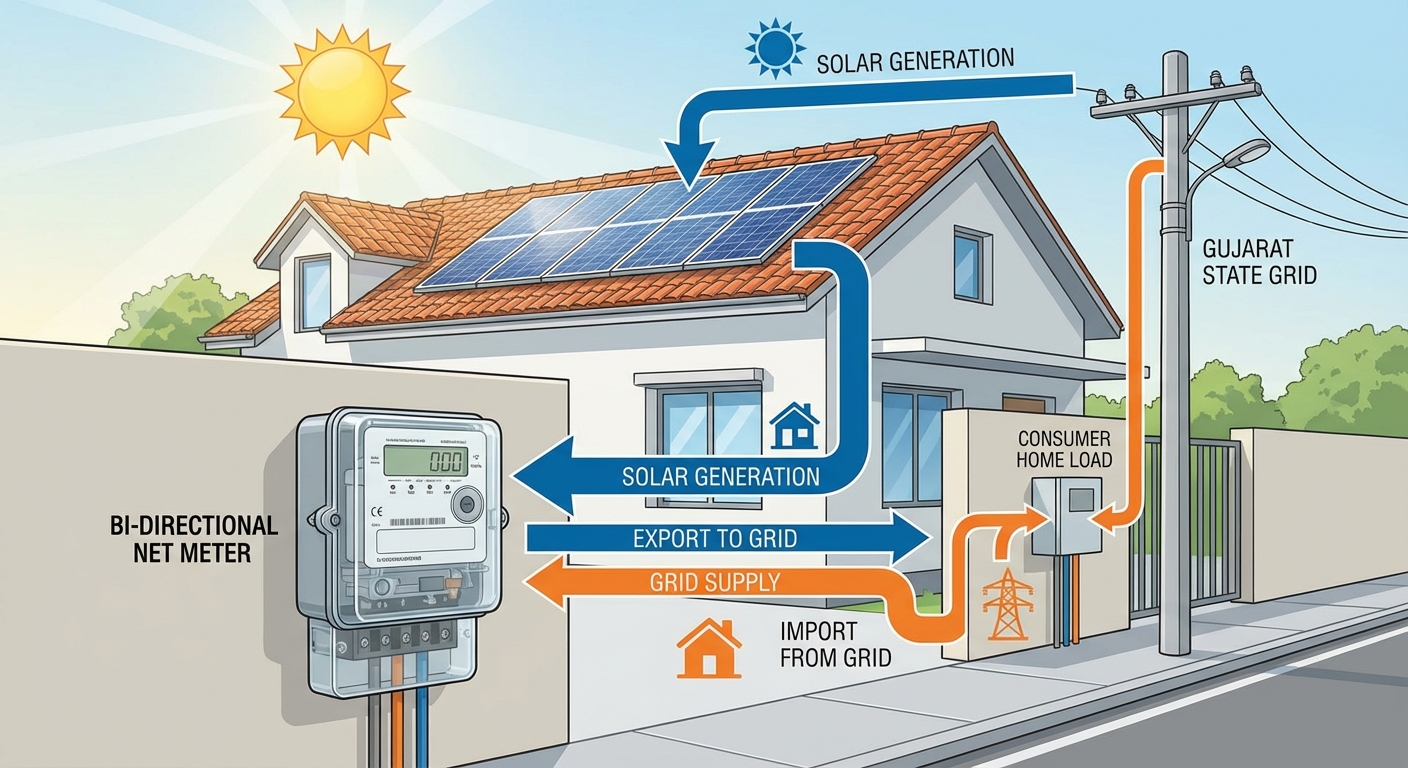
To apply for net metering, you must submit an application to your respective distribution company either online through their portal or at the nearest division office. The application requires your electricity consumer number, details of your proposed solar system including capacity in kilowatts, technical specifications of solar panels and inverters, and a single-line diagram showing how your system will connect to the grid.
Key documents for net metering approval include a copy of your latest electricity bill, proof of property ownership, a technical proposal prepared by your solar installer including system design and equipment specifications, manufacturer datasheets for solar panels and inverters, and a test certificate for the inverter showing it meets grid connectivity standards. Your installer should provide most of these technical documents.
Gujarat’s net metering regulations specify system capacity limits based on your sanctioned load. For residential consumers, the solar system capacity cannot exceed your sanctioned load or 10 kW, whichever is lower, without special approval. Commercial and industrial consumers have higher limits, typically up to their contract demand. Understanding these limits is essential when sizing your system.
The processing time for net metering approval typically takes fifteen to thirty days from the date of complete application submission. The distribution company conducts a technical feasibility study to ensure the local grid can accommodate your solar system. Once approved, they issue a feasibility approval letter, which you need before proceeding with installation. After installation, a final inspection is conducted before the bi-directional meter is installed and your system is commissioned.
3. Municipal Corporation Permissions Across Gujarat
Municipal approvals form another essential layer of solar permits Gujarat, particularly for rooftop installations. These permissions ensure your solar project complies with local building codes, structural safety requirements, and urban planning regulations. The specific requirements vary slightly across different cities in Gujarat.
In Surat, the Surat Municipal Corporation requires building permission for rooftop solar installations, especially for systems above a certain capacity or those requiring significant structural modifications. You must submit architectural drawings showing the proposed solar panel layout, a structural stability certificate from a licensed structural engineer confirming your roof can support the additional load, and your property tax receipt demonstrating legal ownership.
Ahmedabad Municipal Corporation has similar requirements but places additional emphasis on fire safety compliance, particularly for commercial buildings. You may need to obtain a No Objection Certificate (NOC) from the fire department for larger installations. The corporation also requires setback compliance, ensuring solar panels do not violate building setback regulations or obstruct emergency access routes.
In Junagadh and smaller municipalities, the process is generally more straightforward for residential installations. However, you still need to submit a simple application with your property documents and a basic layout plan. The municipal engineer reviews the application to ensure compliance with local building bylaws.
A structural safety certificate is universally required across Gujarat for rooftop solar installations. This certificate, issued by a licensed structural engineer, confirms that your building’s roof can safely bear the weight of solar panels, mounting structures, and associated equipment. The engineer assesses factors like roof age, construction type, existing load, and structural integrity. This certificate is not just a formality; it protects you from potential structural failures that could cause property damage or injury.
For properties in heritage zones or restricted areas, additional approvals may be necessary. If your building is located in a heritage conservation zone or near protected monuments, you may need clearance from heritage committees. These approvals ensure solar installations do not adversely affect the visual character of historically significant areas. While this adds complexity to solar permits Gujarat, it is manageable with proper planning and consultation with experienced installers.
4. Electricity Board Procedures and Grid Connectivity
After obtaining GEDA registration and municipal permissions, the next critical step in solar permits Gujarat involves detailed coordination with your electricity distribution company for grid connectivity. This process ensures your solar system can safely and legally connect to the electrical grid.
The jurisdiction of Gujarat’s four distribution companies is geographically divided. DGVCL covers districts including Surat, Navsari, Valsad, Dang, and Tapi. MGVCL serves Vadodara, Anand, Kheda, Chhota Udaipur, and surrounding areas. UGVCL handles Ahmedabad, Gandhinagar, Mehsana, Sabarkantha, and northern districts. PGVCL covers Rajkot, Junagadh, Jamnagar, Porbandar, and western Gujarat. Knowing your distribution company is essential for directing your applications correctly.
Once you submit your net metering application, the distribution company conducts a technical feasibility study. This study assesses whether the local distribution network can accommodate your solar system without causing voltage fluctuations, power quality issues, or overloading transformers. The study considers factors like existing grid capacity, transformer rating, distance from the distribution transformer, and the number of existing solar installations in your area.
If the feasibility study is positive, you receive approval to proceed with installation. The distribution company specifies technical requirements including the type of bi-directional meter needed, protection equipment specifications, and earthing requirements. Your solar installer must ensure all equipment meets these specifications to pass final inspection.
The grid connectivity agreement is a formal contract between you and the distribution company outlining the terms and conditions of connecting your solar system to the grid. This agreement covers aspects like net metering calculation methodology, billing procedures, maintenance responsibilities, and disconnection protocols. Review this agreement carefully, as it governs your relationship with the utility for the life of your solar system.
After installation, the distribution company conducts an inspection and commissioning procedure. An authorized engineer visits your site to verify that the installation meets all technical and safety standards. They check the quality of installation, proper earthing, protection devices, system capacity, and compliance with approved drawings. Once satisfied, they authorize the installation of the bi-directional meter and issue a commissioning certificate, completing the solar permits Gujarat process for grid connectivity.
5. Documentation Checklist for Solar Permits Gujarat
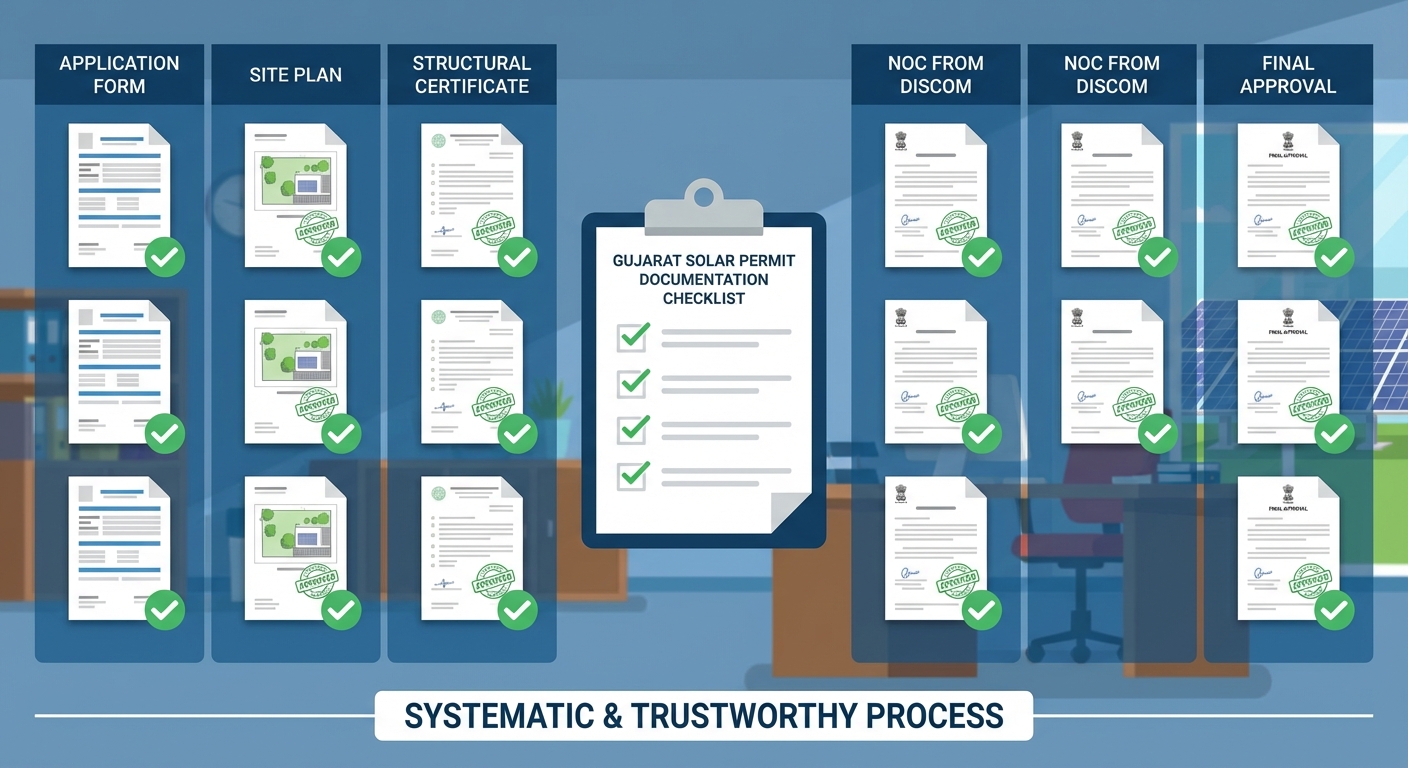
Having a complete documentation checklist is crucial for navigating solar permits Gujarat efficiently. Missing documents are the most common cause of delays and rejections. This comprehensive checklist covers residential, commercial, and industrial installations across Gujarat.
Residential Solar Installation Documents
For residential rooftop solar projects, you need the following core documents. Start with your electricity bill showing your consumer number, sanctioned load, and billing history for the past six months. This establishes your electricity consumption pattern and eligibility for net metering.
Property ownership documents are essential, including your property tax receipt, title deed, or sale deed proving you own the property or have legal authority to install solar panels. If you are a tenant, you need a No Objection Certificate from the property owner.
Identity and address proof include your Aadhaar card, PAN card, and a recent passport-size photograph. These documents verify your identity for GEDA registration and subsidy applications.
Technical documents include a single-line diagram of your proposed solar system showing how panels, inverters, and meters connect. Your solar installer typically prepares this. You also need manufacturer datasheets and test certificates for solar panels and inverters, proving they meet Indian standards and grid connectivity requirements.
A structural stability certificate from a licensed structural engineer confirms your roof can support the solar installation. This is mandatory for obtaining municipal permissions and protects you from structural risks.
Additional Documents for Commercial and Industrial Projects
Commercial and industrial solar installations require additional documentation beyond residential requirements. You need your GST registration certificate and company incorporation documents like the Certificate of Incorporation and Memorandum of Association.
For larger systems, detailed electrical drawings are required, including layout plans, cable routing diagrams, earthing layouts, and protection system designs. These must be prepared by licensed electrical engineers and stamped appropriately.
An environmental clearance may be necessary for very large ground-mounted solar parks or installations in environmentally sensitive areas. Consult with your EPC partner to determine if this applies to your project. Heaven Green Energy’s expertise in turnkey EPC solutions includes handling these complex documentation requirements.
For industrial projects seeking open access or third-party power purchase arrangements, additional agreements and regulatory approvals from the Gujarat Electricity Regulatory Commission (GERC) may be required. These are specialized cases that benefit from experienced legal and technical consultation.
Vendor and Installer Certifications
Your solar installer’s credentials are part of the documentation package for solar permits Gujarat. Ensure your installer is GEDA-empaneled and provides their empanelment certificate. They should also provide proof of technical qualifications, past project experience, and any relevant ISO certifications.
Equipment warranties and guarantees should be documented, including manufacturer warranties for solar panels (typically 25 years for performance), inverter warranties (typically 5-10 years), and installation workmanship warranties. These documents protect your investment and may be required for subsidy claims.
6. Timeline Expectations: From Application to Commissioning
Understanding realistic timelines for solar permits Gujarat helps you plan your project effectively and set appropriate expectations. While individual cases vary, here are typical timeframes for different project types across Gujarat.
For residential solar installations without subsidy, the permit process typically takes four to eight weeks from initial application to final commissioning. This breaks down as follows: GEDA registration (if required) takes seven to fifteen days, net metering application and feasibility approval takes fifteen to thirty days, municipal building permission takes ten to twenty days (often processed in parallel with net metering), and final inspection and meter installation takes seven to ten days after installation completion.
For residential projects with subsidy, add an additional two to four weeks to the timeline. Subsidy applications require additional documentation review and approval stages. The subsidy disbursement itself may take several months after commissioning, though this does not prevent you from using your solar system.
Commercial and industrial projects generally take longer due to their complexity and higher capacity. Expect eight to sixteen weeks for the complete permit process. Larger systems require more detailed technical feasibility studies, additional safety approvals, and more thorough inspections. Ground-mounted solar parks and projects above certain capacity thresholds may require environmental clearances, adding further time.
Several factors can affect these timelines. Complete and accurate documentation submitted the first time significantly speeds up the process. Incomplete applications get rejected and must be resubmitted, adding weeks to your timeline. Working with experienced installers who understand solar permits Gujarat requirements helps avoid these delays.
The location within Gujarat also matters. Urban areas like Surat, Ahmedabad, and Vadodara generally have more streamlined processes and faster turnaround times due to higher volumes and better infrastructure. Smaller towns and rural areas may experience longer processing times due to limited administrative resources.
Peak application periods can cause delays. When new subsidy schemes are announced or deadlines approach, permit offices experience higher application volumes, slowing processing times. Planning your project during off-peak periods can result in faster approvals.
To expedite the solar permits Gujarat process, work with a GEDA-empaneled installer with proven experience in your area. They understand local requirements and have established relationships with regulatory authorities. Ensure all documentation is complete and accurate before submission. Respond promptly to any queries or requests for additional information from authorities. Consider engaging a dedicated project coordinator if you are undertaking a large commercial or industrial installation.
Common Challenges and How to Overcome Them
Even with careful planning, you may encounter challenges while navigating solar permits Gujarat. Understanding common issues and their solutions helps you address problems quickly and keep your project on track.
Incomplete documentation is the most frequent challenge. Applications are often rejected because of missing signatures, outdated documents, or incorrect formats. Solution: Create a comprehensive checklist before starting your application. Have your installer review all documents for completeness. Keep digital and physical copies organized in clearly labeled folders. Double-check that all documents are current and properly signed.
Technical specification mismatches occur when the equipment you install does not match what was approved in your application. This happens when you change panel brands, inverter models, or system capacity after receiving approvals. Solution: Finalize your equipment selection before applying for permits. If changes become necessary, inform the relevant authorities immediately and submit revised technical specifications. Do not proceed with installation until revised approvals are received. Choosing quality equipment from the start reduces the temptation to make changes later; explore options in our comparison of top solar panel brands available in Gujarat.
Coordination between multiple authorities can be complex. You are dealing with GEDA, your distribution company, municipal corporation, and potentially other agencies simultaneously. Each has different timelines, requirements, and communication channels. Solution: Maintain a detailed tracking spreadsheet with application numbers, submission dates, expected response dates, and contact information for each authority. Set calendar reminders to follow up. Consider working with an experienced EPC partner who can manage this coordination on your behalf.
Dealing with rejections and resubmissions is frustrating but sometimes unavoidable. When an application is rejected, carefully review the rejection notice to understand the specific reasons. Solution: Address each point raised in the rejection systematically. If the reason is unclear, contact the authority directly for clarification. Resubmit with a cover letter specifically addressing how you have corrected each issue. Learn from the rejection to ensure other pending applications do not have similar problems.
Structural concerns sometimes arise during municipal review, particularly for older buildings or those with unconventional roof designs. Solution: Engage a qualified structural engineer early in the process. If concerns are raised, the engineer can provide additional calculations, propose reinforcement solutions, or recommend alternative mounting approaches. In some cases, reducing system size or relocating panels to stronger roof sections resolves the issue.
Grid capacity limitations occasionally prevent net metering approval in areas with many existing solar installations or weak grid infrastructure. Solution: If your application is rejected due to grid constraints, ask the distribution company about the timeline for grid upgrades. You may be able to install your system and connect later when capacity becomes available. Alternatively, consider a smaller system that fits within available capacity, or explore off-grid or hybrid solutions that do not require grid connection.
Working with experienced EPC partners dramatically reduces these challenges. Established companies like Heaven Green Energy have processed hundreds of solar permits Gujarat applications and understand how to navigate the system efficiently. They maintain relationships with regulatory authorities, stay updated on changing requirements, and can troubleshoot issues quickly. This expertise translates to faster approvals and fewer headaches for you.
Subsidy and Incentive Documentation
Government subsidies and incentives make solar energy more affordable, but they come with additional documentation requirements as part of solar permits Gujarat. Understanding these requirements ensures you can access available financial support.
The PM-KUSUM scheme (Pradhan Mantri Kisan Urja Suraksha evam Utthaan Mahabhiyan) supports farmers and rural communities in Gujarat with solar installations. Component A covers large-scale ground-mounted solar projects, Component B supports individual farmers installing solar pumps, and Component C provides for solarization of existing grid-connected agricultural pumps. Each component has specific documentation requirements.
For PM-KUSUM applications, you need land ownership documents proving you own agricultural land, a copy of your agricultural electricity connection (for Component C), bank account details for subsidy disbursement, and Aadhaar-linked documentation. The application process goes through GEDA, and you must use GEDA-empaneled vendors to remain eligible for subsidies.
The residential rooftop solar subsidy program provides financial support for homeowners installing solar systems. As of 2026, subsidies are available for systems up to 3 kW capacity, with specific rates per kilowatt. To apply, you must submit your application through the national portal or GEDA’s state portal before installation begins. Installing first and applying later typically disqualifies you from subsidies.
Required documents for residential subsidies include all standard solar permits Gujarat documentation plus proof of subsidy application approval, photographs of the installation at various stages, a commissioning report signed by the installer and verified by the distribution company, and bank account details linked to your Aadhaar for direct benefit transfer.
Additional permits required for subsidy claims include the final commissioning certificate from your distribution company, the bi-directional meter installation certificate, and a performance test report showing your system generates the expected power output. These documents prove your system is operational and meets quality standards.
The timeline for subsidy disbursement varies but typically takes three to six months after commissioning and submission of all required documents. The subsidy is usually transferred directly to your bank account via direct benefit transfer. Some programs disburse subsidies to the installer, who then reduces your upfront cost, while others reimburse you after installation.
How permits affect subsidy eligibility is crucial to understand. You must obtain all required permits and approvals before installation to remain eligible. Installing without proper permits, using non-empaneled vendors, or deviating from approved specifications can disqualify you from subsidies entirely. The financial impact can be significant, so strict compliance with solar permits Gujarat requirements is essential when seeking subsidies.
Even without subsidies, solar energy offers excellent returns on investment through electricity savings. Understanding your payback period helps you make informed decisions; learn more in our detailed analysis of solar payback periods and break-even timelines.
Your Path to Hassle-Free Solar Installation in Gujarat
Navigating solar permits Gujarat may seem complex, but with proper understanding and the right partner, it becomes a manageable process that protects your investment and ensures legal compliance. From GEDA registration and net metering applications to municipal permissions and grid connectivity procedures, each step serves an important purpose in creating a safe, efficient, and financially beneficial solar installation.
The key to success lies in thorough preparation, complete documentation, and working with experienced professionals who understand Gujarat’s regulatory landscape. Whether you are installing a small residential system in Surat, a commercial project in Ahmedabad, or an industrial installation in Junagadh, following the proper permit process ensures your solar system operates legally, connects seamlessly to the grid, and qualifies for available subsidies and incentives.
Remember that timelines vary based on project type, location, and documentation completeness. Starting the permit process early, maintaining organized records, and responding promptly to authority requests keeps your project on schedule. While challenges may arise, they are manageable with the right approach and expert guidance.
At Heaven Green Energy, we have successfully navigated solar permits Gujarat for thousands of installations across the state since 2017. Our team handles the entire documentation and approval process, coordinating with GEDA, distribution companies, and municipal authorities on your behalf. From initial GEDA registration through final commissioning, we ensure your project moves forward smoothly, allowing you to focus on the benefits of clean, affordable solar energy rather than paperwork complexities.
Ready to start your solar journey with expert guidance through every permit and approval? Our experienced team is here to make your solar installation hassle-free. Have any questions? Call us at +91 63904 05060 to discuss your project and learn how we can handle all aspects of solar permits Gujarat for your residential, commercial, or industrial installation. Let us turn your solar vision into reality with complete peace of mind.
This blog post was written using thestacc.com