


Choosing the right solar system for your property in Gujarat can feel overwhelming. With three distinct types available—on-grid, off-grid, and hybrid—each offering unique benefits and trade-offs, making an informed decision requires understanding how these solar systems Gujarat options align with your specific needs, budget, and location. Whether you’re a homeowner in Ahmedabad looking to reduce electricity bills, a factory owner in Surat seeking energy independence, or a farmer in rural Junagadh dealing with frequent power cuts, this comprehensive guide will help you navigate the decision.
Gujarat has emerged as a solar powerhouse in India, with abundant sunshine averaging 5.5 to 6.5 peak sun hours daily and progressive policies supporting renewable energy adoption. However, the state’s diverse electricity infrastructure—from highly reliable urban grids to intermittent rural connections—means that the ideal solar solution varies significantly based on your location and requirements. By the end of this article, you’ll have a clear framework to determine which solar system type delivers the best return on investment and energy security for your Gujarat property in 2026.
Understanding Solar Systems Gujarat: The Three Main Types
Before diving into detailed comparisons, it’s essential to understand the fundamental differences between the three main solar systems Gujarat residents and businesses can choose from. Each system type represents a different approach to generating, storing, and utilizing solar energy, with distinct implications for cost, functionality, and energy independence.
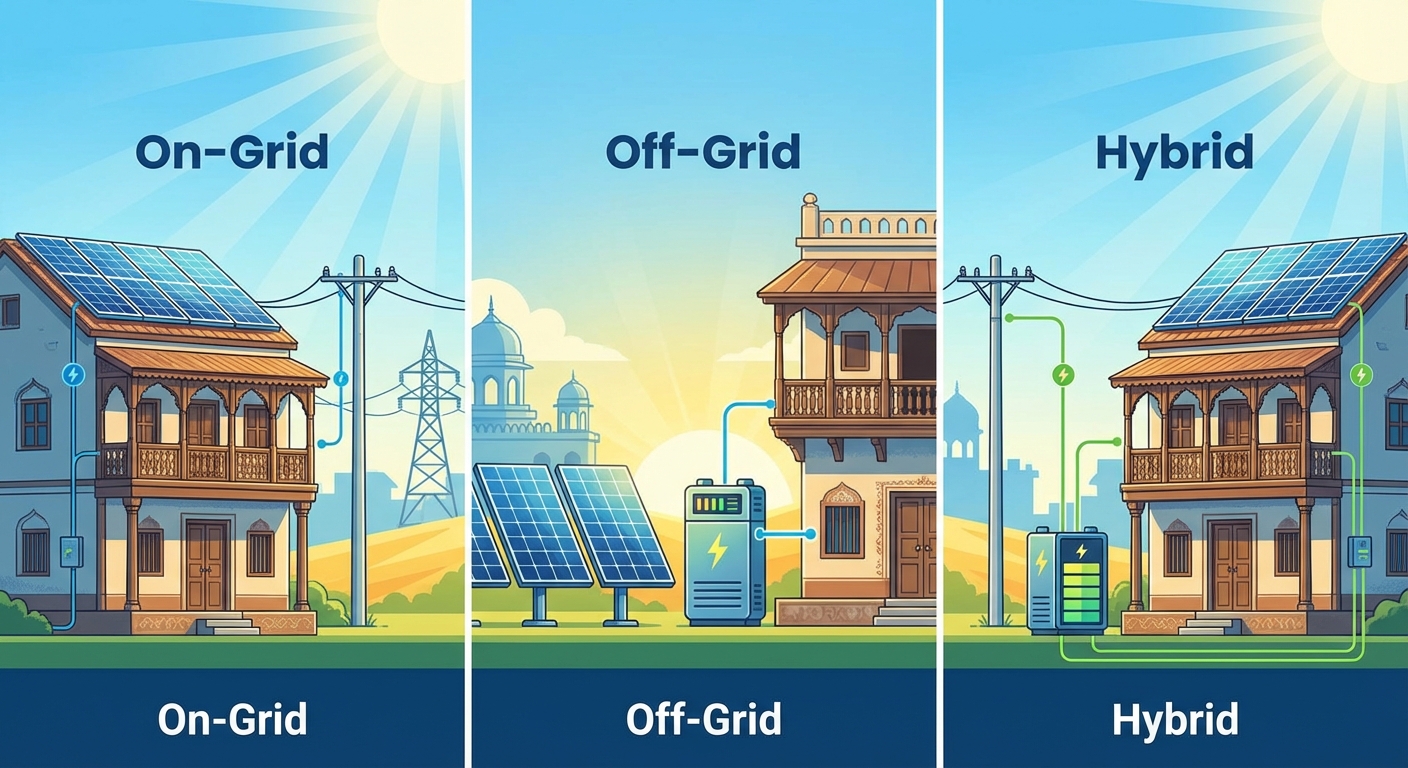
On-grid solar systems connect directly to Gujarat’s electricity grid, allowing you to use solar power when available and draw from the grid when needed. These systems enable net metering, where excess solar energy is exported to the grid, earning you credits that offset your electricity bills. On-grid systems are the most economical option and work seamlessly with Gujarat’s urban electricity infrastructure.
Off-grid solar systems operate independently from the electricity grid, relying entirely on solar panels and battery storage to meet your power needs. These systems provide complete energy autonomy, making them ideal for remote locations in Gujarat where grid connectivity is unreliable or unavailable. The trade-off is higher upfront costs due to substantial battery requirements and the need for careful capacity planning.
Hybrid solar systems combine the best features of both on-grid and off-grid solutions. They connect to the grid while incorporating battery storage, providing backup power during outages while still allowing you to benefit from net metering. Hybrid systems have gained significant popularity in Gujarat’s commercial sector and among homeowners who experience occasional but disruptive power cuts.
Choosing the right system depends on several critical factors specific to Gujarat: your location’s grid reliability, your daily power consumption patterns, your budget for initial investment, your tolerance for power interruptions, and your long-term energy goals. Understanding these factors in the context of each system type will guide you toward the optimal solution.
What is an On-Grid Solar System?
An on-grid solar system, also called a grid-tied or grid-connected system, is the most straightforward and cost-effective solar solution available in Gujarat. These systems work in tandem with the existing electricity grid provided by Gujarat Urja Vikas Nigam Limited (GUVNL) or your local distribution company, creating a symbiotic relationship that maximizes both savings and convenience.
The operation is elegantly simple: during daylight hours, your solar panels generate electricity that powers your home or business. When your panels produce more electricity than you’re consuming, the excess flows back into the grid through a bidirectional meter. This exported energy earns you credits under Gujarat’s net metering policy, effectively running your electricity meter backward. At night or during cloudy periods when your panels aren’t producing enough power, you draw electricity from the grid as usual, using the credits you’ve accumulated to offset these charges.
The core components of an on-grid system include high-efficiency solar modules, a grid-tie inverter that converts DC power from panels to AC power compatible with the grid, mounting structures, wiring, and a net meter installed by your electricity distribution company. Notably absent from this setup are batteries, which significantly reduces both initial costs and ongoing maintenance requirements.
On-Grid Solar Systems Gujarat: Pros and Cons
On-grid systems offer compelling advantages for Gujarat properties with stable grid connectivity. The lower upfront cost makes solar accessible to more homeowners and businesses, with residential systems typically costing 30-40% less than equivalent hybrid systems. You avoid the expense and hassle of battery maintenance, replacement, and disposal. The net metering benefit in Gujarat allows you to maximize your solar investment by monetizing every unit of electricity your system produces.
Additionally, on-grid systems are infinitely scalable—you’re never limited by battery capacity. If your energy needs grow, you can expand your system without worrying about storage constraints. The simplicity of installation and minimal maintenance requirements make these systems particularly attractive for first-time solar adopters in cities like Ahmedabad, Surat, Vadodara, and Rajkot where grid reliability is excellent.
However, on-grid systems have one significant limitation: no backup power during grid outages. When the grid goes down, your solar system automatically shuts off for safety reasons, even if the sun is shining brightly. This is a critical consideration in areas of Gujarat that experience frequent or prolonged power cuts. For businesses that cannot tolerate any downtime or households with medical equipment requiring uninterrupted power, this dependency on grid availability can be a dealbreaker.
In terms of cost, a typical 3kW on-grid residential system in Gujarat ranges from ₹1,50,000 to ₹1,80,000, while a 5kW system costs approximately ₹2,40,000 to ₹2,80,000. Commercial and industrial installations benefit from economies of scale, with per-kilowatt costs decreasing for larger systems. These prices include installation but may vary based on equipment quality and solar panel brands selected.
What is an Off-Grid Solar System?
An off-grid solar system represents complete energy independence, a self-contained power generation and storage solution that operates entirely without connection to Gujarat’s electricity grid. These systems are designed to meet 100% of your electricity needs through solar generation and battery storage, making them the ultimate solution for energy autonomy.
Off-grid systems require meticulous planning and sizing. Your solar array must be large enough to meet your daily energy consumption while simultaneously charging batteries to provide power during nighttime and cloudy periods. The battery bank must store sufficient energy to cover your needs during extended periods of low solar production, typically calculated to provide 2-3 days of backup capacity in Gujarat’s climate.
The component list for off-grid systems is more extensive than on-grid setups. You need solar panels, a charge controller to regulate battery charging and prevent overcharging, a substantial battery bank (typically deep-cycle lead-acid or lithium-ion batteries), an off-grid inverter to convert stored DC power to AC power for your appliances, and robust mounting and wiring infrastructure. The battery bank represents the single largest cost component and requires replacement every 5-10 years depending on battery technology and usage patterns.
Off-grid solar systems Gujarat installations are most common in rural and remote areas where grid connectivity is absent, unreliable, or prohibitively expensive to establish. Farmhouses, agricultural operations, remote industrial facilities, and rural residential properties across Gujarat’s less-developed regions are prime candidates for off-grid solutions.
Off-Grid Solar Systems: Pros and Cons for Gujarat
The primary advantage of off-grid systems is complete energy independence. You’re immune to grid failures, power cuts, and electricity rate increases. For properties in remote areas of Gujarat where grid connection costs can exceed ₹5-10 lakhs or where power supply is unreliable for 4-6 hours daily, off-grid systems provide a viable and often more economical long-term solution.
Off-grid systems also offer environmental benefits beyond typical solar installations. By eliminating transmission losses inherent in grid-connected systems and reducing dependence on fossil fuel-based grid power during peak demand periods, these systems maximize your carbon footprint reduction. For agricultural applications in Gujarat, off-grid solar can power irrigation pumps, cold storage, and farm operations without monthly electricity bills.
However, the disadvantages are substantial. Higher upfront costs due to battery requirements make off-grid systems 60-80% more expensive than comparable on-grid installations. A 5kW off-grid system in Gujarat typically costs ₹4,50,000 to ₹5,50,000, with battery replacement adding ₹1,50,000 to ₹2,50,000 every 5-10 years. Battery maintenance requires regular monitoring, periodic water top-ups for lead-acid batteries, and proper temperature management to maximize lifespan in Gujarat’s hot climate.
Capacity limitations present another challenge. Unlike grid-tied systems where you can draw unlimited power from the grid when needed, off-grid systems are constrained by your battery capacity and solar generation. Running high-power appliances simultaneously or experiencing several consecutive cloudy days can deplete your battery bank, leaving you without power. This requires careful load management and sometimes lifestyle adjustments that many urban Gujarat residents find inconvenient.
Off-grid systems also typically don’t qualify for net metering benefits or certain government subsidies available for grid-connected installations, further impacting the financial equation. The complexity of system design and installation requires working with experienced solar EPC companies who understand off-grid system engineering and Gujarat’s specific climatic conditions.
What is a Hybrid Solar System?
Hybrid solar systems represent the evolution of solar technology, combining grid connectivity with battery storage to deliver the advantages of both on-grid and off-grid solutions while minimizing their respective drawbacks. These sophisticated systems have become increasingly popular among Gujarat’s commercial establishments and discerning homeowners who refuse to compromise between savings and energy security.
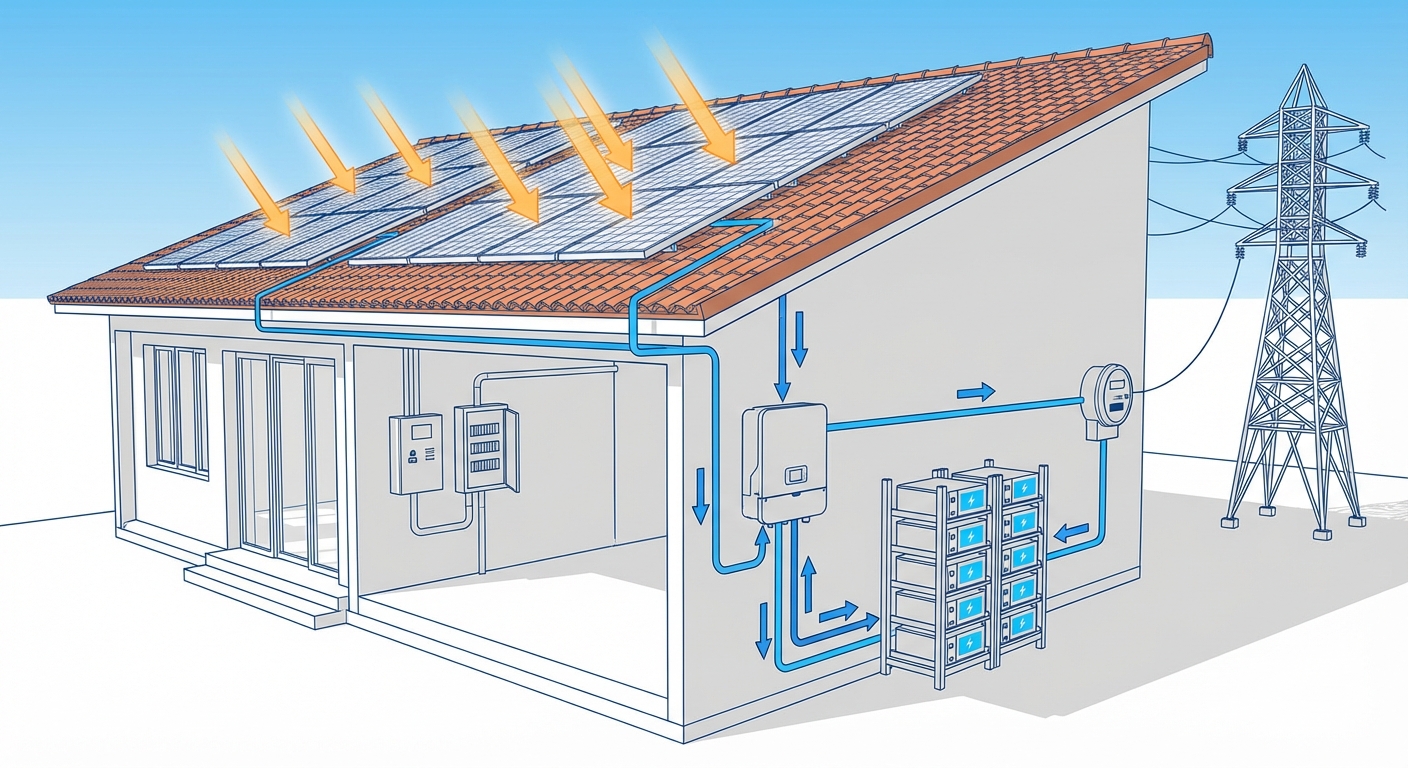
A hybrid system operates intelligently across multiple modes. During sunny periods, your solar panels first power your immediate electricity needs. Excess generation charges your battery bank, and any surplus beyond that is exported to the grid for net metering credits. When solar production is insufficient, the system draws from batteries before tapping into grid power, minimizing your electricity bills. During grid outages, the system seamlessly switches to battery backup, keeping your critical loads operational without interruption.
The key component distinguishing hybrid systems is the hybrid inverter, a sophisticated device that manages power flow between solar panels, batteries, grid connection, and your electrical loads. Modern hybrid inverters feature smart energy management capabilities, allowing you to prioritize battery charging during off-peak hours when grid electricity is cheaper, or to reserve battery capacity specifically for backup during anticipated outages.
Hybrid solar systems Gujarat installations typically include high-efficiency solar modules, a hybrid inverter with built-in charge controller, a battery bank (smaller than off-grid systems since grid backup is available), bidirectional metering for net metering, and comprehensive monitoring systems that provide real-time insights into energy production, consumption, and storage levels.
Hybrid Solar Systems Gujarat: Pros and Cons
Hybrid systems deliver comprehensive energy security without sacrificing financial benefits. You enjoy net metering advantages like on-grid systems while maintaining backup power capability during outages. This dual benefit is particularly valuable in Gujarat’s tier-2 and tier-3 cities where grid reliability is good but not perfect, with occasional outages lasting 1-3 hours during peak summer months or monsoon storms.
The flexibility of hybrid systems is unmatched. You can start with a smaller battery bank and expand it later as your budget allows or as your backup power needs increase. You can configure the system to provide whole-house backup or prioritize critical loads like refrigerators, computers, medical equipment, and lighting. For commercial establishments in Gujarat, from retail stores to small manufacturing units, this selective backup capability ensures business continuity without the expense of backing up heavy machinery or non-essential loads.
Hybrid systems also offer future-proofing advantages. As Gujarat’s electricity tariffs continue rising and time-of-use pricing becomes more common, hybrid systems allow you to store solar energy generated during the day and use it during expensive evening peak hours, maximizing your savings. The battery component also provides a hedge against grid instability and supports Gujarat’s broader renewable energy goals.
The primary disadvantage is higher cost compared to on-grid systems. A 5kW hybrid system in Gujarat typically costs ₹3,80,000 to ₹4,50,000, representing a 50-60% premium over equivalent on-grid installations. Battery replacement costs, while lower than off-grid systems due to smaller battery banks, still add ₹80,000 to ₹1,50,000 every 5-10 years depending on battery technology and usage patterns.
Installation complexity is another consideration. Hybrid systems require more sophisticated design, proper battery placement with adequate ventilation, and configuration of backup load panels. This necessitates working with qualified solar installation Gujarat professionals who have specific experience with hybrid system integration. Maintenance requirements, while manageable, exceed those of simple on-grid systems due to battery monitoring and periodic checks.
Solar System Cost Comparison in Gujarat 2026
Understanding the complete financial picture, including upfront costs, ongoing expenses, and long-term returns, is essential for making an informed decision about solar systems Gujarat installations. The following breakdown reflects current market conditions in Gujarat for 2026, though prices vary based on equipment quality, installation complexity, and specific site requirements.
For a 3kW residential system, on-grid installations range from ₹1,50,000 to ₹1,80,000, hybrid systems cost ₹2,40,000 to ₹2,90,000, and off-grid systems run ₹2,80,000 to ₹3,40,000. The 3kW capacity typically suits small homes or apartments with modest electricity consumption of 300-400 units monthly.
A 5kW residential system, suitable for medium to large homes consuming 500-700 units monthly, costs ₹2,40,000 to ₹2,80,000 for on-grid, ₹3,80,000 to ₹4,50,000 for hybrid, and ₹4,50,000 to ₹5,50,000 for off-grid configurations. This capacity is the most popular choice among Gujarat homeowners, offering substantial electricity bill savings while remaining affordable for middle-class families.
For 10kW commercial systems, which suit small businesses, clinics, or large residential properties, on-grid installations cost ₹4,50,000 to ₹5,20,000, hybrid systems range from ₹7,20,000 to ₹8,50,000, and off-grid setups run ₹8,50,000 to ₹10,50,000. Commercial installations benefit from accelerated depreciation tax benefits and typically achieve faster payback periods due to higher daytime consumption patterns that align well with solar generation.
Beyond initial installation, consider ongoing costs. On-grid systems have minimal maintenance expenses, typically ₹3,000 to ₹5,000 annually for cleaning and inspections. Hybrid and off-grid systems add battery maintenance costs of ₹5,000 to ₹10,000 annually, plus eventual battery replacement. Lead-acid batteries require replacement every 5-7 years, while lithium-ion batteries last 10-12 years but cost approximately double upfront.
The solar panel cost component represents about 40-50% of total system cost for on-grid installations, with inverters accounting for 15-20%, and installation labor and materials comprising the remainder. For hybrid and off-grid systems, batteries represent 30-40% of total cost, significantly altering the cost structure.
Return on investment varies by system type and usage pattern. On-grid systems in Gujarat typically achieve payback in 4-6 years, with 25-year lifetime savings of ₹12-18 lakhs for a 5kW system. Hybrid systems have longer payback periods of 6-8 years but provide additional value through backup power that’s difficult to quantify financially. Off-grid systems in areas with reliable grid access rarely make financial sense, but in remote locations where grid connection costs exceed ₹5 lakhs, they can achieve payback in 7-10 years while providing superior reliability. For detailed ROI calculations specific to your situation, review our guide on solar payback periods.
Government subsidies significantly improve the financial equation for residential installations. Under the PM-KUSUM and rooftop solar schemes, Gujarat residents can receive subsidies of ₹14,588 per kW for systems up to 3kW, and ₹7,294 per kW for additional capacity up to 10kW. These subsidies apply primarily to on-grid systems, though some hybrid configurations may qualify. Commercial and industrial installations typically don’t receive direct subsidies but benefit from accelerated depreciation and other tax incentives.
Gujarat’s Electricity Infrastructure: What You Need to Know
Gujarat’s electricity infrastructure varies dramatically across the state, and understanding your local grid conditions is crucial for selecting the appropriate solar system type. This diversity stems from Gujarat’s mix of highly urbanized industrial centers, developing tier-2 cities, and rural agricultural regions, each with distinct power supply characteristics.
Urban areas including Ahmedabad, Surat, Vadodara, and Rajkot enjoy highly reliable grid connectivity with minimal planned or unplanned outages. Power supply in these cities is typically uninterrupted for 23-24 hours daily, with occasional brief outages during severe weather or maintenance activities. For properties in these areas, on-grid systems deliver maximum financial returns, as the reliable grid effectively serves as unlimited free battery storage through net metering.
Tier-2 cities and industrial areas like Ankleshwar, Vapi, Bharuch, and Morbi experience good but not perfect grid reliability. Power cuts of 1-3 hours occur occasionally, particularly during peak summer months when demand strains the system. These areas represent the sweet spot for hybrid solar systems, where the modest additional investment in battery backup provides valuable insurance against business disruption or household inconvenience without the full cost of off-grid systems.
Rural Gujarat, particularly in districts like Banaskantha, Patan, Dahod, and parts of Kutch, faces more significant grid challenges. Power supply can be interrupted for 4-8 hours daily in some areas, with longer outages during agricultural seasons when irrigation demand peaks. For these locations, hybrid systems with larger battery banks or even off-grid systems may be justified, depending on the criticality of uninterrupted power supply.
Gujarat’s net metering policy, governed by GUVNL regulations, allows solar system owners to export excess generation to the grid and receive credits at rates close to retail electricity prices. The policy supports systems up to 500kW for commercial installations and up to 1MW for industrial consumers, making rooftop solar Gujarat installations financially attractive across all consumer categories. However, net metering is only available for grid-connected systems (on-grid and hybrid), not for off-grid installations.
The connection approval process in Gujarat is relatively streamlined compared to many other Indian states. GUVNL and distribution companies have established online portals for net metering applications, with approval timelines of 30-45 days for residential systems and 60-90 days for larger commercial installations. Working with experienced solar companies Gujarat who understand the regulatory process can significantly expedite approvals and ensure compliance with technical requirements.
Electricity tariffs in Gujarat vary by consumer category and consumption slabs. Residential consumers pay ₹3.50 to ₹7.50 per unit depending on monthly consumption, with higher slabs paying premium rates. Commercial tariffs range from ₹6.50 to ₹8.50 per unit, while industrial consumers pay ₹5.50 to ₹7.50 per unit plus demand charges. These relatively high tariffs make solar economically attractive, with on-grid systems effectively generating electricity at ₹2.50 to ₹3.50 per unit over their lifetime, delivering substantial savings.
Which Solar System is Right for Your Gujarat Property?
Selecting the optimal solar system type requires evaluating your specific circumstances against the characteristics of each system. This decision framework will guide you through the key considerations to identify which solar systems Gujarat option aligns best with your needs, budget, and location.
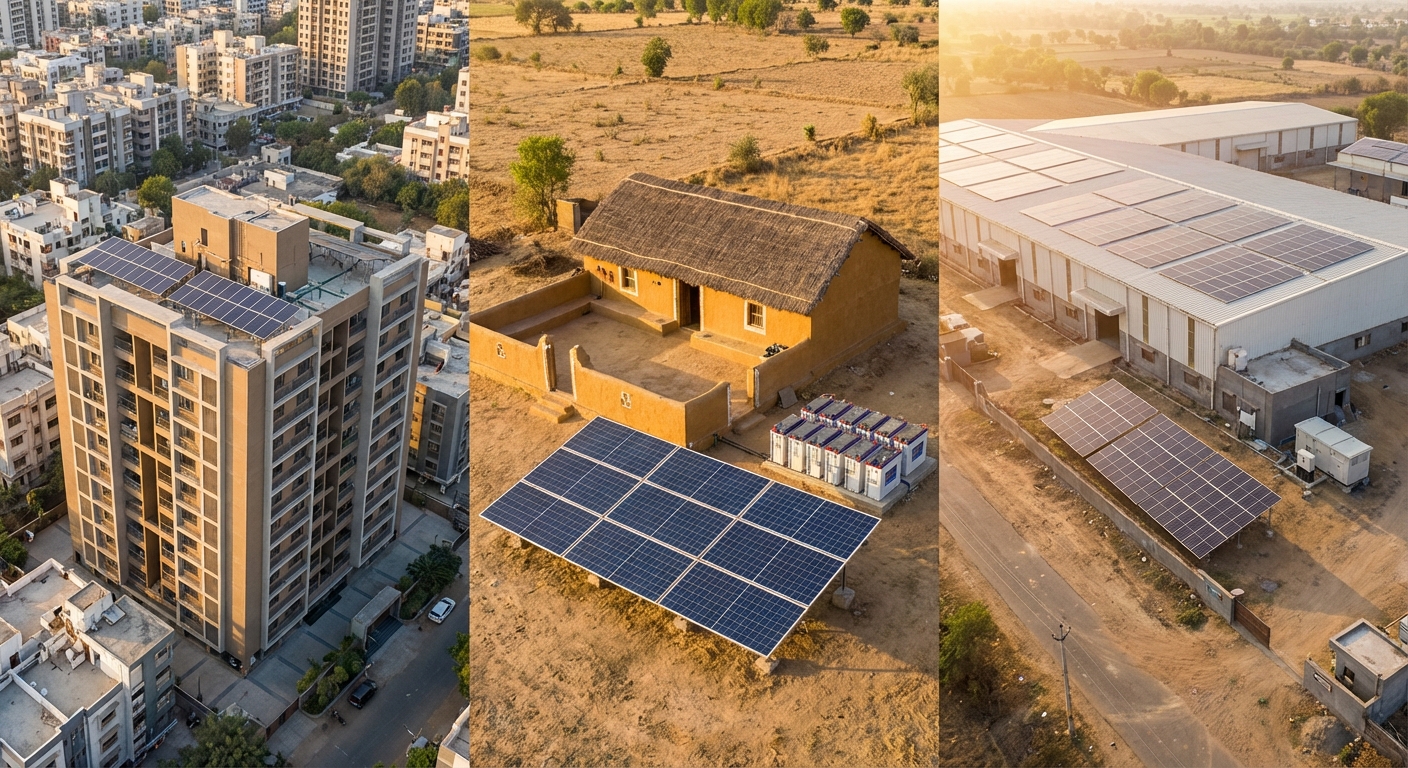
Start by assessing your location and grid reliability. Document the frequency, duration, and timing of power cuts you experience. If outages are rare (less than 5 hours monthly) and brief, on-grid systems maximize financial returns. If you experience regular outages totaling 10-30 hours monthly, hybrid systems provide optimal balance. If power supply is absent or unreliable for more than 4 hours daily, off-grid systems warrant serious consideration.
Next, evaluate your power consumption patterns. Review 12 months of electricity bills to understand your average monthly consumption, seasonal variations, and peak usage times. Properties with high daytime consumption, such as commercial establishments, manufacturing units, or homes with daytime occupancy, benefit most from solar regardless of system type. Evening-heavy consumption patterns favor hybrid systems that can store daytime solar generation for evening use.
Consider your budget and financial priorities. If minimizing upfront investment and maximizing ROI are paramount, on-grid systems are the clear choice. If you can allocate additional budget for energy security and backup power, hybrid systems deliver comprehensive benefits. Off-grid systems make financial sense primarily when grid connection costs are prohibitive or when energy independence is a non-negotiable priority.
Assess your criticality of uninterrupted power. Households with medical equipment, home offices requiring reliable connectivity, or businesses where even brief outages cause significant disruption should prioritize hybrid or off-grid systems. Conversely, if you can tolerate occasional outages without major inconvenience, on-grid systems offer better value.
Factor in your property characteristics. Adequate roof space with proper orientation and minimal shading is essential for all system types. Off-grid and hybrid systems require additional space for battery installation with proper ventilation and temperature control, particularly important in Gujarat’s hot climate where battery performance and lifespan are temperature-sensitive. Structural capacity to support panel weight and mounting systems must be verified, especially for older buildings.
On-Grid Solar Systems Gujarat: Best For
On-grid systems are the optimal choice for urban Gujarat properties with reliable electricity supply. If you’re located in Ahmedabad, Surat, Vadodara, Rajkot, or other major cities where power cuts are minimal, on-grid installations deliver maximum financial returns with minimal complexity.
These systems are ideal for budget-conscious customers seeking to reduce electricity bills without significant upfront investment. First-time solar adopters appreciate the simplicity of on-grid systems, no battery maintenance, straightforward operation, and proven technology with minimal failure points.
Properties with consistent daytime power consumption maximize on-grid benefits. Commercial establishments operating during business hours, educational institutions, daytime manufacturing operations, and homes with daytime occupancy consume solar generation as it’s produced, minimizing grid export and maximizing self-consumption savings.
Customers who can tolerate occasional power cuts without significant disruption, typically residential properties without critical medical equipment or home offices, find on-grid systems perfectly adequate. The rare outages are minor inconveniences rather than serious problems, making the cost premium for battery backup unjustifiable.
Off-Grid Systems: Best For
Off-grid solar systems are purpose-built for Gujarat’s remote and rural locations where grid connectivity is absent, unreliable, or prohibitively expensive to establish. If you’re developing a farmhouse in rural Banaskantha, operating an agricultural facility in remote Kutch, or establishing an industrial unit in an area without reliable power supply, off-grid systems provide viable solutions.
These systems suit customers prioritizing complete energy independence over financial optimization. Environmental enthusiasts, sustainability advocates, and those seeking self-sufficiency find off-grid systems aligned with their values, even when grid connection is technically available.
Agricultural applications across Gujarat represent a major use case for off-grid solar. Irrigation pumps, cold storage facilities, dairy operations, and farm equipment can operate entirely on solar power, eliminating monthly electricity bills and providing reliable power for critical agricultural activities regardless of grid availability.
Properties in areas experiencing frequent extended power cuts, more than 4-6 hours daily, may find off-grid systems more practical and economical than hybrid alternatives. When grid supply is so unreliable that you’d need very large battery banks in a hybrid system anyway, the incremental cost of going fully off-grid becomes minimal while eliminating grid dependency entirely.
Hybrid Systems: Best For
Hybrid solar systems have emerged as the preferred choice for Gujarat’s commercial sector and quality-conscious residential customers who refuse to compromise between savings and reliability. These systems shine in tier-2 cities and suburban areas where grid supply is generally good but occasional outages create disruption.
Commercial establishments requiring uninterrupted power for business continuity, including retail stores, restaurants, clinics, diagnostic centers, small manufacturing units, and professional offices, find hybrid systems invaluable. The ability to maintain operations during grid outages prevents revenue loss, protects equipment from power fluctuations, and ensures customer satisfaction.
Healthcare facilities, data centers, and operations with critical power requirements benefit enormously from hybrid systems. These installations can be configured to provide whole-facility backup or to prioritize critical loads, ensuring essential equipment remains operational regardless of grid conditions while still capturing net metering benefits during normal operations.
Residential customers in areas with moderate power cuts, typically 10-30 hours monthly, find hybrid systems deliver optimal value. The backup capability provides peace of mind and convenience during outages, while the grid connection and net metering ensure strong financial returns that pure off-grid systems cannot match.
Forward-thinking customers anticipating future grid instability, electricity rate increases, or time-of-use pricing find hybrid systems provide valuable flexibility. As Gujarat’s electricity sector evolves, the ability to store and strategically deploy solar energy becomes increasingly valuable, making hybrid systems a future-proof investment.
Solar Subsidy and Financing Options in Gujarat
Government subsidies and financing options significantly improve the affordability and accessibility of solar installation Gujarat projects, particularly for residential consumers. Understanding available incentives and structuring your investment optimally can reduce effective costs by 30-40% and accelerate payback periods substantially.
The PM-KUSUM scheme and rooftop solar subsidy programs offer direct capital subsidies for residential solar installations in Gujarat. For systems up to 3kW capacity, the subsidy is ₹14,588 per kW, providing ₹43,764 for a 3kW system. For capacity between 3kW and 10kW, the subsidy is ₹7,294 per kW for the additional capacity. A 5kW system thus receives ₹43,764 for the first 3kW plus ₹14,588 for the additional 2kW, totaling ₹58,352 in direct subsidy.
These subsidies apply primarily to on-grid systems and certain hybrid configurations that maintain grid connectivity and net metering capability. Off-grid systems typically don’t qualify for residential subsidies, though agricultural off-grid installations may qualify under specific PM-KUSUM components for solar irrigation pumps and farm applications.
The subsidy application process is integrated with the net metering approval process in Gujarat. When you apply for net metering through GUVNL’s online portal, subsidy eligibility is automatically assessed. The subsidy amount is typically disbursed directly to the solar installation company, reducing your out-of-pocket payment. Working with empaneled solar companies Gujarat who are registered under the subsidy scheme ensures smooth processing and timely disbursement.
Beyond direct subsidies, several solar financing options make solar accessible without large upfront payments. Many nationalized and private banks offer dedicated solar loans with interest rates of 9-11% per annum and tenures up to 10 years. These loans often require minimal documentation for salaried individuals and can cover up to 90% of project cost after subsidy.
Non-banking financial companies (NBFCs) and specialized green financing institutions offer flexible solar financing with quick approvals, sometimes within 48-72 hours. While interest rates may be slightly higher at 11-13%, the convenience and speed appeal to customers eager to start their solar journey quickly.
Commercial and industrial consumers, while typically ineligible for direct subsidies, benefit from accelerated depreciation allowing them to depreciate 40% of solar system cost in the first year for tax purposes. This tax benefit significantly improves project economics for businesses, effectively reducing the net investment by 10-15% for companies in higher tax brackets.
Some solar companies in Gujarat offer in-house financing or partnerships with financial institutions, providing one-stop solutions where system design, equipment supply, installation, and financing are bundled together. While convenient, compare these offers carefully against direct bank loans to ensure competitive interest rates and terms.
Installation and Maintenance Considerations
Proper installation and ongoing maintenance are critical for maximizing the performance, lifespan, and returns from your solar investment. The quality of installation often matters as much as equipment quality, making the selection of qualified solar EPC Gujarat contractors a crucial decision.
Installation timelines vary by system type and complexity. On-grid residential systems typically take 3-5 days from commencement to commissioning, including mounting structure installation, panel installation, inverter setup, wiring, and net meter installation. Hybrid systems require 5-7 days due to additional battery installation and configuration. Off-grid systems, particularly larger installations, may take 7-10 days given the complexity of battery bank setup and system balancing.
However, these installation timelines don’t include the approval process. Net metering approval from GUVNL typically takes 30-45 days for residential systems, during which your installer submits technical documentation, load calculations, and system specifications. For commercial systems above 10kW, approvals may take 60-90 days. Plan your solar project timeline accordingly, ideally initiating the process 2-3 months before you want the system operational.
Choosing qualified solar companies Gujarat with proven track records is essential. Look for companies with at least 3-5 years of experience, substantial completed project portfolios in Gujarat, proper licensing and empanelment with GUVNL, and positive customer reviews. Companies offering comprehensive EPC services, engineering, procurement, and construction, provide single-point accountability for system performance.
Verify that your installer uses quality components from reputable manufacturers. Solar panels should carry 25-year performance warranties, inverters should have 5-10 year warranties, and batteries should offer warranties appropriate to their technology (3-5 years for lead-acid, 7-10 years for lithium-ion). Insist on proper documentation, including equipment datasheets, warranty certificates, and installation certifications.
Maintenance requirements vary significantly by system type. On-grid systems require minimal maintenance, primarily periodic cleaning of solar panels to remove dust, bird droppings, and debris that reduce generation efficiency. In Gujarat’s dusty environment, cleaning every 2-3 months is recommended, more frequently during summer months. Annual professional inspections to check wiring connections, inverter performance, and mounting structure integrity cost ₹3,000 to ₹5,000 and help identify potential issues before they cause failures.
Hybrid and off-grid systems require additional battery maintenance. Lead-acid batteries need monthly checks of electrolyte levels and periodic water top-ups, quarterly terminal cleaning to prevent corrosion, and annual capacity testing. Lithium-ion batteries require less hands-on maintenance but benefit from monitoring systems that track individual cell performance and alert you to potential issues. Battery room temperature management is crucial in Gujarat’s climate, maintaining batteries in cool, well-ventilated spaces significantly extends their lifespan.
Modern solar systems increasingly include monitoring capabilities that provide real-time performance data via smartphone apps or web portals. These systems alert you to generation anomalies, inverter faults, or battery issues, enabling proactive maintenance rather than reactive repairs. Insist on monitoring systems as part of your installation, the modest additional cost pays dividends in system reliability and performance optimization.
Warranty and after-sales support deserve careful attention. Verify that your solar company provides responsive after-sales service with local presence in Gujarat. Companies with branch offices in multiple Gujarat cities can provide faster service response than those operating from distant locations. Clarify warranty terms, what’s covered, response times for service calls, and procedures for claiming warranty service. The cheapest quote often comes from companies that disappear after installation, leaving you stranded when issues arise.
Making Your Decision: Solar Systems Gujarat Selection Guide
Armed with comprehensive information about on-grid, off-grid, and hybrid solar systems, you’re ready to make an informed decision for your Gujarat property. Follow this step-by-step framework to identify the optimal solution for your specific circumstances.
Step 1: Assess Your Grid Reliability. Document power cut frequency and duration over the past 3-6 months. If outages total less than 5 hours monthly, on-grid systems are optimal. For 10-30 hours monthly, hybrid systems provide the best balance. For more than 50 hours monthly or no grid access, consider off-grid systems.
Step 2: Analyze Your Power Consumption. Review 12 months of electricity bills to calculate average monthly consumption, identify seasonal patterns, and understand your tariff slab. Properties consuming 300-500 units monthly suit 3-5kW systems, while 500-800 units require 5-7kW systems. Commercial consumers should analyze hourly consumption patterns to optimize system sizing.
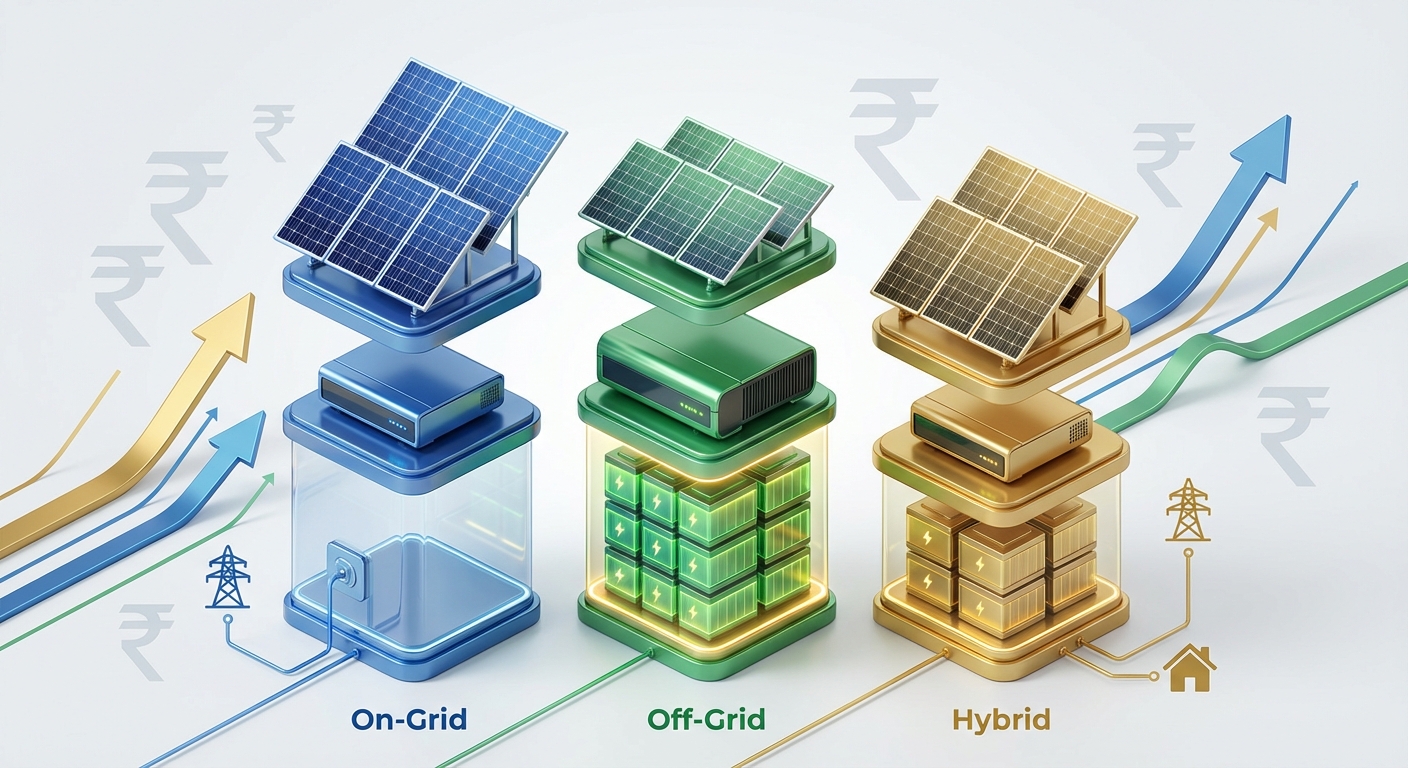
Step 3: Define Your Budget. Determine your available investment for solar, considering both upfront payment and financing options. On-grid systems offer the lowest entry point, hybrid systems require 50-60% additional investment, and off-grid systems cost 80-100% more than on-grid alternatives. Factor in available subsidies that reduce effective costs for residential installations.
Step 4: Prioritize Your Requirements. Rank your priorities: maximum ROI, backup power capability, energy independence, environmental impact, or future-proofing. Your priority ranking will guide system selection when trade-offs are necessary. Commercial customers should quantify the cost of power interruptions to determine justified investment in backup capability.
Step 5: Evaluate Your Property. Assess available roof space, structural capacity, shading issues, and space for battery installation if considering hybrid or off-grid systems. Properties with limited roof space may need higher-efficiency panels, while shading issues may require microinverters or optimizers that add cost but improve performance.
Step 6: Request Professional Site Assessments. Contact 3-4 qualified solar companies Gujarat for site visits and detailed proposals. Reputable companies will conduct thorough assessments, provide customized system designs, offer multiple equipment options at different price points, and explain trade-offs clearly. Be wary of companies pushing single solutions without understanding your specific needs.
Step 7: Compare Proposals Comprehensively. Don’t select based solely on price. Evaluate equipment quality and warranties, company experience and reputation, installation timeline and process, after-sales support and maintenance offerings, and financing options if needed. The lowest quote often uses inferior equipment or comes from inexperienced installers, leading to poor performance and reliability issues.
Step 8: Verify Credentials and References. Check that your selected company is empaneled with GUVNL, holds necessary licenses and certifications, and has completed similar projects in Gujarat. Request references and contact previous customers about their experience with installation quality, system performance, and after-sales support.
Step 9: Review Contracts Carefully. Before signing, ensure contracts clearly specify equipment models and specifications, installation scope and timeline, warranty terms for all components, maintenance responsibilities and costs, and payment schedule tied to project milestones. Avoid contractors demanding full payment upfront, standard practice is 30-40% advance, 50-60% on installation completion, and 10% after commissioning and net meter installation.
Step 10: Plan for Long-Term Success. Once your system is operational, establish a maintenance schedule, monitor performance regularly through your monitoring system, keep warranty documents and service records organized, and budget for eventual battery replacement if you’ve installed hybrid or off-grid systems. Well-maintained solar systems in Gujarat routinely exceed 25-year lifespans, delivering decades of clean energy and savings.
Choosing the right solar system type is one of the most impactful decisions you’ll make for your Gujarat property. On-grid systems maximize financial returns for urban properties with reliable grids, off-grid systems provide independence for remote locations, and hybrid systems deliver comprehensive benefits for those unwilling to compromise between savings and security. By carefully evaluating your specific circumstances against the characteristics of each system type, you can select a solution that delivers optimal value for decades to come.
Ready to start your solar journey in Gujarat? Heaven Green Energy Limited has been helping homeowners, businesses, and industrial facilities across Gujarat harness solar power since 2017. With over 10,000 installations completed and branch offices in Ahmedabad, Surat, and Junagadh, we provide expert guidance on selecting the right solar system type for your specific needs. Our experienced team conducts thorough site assessments, designs customized solutions, handles all approvals and paperwork, and provides comprehensive after-sales support to ensure your solar investment delivers maximum returns. Whether you’re considering on-grid, off-grid, or hybrid solar systems Gujarat installations, we’ll help you make an informed decision and execute a flawless installation. Have Any Questions? +91 63904 05060 to schedule your free site assessment and receive a detailed proposal tailored to your property, consumption patterns, and budget. Take the first step toward energy independence and substantial electricity savings today.
This blog post was written using thestacc.com