


Installing solar panels on your rooftop is just the first step toward energy independence. The real magic happens during solar commissioning Gujarat—the critical phase where your investment transforms from hardware into a fully functional, grid-connected power generation system. This comprehensive testing and handover process ensures your solar system operates safely, efficiently, and in compliance with Gujarat’s regulatory requirements.
Whether you’re a homeowner in Surat, a factory owner in Ahmedabad, or managing an industrial facility in Junagadh, understanding the solar commissioning process helps you know exactly what to expect after installation. This guide walks you through every testing procedure, safety inspection, and documentation requirement that stands between installation completion and your first kilowatt-hour of clean energy generation.
What is Solar System Commissioning?
Solar system commissioning is the systematic process of verifying, testing, and certifying that your newly installed solar energy system meets all technical specifications, safety standards, and performance requirements before it begins regular operation. Think of it as the final quality assurance checkpoint that validates your entire investment.
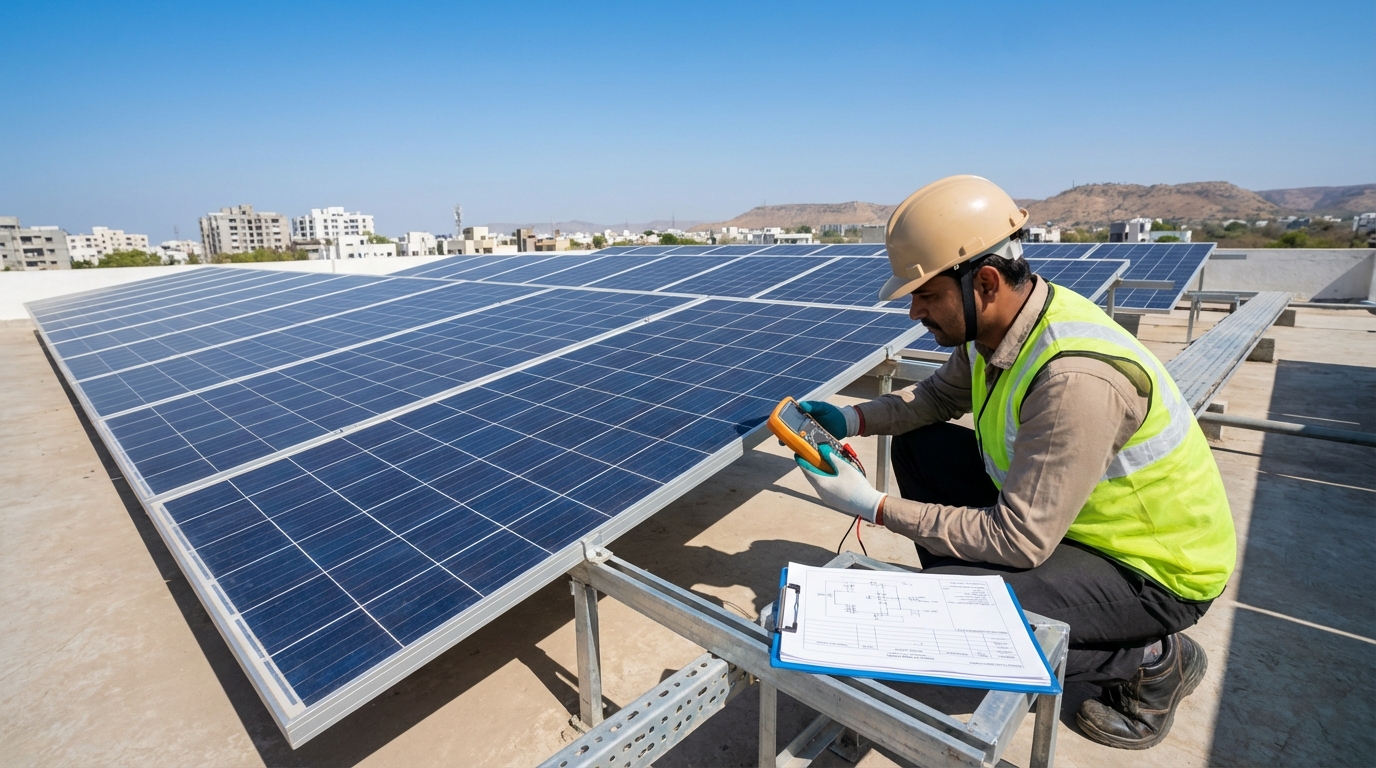
Many people confuse installation with commissioning, but these are distinct phases. Installation involves the physical mounting of solar panels, inverters, and electrical components. Solar commissioning Gujarat begins after installation and involves rigorous testing to ensure everything works correctly together as an integrated system.
In Gujarat, commissioning typically takes 3-7 days depending on system size and complexity. For residential rooftop solar systems under 10 kW, the process usually completes within 3-4 days. Commercial and industrial solar Gujarat installations may require 5-7 days due to more extensive testing requirements and larger system capacities.
The commissioning phase is critical because it identifies potential issues before they become expensive problems. A properly commissioned system will deliver optimal performance, maximize your solar ROI, and operate safely for 25+ years. Gujarat’s regulatory framework mandates specific commissioning procedures to ensure grid stability and consumer safety, making this process non-negotiable for any solar installation in the state.
1. Pre-Commissioning Checks and Preparations
Before any electrical testing begins, experienced solar EPC Gujarat companies conduct thorough visual and mechanical inspections. This pre-commissioning phase catches installation errors that could compromise system performance or safety.
The visual inspection covers every component of your solar installation:
- Module mounting verification: Engineers check that all solar panels are securely fastened with proper torque specifications, aligned correctly for optimal sun exposure, and free from physical damage or manufacturing defects
- Structural integrity assessment: The mounting structure undergoes load-bearing verification to ensure it can withstand Gujarat’s monsoon winds and weather conditions throughout the system’s 25-year lifespan
- Cable routing inspection: All DC and AC cables must be properly routed, secured with appropriate cable ties, protected from UV exposure, and organized to prevent accidental damage during maintenance
- Connection verification: Every electrical connection—from module junction boxes to combiner boxes to inverters—is inspected for proper termination, correct polarity, and secure fastening
- Earthing system checks: The grounding network is verified for continuity, proper bonding of all metallic components, and compliance with Indian Electricity Rules
- Lightning protection: For rooftop solar Gujarat installations, lightning arrestors and surge protection devices are verified for correct installation and proper grounding
Documentation review is equally important during this phase. The commissioning team verifies that all equipment serial numbers match purchase orders, warranty registrations are complete, and installation records accurately reflect the as-built system configuration. This documentation becomes crucial for warranty claims and future maintenance.
The pre-commissioning phase also includes inverter installation verification. Engineers confirm that solar inverters are mounted in well-ventilated locations away from direct sunlight, properly grounded, and positioned for easy access during maintenance. Inverter display panels should be clearly visible, and all indicator lights should be functional.
2. Electrical Testing and Safety Inspections
Once pre-commissioning checks are complete, the solar commissioning Gujarat process moves into detailed electrical testing. This phase uses specialized equipment to measure system parameters and verify safety compliance.
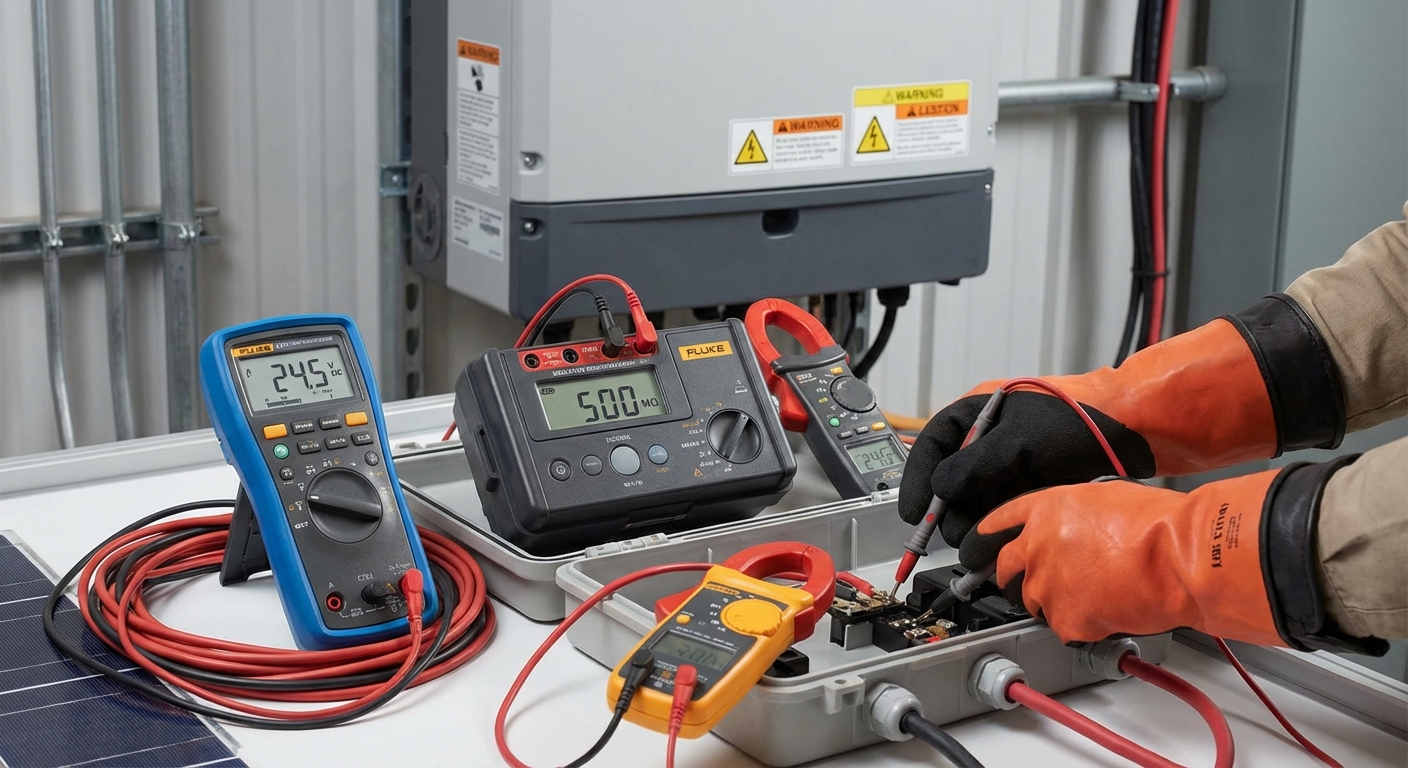
String voltage and current measurements form the foundation of electrical testing. Engineers measure the open-circuit voltage (Voc) and short-circuit current (Isc) of each solar panel string to verify they match manufacturer specifications. These measurements must be taken under specific irradiance conditions and temperature-corrected for accuracy. Any string showing voltage or current deviations beyond 5% indicates potential issues with module quality, shading, or connection problems.
Insulation resistance testing is critical for safety. Using a megohmmeter, technicians apply high voltage (typically 500-1000V DC) between the solar array and ground to measure insulation resistance. Gujarat’s humid climate makes this test especially important, insulation resistance must exceed 1 megaohm to pass safety standards. Low insulation resistance indicates moisture ingress, damaged cables, or compromised junction boxes that could create shock hazards.
Earth continuity testing verifies that all metallic components maintain proper electrical connection to the grounding system. This test ensures that in the event of a fault, dangerous voltages are safely directed to ground rather than creating shock hazards. The resistance between any metallic component and the main earth terminal should not exceed 1 ohm.
Polarity checks confirm that all DC connections maintain correct positive and negative orientation throughout the system. Reversed polarity can damage inverters and create fire hazards. Engineers use specialized DC voltage testers to verify polarity at every connection point from solar modules through combiner boxes to inverter inputs.
Additional safety inspections include:
- Verification of DC disconnect switches and their proper labeling
- Testing of AC circuit breakers and isolation devices
- Confirmation of proper cable sizing for current-carrying capacity
- Fire safety equipment placement and accessibility checks
- Emergency shutdown procedure verification
- Signage and warning label compliance with Indian standards
For industrial solar Gujarat installations, additional safety protocols include arc flash hazard analysis, personal protective equipment (PPE) requirements documentation, and lockout-tagout procedure establishment for maintenance activities.
3. Inverter Configuration and Performance Testing
The solar inverter serves as the brain of your solar energy system, converting DC power from panels into AC power for your home or business. Proper inverter configuration during solar commissioning Gujarat ensures optimal performance and grid compatibility.
Engineers begin by configuring inverter parameters specific to Gujarat’s electrical grid characteristics. This includes setting the nominal grid voltage (typically 230V single-phase or 400V three-phase), frequency (50 Hz), and voltage/frequency operating ranges as specified by GUVNL (Gujarat Urja Vikas Nigam Limited). These settings ensure your system operates within acceptable grid parameters and disconnects automatically if grid conditions fall outside safe ranges.
Anti-islanding protection testing is mandatory for all grid-connected solar installations. This safety feature ensures your solar system immediately shuts down if the main grid loses power, preventing dangerous “islanding” conditions where your system continues energizing grid lines that utility workers assume are de-energized. Testing involves simulating grid disconnection while the system operates and verifying shutdown occurs within 2 seconds.
Power quality measurements assess the “cleanliness” of electricity your system feeds into the grid. Engineers measure total harmonic distortion (THD), power factor, and voltage fluctuations to ensure your system meets IEEE and Indian grid code standards. High-quality solar brands Gujarat typically produce THD below 3%, well within the 5% maximum allowed.
Efficiency testing under different load conditions verifies that your inverter performs according to manufacturer specifications. Engineers measure conversion efficiency at 25%, 50%, 75%, and 100% load levels. Modern inverters should achieve peak efficiency above 97%, with weighted efficiency (accounting for typical operating conditions) above 96%.
The monitoring system setup is the final component of inverter configuration. Technicians configure data logging parameters, set up remote monitoring access, establish alert thresholds for system faults, and verify that generation data transmits correctly to monitoring platforms. This enables you to track your system’s performance and receive immediate notifications of any issues.
4. Grid Connectivity Approval Process in Gujarat
Connecting your solar system to Gujarat’s electrical grid requires formal approval from your local distribution company (DISCOM). This regulatory process ensures grid stability and protects both consumers and utility infrastructure.
The grid connectivity approval process in Gujarat involves several key steps:
GUVNL approval requirements form the regulatory foundation. For rooftop solar systems, you must submit a net metering application to your DISCOM (such as DGVCL, MGVCL, PGVCL, or UGVCL depending on your location). The application includes technical details of your solar installation, single-line diagrams, equipment specifications, and proof of ownership or authorization for the installation premises.
Net metering installation is coordinated between your solar EPC Gujarat provider and the DISCOM. The utility installs a bidirectional meter that tracks both electricity you consume from the grid and excess solar generation you export back to the grid. This meter becomes the basis for calculating your net electricity consumption and any credits for exported power.
DISCOM inspection procedures vary slightly across Gujarat’s regions, but generally include:
- Physical inspection of the solar installation by utility engineers
- Verification of safety equipment and earthing systems
- Review of commissioning test reports and certificates
- Confirmation of anti-islanding protection functionality
- Verification that system capacity matches approved application
- Testing of isolation devices and disconnect switches
Required documentation for grid connection includes the commissioning report, electrical safety certificates, inverter test certificates, module datasheets, single-line diagram, earthing layout, and insurance documentation. Incomplete documentation is the most common cause of approval delays.
Timeline for approval varies across Gujarat. In Surat and Ahmedabad, where solar installation Gujarat is more common, DISCOMs typically complete inspections within 7-15 days of application. In smaller cities and rural areas, the process may take 15-30 days. Experienced EPC companies like Heaven Green Energy maintain strong relationships with local DISCOMs, often expediting the approval process through proper documentation and proactive coordination.
Common issues during grid approval include documentation errors, system capacity mismatches with approved applications, inadequate earthing systems, and missing safety equipment. Working with an experienced solar EPC services provider ensures these issues are addressed proactively during installation and commissioning, avoiding costly delays.
5. Performance Verification and Load Testing
With electrical testing complete and grid approval secured, solar commissioning Gujarat enters the performance verification phase. This critical step confirms your system generates the expected power output and operates efficiently under real-world conditions.
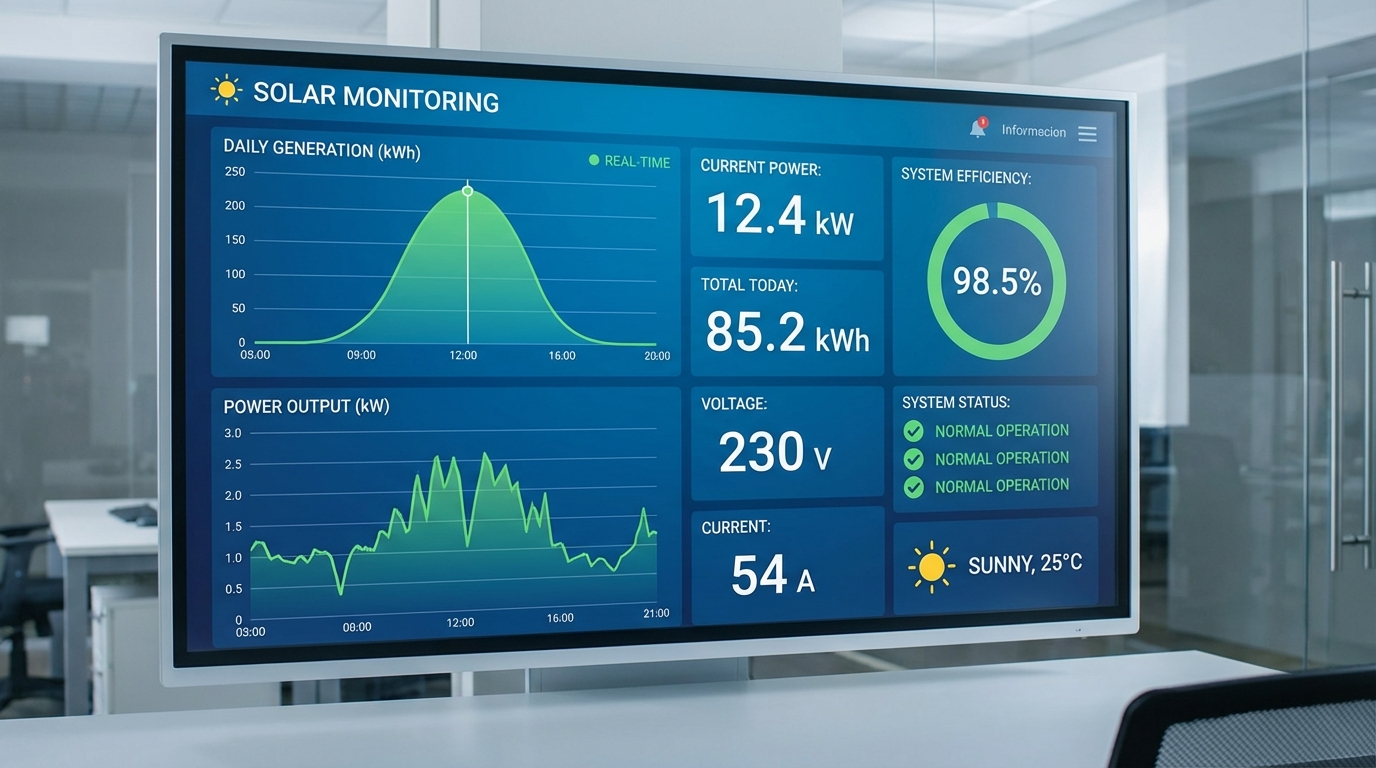
System performance ratio calculation provides the most comprehensive measure of solar system quality. The performance ratio (PR) compares actual energy generation to theoretical maximum generation under current weather conditions. A well-designed and properly commissioned system in Gujarat should achieve a performance ratio of 75-85%, accounting for inevitable losses from temperature, soiling, cable resistance, and inverter efficiency.
Generation capacity verification involves operating the system under peak sunlight conditions (typically between 11 AM and 2 PM) and measuring actual power output. For a 5 kW residential system, engineers expect to see 4.5-5 kW generation during peak hours on clear days. Any significant deviation triggers investigation into potential shading issues, module defects, or configuration problems.
Load testing procedures verify that your solar system integrates properly with your existing electrical loads. Engineers monitor system behavior as various appliances and equipment cycle on and off, ensuring smooth power transitions and stable voltage levels. For commercial and industrial solar Gujarat installations, load testing includes verification that the system handles motor starting currents and other high-inrush loads without tripping protection devices.
Monitoring system accuracy checks compare the energy readings from your solar inverter, net meter, and monitoring platform. These three sources should show consistent generation data within 2-3% variance. Significant discrepancies indicate calibration issues or communication errors that need correction.
Comparison with expected performance metrics uses solar design software projections as the baseline. Your commissioning report should include expected monthly and annual generation figures based on Gujarat’s solar irradiance data, system specifications, and site-specific factors. First-month performance should align closely with these projections, adjusted for seasonal variations.
Weather-adjusted performance analysis accounts for Gujarat’s varying solar conditions. Engineers use pyranometer data or satellite-based irradiance measurements to normalize performance data, enabling accurate comparison between actual and expected generation regardless of weather variations during the commissioning period.
6. Final Documentation and System Handover
The culmination of solar commissioning Gujarat is the formal system handover, where you receive comprehensive documentation and training to operate and maintain your solar investment.

The commissioning report serves as the official record of your system’s quality and performance. This detailed document includes all test results, measurements, photographs of the installation, equipment serial numbers, and certification that the system meets technical and safety standards. You’ll need this report for warranty claims, insurance purposes, and any future system modifications.
As-built drawings and system documentation provide a complete technical record of your installation. These include updated electrical diagrams reflecting any field changes from original designs, equipment layout drawings, cable routing schedules, and earthing system layouts. This documentation is invaluable for future maintenance, troubleshooting, and system expansions.
Warranty documentation and activation is handled during handover. Your solar EPC Gujarat provider ensures all equipment warranties are properly registered, provides warranty certificates for solar modules (typically 25 years performance warranty), inverters (5-10 years), and installation workmanship (typically 5 years). Understanding warranty coverage and claim procedures protects your investment.
The operation and maintenance manual provides practical guidance for system owners. This manual covers:
- Daily, monthly, and annual maintenance tasks
- Monitoring system access and interpretation
- Troubleshooting common issues
- Safety procedures for system shutdown and isolation
- Cleaning recommendations for Gujarat’s dusty conditions
- Contact information for technical support
Training for system owners and operators ensures you can confidently manage your solar investment. For residential installations, training covers monitoring system access, basic troubleshooting, and when to contact professional support. For industrial solar Gujarat installations, training includes detailed technical instruction for facility maintenance staff on system operation, safety procedures, and preventive maintenance tasks.
The maintenance schedule outlines recommended service intervals. In Gujarat’s climate, solar panel cleaning every 2-4 weeks during dry seasons significantly improves generation. Annual professional inspections verify electrical connections, test safety systems, and optimize inverter settings. Your EPC provider should offer solar maintenance Gujarat packages to simplify ongoing system care.
Emergency contact information ensures you know exactly who to call if issues arise. Reputable companies like Heaven Green Energy provide dedicated technical support lines and rapid response for system faults. Have any questions? Call +91 63904 05060 for immediate assistance with your solar system.
Common Solar Commissioning Gujarat Challenges and Solutions
Even with experienced EPC providers, solar commissioning Gujarat can encounter challenges. Understanding common issues and their solutions helps set realistic expectations.
Grid approval delays remain the most frequent challenge. DISCOMs sometimes face application backlogs, particularly during peak solar installation seasons. Solutions include submitting complete documentation from the start, maintaining regular follow-up with utility officials, and leveraging your EPC provider’s relationships with local DISCOMs. Some companies maintain dedicated liaison staff who expedite approvals through proper channels.
Weather-related testing challenges affect commissioning schedules. Gujarat’s monsoon season (June-September) can interrupt testing procedures that require specific sunlight conditions. Experienced commissioning teams schedule weather-dependent tests during morning hours when conditions are typically clearer, and maintain flexible scheduling to accommodate weather variations.
Documentation gaps and corrections cause unnecessary delays. Missing equipment certificates, incomplete test reports, or errors in technical drawings require time-consuming corrections. Professional solar EPC services maintain rigorous documentation protocols throughout installation, ensuring commissioning documentation is complete and accurate from the start.
Technical issues discovered during testing occasionally reveal installation errors or equipment defects. Common findings include loose electrical connections, damaged cables, underperforming modules, or inverter configuration errors. Reputable EPC companies address these issues immediately at no additional cost, viewing commissioning as quality assurance rather than just a formality.
Coordination with multiple stakeholders, building owners, electrical contractors, DISCOMs, and equipment suppliers, requires strong project management. Delays occur when stakeholders aren’t available for inspections or approvals. Experienced providers maintain clear communication channels and proactive scheduling to minimize coordination delays.
How experienced EPC companies handle these challenges makes the difference between smooth commissioning and frustrating delays. Companies with 10,000+ installations like Heaven Green Energy have refined commissioning procedures through years of experience across Gujarat’s diverse locations and regulatory environments. This expertise translates to faster approvals, fewer technical issues, and confident system handovers.
Post-Commissioning: What Happens Next?
Successful solar commissioning Gujarat marks the beginning of your solar journey, not the end. Understanding post-commissioning expectations helps you maximize system performance and longevity.
The initial monitoring period during the first 30 days is critical for identifying any early issues. Your EPC provider should actively monitor system performance during this period, comparing actual generation against projections and investigating any anomalies. Most technical issues that weren’t caught during commissioning reveal themselves within the first month of operation.
First-month performance tracking establishes your system’s baseline generation patterns. You’ll learn how much energy your system produces during different times of day and under various weather conditions. This baseline becomes your reference for identifying future performance degradation or issues.
Scheduled maintenance visits typically begin 3-6 months after commissioning. These visits include cleaning solar panels, inspecting electrical connections, testing safety systems, and optimizing inverter settings based on actual operating data. Regular solar maintenance Gujarat services prevent small issues from becoming expensive problems.
Warranty coverage and claims process should be clearly understood. Module performance warranties guarantee that panels maintain at least 80-85% of rated capacity after 25 years, with specific degradation curves outlined in warranty documents. Inverter warranties typically cover defects and failures for 5-10 years. Understanding what’s covered and the claim process ensures you can exercise warranty rights if needed.
Performance guarantees from your EPC provider offer additional protection. Many companies guarantee minimum annual generation levels, offering compensation or corrective action if your system underperforms. These guarantees demonstrate confidence in system design and installation quality.
Long-term system optimization involves periodic reviews of your energy consumption patterns and solar generation. As your electricity needs change or new technologies emerge, your EPC provider can recommend system expansions, battery storage additions, or configuration adjustments to maximize your solar ROI.
Conclusion: Ensuring Your Solar Investment Delivers
Proper solar commissioning Gujarat is the foundation of a successful solar investment. This comprehensive testing and verification process ensures your system operates safely, generates expected power output, and complies with all regulatory requirements. From pre-commissioning checks through electrical testing, inverter configuration, grid approval, performance verification, and final handover, each step validates your investment and protects your long-term returns.
Working with experienced solar EPC Gujarat providers makes all the difference. Companies with proven track records understand Gujarat’s regulatory environment, maintain strong relationships with local DISCOMs, and have refined commissioning procedures through thousands of successful installations. This expertise translates to faster approvals, fewer technical issues, and confident system handovers that let you start generating clean energy sooner.
Whether you’re planning a residential rooftop installation in Surat, a commercial project in Ahmedabad, or an industrial solar Gujarat facility in Junagadh, understanding the commissioning process helps you set realistic expectations and recognize quality workmanship. The commissioning phase is your assurance that every component works correctly, every safety system functions properly, and your system is positioned to deliver 25+ years of reliable, clean energy generation.
Heaven Green Energy Limited brings over seven years of solar commissioning expertise across Gujarat, with 10,000+ successful installations and deep knowledge of local regulatory requirements. Our comprehensive commissioning process ensures your solar system operates at peak efficiency from day one, backed by thorough testing, complete documentation, and ongoing support. Ready to start your solar journey with confidence? Contact our team at +91 63904 05060 to discuss your solar commissioning Gujarat needs and learn how our turnkey EPC solutions deliver reliable, high-performing solar systems that maximize your energy savings and environmental impact.
This blog post was written using thestacc.com