


For commercial and industrial businesses in Gujarat, solar financing is no longer a niche conversation. It is a boardroom priority. With industrial electricity tariffs climbing year after year and Gujarat’s solar irradiance among the highest in India, the financial case for going solar has never been stronger. But the question most decision-makers struggle with is not whether to go solar. It is how to pay for it.
Unlike residential buyers who typically choose between a subsidy-backed purchase or a simple bank loan, commercial and industrial (C&I) units face a far more complex landscape. Should you buy the system outright and claim accelerated depreciation? Take a term loan and preserve working capital? Sign a Power Purchase Agreement and pay zero upfront? Or explore a government-backed credit line through IREDA or GEDA? Each solar financing pathway has a different impact on your balance sheet, your tax position, and your long-term energy costs.
This guide is built specifically for factory owners, plant managers, CFOs, and business decision-makers in Gujarat. We break down every major solar financing model available in 2026, compare them side by side, and give you a structured framework to choose the one that fits your business best.
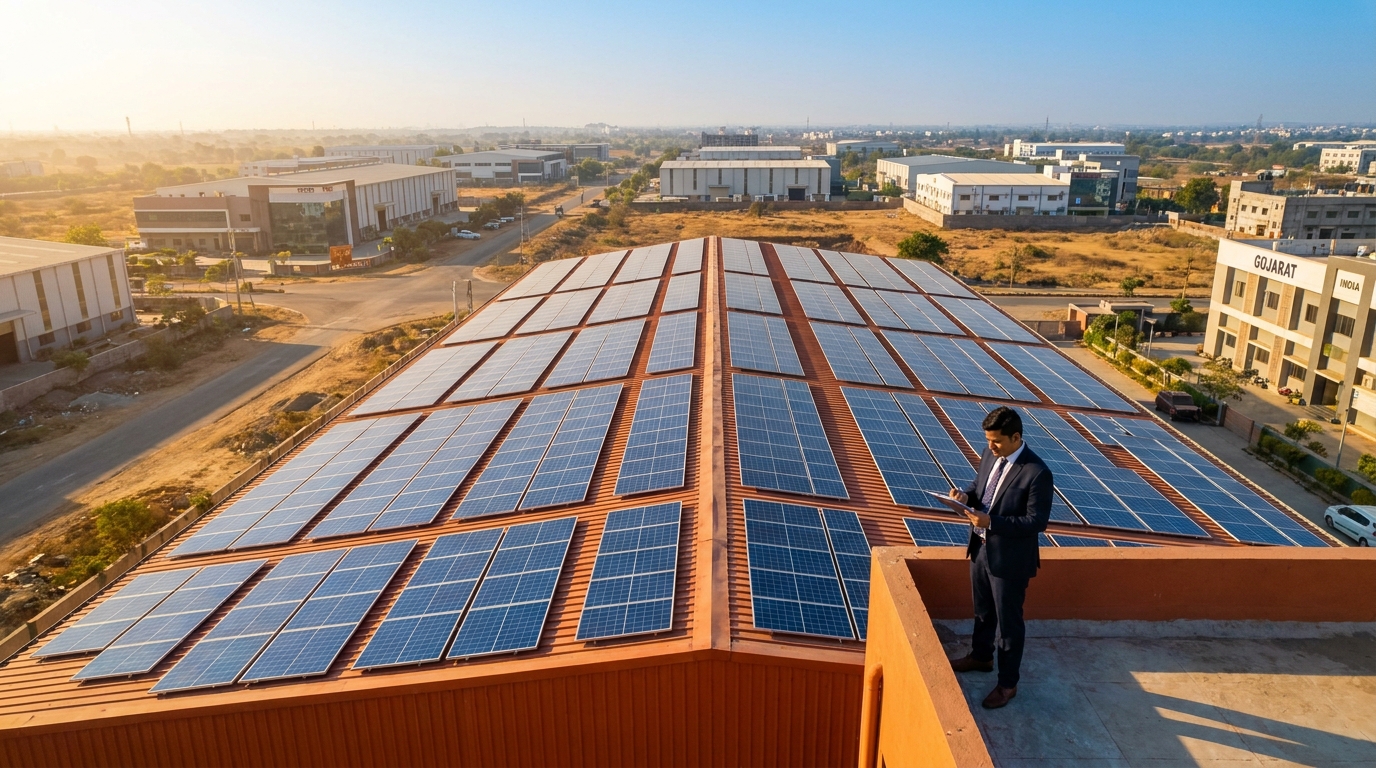
Why Solar Financing Is a Strategic Decision for Gujarat Businesses
Gujarat’s industrial sector runs on electricity. Whether you operate a textile mill in Surat, a chemical plant in Vadodara, or a food processing unit in Rajkot, energy is one of your largest operating costs. The state’s High Tension (HT) and Low Tension (LT) industrial tariffs have seen consistent upward revisions, and there is little reason to expect that trend to reverse.
Solar energy offers a direct hedge against rising tariffs. Once a system is installed, the cost of generating electricity from solar panels is essentially fixed for 25 years. That predictability is enormously valuable for businesses that need to plan budgets and protect margins.
But here is the critical insight that many businesses miss: the solar financing model you choose determines how quickly you realize those savings, how the investment appears on your books, and who bears the risk if the system underperforms. A factory that chooses the wrong financing structure may find itself locked into unfavorable terms for a decade or more.
The core decision every C&I buyer must make is between a CAPEX model (you own the system) and an OPEX model (a third party owns the system and you pay for the energy it produces). Both have legitimate use cases. The right answer depends on your cash flow, your tax position, your appetite for ownership, and your energy consumption profile.
According to the Ministry of New and Renewable Energy (MNRE), India’s commercial and industrial solar segment is one of the fastest-growing in the country, driven precisely by the financial attractiveness of solar financing options now available to businesses.
1. Outright Purchase (CAPEX Model): Full Ownership, Maximum ROI
The outright purchase model is the most straightforward form of solar financing. Your business pays the full cost of the solar system upfront, owns the asset entirely, and captures 100% of the energy savings from day one.
How It Works
You engage a solar EPC company in Gujarat, agree on a system design and price, and pay for the installation. The system is commissioned, connected to the grid via net metering, and begins generating electricity. Every unit of solar power your system produces reduces your DISCOM bill directly.
The Accelerated Depreciation Advantage
For C&I buyers, the most powerful financial benefit of the CAPEX model is accelerated depreciation. Under the Income Tax Act, solar power plants qualify for 40% depreciation in the first year. This means a business that installs a ₹1 crore solar system can claim ₹40 lakh as a depreciation expense in Year 1, significantly reducing its taxable income. For businesses in the 25-30% tax bracket, this translates to a real cash saving of ₹10-12 lakh in the first year alone.
Typical Payback Period
For industrial units in Gujarat with high daytime energy consumption, the payback period on a CAPEX solar investment typically ranges from 4 to 6 years, depending on system size, tariff rates, and the accelerated depreciation benefit claimed. After payback, the system continues generating free electricity for another 19-21 years. That is a compelling return on any capital investment.
To understand how payback timelines are calculated in detail, read our guide on Solar Payback Period Explained: Break-Even Timeline 2026.
Best Suited For
- Businesses with strong cash reserves or access to internal funds
- Companies with significant taxable income that can benefit from accelerated depreciation
- Industrial units with high and consistent daytime electricity consumption
- Businesses that prefer full asset ownership and control
2. Bank Loans & Term Financing: Preserve Cash, Own the Asset
For businesses that want the benefits of ownership without deploying large amounts of capital upfront, a solar term loan is the most popular solar financing route in Gujarat’s C&I segment. You borrow the funds to purchase the system, repay the loan over a fixed tenure, and own the asset outright once the loan is cleared.
Key Lenders Active in Gujarat
Several financial institutions actively finance solar projects for commercial and industrial borrowers in Gujarat:
- State Bank of India (SBI) – Offers dedicated green energy loans with competitive interest rates
- Bank of Baroda – Has specific solar financing products for MSMEs and larger industrial borrowers
- IREDA (Indian Renewable Energy Development Agency) – A government-backed institution offering long-tenure loans specifically for renewable energy projects
- SIDBI, Provides solar financing to small and medium enterprises under its green finance programs
- NBFCs and fintech lenders, Offer faster processing with slightly higher interest rates, suitable for smaller systems
Typical Loan Terms
Solar term loans for C&I projects in Gujarat typically come with tenures of 5 to 10 years, interest rates ranging from 8% to 12% per annum depending on the lender and borrower profile, and loan-to-value ratios of 70-80% of the project cost. Collateral requirements vary; larger loans typically require property or plant assets as security.
Combining Loans with Accelerated Depreciation
One of the most effective solar financing strategies for profitable businesses is to take a term loan and simultaneously claim accelerated depreciation. The depreciation benefit in Year 1 can effectively offset a significant portion of the loan’s interest cost, making the net cost of financing very attractive. Your EPC partner and tax advisor should model this scenario before you commit to a financing structure.
What Lenders Typically Require
- Last 2-3 years of audited financial statements
- Electricity bills showing consumption history
- Roof ownership or long-term lease agreement
- Quotation and project report from a qualified solar EPC company
- Net metering approval or application from the DISCOM
3. RESCO / Energy-as-a-Service Model: Zero Upfront, Pay Per Unit
The RESCO (Renewable Energy Service Company) model, also known as the Energy-as-a-Service or Power Purchase Agreement (PPA) model, is the most disruptive form of solar financing available to C&I businesses today. Under this model, you pay zero upfront. A third-party developer installs, owns, and operates the solar system on your premises. You simply buy the electricity it generates at a pre-agreed per-unit rate.
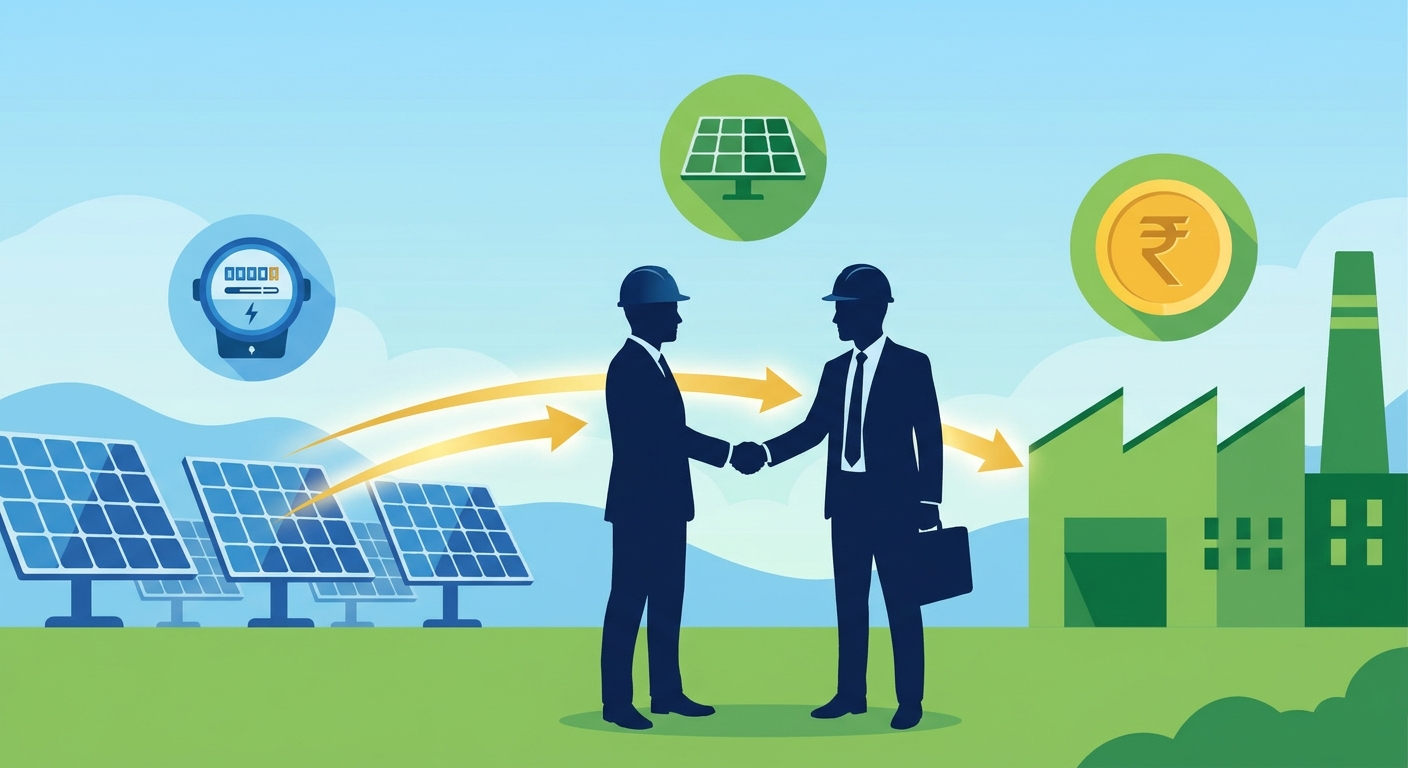
How PPAs Work in Gujarat
The RESCO developer signs a Power Purchase Agreement with your business, typically for a tenure of 15 to 25 years. The agreed PPA tariff is usually set below your current DISCOM tariff, so you save money from the very first month without spending a rupee on installation. The developer recovers their investment through the electricity payments you make over the contract period.
For example, if your current industrial tariff is ₹8 per unit, a RESCO developer might offer solar power at ₹5-6 per unit. That is an immediate saving of ₹2-3 per unit on every unit the solar system generates.
Who Handles Maintenance?
Under the RESCO model, the developer is responsible for all solar maintenance, performance monitoring, and equipment replacement. This is a significant operational advantage for businesses that do not want to manage a solar asset in-house. Your only obligation is to pay for the units consumed and provide roof access.
Key Contract Terms to Watch
Before signing a PPA, your legal and finance teams should scrutinize these clauses carefully:
- Tariff escalation clause: Many PPAs include an annual escalation of 1-3% on the per-unit rate. Understand the long-term cost implications.
- Minimum offtake guarantee: Some agreements require you to pay for a minimum number of units regardless of actual consumption.
- Exit provisions: What happens if you want to terminate the agreement early? Penalties can be substantial.
- System ownership at end of tenure: Does ownership transfer to you at the end of the PPA, or does the developer remove the system?
Best Suited For
- Businesses with limited capital or those that prefer to keep solar off their balance sheet
- Companies that want immediate savings without ownership responsibility
- Industrial units with stable, long-term energy consumption profiles
- Businesses that lack the internal expertise to manage a solar asset
4. Solar Leasing: A Middle Ground Between CAPEX and RESCO
Solar leasing is a less common but increasingly available solar financing option in Gujarat’s C&I market. Under a lease arrangement, a third party owns the solar system and installs it on your premises. You pay a fixed monthly lease payment, regardless of how much electricity the system generates.
How Leasing Differs from PPA
The key distinction is in how you pay. Under a PPA, you pay per unit of electricity generated. Under a lease, you pay a fixed monthly amount. This means your payment does not vary with solar generation, which can be a disadvantage in months with lower sunlight. However, it also means your costs are completely predictable, which some CFOs prefer for budgeting purposes.
Lease-to-Own Options
Some solar financing providers in Gujarat offer lease-to-own structures, where a portion of each lease payment goes toward eventual ownership of the system. At the end of the lease tenure, you can purchase the system at a residual value, often significantly below the original installation cost. This can be an attractive middle path for businesses that want ownership eventually but cannot commit to full CAPEX upfront.
Key Considerations
- Accelerated depreciation is generally not available to the lessee under a standard lease (it goes to the lessor/owner)
- Fixed payments can be a disadvantage if your energy consumption drops significantly
- Lease agreements may have restrictions on modifying or expanding the system
5. Government-Backed Solar Financing Schemes in Gujarat
Gujarat has one of the most active state-level renewable energy ecosystems in India, and several government-backed solar financing programs are available to C&I businesses in 2026.
GEDA (Gujarat Energy Development Agency)
GEDA is the nodal agency for renewable energy in Gujarat and facilitates access to subsidized loans and grants for solar projects. GEDA works with financial institutions to channel funds to eligible businesses and also provides technical guidance on system design and compliance. C&I businesses should check GEDA’s current scheme notifications for applicable incentives.
IREDA Credit Lines for MSMEs
The Indian Renewable Energy Development Agency (IREDA) offers dedicated credit lines for MSME solar projects at concessional interest rates. These loans are channeled through partner banks and NBFCs and are specifically designed to make solar financing accessible to smaller industrial borrowers who may not qualify for large commercial loans.
Priority Sector Lending (PSL) Benefits
Solar projects for MSMEs qualify as Priority Sector Lending under RBI guidelines. This means banks have a regulatory incentive to lend to MSME solar projects, often resulting in more favorable terms, faster processing, and lower collateral requirements compared to standard commercial loans.
PM Surya Ghar Muft Bijli Yojana
While this central government scheme is primarily targeted at residential consumers, it has created significant momentum in the broader solar financing ecosystem. C&I businesses should be aware that the scheme’s success has prompted state governments, including Gujarat, to expand solar financing support to commercial segments as well. Stay updated with GEDA notifications for any C&I-specific extensions of central schemes.
Solar Financing Comparison: Which Model Fits Your Business?
Choosing the right solar financing model requires an honest assessment of your business’s financial position, energy goals, and risk appetite. Here is a structured comparison to guide your decision.

Side-by-Side Comparison
| Factor | CAPEX (Outright) | Bank Loan | RESCO / PPA | Lease |
|---|---|---|---|---|
| Upfront Cost | High | Low (10-30% down) | Zero | Zero or minimal |
| Asset Ownership | Immediate | After loan repayment | Developer (may transfer) | Lessor (may transfer) |
| Accelerated Depreciation | Yes (40% Year 1) | Yes | No (goes to developer) | No (goes to lessor) |
| Maintenance Responsibility | Owner (you) | Owner (you) | Developer | Lessor |
| Long-Term Savings | Highest | High | Moderate | Moderate |
| Balance Sheet Impact | Asset added | Asset + liability | Off-balance sheet | Off-balance sheet |
| Risk | Performance risk on owner | Performance risk on owner | Performance risk on developer | Performance risk on lessor |
Three Questions Every Decision-Maker Should Answer
- Do you have significant taxable income? If yes, the CAPEX model (outright purchase or bank loan) with accelerated depreciation will likely deliver the best financial outcome. If your business is in a tax holiday period or has low taxable income, the depreciation benefit is less valuable, making RESCO more attractive.
- Is capital preservation a priority right now? If your business is in a growth phase and needs working capital for core operations, RESCO or leasing keeps solar off your balance sheet and preserves liquidity. If capital is available and idle, deploying it in solar delivers strong, predictable returns.
- How long do you plan to operate from this premises? RESCO and lease agreements run for 15-25 years. If there is any uncertainty about your long-term presence at the site, a shorter-tenure bank loan with ownership may be safer. Exiting a long-term PPA early can be costly.
Scenario Examples
Scenario A, Textile Factory in Surat (500 kW system): High taxable income, strong cash flow, owns the factory building. Best fit: CAPEX with accelerated depreciation. Payback in approximately 4-5 years, then 20+ years of near-free electricity.
Scenario B, Commercial Complex in Ahmedabad (200 kW system): Moderate cash flow, prefers to preserve capital for expansion. Best fit: Bank loan (IREDA or SBI green energy loan) with 7-year tenure. EMI is offset by electricity savings from Month 1.
Scenario C, MSME Chemical Unit in Ankleshwar (100 kW system): Limited capital, tax holiday period, wants immediate savings. Best fit: RESCO/PPA model. Zero upfront, immediate per-unit savings, maintenance handled by developer.
How to Evaluate Your Solar ROI Before Committing to a Financing Model
No solar financing decision should be made without a rigorous financial analysis. The good news is that solar ROI calculations are well-established, and a qualified solar EPC partner in Gujarat can provide detailed projections before you commit to anything.
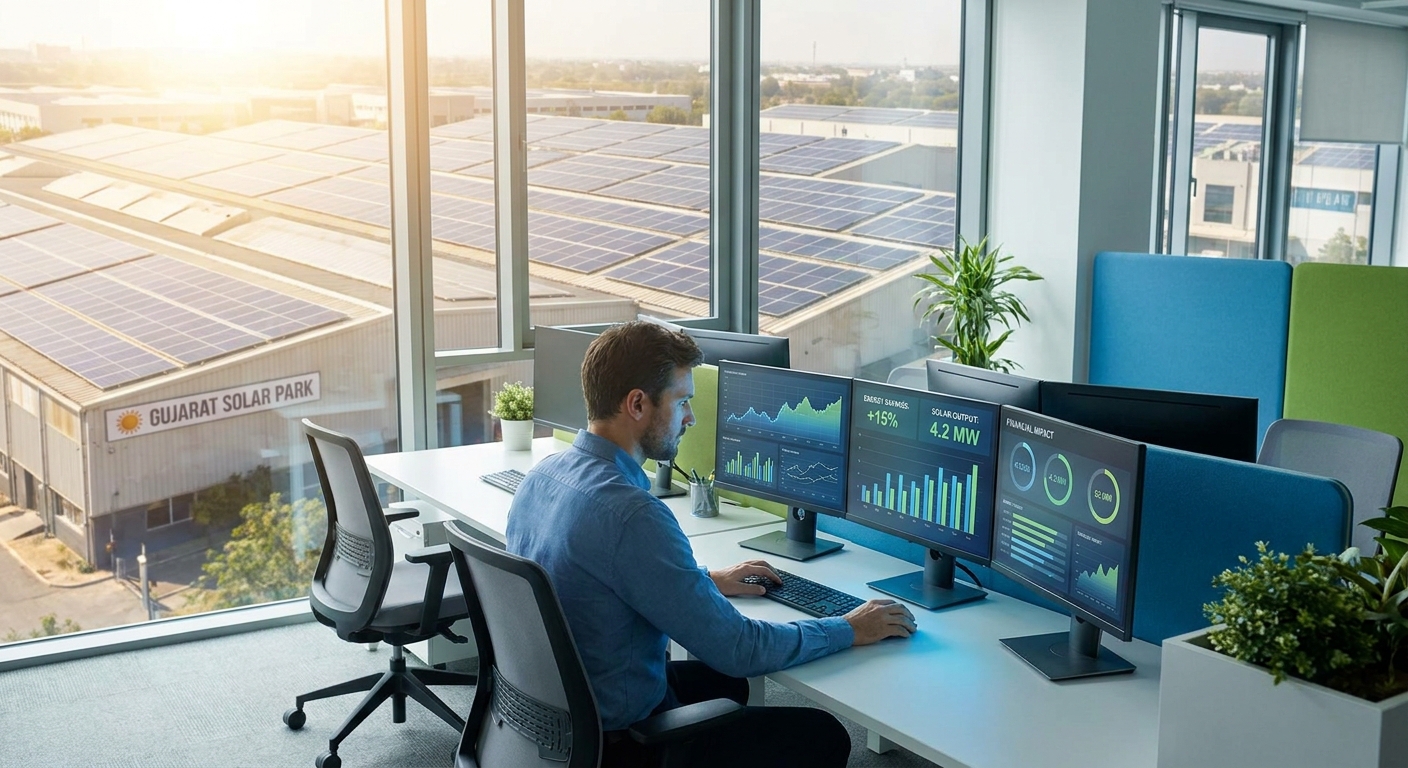
Key Financial Metrics to Understand
- Payback Period: The number of years it takes for cumulative energy savings to equal the total investment. For C&I solar in Gujarat, this typically ranges from 4 to 7 years depending on the financing model and system size.
- Internal Rate of Return (IRR): The annualized return on your solar investment. Well-designed C&I solar projects in Gujarat typically deliver IRRs of 15-25%, making them highly competitive with other capital investments.
- Net Present Value (NPV): The total value of future energy savings discounted to today’s money. A positive NPV confirms the investment creates value for your business.
- Levelized Cost of Energy (LCOE): The effective cost per unit of electricity generated by your solar system over its lifetime. Comparing LCOE to your current DISCOM tariff tells you exactly how much you save per unit.
The Role of a Detailed Energy Audit
Before any solar financing conversation, your business needs a thorough energy audit. This audit maps your consumption patterns, identifies peak demand periods, and determines the optimal system size. Oversizing a system wastes capital; undersizing it leaves savings on the table. A reliable solar EPC company in Gujarat will conduct this audit as part of the project development process.
Understanding the full scope of what a solar EPC partner does is essential before you engage one. Read our detailed breakdown in What is Solar EPC? Complete Service Guide 2026 to know exactly what to expect.
Solar Panel Cost and System Quality
The solar panel cost and quality of components you choose directly affect your ROI projections. Higher-efficiency modules from reputable brands may cost more upfront but generate more electricity per square meter of roof space, improving your returns. Before finalizing any solar financing arrangement, ensure your EPC partner specifies the exact modules, inverters, and mounting structures being used. For a detailed comparison of panel brands available in Gujarat, see our guide on Solar Brands Gujarat: Top Panel Manufacturers Compared 2026.
Net Metering and Its Impact on Financing
Gujarat’s net metering policy allows grid-connected solar systems to export surplus electricity to the DISCOM and receive credit on future bills. This is a critical factor in your solar ROI calculation. Under CAPEX and bank loan models, you benefit directly from net metering credits. Under RESCO models, the PPA agreement determines who receives the net metering benefit, so this must be clearly defined in the contract.
Frequently Asked Questions About Solar Financing in Gujarat
Can MSMEs get solar loans without collateral?
Yes, in many cases. IREDA’s MSME-focused credit lines and Priority Sector Lending guidelines have made collateral-free or low-collateral solar loans more accessible. Some NBFCs also offer unsecured solar loans for smaller systems (typically under ₹50 lakh) based on the business’s cash flow and credit history. Discuss your specific situation with your bank or a solar financing advisor.
Is accelerated depreciation available for leased solar systems?
No. Accelerated depreciation is available only to the owner of the solar asset. Under a lease or RESCO arrangement, the developer or lessor claims the depreciation benefit, not your business. This is one of the key financial trade-offs to consider when comparing ownership vs. non-ownership solar financing models.
What is the minimum system size for RESCO/PPA in Gujarat?
Most RESCO developers in Gujarat require a minimum system size of 100 kW to 200 kW to make the economics of the PPA model work for them. Smaller systems are generally better served by CAPEX or bank loan models. However, as the market matures, some developers are beginning to offer PPA structures for systems as small as 50 kW.
How does net metering work with different solar financing models?
Under CAPEX and bank loan models, your business is the system owner and directly receives net metering credits from the DISCOM. Under RESCO/PPA models, the contract must specify who receives net metering credits. In most Gujarat PPA structures, the developer retains the net metering benefit and factors it into the PPA tariff offered to you. Always clarify this in the contract before signing.
Can I switch solar financing models mid-way through a project?
Switching is generally not possible once a contract is signed and the system is installed. However, if you are in the planning stage, you can absolutely change your preferred model before committing. This is why it is critical to evaluate all solar financing options thoroughly before signing any agreement. If you own the system (CAPEX or bank loan), you can refinance the loan at a later stage if better rates become available.
Make the Right Solar Financing Decision for Your Gujarat Business
Solar financing for commercial and industrial units in Gujarat is not a one-size-fits-all decision. The right model depends on your cash flow, tax position, ownership preferences, and long-term energy strategy. What is clear is that every major solar financing pathway available today, whether CAPEX, bank loan, RESCO, or lease, offers a compelling financial case compared to continuing to pay rising DISCOM tariffs indefinitely.
The businesses that benefit most from solar are those that take the time to model each option carefully, engage a trusted solar EPC partner in Gujarat for accurate projections, and choose a financing structure that aligns with their broader financial goals. With the right solar financing framework in place, a well-designed industrial solar system in Gujarat can deliver returns that rival or exceed most other capital investments available to businesses today.
At Heaven Green Energy, we have helped hundreds of commercial and industrial businesses across Gujarat navigate exactly this decision. From conducting detailed energy audits and preparing bankable project reports to coordinating with lenders and managing the full EPC process, we are with you at every step. If you are ready to evaluate your solar financing options and want expert guidance tailored to your specific business, call our team at +91 63904 05060 and let’s build a solar investment plan that works for your bottom line.
This blog post was written using thestacc.com