


When planning a solar energy project for your home, business, or industrial facility, you’ll quickly encounter the term “solar EPC services.” But what exactly does EPC mean, and why has this turnkey approach become the gold standard for solar installations across Gujarat and India? Whether you’re a homeowner looking to reduce electricity bills, a factory owner seeking to cut operational costs, or a developer planning a large-scale solar park, understanding solar EPC services is crucial to making informed decisions about your renewable energy investment.
Solar EPC services represent a comprehensive, single-responsibility approach to solar project implementation that streamlines the entire process from initial design to final commissioning. In this complete guide, we’ll demystify the EPC model, walk you through each phase of the process, explain what’s included in professional EPC packages, and help you understand how businesses and property owners in Gujarat can benefit from partnering with experienced solar EPC providers like Heaven Green Energy.
Understanding Solar EPC Services: The Foundation of Turnkey Solar Projects
EPC stands for Engineering, Procurement, and Construction—three critical phases that together form a complete turnkey solution for solar energy projects. In the solar EPC services model, a single contractor takes full responsibility for designing your system, sourcing all necessary equipment, and executing the installation from start to finish. This integrated approach eliminates the complexity of coordinating multiple vendors, engineers, and contractors that traditionally plagued solar installations.
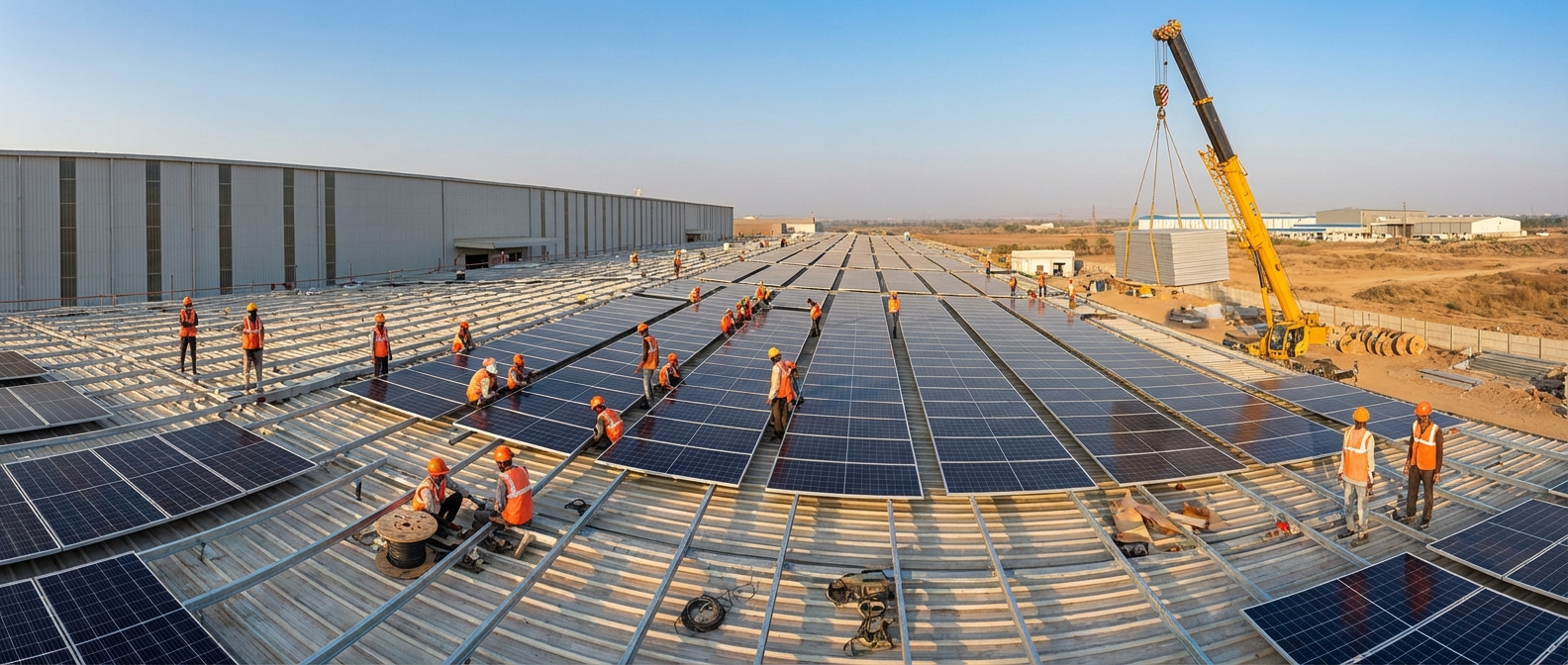
The turnkey concept means you have one point of contact throughout your entire solar journey. Your EPC partner handles everything: site surveys, engineering calculations, government approvals, equipment procurement, installation work, grid connectivity, testing, and final commissioning. This single-point accountability significantly reduces project risks, coordination challenges, and timeline delays that often occur when different parties handle separate aspects of a solar project.
In Gujarat’s rapidly growing solar market, the EPC model has become the preferred approach for several compelling reasons. The state’s ambitious renewable energy targets, favorable solar irradiation levels averaging 5-6 kWh/m²/day, and supportive government policies have created strong demand for professional solar EPC services. Companies like Heaven Green Energy, established in 2017 and recognized among the top EPC providers in Gujarat, have completed over 10,000 installations by leveraging this integrated approach to deliver reliable, high-quality solar solutions across residential, commercial, industrial, and utility-scale projects.
Unlike fragmented installation approaches where you might hire separate consultants for design, different vendors for equipment, and independent contractors for installation, solar EPC services provide seamless integration. This integration translates to faster project completion, better quality control, clearer warranties, and ultimately, a more reliable solar energy system that delivers the expected returns on your investment.
The Three Pillars of Solar EPC Services
The strength of solar EPC services lies in how three distinct but interconnected phases work together to create a cohesive solar solution. Each pillar—Engineering, Procurement, and Construction—plays a vital role, and their integration is what makes the EPC model so effective for solar projects of all sizes.
Engineering Phase: Designing Your Solar Solution
The engineering phase forms the foundation of any successful solar project. This critical first step involves comprehensive site assessment and feasibility analysis where experienced engineers visit your property to evaluate its solar potential. For rooftop installations in Gujarat’s residential and commercial sectors, engineers conduct detailed structural assessments to ensure your roof can support the solar array’s weight, typically adding 15-20 kg per square meter.
During this phase, solar EPC providers perform shadow analysis using specialized software to identify any obstructions—nearby buildings, trees, water tanks, or other structures, that might cast shadows on your panels and reduce energy generation. In Gujarat’s urban areas like Surat, Ahmedabad, and Vadodara, this analysis is particularly important due to dense construction patterns.
Engineers also conduct thorough electrical load analysis by examining your electricity bills and consumption patterns over the past year. This data helps determine the optimal system size that matches your energy needs without oversizing (which increases costs unnecessarily) or undersizing (which fails to deliver expected savings). For industrial solar Gujarat projects, load profiling becomes even more critical as factories often have variable consumption patterns across shifts and seasons.
The engineering deliverables include detailed technical drawings, single-line diagrams showing electrical connections, system specifications, structural calculations, and all documentation required for obtaining necessary permits and approvals from local authorities and electricity distribution companies. In Gujarat, this includes coordination with companies like DGVCL, MGVCL, PGVCL, and UGVCL depending on your location.
Procurement Phase: Sourcing Quality Components
Once engineering designs are finalized, the procurement phase begins. This is where your solar EPC partner’s industry relationships and purchasing power create significant value. Professional EPC companies maintain established relationships with leading manufacturers of solar modules, inverters, mounting structures, and balance-of-system components, enabling them to source quality equipment at competitive prices.
The procurement phase involves careful selection of tier-1 solar panels from reputable brands that offer strong performance warranties (typically 25 years for power output) and product warranties (10-12 years for manufacturing defects). Your EPC provider evaluates factors like panel efficiency, temperature coefficients (important in Gujarat’s hot climate where summer temperatures exceed 40°C), degradation rates, and manufacturer financial stability.
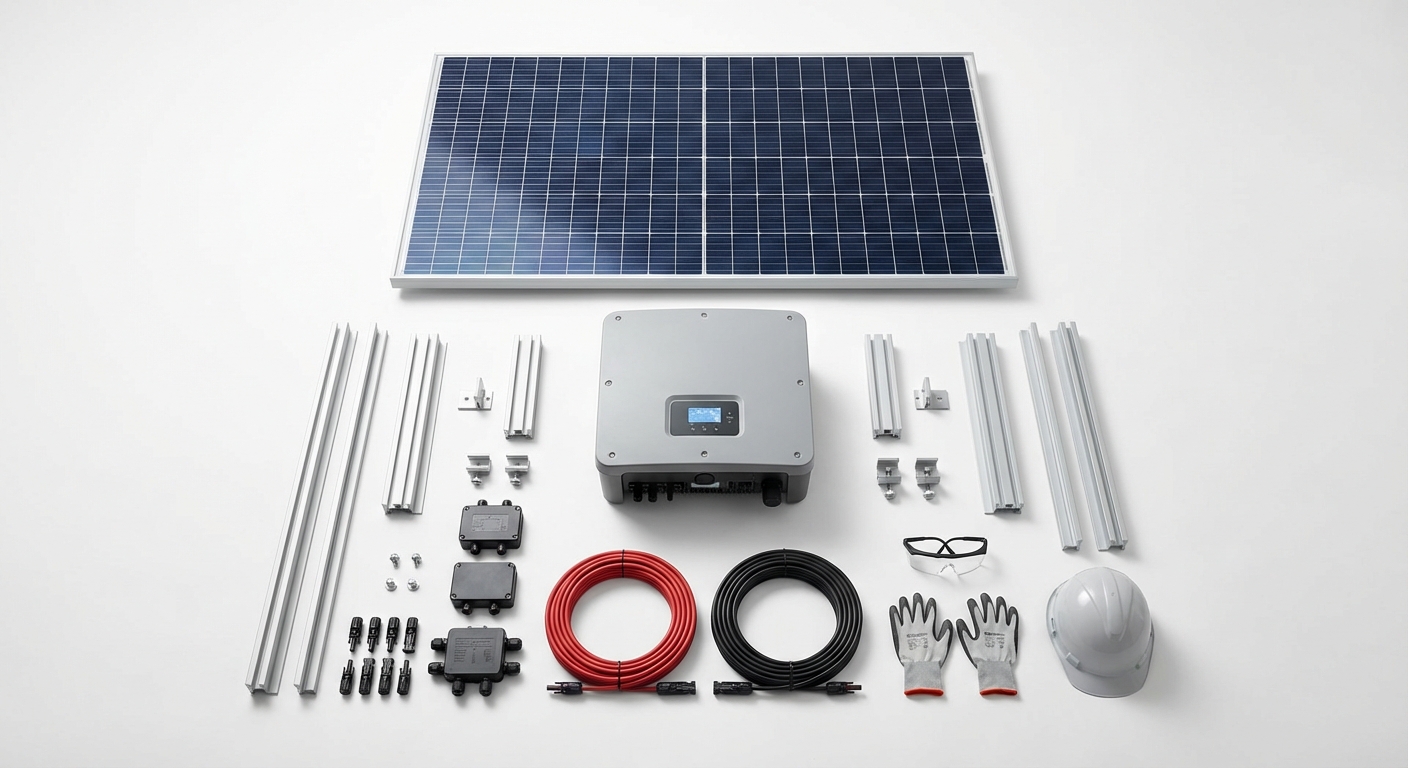
Similarly, solar inverter selection is critical as this component converts the DC electricity generated by panels into AC electricity usable by your appliances and the grid. EPC providers choose between string inverters for smaller installations or central/micro-inverters for larger commercial and industrial projects, considering factors like efficiency, monitoring capabilities, warranty terms, and service network availability in Gujarat.
Beyond major components, procurement includes mounting structures (typically aluminum or galvanized steel), AC and DC cables rated for outdoor solar applications, junction boxes, earthing materials, lightning protection systems, and monitoring equipment. Quality EPC providers ensure all components meet relevant Indian standards (BIS certifications) and international quality benchmarks, protecting your investment and ensuring long-term system reliability.
Construction Phase: From Installation to Commissioning
The construction phase is where engineering plans and procured equipment come together as your solar energy system takes physical form. This phase demands skilled labor, proper safety protocols, and meticulous attention to detail to ensure your system performs optimally for its 25+ year lifespan.
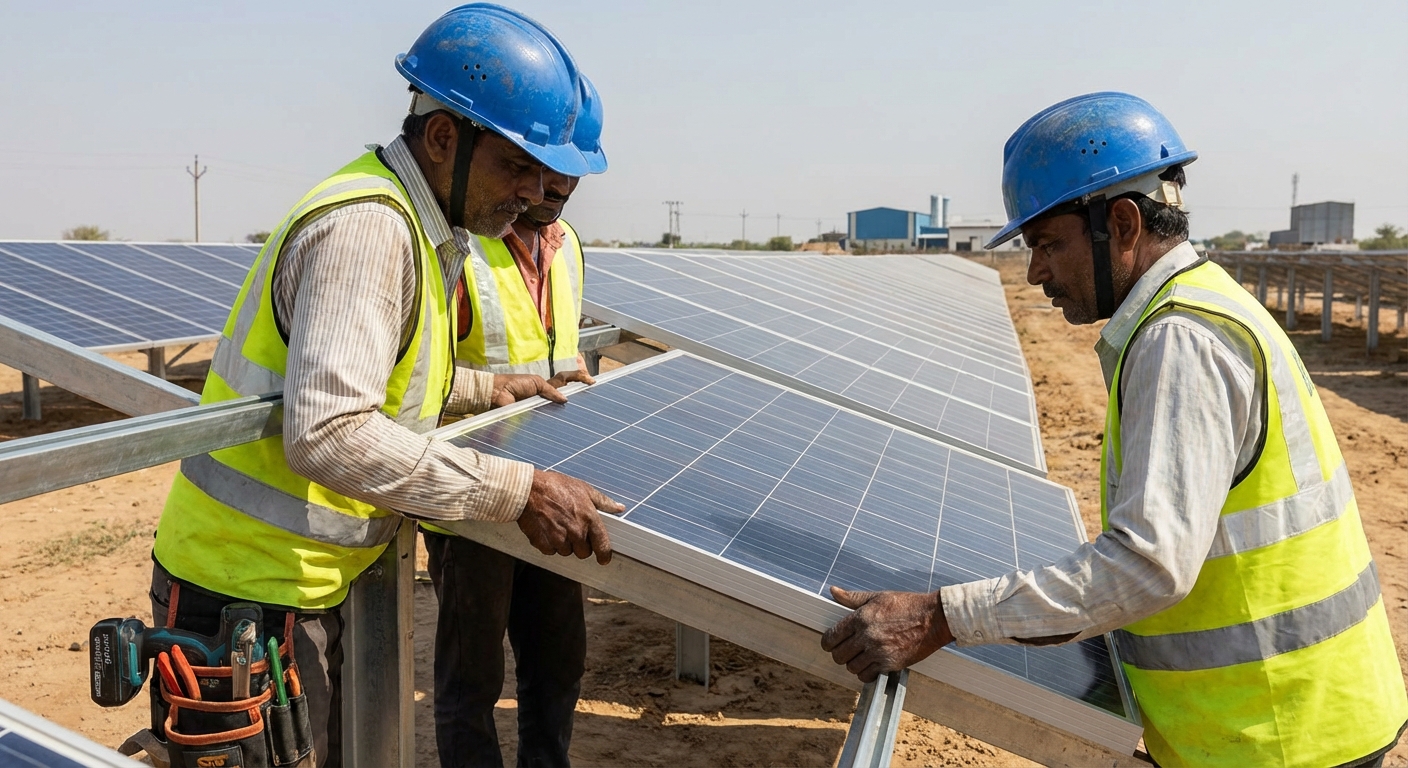
Construction begins with site preparation, which varies depending on project type. For rooftop solar installations, this involves cleaning the roof surface, marking mounting points, and setting up safety equipment like harnesses and guardrails. For ground-mounted solar parks in Gujarat’s rural areas, site preparation includes land leveling, boundary fencing, and foundation work for mounting structures.
The mounting structure installation follows, where aluminum or steel rails are securely fastened to your roof or ground foundations. Proper mounting is crucial, it must withstand Gujarat’s monsoon winds (which can exceed 100 km/h during cyclonic conditions) while maintaining the optimal tilt angle (typically 15-20 degrees in Gujarat) for maximum solar energy capture throughout the year.
Next comes module installation, where solar panels are carefully mounted on the structures and secured with clamps. Experienced installers ensure proper spacing between panels for maintenance access and air circulation, which helps keep panels cooler and more efficient in Gujarat’s hot climate. Panels are connected in series to form strings, with careful attention to polarity and connection quality using weatherproof MC4 connectors.
The electrical installation phase involves running DC cables from the solar array to the inverter location, installing the inverter itself (typically in a shaded, well-ventilated area), and connecting the AC output to your electrical distribution board or directly to the grid connection point. This work must comply with the Central Electricity Authority (CEA) regulations and Gujarat’s state electricity board requirements.
Finally, testing and commissioning ensure everything works correctly. Technicians perform insulation resistance tests, earth continuity tests, polarity checks, and string voltage measurements. The system is then synchronized with the grid (for on-grid installations) or configured for battery charging (for off-grid or hybrid systems). Performance verification confirms that your system generates the expected power output under prevailing weather conditions.
Upon successful commissioning, your solar EPC provider conducts a formal handover, providing you with all system documentation, warranty certificates, operation manuals, and training on monitoring your system’s performance through mobile apps or web portals.
What’s Included in a Complete Solar EPC Package?
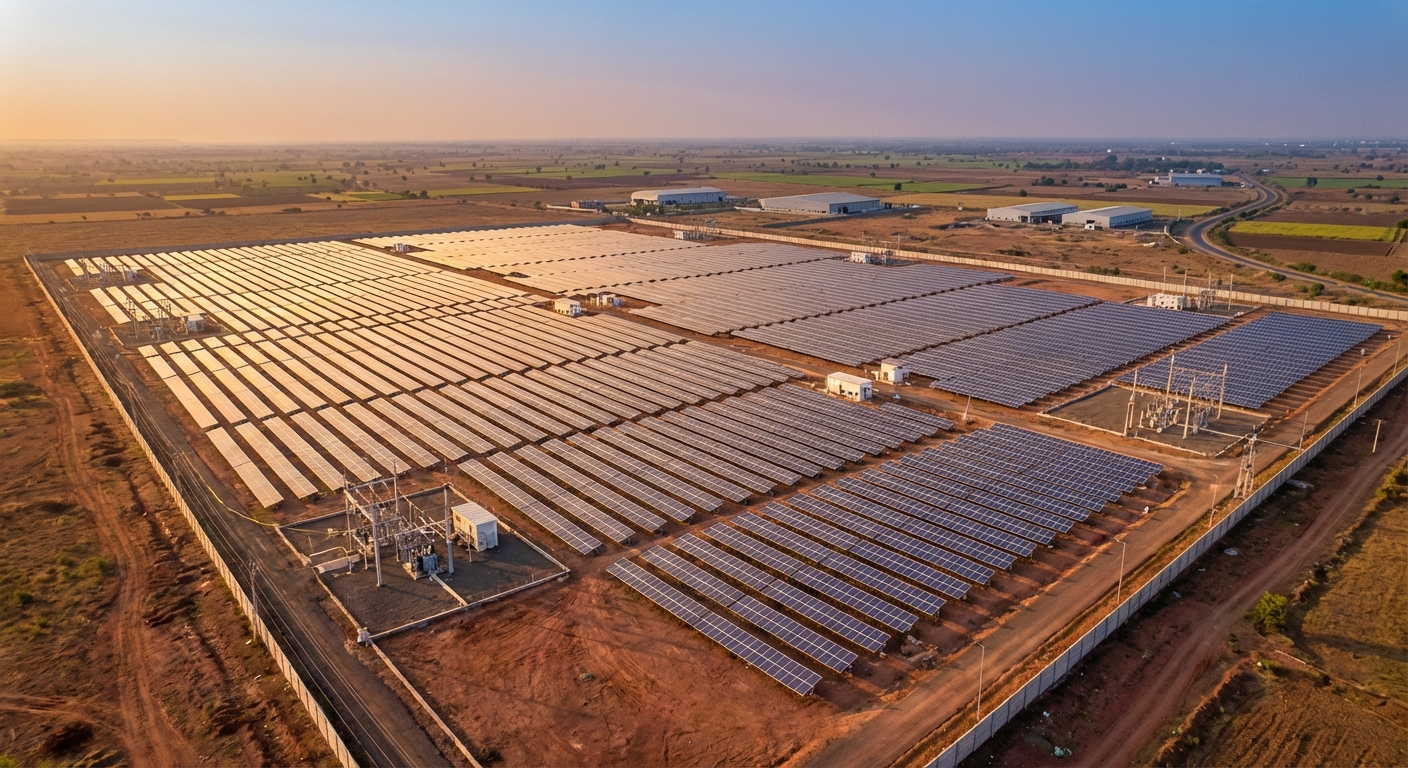
Understanding exactly what’s included in solar EPC services helps you evaluate proposals and ensure you’re getting comprehensive coverage. A complete EPC package from professional providers like Heaven Green Energy typically encompasses the following deliverables:
Design and Engineering Services:
- Detailed site survey and feasibility assessment
- Shadow analysis and solar potential evaluation
- Electrical load analysis and system sizing calculations
- Technical drawings, layouts, and single-line diagrams
- Structural engineering calculations and certifications
- Assistance with permits, approvals, and net metering applications
Equipment and Materials:
- Solar photovoltaic modules (panels) with manufacturer warranties
- Solar inverters (string, central, or micro-inverters as appropriate)
- Mounting structures (roof-mounted or ground-mounted systems)
- DC and AC cables, wires, and conduits
- Junction boxes, combiner boxes, and DC distribution boxes
- Earthing and lightning protection systems
- Monitoring systems and communication equipment
- AC/DC distribution boards and protection devices (MCBs, SPDs, isolators)
Installation and Construction Services:
- Complete installation labor and project management
- Civil works (if required for ground-mounted systems)
- Mechanical installation of mounting structures and panels
- Electrical installation and wiring
- Grid connectivity and net metering setup
- Safety equipment and protocols during installation
Testing, Commissioning, and Documentation:
- Comprehensive system testing and quality checks
- Grid synchronization and performance verification
- As-built drawings and technical documentation
- Operation and maintenance manuals
- Warranty documentation for all components
- Training on system operation and monitoring
Warranties and Support:
- Workmanship warranty (typically 2-5 years on installation)
- Product warranties (panels: 10-12 years product, 25 years performance; inverters: 5-10 years)
- Post-installation support and troubleshooting assistance
- Performance monitoring and remote diagnostics
It’s equally important to understand what’s typically NOT included in standard solar EPC packages. Ongoing maintenance contracts beyond the warranty period, insurance coverage for the solar system, electricity board charges for net metering applications, and structural reinforcement work (if your roof requires strengthening) may be additional costs. Always clarify these aspects when reviewing EPC proposals to avoid surprises later.
Solar EPC Project Timeline: What to Expect
One of the most common questions about solar EPC services concerns project duration. While timelines vary based on project size, complexity, and regulatory approvals, here’s what you can typically expect for different types of solar installations in Gujarat:
Residential Rooftop Solar Projects (1-10 kW): These smaller installations typically take 4-8 weeks from contract signing to commissioning. The timeline breaks down approximately as follows: engineering and design (1 week), approvals and net metering application (2-3 weeks), procurement (1-2 weeks, often overlapping with approvals), and installation and commissioning (3-5 days of actual on-site work). The approval process with Gujarat’s electricity distribution companies can vary, with some areas experiencing faster processing than others.
Commercial and Industrial Solar Projects (10-500 kW): Mid-sized commercial and industrial solar installations require 8-16 weeks for completion. These projects involve more complex engineering, longer approval processes (especially for high-tension connections), and extended installation periods. A 100 kW rooftop solar system for a factory in Surat or Ahmedabad might require 2 weeks for engineering, 4-6 weeks for approvals and procurement, and 2-3 weeks for installation and commissioning.
Large-Scale Ground-Mounted Solar Parks (1-50 MW): Utility-scale solar EPC projects are significantly more complex and typically require 6-12 months or longer. These projects involve land acquisition or leasing, environmental clearances, detailed geotechnical surveys, extensive civil works, high-voltage grid connectivity approvals, and phased construction. A 5 MW ground-mounted solar park in rural Gujarat might take 2-3 months for engineering and approvals, 2-3 months for procurement, and 4-6 months for construction and commissioning.
Several factors can affect these timelines. Regulatory approvals from electricity boards, municipal authorities, and other agencies can vary significantly based on location and current processing backlogs. Monsoon season (June-September in Gujarat) can slow or halt rooftop and ground-mounted construction work due to safety concerns and weather delays. Equipment availability, particularly for specific inverter models or panel brands, can extend procurement timelines. Site complexity, such as difficult roof access, structural limitations, or challenging terrain for ground-mounted systems, can add time to the construction phase.
Professional solar EPC providers maintain realistic timelines and communicate proactively about any delays. When evaluating EPC partners, be wary of promises that seem too fast, quality solar installations require proper engineering, careful procurement, and meticulous installation work that shouldn’t be rushed.
Benefits of Choosing Solar EPC Services in Gujarat
The solar EPC services model offers compelling advantages that explain its dominance in Gujarat’s solar market. Understanding these benefits helps you appreciate why partnering with an experienced EPC provider delivers better outcomes than attempting to coordinate solar projects independently.
Single-Point Accountability: Perhaps the most significant advantage of solar EPC services is having one entity responsible for your entire project. If any issues arise during installation or operation, you have a single point of contact rather than multiple vendors pointing fingers at each other. This accountability extends through the warranty period, ensuring someone is always responsible for addressing problems promptly.
Faster Project Completion: The integrated approach of solar EPC services eliminates coordination delays between separate engineering, procurement, and construction teams. Your EPC partner’s experience with similar projects and established processes accelerate every phase. In Gujarat’s competitive business environment, faster commissioning means earlier realization of electricity cost savings and quicker solar ROI.
Cost Efficiency: While it might seem that hiring separate specialists could save money, professional solar EPC services typically deliver better value. EPC companies leverage bulk procurement relationships to secure better pricing on solar modules, inverters, and other components. Their experience prevents costly mistakes during design and installation. The streamlined process reduces overall project management overhead. For industrial solar Gujarat projects where system sizes range from 100 kW to several megawatts, these cost efficiencies become substantial.
Quality Assurance: Reputable EPC providers stake their reputation on every project. They implement quality control processes across all phases, from selecting tier-1 components to ensuring installation work meets industry standards. This quality focus translates to better system performance, longer equipment life, and fewer maintenance issues over your solar system’s 25+ year lifespan.
Comprehensive Warranties: Solar EPC services include coordinated warranties covering both equipment and workmanship. Your EPC partner manages warranty claims with component manufacturers, simplifying the process if issues arise. This is particularly valuable for solar panel warranties (25 years) and solar inverter warranties (5-10 years), where having an established local partner in Gujarat ensures responsive service.
Technical Expertise: Professional EPC companies employ experienced engineers, project managers, and installation teams who understand the nuances of solar technology, local regulations, and Gujarat-specific considerations. They navigate complex approvals from electricity boards, optimize system designs for Gujarat’s climate (high temperatures, monsoon considerations, dust accumulation), and ensure compliance with all relevant standards and codes.
Gujarat-Specific Advantages: Gujarat offers unique advantages for solar adoption that experienced EPC providers help you leverage. The state receives excellent solar irradiation (5-6 kWh/m²/day), making solar investments highly attractive. Gujarat’s progressive policies, including streamlined net metering processes and support for government schemes like PM-KUSUM and DREBP, create opportunities that knowledgeable EPC partners help you access. The state’s strong industrial base, particularly in cities like Surat, Ahmedabad, Vadodara, and Rajkot, creates substantial demand for commercial and industrial solar installations where EPC services deliver maximum value.
For businesses in Gujarat’s textile, chemical, ceramic, and manufacturing sectors, industries with high electricity consumption, professional solar EPC services can design systems that significantly reduce operational costs while supporting sustainability goals. Heaven Green Energy’s experience across Gujarat, with offices in Surat, Ahmedabad, and Junagadh, enables them to understand regional variations in regulations, electricity tariffs, and site conditions that impact project success.
Types of Solar Projects Suited for Solar EPC Services
Solar EPC services adapt to various project types and scales, making them suitable for diverse applications across Gujarat’s residential, commercial, industrial, and utility sectors.
Residential Rooftop Solar Installations: Homeowners across Gujarat increasingly adopt rooftop solar to reduce electricity bills and gain energy independence. Residential solar EPC services typically handle systems ranging from 1 kW to 10 kW, designed to offset household consumption. These projects benefit from the EPC model’s simplicity, homeowners don’t need technical expertise to navigate the solar installation process. The EPC provider handles everything from assessing your roof’s suitability to completing net metering applications with your local electricity distribution company.
Commercial and Industrial Rooftop Systems: Businesses, factories, hotels, hospitals, educational institutions, and commercial buildings represent the largest segment for solar EPC services in Gujarat. These installations range from 10 kW for small businesses to several megawatts for large industrial facilities. Commercial and industrial solar projects require sophisticated engineering to match solar generation with consumption patterns, integrate with existing electrical infrastructure, and optimize solar ROI. The complexity of these projects makes professional EPC services essential rather than optional.
Ground-Mounted Solar Parks: Large-scale solar parks on open land represent another major application for solar EPC services. These utility-scale projects, ranging from 1 MW to 50 MW or larger, require extensive civil works, high-voltage electrical infrastructure, and complex grid connectivity. In Gujarat’s rural areas, where land is available and solar irradiation is excellent, ground-mounted solar parks offer attractive investment opportunities for developers and businesses with high electricity needs.
Government Scheme Projects: Gujarat actively implements central government schemes like PM-KUSUM (for agricultural solar pumps and solar parks on agricultural land) and state programs like DREBP (Decentralized Renewable Energy Generation Programme). These schemes offer subsidies and incentives but involve specific technical requirements and documentation. Experienced solar EPC providers navigate these program requirements, ensuring your project qualifies for available benefits while meeting all compliance standards.
Hybrid and Off-Grid Solar Solutions: Beyond standard grid-connected systems, solar EPC services also cover hybrid systems (combining solar with battery storage and grid connection) and off-grid installations for remote locations. These specialized applications require additional engineering for battery sizing, charge controller selection, and backup power management, making professional EPC expertise particularly valuable.
How to Choose the Right Solar EPC Partner in Gujarat
Selecting the right solar EPC provider significantly impacts your project’s success, system performance, and long-term satisfaction. Consider these critical factors when evaluating potential EPC partners in Gujarat:
Experience and Track Record: Look for EPC companies with substantial experience in projects similar to yours. A provider with hundreds or thousands of completed installations demonstrates proven capabilities. Ask about their project portfolio, residential, commercial, industrial, or utility-scale experience relevant to your needs. Companies like Heaven Green Energy, with over 10,000 installations since 2017, offer the experience that translates to smoother project execution and better problem-solving when challenges arise.
Technical Expertise: Evaluate the EPC provider’s engineering capabilities. Do they employ qualified electrical engineers and experienced project managers? Can they handle complex technical challenges like structural assessments, high-voltage connections, or integration with existing power systems? Request to see sample engineering drawings and technical documentation from previous projects to assess their technical depth.
Quality of Components: Investigate which solar panel brands, inverter manufacturers, and other component suppliers the EPC provider uses. Reputable companies use tier-1 equipment from established manufacturers with strong warranties and service networks in India. Be cautious of providers offering significantly lower prices by using unknown brands or components without proper certifications, these savings often lead to higher costs through poor performance and frequent failures.
Financial Stability: Your EPC partner’s financial health matters because they provide workmanship warranties and coordinate equipment warranties over many years. A financially unstable company may not be around to honor commitments. Look for established companies with steady growth and positive market reputation.
After-Sales Service: Solar systems operate for 25+ years, making post-installation support crucial. Does the EPC provider offer responsive maintenance services? Do they have local service teams in Gujarat who can address issues quickly? What monitoring systems do they provide to track your system’s performance? Companies with multiple offices across Gujarat, like Heaven Green Energy’s presence in Surat, Ahmedabad, and Junagadh, can provide better local support than distant providers.
Customer References: Request references from previous customers with similar projects. Speaking with existing clients provides insights into the EPC provider’s communication, project management, problem-solving, and post-installation support that you won’t find in marketing materials.
Local Knowledge: Gujarat-specific expertise matters. Does the EPC provider understand local electricity board procedures, regional regulations, and Gujarat’s solar subsidy programs? Local knowledge accelerates approvals and ensures compliance with all requirements.
Transparent Pricing: Quality EPC providers offer detailed quotations breaking down costs for equipment, installation, approvals, and other components. Be wary of vague pricing or proposals that seem too good to be true. Understanding exactly what’s included and excluded prevents disputes later.
Solar EPC Cost Factors and ROI Considerations
Understanding the cost structure of solar EPC services and how to evaluate return on investment helps you make informed financial decisions about your solar project.
Key Cost Components: Solar EPC pricing typically includes several major elements. Solar modules represent 40-50% of total project cost, with prices varying based on panel efficiency, brand, and technology (monocrystalline vs. polycrystalline). Inverters account for 10-15% of costs, with string inverters generally less expensive than micro-inverters but offering different performance characteristics. Balance of system components (mounting structures, cables, junction boxes, protection devices) comprise 15-20% of costs. Installation labor and project management typically represent 15-20% of the total investment. Engineering, approvals, and documentation add another 5-10%.
For reference, residential rooftop solar installations in Gujarat typically cost between ₹50,000-70,000 per kW installed capacity for quality systems from reputable EPC providers. Commercial and industrial projects benefit from economies of scale, with costs ranging from ₹40,000-60,000 per kW for larger systems. These figures include all components, installation, and commissioning but exclude any applicable subsidies.
Factors Affecting Solar Panel Cost: Several variables influence overall project costs. System size significantly impacts per-kW pricing, with larger installations achieving better economies of scale. Panel efficiency affects costs, higher efficiency panels cost more per watt but require less roof space, which can be valuable in space-constrained installations. Roof complexity, including difficult access, structural reinforcement needs, or challenging layouts, increases installation costs. Ground-mounted systems involve additional civil works and land preparation expenses. Grid connectivity requirements, particularly for high-voltage connections in large industrial projects, add to electrical infrastructure costs.
Understanding Solar ROI in Gujarat: Return on investment for solar projects in Gujarat is typically attractive due to high electricity tariffs, excellent solar irradiation, and available incentives. Most commercial and industrial solar installations achieve payback periods of 3-5 years, after which the system generates essentially free electricity for its remaining 20+ year lifespan. Residential systems typically see payback periods of 5-7 years.
Calculate your potential solar ROI by considering your current electricity costs (Gujarat’s commercial and industrial tariffs range from ₹6-10 per kWh depending on consumption slabs and time-of-day), expected solar generation (a 1 kW system in Gujarat generates approximately 1,400-1,600 kWh annually), and system costs. Factor in available solar subsidies, residential installations may qualify for central government subsidies of ₹14,588 per kW for systems up to 3 kW and ₹7,294 per kW for additional capacity up to 10 kW.
Solar Financing Options: If upfront capital is a constraint, several solar financing options exist in Gujarat. Many banks and financial institutions offer solar loans with competitive interest rates and tenures up to 10 years. Some EPC providers partner with financing companies to offer integrated financing solutions. For commercial and industrial projects, power purchase agreements (PPAs) allow you to install solar with zero upfront investment, paying only for the electricity generated at rates lower than grid tariffs.
Evaluating EPC Proposals: When comparing quotations from different solar EPC providers, look beyond the bottom-line price. Compare the quality of proposed equipment, panel brands, inverter specifications, mounting structure materials. Evaluate warranty terms for both equipment and workmanship. Consider the provider’s experience, reputation, and after-sales support capabilities. The cheapest proposal often proves most expensive in the long run if it involves inferior components or poor installation quality that leads to underperformance and frequent repairs.
Common Questions About Solar EPC Services
What exactly does a solar EPC contractor do? A solar EPC contractor manages your entire solar project from start to finish. They conduct site assessments, design your system, obtain necessary approvals, procure all equipment, install the solar array, connect it to the grid, test everything, and hand over a fully operational system. You deal with one company for everything rather than coordinating multiple vendors.
How long does solar installation take? Installation timelines vary by project size. Residential systems (1-10 kW) typically take 4-8 weeks from contract to commissioning, with actual on-site installation work requiring just 3-5 days. Commercial and industrial projects (10-500 kW) need 8-16 weeks. Large ground-mounted solar parks can take 6-12 months or longer. Approval processes from electricity boards often represent the longest part of the timeline.
What warranties are provided with solar EPC services? Comprehensive solar EPC packages include multiple warranties. Solar panels typically come with 10-12 year product warranties and 25-year performance warranties (guaranteeing at least 80% output after 25 years). Inverters carry 5-10 year warranties depending on the model. The EPC contractor provides workmanship warranties covering installation quality, typically for 2-5 years. Always get warranty terms in writing and understand the claim process.
Who handles maintenance after installation? Basic maintenance like panel cleaning and visual inspections can be performed by building maintenance staff. However, technical maintenance, troubleshooting, and repairs should be handled by qualified technicians. Many EPC providers offer annual maintenance contracts (AMCs) covering periodic inspections, cleaning, performance monitoring, and repairs. Even without an AMC, reputable EPC companies provide post-installation support and can dispatch technicians when needed.
What happens if something goes wrong with my solar system? With solar EPC services, you contact your EPC provider who takes responsibility for diagnosing and resolving issues. They coordinate warranty claims with equipment manufacturers if needed and dispatch technicians for repairs. This single-point accountability is a major advantage over fragmented installations where you might struggle to determine whether problems stem from equipment defects, installation errors, or design issues.
Can I expand my solar system later? System expansion is possible but requires planning. Inform your EPC provider during initial design if you anticipate future expansion, they can size inverters and electrical infrastructure to accommodate additional panels later. Expansion is easier for ground-mounted systems than rooftop installations where space may be limited. Keep in mind that expanding systems installed under subsidy programs may have restrictions.
Do solar EPC services include government subsidy applications? Most professional EPC providers assist with subsidy applications for eligible projects, including residential subsidies and schemes like PM-KUSUM. However, clarify this during proposal discussions as some providers may charge separately for subsidy application assistance or exclude it from base pricing.
What’s the difference between on-grid and off-grid solar EPC projects? On-grid (grid-connected) systems are connected to the electricity grid, allowing you to export excess solar generation and draw power when solar production is insufficient. These systems don’t require batteries and are most common for residential and commercial installations. Off-grid systems operate independently with battery storage, suitable for remote locations without grid access. Hybrid systems combine both approaches. Solar EPC services can design and install any configuration based on your needs.
Taking the Next Step: Your Solar EPC Journey with Heaven Green Energy
Understanding solar EPC services is the first step toward harnessing solar energy for your home, business, or industrial facility. The turnkey EPC model simplifies what could otherwise be a complex, fragmented process into a streamlined journey with a single, accountable partner guiding you from initial assessment to final commissioning and beyond.
Whether you’re a homeowner in Surat looking to reduce electricity bills with rooftop solar, a factory owner in Ahmedabad seeking to cut operational costs through industrial solar installations, or a developer planning a large-scale solar park in rural Gujarat, professional solar EPC services provide the expertise, resources, and accountability needed for successful project execution.
The key advantages of solar EPC services, single-point responsibility, integrated engineering and construction, quality assurance, comprehensive warranties, and faster project completion, translate directly into better outcomes: systems that perform as expected, generate the promised savings, require minimal maintenance, and deliver strong returns on investment over their 25+ year lifespan.
Heaven Green Energy brings nearly a decade of solar EPC experience to Gujarat’s renewable energy landscape. With over 10,000 installations completed across residential, commercial, industrial, and utility-scale projects, and a presence in Surat, Ahmedabad, and Junagadh, the company offers the local expertise and technical capabilities needed to navigate Gujarat’s solar market successfully. From understanding regional electricity board procedures to optimizing system designs for Gujarat’s climate and leveraging available government schemes, experienced EPC providers ensure your solar investment delivers maximum value.
As Gujarat continues its transition toward renewable energy, with ambitious solar capacity targets and supportive policies, the opportunities for solar adoption have never been better. High electricity tariffs, excellent solar irradiation, available subsidies, and proven technology combine to make solar energy one of the most attractive investments for property owners and businesses across the state.
If you’re ready to explore how solar EPC services can transform your energy costs and support your sustainability goals, the next step is a professional site assessment and feasibility analysis. This evaluation provides clarity on your property’s solar potential, expected system size, generation estimates, costs, savings projections, and payback timelines, all the information needed to make an informed decision about your solar investment.
Don’t let high electricity costs continue draining your budget when clean, renewable solar energy offers a proven alternative. Professional solar EPC services make the transition straightforward, handling all technical complexities while you enjoy the benefits of reduced energy costs and energy independence. Have any questions about solar EPC services for your property in Gujarat? Contact Heaven Green Energy at +91 63904 05060 to discuss your project requirements, schedule a site assessment, and take the first step toward your solar energy future today.
This blog post was written using thestacc.com