


When considering a solar energy investment for your home or business in Gujarat, one question stands above all others: “How long will it take to recover my investment?” This critical timeline, known as the solar payback period, determines when your solar installation transitions from a cost center to a profit generator. Understanding your break-even timeline isn’t just about numbers on a spreadsheet—it’s about making an informed decision that aligns with your financial goals and sustainability vision.
The solar payback period represents the time required for your cumulative electricity savings to equal your initial solar investment. In Gujarat, where abundant sunshine meets rising electricity costs, solar installations typically achieve payback faster than many other regions in India. However, your specific timeline depends on multiple interconnected factors, from system size and component quality to available subsidies and local electricity rates.
This comprehensive guide breaks down everything affecting your solar payback timeline in 2026, providing calculation methods, regional insights specific to Gujarat, and proven strategies to accelerate your break-even point. Whether you’re a homeowner exploring rooftop solar or a business owner evaluating industrial solar Gujarat installations, understanding these dynamics will help you maximize your solar investment returns.
What Is Solar Payback Period and Why Does It Matter?
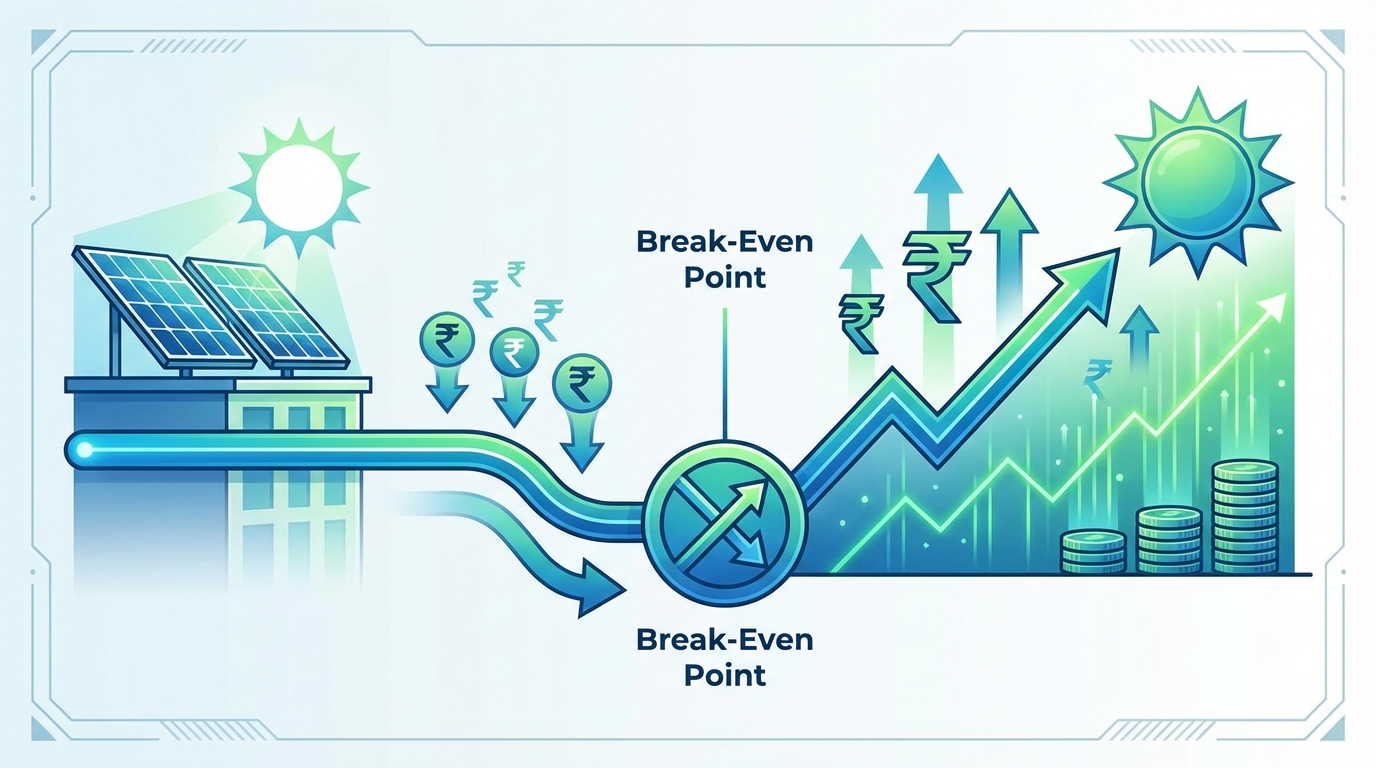
The solar payback period is the length of time required for your solar energy system to generate enough savings to offset its initial purchase and installation costs. Think of it as your investment’s break-even point—the moment when your solar panels have “paid for themselves” through reduced electricity bills.
Unlike return on investment (ROI), which measures the total profit over the system’s lifetime, the solar payback period focuses specifically on when you recover your initial outlay. This distinction matters because it helps you understand your cash flow timeline and when your solar installation begins generating pure profit.
For most residential installations in Gujarat, the solar payback period ranges between 4 to 7 years, depending on system size, electricity consumption patterns, and available incentives. Commercial and industrial installations often see even shorter payback periods of 3 to 5 years due to higher electricity consumption, better economies of scale, and commercial tariff structures that favor solar adoption.
Why does this metric matter so much? The payback period directly influences several critical decisions:
- Financing options: Banks and financial institutions evaluate payback periods when approving solar loans, with shorter timelines often securing better interest rates
- Investment priority: Businesses compare solar payback against other capital investments to allocate resources effectively
- System design choices: Understanding payback helps you balance upfront costs against long-term savings when selecting components
- Risk assessment: Shorter payback periods reduce investment risk and provide faster access to positive cash flow
Given that quality solar panels carry warranties of 25 years and can function efficiently for 30+ years, a 5-year payback period means you’ll enjoy 20-25 years of essentially free electricity after breaking even. This extended profit period is what makes solar energy one of the most attractive long-term investments available today.
How to Calculate Your Solar Payback Period
Calculating your solar payback period involves a straightforward formula, though gathering accurate inputs requires careful consideration of all costs and savings. The basic formula is:
Solar Payback Period = Total System Cost ÷ Annual Savings
Let’s break down each component with a practical example for a typical Gujarat homeowner:
Step 1: Calculate Total System Cost
Your total system cost includes all upfront expenses minus any subsidies or incentives you receive. For a 5 kW residential rooftop solar system in Gujarat, this typically includes:
- Solar panels (modules): ₹1,25,000
- Solar inverter: ₹50,000
- Mounting structures and balance of system: ₹35,000
- Installation and labor: ₹25,000
- Net metering setup and permissions: ₹15,000
- Gross Total: ₹2,50,000
- Less: Central Government Subsidy (₹78,000 for 5 kW residential)
- Net System Cost: ₹1,72,000
Step 2: Calculate Annual Electricity Savings
A 5 kW system in Gujarat typically generates approximately 7,500 units (kWh) annually, considering the state’s excellent solar irradiation of 5.5-6.0 kWh/m²/day. If your current electricity rate averages ₹7 per unit:
- Annual generation: 7,500 kWh
- Electricity rate: ₹7 per kWh
- Annual savings: ₹52,500
Step 3: Apply the Formula
Solar Payback Period = ₹1,72,000 ÷ ₹52,500 = 3.3 years
This calculation provides a simple payback estimate. For a more accurate assessment, consider these additional factors:
- Electricity rate escalation: Electricity rates typically increase 5-8% annually, which actually shortens your payback period over time
- System degradation: Solar panels lose approximately 0.5% efficiency per year, slightly reducing generation over time
- Maintenance costs: Budget ₹3,000-5,000 annually for cleaning and minor maintenance
- Financing costs: If you take a solar loan, include interest payments in your total cost
Many solar companies, including experienced solar EPC providers, offer detailed payback calculations as part of their proposal process. These professional assessments account for your specific consumption patterns, roof orientation, shading analysis, and local electricity tariffs to provide highly accurate projections.
Key Factors That Affect Solar Payback Timeline
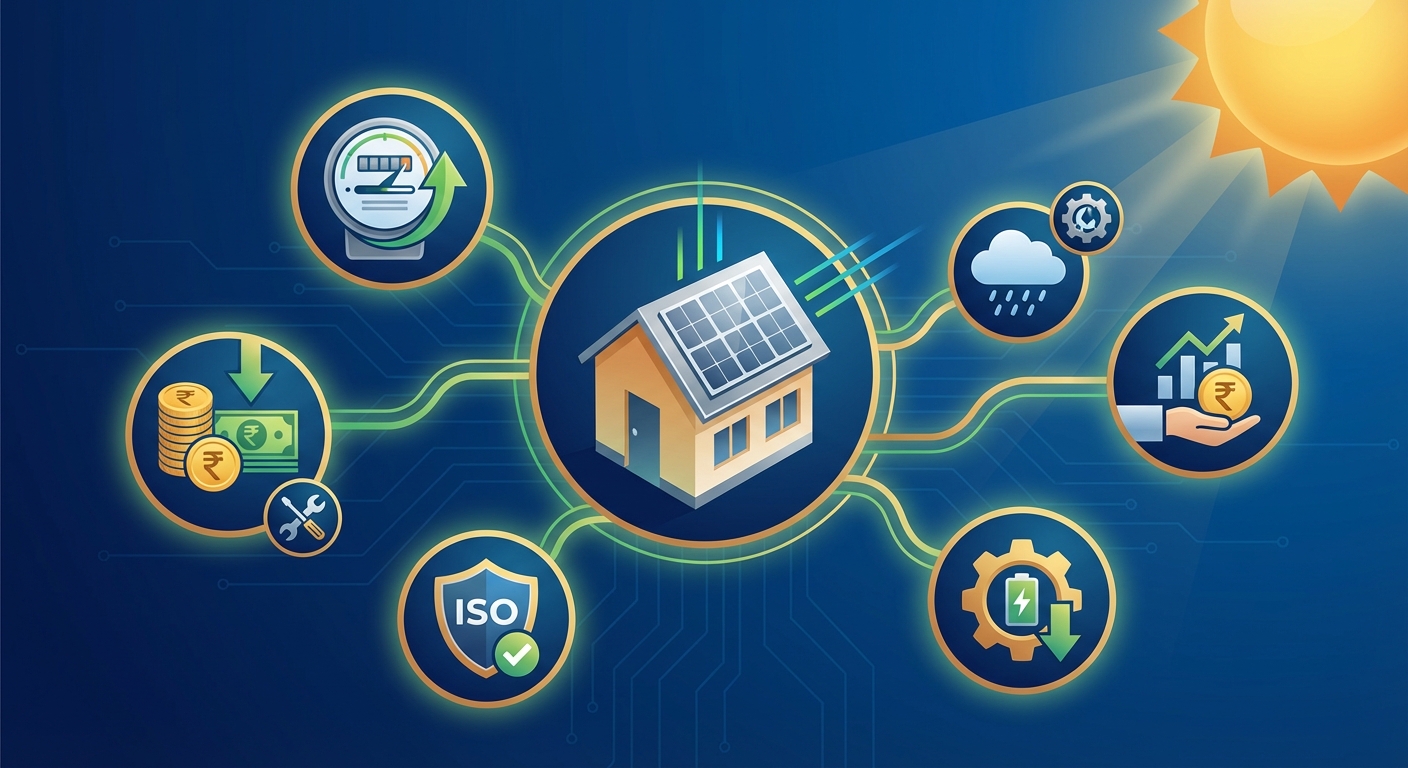
Your solar payback period isn’t determined by a single variable but rather by the complex interaction of multiple factors. Understanding these elements helps you make strategic decisions that can significantly accelerate your break-even timeline.
System Size and Electricity Consumption Impact
The relationship between system size and solar payback is nuanced. While larger systems cost more upfront, they also generate proportionally greater savings—but only if your electricity consumption justifies the size.
A properly sized system matches your consumption patterns without significant excess generation. In Gujarat, net metering policies allow you to bank excess generation, but the compensation rate may be lower than your consumption rate, affecting overall economics. For residential installations, systems between 3-10 kW typically offer optimal payback periods when matched to household consumption.
Commercial and industrial installations benefit from economies of scale. A 100 kW commercial system might cost ₹45-50 per watt installed, while a 5 kW residential system costs ₹50-55 per watt. This cost advantage, combined with higher daytime consumption that matches solar generation patterns, often results in industrial solar Gujarat installations achieving payback in just 3-4 years.
The key is right-sizing: oversizing wastes capital on generation you can’t fully monetize, while undersizing leaves savings on the table. Professional system design based on your actual consumption data ensures optimal payback.
Electricity Rates and Tariff Structure
Your current electricity rate is perhaps the single most influential factor in determining solar payback. The higher your electricity costs, the faster your solar investment pays for itself.
Gujarat’s electricity tariff structure varies significantly across consumer categories:
- Residential consumers: ₹4-8 per unit depending on consumption slabs, with higher consumption attracting higher rates
- Commercial establishments: ₹7-10 per unit, making solar particularly attractive for shops, offices, and retail spaces
- Industrial consumers: ₹6-9 per unit plus demand charges, with time-of-day variations that solar can offset effectively
Consider two scenarios: A homeowner paying ₹5 per unit versus a commercial establishment paying ₹9 per unit. For the same 10 kW system generating 15,000 units annually:
- Residential savings: 15,000 × ₹5 = ₹75,000/year → Payback ~4.7 years
- Commercial savings: 15,000 × ₹9 = ₹1,35,000/year → Payback ~2.6 years
Furthermore, electricity rates have historically increased 6-8% annually in India. This escalation works in your favor, your solar savings grow each year while your system cost remains fixed, effectively shortening the real payback period compared to initial calculations.
Solar Subsidies and Incentives That Reduce Payback Period
Government subsidies and incentives can dramatically reduce your solar payback period by lowering the effective system cost. In 2026, several programs make solar adoption more financially attractive across Gujarat.
Central Government Solar Subsidy
The Ministry of New and Renewable Energy (MNRE) provides direct capital subsidies for residential rooftop solar installations:
- Systems up to 3 kW: ₹18,000 per kW (₹54,000 total)
- Systems above 3 kW up to 10 kW: ₹18,000 per kW for first 3 kW + ₹9,000 per kW for additional capacity
- Example: 5 kW system receives ₹54,000 + ₹18,000 = ₹78,000 subsidy
This subsidy directly reduces your net system cost, shortening payback by 1-2 years for most residential installations. The subsidy is typically processed through your installation company and reflected in your final invoice.
PM-KUSUM Scheme Benefits
The Pradhan Mantri Kisan Urja Suraksha evam Utthaan Mahabhiyan (PM-KUSUM) scheme offers substantial support for agricultural and rural solar installations. Component B of the scheme provides 30% central subsidy plus 30% state subsidy for farmers installing solar pumps, with an additional 30% available through low-interest loans.
For businesses and farmers in Gujarat, PM-KUSUM can reduce effective system costs by up to 60%, resulting in payback periods as short as 2-3 years for agricultural solar applications.
Net Metering Policies
Gujarat’s net metering regulations allow you to export excess solar generation to the grid and receive credits against future consumption. While not a direct subsidy, net metering ensures you monetize every unit your system generates, maximizing savings and accelerating payback.
Under Gujarat’s net metering policy, excess generation is banked on a monthly basis, with annual settlement. This mechanism is particularly valuable for residential consumers whose generation exceeds daytime consumption.
Accelerated Depreciation for Commercial Installations
Commercial and industrial entities can claim 40% accelerated depreciation on solar assets in the first year, providing significant tax benefits. For a ₹50 lakh commercial installation, this translates to ₹20 lakh in depreciation claims, reducing tax liability and improving effective payback by 6-12 months.
To maximize these benefits, work with experienced solar installation Gujarat providers who understand the application processes and can help you access all available incentives. Missing out on subsidies you’re entitled to unnecessarily extends your payback period.
Regional Variations in Solar Payback Across Gujarat
Gujarat’s geography creates meaningful variations in solar payback periods across different regions. Understanding these differences helps set realistic expectations based on your specific location.

Solar Irradiation Differences
Gujarat enjoys some of India’s best solar resources, but irradiation levels vary across the state:
- Northern Gujarat (Mehsana, Patan): 5.8-6.2 kWh/m²/day, highest generation potential
- Central Gujarat (Ahmedabad, Anand): 5.6-5.9 kWh/m²/day, excellent generation
- Southern Gujarat (Surat, Valsad): 5.3-5.7 kWh/m²/day, very good generation with slightly higher monsoon cloud cover
- Saurashtra (Junagadh, Rajkot): 5.7-6.0 kWh/m²/day, excellent coastal sunshine
A 5 kW system in Mehsana might generate 7,800 units annually, while the same system in Valsad generates 7,200 units, a 600-unit difference worth approximately ₹4,200 annually at ₹7 per unit. Over a typical payback period, this translates to several months’ difference in break-even timing.
Local Electricity Rate Variations
While Gujarat’s electricity distribution is primarily managed by state utilities, tariff structures can vary slightly between urban and rural areas, and between different distribution companies serving various regions. Commercial rates in major cities like Ahmedabad and Surat tend to be at the higher end of the range, making solar particularly attractive in these urban centers.
Installation and Service Accessibility
Cities with established solar ecosystems, Ahmedabad, Surat, Vadodara, Rajkot, benefit from competitive pricing due to multiple providers and streamlined installation processes. Remote areas might face slightly higher installation costs due to logistics, though this is typically offset by lower labor costs.
Heaven Green Energy Limited, with offices in Surat, Ahmedabad, and Junagadh, provides consistent pricing and service quality across Gujarat, eliminating regional disparities in installation costs and ensuring reliable support regardless of location.
Why Gujarat Offers Favorable Payback Nationally
Compared to other Indian states, Gujarat consistently ranks among the best for solar payback periods due to:
- Excellent solar irradiation (300+ sunny days annually)
- Progressive solar policies and streamlined net metering
- Relatively higher electricity tariffs, especially for commercial consumers
- Strong solar ecosystem with competitive pricing
- Proactive state support for renewable energy adoption
These factors combine to make rooftop solar Gujarat installations among the most financially attractive in India, with payback periods typically 6-12 months shorter than national averages.
Proven Strategies to Reduce Your Solar Payback Period
While many factors affecting solar payback are external, you can employ several strategic approaches to accelerate your break-even timeline and maximize investment returns.
1. Choose High-Efficiency Components
Investing in quality solar modules and inverters pays dividends throughout your system’s lifetime. Premium monocrystalline panels with 20-22% efficiency generate more electricity from the same roof space compared to lower-efficiency alternatives. While they cost 10-15% more upfront, the additional generation can shorten payback by 4-6 months.
Similarly, high-quality inverters with 97-98% efficiency ensure minimal conversion losses. Selecting reputable solar brands with proven performance records protects your investment and ensures consistent generation that meets payback projections.
2. Optimize System Design for Maximum Generation
Professional system design considers roof orientation, tilt angle, shading analysis, and seasonal sun paths to maximize generation. A well-designed system can generate 10-15% more electricity than a poorly planned installation on the same roof.
Key design optimizations include:
- Optimal tilt angle (typically 15-20° in Gujarat for year-round performance)
- South-facing orientation where possible (or east-west for morning/evening generation)
- Minimizing shading from trees, buildings, or roof obstructions
- Proper string configuration to minimize mismatch losses
- Adequate ventilation to prevent heat-related efficiency losses
Working with experienced solar EPC Gujarat providers ensures your system design maximizes generation potential, directly improving payback timelines.
3. Maximize Available Subsidies and Incentives
Ensure you access every subsidy and incentive you’re eligible for. Many solar adopters miss out on benefits simply due to lack of awareness or incomplete applications. Your solar installer should guide you through:
- MNRE residential subsidy applications
- State-specific incentive programs
- Net metering registration and setup
- Accelerated depreciation claims for commercial installations
- Special schemes like PM-KUSUM for eligible applications
Missing even a single applicable subsidy can extend your payback period by 6-18 months unnecessarily.
4. Select Quality EPC Services to Minimize Maintenance
Poor installation quality leads to underperformance, frequent repairs, and unexpected maintenance costs, all of which extend payback periods. Quality EPC services ensure:
- Proper mounting that withstands Gujarat’s monsoon winds
- Weatherproof electrical connections that prevent failures
- Correct inverter sizing and configuration
- Compliance with safety standards and regulations
- Comprehensive warranties and after-sales support
While premium EPC services might cost 5-8% more upfront, they eliminate the hidden costs of poor installation that can add years to your payback period through reduced generation and repair expenses.
5. Implement Energy Efficiency Measures Alongside Solar
Reducing your overall electricity consumption amplifies solar’s impact. When solar covers a larger percentage of your reduced consumption, you achieve payback faster. Consider:
- Switching to LED lighting (reduces consumption by 60-80% vs. traditional bulbs)
- Installing energy-efficient air conditioning (can reduce cooling costs by 30-40%)
- Optimizing industrial processes to shift consumption to solar generation hours
- Improving building insulation to reduce heating/cooling loads
These measures create a multiplier effect, your solar investment covers more of your needs while your overall electricity expenses decrease, accelerating break-even.
6. Maintain Your System for Optimal Performance
Regular maintenance preserves system performance and prevents degradation that extends payback. In Gujarat’s dusty environment, panel cleaning every 4-6 weeks can improve generation by 15-20%. Annual professional inspections catch small issues before they become expensive problems.
Budget ₹3,000-5,000 annually for maintenance, this small investment protects the much larger payback calculation by ensuring your system generates at projected levels throughout the payback period.
Real-World Solar Payback Examples in Gujarat
Understanding theoretical calculations is valuable, but real-world examples provide concrete context for what you can expect based on your specific situation.
Residential Rooftop Solar: 5 kW System in Surat
- System cost: ₹2,50,000 (₹50 per watt installed)
- Less MNRE subsidy: ₹78,000
- Net investment: ₹1,72,000
- Annual generation: 7,500 units
- Electricity rate: ₹7 per unit average
- Annual savings: ₹52,500
- Annual maintenance: ₹4,000
- Net annual benefit: ₹48,500
- Payback period: 3.5 years
After payback, this homeowner enjoys 22+ years of savings worth approximately ₹11-15 lakhs over the system’s lifetime, accounting for electricity rate escalation.
Commercial Establishment: 25 kW System in Ahmedabad
- System cost: ₹11,25,000 (₹45 per watt for larger system)
- No residential subsidy (commercial installation)
- Net investment: ₹11,25,000
- Annual generation: 37,500 units
- Commercial electricity rate: ₹9 per unit
- Annual savings: ₹3,37,500
- Annual maintenance: ₹12,000
- Net annual benefit: ₹3,25,500
- Accelerated depreciation benefit (Year 1): ₹4,50,000 × 30% tax rate = ₹1,35,000
- Effective payback period: 3.0 years
This commercial installation benefits from higher electricity rates, economies of scale, and tax advantages, resulting in faster payback despite no direct subsidy.
Industrial Solar: 100 kW System in Rajkot
- System cost: ₹42,00,000 (₹42 per watt for large-scale installation)
- Net investment: ₹42,00,000
- Annual generation: 1,50,000 units
- Industrial electricity rate: ₹8 per unit plus demand charge savings
- Annual electricity savings: ₹12,00,000
- Demand charge reduction: ₹1,50,000
- Total annual savings: ₹13,50,000
- Annual maintenance: ₹35,000
- Net annual benefit: ₹13,15,000
- Accelerated depreciation benefit (Year 1): ₹16,80,000 × 30% = ₹5,04,000
- Effective payback period: 2.8 years
Large industrial solar Gujarat installations achieve the shortest payback periods due to optimal economies of scale, high consumption that matches solar generation patterns, and significant tax benefits.
These examples demonstrate how solar payback varies across applications, but all scenarios show attractive returns that justify the investment, particularly when you consider the 20+ years of benefits following the payback period.
Common Mistakes That Extend Solar Payback Period
Avoiding these frequent errors can save you months or even years on your solar payback timeline.
Choosing Low-Quality Components to Save Upfront Costs
The cheapest solar panel cost isn’t always the best value. Low-quality modules degrade faster (1-2% annually vs. 0.5% for premium panels), have higher failure rates, and generate less electricity than specifications suggest. A ₹20,000 saving on cheaper panels can cost you ₹1-2 lakhs in lost generation over the system’s lifetime, extending payback by 1-2 years.
Incorrect System Sizing
Both oversizing and undersizing hurt payback economics. Oversized systems waste capital on generation you can’t fully monetize, while undersized systems leave savings on the table. Professional consumption analysis and system design ensure optimal sizing for fastest payback.
Ignoring Maintenance Requirements
Neglecting regular cleaning and maintenance can reduce generation by 20-30% in Gujarat’s dusty environment. This performance loss directly extends your payback period. A system projected to pay back in 4 years might take 5-6 years if poorly maintained.
Not Maximizing Available Subsidies
Failing to apply for subsidies you’re eligible for is leaving money on the table. Ensure your installer helps you access all available incentives, residential subsidies, PM-KUSUM benefits, net metering registration, and commercial tax advantages.
Poor Installation Quality
Substandard installation leads to underperformance, safety issues, and frequent repairs. Loose connections, improper grounding, inadequate mounting, and incorrect inverter configuration all reduce generation and increase costs. Choose experienced solar EPC services with proven track records, even if they cost slightly more upfront.
Failing to Account for Warranty and Support
Solar panels carry 25-year performance warranties, but only if the manufacturer and installer remain in business to honor them. Choosing fly-by-night operators or unknown brands might save money initially but leaves you without recourse when issues arise. The cost of replacing failed components out-of-warranty can add 1-2 years to your payback period.
Frequently Asked Questions About Solar Payback
What is the average solar payback period in Gujarat?
The average solar payback period in Gujarat ranges from 3-7 years depending on system type and application. Residential installations typically see 4-6 year payback, commercial systems achieve 3-5 years, and industrial solar Gujarat installations often break even in just 3-4 years. Gujarat’s excellent solar irradiation and supportive policies make these timelines among the shortest in India.
Does solar payback period include maintenance costs?
Yes, accurate solar payback calculations should include ongoing maintenance costs. Budget approximately ₹3,000-5,000 annually for residential systems and ₹10,000-40,000 for commercial/industrial installations depending on size. These costs cover regular cleaning, inspections, and minor repairs. While maintenance reduces annual net savings slightly, it’s essential for preserving system performance and achieving projected payback timelines.
How do rising electricity rates affect payback?
Rising electricity rates actually shorten your effective solar payback period. While your initial calculation uses current rates, electricity costs typically increase 6-8% annually in India. Your solar savings grow each year as rates rise, while your system cost remains fixed. A system calculated to pay back in 5 years at current rates might actually break even in 4-4.5 years when accounting for rate escalation.
What happens after the payback period ends?
After achieving payback, your solar system generates pure profit for the remainder of its operational life. With quality panels lasting 25-30+ years, you typically enjoy 20-25 years of essentially free electricity after breaking even. For a residential system saving ₹50,000 annually, this translates to ₹10-12.5 lakhs in additional savings over the system’s lifetime, not accounting for electricity rate increases that make actual savings even higher.
Is payback period different for commercial vs residential?
Yes, commercial and industrial installations typically achieve faster payback than residential systems due to several factors: higher electricity rates (₹8-10 per unit vs. ₹5-7 for residential), better economies of scale on larger systems, daytime consumption patterns that match solar generation, and tax benefits like accelerated depreciation. Commercial systems often break even 1-2 years faster than comparable residential installations.
Take the First Step Toward Solar Savings Today
Understanding your solar payback period transforms solar from an abstract environmental choice into a concrete financial decision with measurable returns. In Gujarat’s favorable solar environment, most installations achieve break-even within 3-6 years, followed by decades of profit and energy independence.
The key to optimizing your solar payback timeline lies in making informed decisions: choosing quality components, working with experienced installers, maximizing available subsidies, and maintaining your system properly. Each of these factors can shorten your payback by months or years, dramatically improving your investment returns.
Whether you’re considering a residential rooftop installation, a commercial solar system, or an industrial solar Gujarat project, the financial case for solar has never been stronger. With electricity rates rising, technology costs falling, and generous subsidies available, 2026 presents an ideal opportunity to invest in solar energy.
Heaven Green Energy Limited brings over seven years of solar expertise to help you achieve optimal solar payback periods. With 10,000+ successful installations across Gujarat and comprehensive EPC services covering design, installation, and ongoing support, we ensure your solar investment performs exactly as projected. Our team handles everything from subsidy applications and net metering registration to system design optimization and quality component selection, all the factors that determine your break-even timeline.
Ready to calculate your specific solar payback period and discover how quickly solar can start generating returns for your home or business? Have Any Questions? +91 63904 05060. Our solar experts will provide a detailed payback analysis customized to your consumption patterns, location, and financial goals, helping you make a confident decision about your solar investment.
Don’t let another month of high electricity bills pass while your roof sits empty. Start your journey toward energy independence and financial savings today, your solar payback period is shorter than you think.