


If your business is investing in solar energy in 2026, you already know about lower electricity bills and a greener footprint. But there is another major financial benefit that many business owners overlook: solar depreciation. When used correctly, solar depreciation can dramatically reduce your tax burden in the first few years after installation, accelerating your return on investment and making commercial solar even more financially attractive.
This guide breaks down everything businesses need to know about solar depreciation in 2026, including MACRS schedules, bonus depreciation rules, calculation methods, and how these benefits apply to commercial and industrial solar installations across Gujarat and India. Whether you run a factory, a warehouse, or a commercial complex, understanding solar depreciation is key to maximizing your solar investment.

What Is Solar Depreciation and Why It Matters for Businesses
Solar depreciation is the process of deducting the cost of a solar energy system from your taxable income over a set number of years. Like any business asset, a solar installation loses value over time. Tax authorities allow businesses to account for this loss in value as a deductible expense, which reduces the amount of income tax you owe each year.
For businesses, this is a significant advantage. A large commercial solar system can cost tens of lakhs or even crores of rupees. Being able to write off a substantial portion of that cost against your taxable income in the early years of ownership means real, measurable savings on your tax bill. The faster you can depreciate the asset, the sooner you recover your investment.
In 2026, solar depreciation remains one of the most powerful financial tools available to commercial and industrial solar adopters. Businesses in Gujarat, where solar irradiation is among the highest in India, stand to gain especially well from combining strong energy generation with smart tax planning. When you pair solar depreciation with other incentives like government subsidies and net metering, the financial case for going solar becomes very compelling.
Key Takeaway: Solar depreciation reduces your taxable income by allowing you to deduct the cost of your solar system over time. For businesses, this translates directly into lower tax payments and a faster payback period.
Types of Solar Depreciation Methods Available in 2026
Not all depreciation methods work the same way. Businesses typically have a few options when it comes to depreciating solar assets, and choosing the right method can make a significant difference in how quickly you recover your investment.
Accelerated Depreciation (MACRS)
The Modified Accelerated Cost Recovery System (MACRS) is the most commonly used depreciation method for solar assets in the United States and is the benchmark framework referenced globally for commercial solar tax planning. Under MACRS, solar energy systems are classified as 5-year property, meaning you can depreciate the full cost over just five years using an accelerated schedule. This front-loads your deductions, giving you larger write-offs in the early years when your investment is greatest.
Bonus Depreciation
Bonus depreciation allows businesses to deduct a large percentage of the asset’s cost in the very first year of service. This is separate from the regular MACRS schedule and can be stacked on top of it for even greater first-year savings. The percentage available changes based on current tax legislation, which we cover in detail in a later section.
Straight-Line Depreciation
Straight-line depreciation spreads the cost of the solar system equally over its useful life, typically 25 to 30 years for solar panels. While this method is simpler, it is far less advantageous for businesses because it delays the bulk of your deductions. Most businesses with significant tax liability prefer accelerated methods like MACRS.
Which Method Is Best for Your Business?
For most commercial and industrial businesses with substantial taxable income, MACRS combined with bonus depreciation offers the greatest financial benefit. Smaller businesses or those with lower tax liability may benefit from spreading deductions over more years. Always consult a qualified tax professional to determine the best approach for your specific situation.
MACRS Solar Depreciation: The 5-Year Schedule Explained
The MACRS 5-year depreciation schedule is the gold standard for commercial solar tax planning. Under this system, your solar installation is treated as a 5-year asset, but the actual depreciation period extends to six tax years due to the half-year convention. This convention assumes the asset was placed in service at the midpoint of the first year, regardless of when it was actually installed.
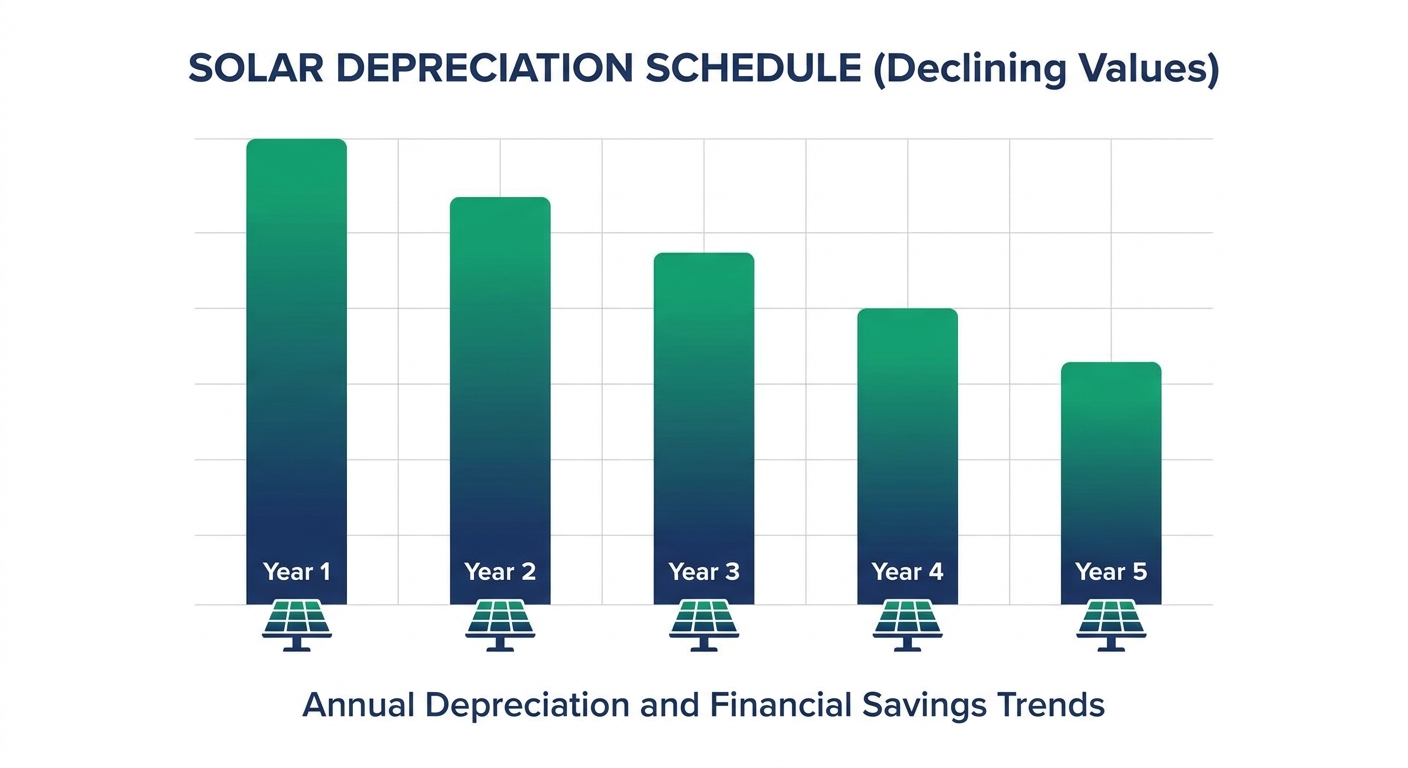
Here is how the standard MACRS depreciation percentages break down for a solar energy system over the six-year period:
- Year 1: 20.00%
- Year 2: 32.00%
- Year 3: 19.20%
- Year 4: 11.52%
- Year 5: 11.52%
- Year 6: 5.76%
These percentages are applied to the depreciable basis of the solar system, which is the installed cost after accounting for any applicable tax credits. Over the full six-year period, you will have depreciated 100% of the depreciable basis, recovering the full cost of the asset through tax deductions.
Why the 5-Year MACRS Schedule Is So Powerful
Solar panels typically have a useful life of 25 years or more. Being able to depreciate the full cost in just five to six years means you are taking deductions far faster than the asset actually wears out. This accelerated timeline significantly reduces your net cost of ownership in the early years, improving cash flow and shortening your payback period. For industrial solar installations in Gujarat, where system sizes are often large, this can translate into very substantial tax savings.
How MACRS Applies to Different Solar Installation Types
MACRS applies to solar energy systems that are used for business purposes. This includes rooftop solar on commercial buildings, ground-mounted solar on industrial land, and solar carports or canopies. The key requirement is that the system must be owned by the business (not leased) and used in a trade or business. For more details on the types of solar installations that qualify, see our guide on What is Solar EPC? Complete Service Guide 2026.
Bonus Depreciation for Solar in 2026: What Businesses Need to Know
Bonus depreciation is an additional first-year deduction that allows businesses to write off a large portion of a solar system’s cost immediately, on top of the regular MACRS schedule. It was introduced to encourage business investment in capital assets, and solar energy systems have consistently qualified for this benefit.
Bonus Depreciation Percentage in 2026
Under the Tax Cuts and Jobs Act (TCJA) framework, bonus depreciation was set at 100% through 2022 and has been phasing down since then. In 2026, the bonus depreciation rate is 40%, following the scheduled phase-down. This means businesses can deduct 40% of the solar system’s depreciable basis in the first year, in addition to the regular MACRS first-year deduction.
While 40% is lower than the 100% available in earlier years, it still represents a significant first-year tax benefit. For a solar system with a depreciable basis of ₹50 lakhs, a 40% bonus depreciation deduction equals ₹20 lakhs in additional first-year write-offs.
How Bonus Depreciation Stacks With MACRS
When you claim bonus depreciation, it is applied first to the depreciable basis. The remaining basis is then depreciated using the standard MACRS schedule. This means your first-year deduction is significantly larger than the standard 20% MACRS rate alone. The combined effect front-loads a large portion of your total deductions into year one, maximizing early cash flow benefits.
Eligibility Requirements for Bonus Depreciation
To qualify for bonus depreciation on a solar installation, the system must be new (not used), placed in service during the tax year, and used for business purposes. The business must own the system outright. Leased systems do not qualify for depreciation benefits on the lessee’s side. Always verify current eligibility rules with a tax advisor, as legislation can change.
How to Calculate Solar Depreciation for Your Business
Calculating solar depreciation involves a few straightforward steps. Here is a practical walkthrough using a sample commercial solar installation to illustrate the process.
Step 1: Determine the Total Installed Cost
Start with the total cost of your solar system, including equipment, installation, wiring, inverters, and all associated costs. For this example, let us assume a total installed cost of ₹1,00,00,000 (₹1 crore) for a 200 kW commercial rooftop solar system.
Step 2: Adjust for Any Tax Credits
If you receive a government subsidy or tax credit that reduces your net cost, you may need to adjust the depreciable basis accordingly. In India, businesses receiving accelerated depreciation benefits under the Income Tax Act should consult with a chartered accountant to determine the correct depreciable basis after accounting for any subsidies received under schemes like PM-KUSUM or state-level incentives.
Step 3: Apply the Depreciation Schedule
Under India’s Income Tax Act, solar energy equipment qualifies for accelerated depreciation at 40% under the Written Down Value (WDV) method. This is a significant benefit for Indian businesses. Here is how the depreciation works over the first few years on a ₹1 crore system:
- Year 1: 40% of ₹1,00,00,000 = ₹40,00,000 depreciation deduction; WDV at end of year = ₹60,00,000
- Year 2: 40% of ₹60,00,000 = ₹24,00,000 depreciation deduction; WDV at end of year = ₹36,00,000
- Year 3: 40% of ₹36,00,000 = ₹14,40,000 depreciation deduction; WDV at end of year = ₹21,60,000
- Year 4: 40% of ₹21,60,000 = ₹8,64,000 depreciation deduction; WDV at end of year = ₹12,96,000
- Year 5: 40% of ₹12,96,000 = ₹5,18,400 depreciation deduction; WDV at end of year = ₹7,77,600
Over the first five years alone, this business would claim over ₹92 lakhs in depreciation deductions on a ₹1 crore investment. At a corporate tax rate of 25%, that translates to approximately ₹23 lakhs in actual tax savings, significantly reducing the net cost of the solar installation.
Step 4: Factor In Additional Benefits
Solar depreciation works best when combined with other financial benefits. Add your electricity bill savings, net metering credits, and any applicable government subsidies to get a complete picture of your solar ROI. To understand how all these factors combine to determine your break-even point, read our detailed article on Solar Payback Period Explained: Break-Even Timeline 2026.
Solar Depreciation and ROI: The Real Financial Impact
Solar depreciation does not just save you money on taxes. It fundamentally changes the financial math of your solar investment. By recovering a large portion of your capital cost through tax deductions in the early years, you effectively reduce the net cost of your solar system and shorten the time it takes to break even.

How Depreciation Accelerates Your Payback Period
Consider a commercial solar installation with a 6-year simple payback period based on electricity savings alone. When you add the tax savings from solar depreciation, the effective payback period can shrink to 4 years or less. This is because the depreciation deductions provide real cash savings in the form of reduced tax payments, which count just as much as electricity bill savings when calculating your return.
The Combined Effect of Depreciation and Other Incentives
The most financially savvy businesses stack multiple benefits together. In India, a commercial solar installation can benefit from:
- Accelerated depreciation at 40% WDV under the Income Tax Act
- Government subsidies under PM-KUSUM and state schemes for eligible categories
- Net metering credits for excess power fed back to the grid
- Reduced electricity bills from self-generated solar power
- GST input tax credit on solar equipment for registered businesses
When all these benefits are combined, the total financial return on a commercial solar investment in Gujarat can be exceptional. Businesses with high electricity consumption and significant tax liability stand to benefit the most from solar depreciation.
Long-Term Financial Planning With Solar Assets
Beyond the depreciation period, your solar system continues to generate free electricity for 20 to 25 years. Once the system is fully depreciated and your initial investment is recovered, every unit of solar power generated is pure savings. This long-term perspective makes solar one of the most financially sound capital investments a business can make in 2026. For a deeper look at how solar panels from leading manufacturers perform over time, see our comparison of Solar Brands Gujarat: Top Panel Manufacturers Compared 2026.
Eligibility Criteria: Which Businesses Qualify for Solar Depreciation
Not every business or every solar installation automatically qualifies for accelerated solar depreciation. Understanding the eligibility criteria helps you plan your installation correctly and ensures you can claim the full benefit.

Ownership Requirement
The most important requirement is that your business must own the solar system outright. If you lease a solar system or enter into a Power Purchase Agreement (PPA) where a third party owns the panels, you cannot claim depreciation on the system. The depreciation benefit belongs to the asset owner. This is a key reason why many businesses choose to purchase their solar systems rather than lease them.
Business Use Requirement
The solar system must be used for business purposes. This includes commercial buildings, factories, warehouses, offices, retail spaces, and industrial facilities. Systems installed on properties used exclusively for personal or residential purposes do not qualify for business depreciation. However, if a portion of a property is used for business, a proportional depreciation claim may be possible.
System Types That Qualify
The following types of solar installations typically qualify for accelerated solar depreciation under Indian tax law:
- Rooftop solar systems on commercial and industrial buildings
- Ground-mounted solar installations on business-owned land
- Solar carports and canopies used for business premises
- Solar water heating systems used in commercial operations
- Off-grid solar systems powering business operations
Documentation Required
To successfully claim solar depreciation, businesses should maintain the following documentation:
- Purchase invoices and installation contracts showing the total cost of the system
- Commissioning certificate confirming the system is operational
- Proof of ownership (not a lease agreement)
- Details of any subsidies or grants received, which may affect the depreciable basis
- Technical specifications of the solar system including capacity and equipment details
Working with an experienced solar EPC company ensures that all commissioning documentation is properly prepared from day one, making the depreciation claim process straightforward for your accountant or tax advisor.
Frequently Asked Questions About Solar Depreciation
Can small businesses and MSMEs claim solar depreciation?
Yes. Any business registered under Indian tax law that owns a solar energy system used for business purposes can claim accelerated depreciation at 40% WDV. There is no minimum system size requirement. MSMEs and small businesses with taxable income can benefit significantly from this deduction, especially in the first few years after installation.
Does solar depreciation affect government subsidy eligibility?
In most cases, claiming accelerated depreciation does not affect your eligibility for government subsidies under schemes like PM-KUSUM or state-level programs. However, the subsidy amount received may reduce the depreciable basis of the asset. Always consult a chartered accountant familiar with solar tax benefits to ensure you are claiming both correctly.
What happens if you sell the solar system?
If you sell a solar system that has been depreciated, the sale proceeds may be subject to capital gains tax. The taxable gain is calculated based on the difference between the sale price and the written-down value (WDV) of the asset at the time of sale. Proper tax planning before selling a depreciated solar asset is important to minimize any tax liability.
How does solar depreciation work with leased systems?
If you lease a solar system, the leasing company (the asset owner) claims the depreciation benefit, not your business. In some cases, the leasing company may pass on a portion of the tax savings to you through lower lease rates. However, owning the system outright gives your business direct access to the full depreciation benefit, which is generally more financially advantageous.
Do residential solar installations qualify for accelerated depreciation?
No. Accelerated depreciation under the Income Tax Act is available only for assets used in a business or profession. Residential solar installations used purely for personal electricity consumption do not qualify. However, if a home is used partly for business purposes (such as a home office), a proportional claim may be possible with proper documentation.
Is solar depreciation available for solar installations in Gujarat specifically?
Yes. Solar depreciation under the Income Tax Act applies uniformly across India, including Gujarat. Businesses in Gujarat benefit from the same 40% accelerated depreciation rate as businesses anywhere else in the country. Additionally, Gujarat’s strong solar irradiation means higher energy generation, which further improves the overall financial return on solar investments in the state.
Can I claim both depreciation and GST input tax credit?
Yes, GST-registered businesses can claim GST input tax credit on the purchase of solar equipment and installation services, in addition to claiming income tax depreciation on the asset. These are two separate benefits under different tax laws and can both be claimed simultaneously, subject to the applicable rules and conditions.
Maximize Your Solar Depreciation Benefits With the Right EPC Partner
Understanding solar depreciation is the first step. The second step is ensuring your solar installation is designed, installed, and documented correctly so you can claim every rupee of tax benefit you are entitled to. This is where choosing the right solar EPC partner makes all the difference.
At Heaven Green Energy, we have been helping commercial and industrial businesses across Gujarat maximize their solar investments since 2017. Our turnkey EPC solutions include complete project documentation, commissioning certificates, and technical specifications that your chartered accountant needs to process your solar depreciation claim without any hassle. With over 10,000 installations completed and a reputation as one of the top EPC companies in Gujarat, we understand the financial as well as the technical side of solar.
Whether you are planning a rooftop solar system for your factory, a ground-mounted installation for your commercial property, or a large-scale solar park, our team will help you structure your investment to maximize solar depreciation benefits and overall ROI. If you have questions about how solar depreciation applies to your specific business situation, or if you want to understand the full financial picture before committing to a solar installation, our experts are ready to help.
Ready to put solar depreciation to work for your business? Call us today at +91 63904 05060 to speak with a solar investment specialist who can walk you through the tax benefits, system sizing, and financing options for your commercial or industrial solar project in Gujarat.
This blog post was written using thestacc.com