


Ahmedabad is quietly becoming one of India’s most compelling cities for solar energy investment. With some of the highest solar irradiance levels in the country, a supportive state policy environment, and rapidly rising electricity tariffs, solar Ahmedabad is no longer just a buzzword — it is a financially smart decision for homeowners, businesses, and industrial operators alike. This guide breaks down exactly where the opportunity lies, how much you can realistically save, and what the numbers look like for different property types across the city in 2026.
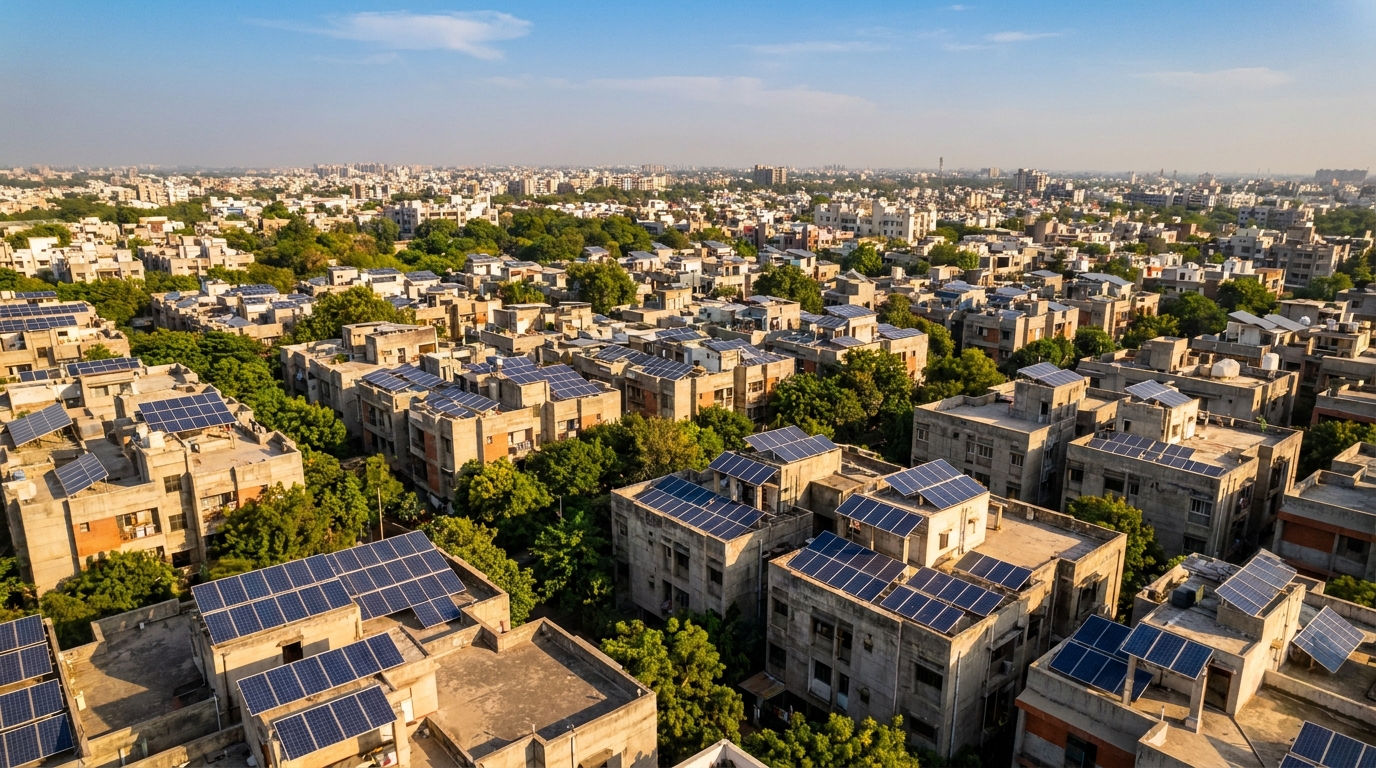
Why Solar Ahmedabad Is One of India’s Best Solar Markets
Gujarat consistently ranks among the top solar states in India, and Ahmedabad sits at the heart of that advantage. The city receives an average of 5.5 to 6.0 peak sun hours per day, which is significantly higher than the national average of around 4.5 to 5.0 hours. More sun hours mean more electricity generated per kilowatt of installed capacity, which directly improves your return on investment.
Beyond sunshine, the policy environment in Ahmedabad strongly favors solar adoption. The Uttar Gujarat Vij Company Limited (UGVCL) and Dakshin Gujarat Vij Company Limited (DGVCL) both operate net metering frameworks that allow consumers to export surplus solar power back to the grid and receive credits on their electricity bills. This dramatically shortens the payback period for solar Ahmedabad installations.
Electricity tariffs in Ahmedabad have also been rising steadily. Residential consumers in the city now pay between ₹4.50 and ₹6.50 per unit depending on their consumption slab, while commercial and industrial consumers often pay ₹7.00 to ₹9.00 per unit or more. Every unit your solar system generates is a unit you do not buy from the grid — and at these tariff rates, the savings add up fast.
Finally, Ahmedabad’s rapid urban expansion, particularly in the western and northern corridors, has created a large stock of newer buildings with flat concrete rooftops that are ideal for solar panel installation. This combination of solar resource, policy support, rising tariffs, and suitable building stock makes solar Ahmedabad one of the most attractive solar markets in the country.
Top Localities in Ahmedabad for Rooftop Solar Potential
Not every part of Ahmedabad offers the same solar opportunity. Rooftop potential depends on several factors: available rooftop area, shading from adjacent buildings or trees, DISCOM feeder connectivity, and the density of existing solar installations in the area. Based on these parameters, certain localities stand out clearly.

High-Potential Residential Localities
- Bopal and South Bopal: One of Ahmedabad’s fastest-growing residential corridors, Bopal features large independent bungalows and newer apartment complexes with generous rooftop space. The area has seen strong solar adoption, and UGVCL feeder connectivity here is reliable.
- Prahlad Nagar: A premium residential and mixed-use zone with wide plots and low-rise buildings. Minimal shading and excellent sun exposure make this one of the best localities for solar Ahmedabad residential projects.
- Satellite and Jodhpur: Established residential neighborhoods with a mix of independent houses and housing societies. Many resident welfare associations here have already explored group solar procurement, reducing per-unit installation costs.
- Thaltej and Shilaj: Newer developments with modern construction standards. Flat rooftops and good structural load capacity make solar installation straightforward and cost-effective.
- Gota and Chandkheda: Rapidly developing areas in north Ahmedabad with a high density of independent homes. Solar adoption is growing quickly here as awareness increases and panel costs continue to fall.
High-Potential Commercial and Industrial Zones
- SG Highway Corridor: Commercial offices, retail complexes, and hospitality businesses along Sarkhej-Gandhinagar Highway have large rooftop areas and high daytime electricity consumption, a perfect match for solar energy generation.
- GIFT City, Gandhinagar (Ahmedabad Metro Region): India’s first operational smart city and international financial hub. Buildings here are designed with sustainability in mind, and solar installations align with the city’s green building mandates.
- Naroda GIDC: One of Gujarat’s largest industrial estates, located in northeast Ahmedabad. Factories and manufacturing units here have massive rooftop areas and consume enormous amounts of electricity, making industrial solar Gujarat installations highly viable.
- Vatva GIDC: Another major industrial cluster with chemical, textile, and engineering industries. High electricity consumption and large shed rooftops create excellent conditions for commercial and industrial solar projects.
If you are unsure whether your specific property qualifies for a solar installation, a site assessment from an experienced solar EPC company will give you a precise picture of your rooftop’s potential.
Understanding Solar Subsidies Available in Ahmedabad
One of the most important factors in the solar Ahmedabad equation is the subsidy landscape. The central and state governments have made significant financial support available to reduce the upfront cost of going solar, particularly for residential consumers.
PM Surya Ghar Muft Bijli Yojana
Launched by the Government of India, the PM Surya Ghar Muft Bijli Yojana is the flagship residential solar subsidy scheme. Under this scheme, eligible homeowners in Ahmedabad can receive a direct benefit transfer (DBT) subsidy based on the size of their rooftop solar system:
- Up to 2 kW system: ₹30,000 per kW subsidy
- 2 kW to 3 kW system: ₹18,000 per kW for the additional capacity
- Above 3 kW: Subsidy capped at the 3 kW level (₹78,000 maximum for residential)
This subsidy is available only for grid-connected rooftop solar systems installed through MNRE-empanelled vendors. The application is processed through the national portal, and the subsidy amount is credited directly to the consumer’s bank account after successful installation and inspection.
Gujarat GEDA Incentives
The Gujarat Energy Development Agency (GEDA) administers state-level solar incentives and facilitates the net metering application process for Ahmedabad consumers. GEDA also runs awareness programs and maintains a list of approved solar vendors in Gujarat, helping consumers identify reliable installation partners.
Net Metering Policy in Ahmedabad
Net metering is available to all UGVCL and DGVCL consumers in Ahmedabad who install grid-connected rooftop solar systems. Under this policy, surplus electricity exported to the grid is credited against your consumption at a rate determined by the Gujarat Electricity Regulatory Commission (GERC). For residential consumers, this effectively means your electricity meter runs backwards when your solar system produces more than you consume, reducing or even eliminating your monthly electricity bill.
To apply for net metering in Ahmedabad, you will need your electricity consumer number, a copy of your property documents, the solar system technical specifications, and a net metering application form submitted through your DISCOM. A qualified solar EPC partner can handle this entire process on your behalf.
For a deeper understanding of how government solar subsidy schemes work and how to navigate them, the National Solar Rooftop Portal maintained by the Ministry of New and Renewable Energy (MNRE) is an authoritative resource.
Real-World ROI Scenarios for Ahmedabad Property Owners
Understanding the financial case for solar Ahmedabad requires looking at real numbers. The following scenarios are based on typical system sizes, current panel costs, prevailing electricity tariffs in Ahmedabad, and available subsidies in 2026. They illustrate the range of outcomes for different property types.
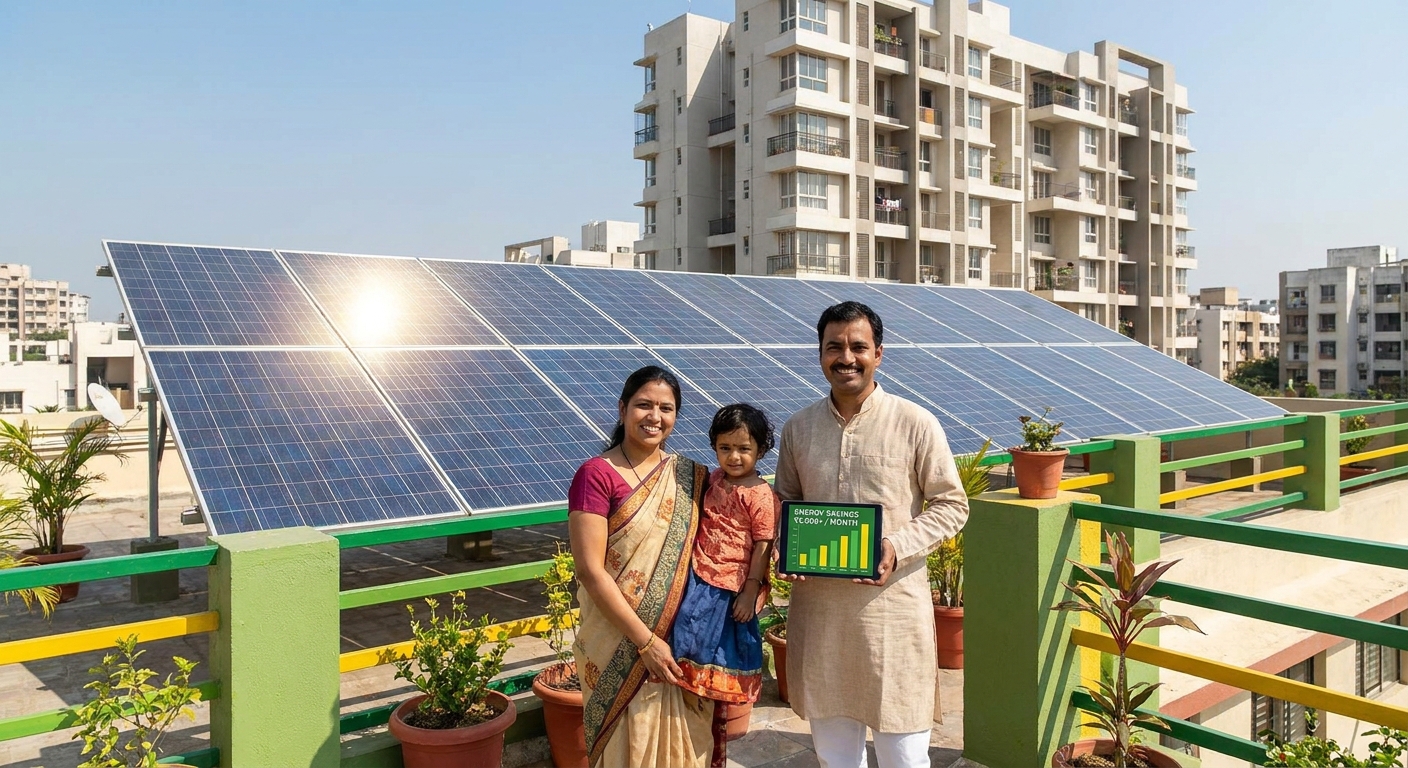
Case 1: 3 kW Residential System in Bopal
A typical middle-income household in Bopal consuming around 300 to 400 units per month is an ideal candidate for a 3 kW rooftop solar system.
- Gross system cost: Approximately ₹1,50,000 to ₹1,80,000
- PM Surya Ghar subsidy: ₹78,000 (maximum for residential)
- Net cost after subsidy: Approximately ₹72,000 to ₹1,02,000
- Monthly generation: ~375 units (at 5.5 peak sun hours/day)
- Monthly savings: ₹1,875 to ₹2,437 (at ₹5.00 to ₹6.50 per unit)
- Simple payback period: 3 to 4.5 years
- 25-year lifetime savings: ₹5.6 lakh to ₹7.3 lakh
This is one of the strongest residential solar ROI cases in India. The combination of high sun hours, meaningful subsidies, and rising tariffs makes solar payback in Ahmedabad significantly faster than in most other Indian cities. To understand how payback periods are calculated in detail, read our guide on the solar payback period and break-even timeline.
Case 2: 10 kW Commercial Rooftop in Prahlad Nagar
A small commercial office or retail establishment in Prahlad Nagar consuming 1,000 to 1,200 units per month can benefit significantly from a 10 kW rooftop solar system.
- System cost: Approximately ₹4,50,000 to ₹5,50,000
- Subsidy: Commercial systems are not eligible for PM Surya Ghar residential subsidy, but accelerated depreciation benefits apply for businesses
- Monthly generation: ~1,250 units
- Monthly savings: ₹8,750 to ₹11,250 (at ₹7.00 to ₹9.00 per unit)
- Simple payback period: 3.5 to 5 years
- 25-year lifetime savings: ₹26 lakh to ₹33 lakh
Commercial solar Ahmedabad installations benefit from the fact that businesses consume most of their electricity during daytime hours, exactly when solar panels are generating at peak capacity. This alignment between generation and consumption maximizes self-consumption and reduces dependence on grid power.
Case 3: 50 kW Industrial System in Naroda GIDC
A medium-scale manufacturing unit in Naroda GIDC with monthly electricity bills of ₹2 lakh to ₹3 lakh can achieve dramatic cost reductions with a 50 kW or larger rooftop solar system.
- System cost: Approximately ₹20,00,000 to ₹25,00,000
- Accelerated depreciation benefit: 40% in Year 1 under Income Tax Act
- Monthly generation: ~6,250 units
- Monthly savings: ₹50,000 to ₹56,250 (at ₹8.00 to ₹9.00 per unit)
- Simple payback period: 3 to 4 years
- 25-year lifetime savings: ₹1.5 crore to ₹1.7 crore
For industrial solar Gujarat projects, the financial case is often the most compelling of all. High electricity tariffs, large rooftop areas, and significant tax benefits combine to deliver exceptional returns. Industrial solar Ahmedabad projects at Naroda and Vatva GIDC have become a growing segment of the market precisely because the numbers are so strong.
Solar Panel Cost Breakdown for Ahmedabad Installations
Understanding what drives solar panel cost in Ahmedabad helps you evaluate quotes and make informed decisions. In 2026, the cost of a complete rooftop solar system in Ahmedabad typically breaks down as follows:
- Solar modules: 40 to 50% of total system cost. Monocrystalline PERC and TOPCon panels are the most popular choices for Ahmedabad’s high-irradiance environment due to their superior efficiency.
- Solar inverter: 15 to 20% of total cost. String inverters are standard for most residential and small commercial systems, while microinverters or hybrid inverters are chosen for systems with partial shading or battery backup requirements.
- Mounting structure: 10 to 15% of total cost. Hot-dip galvanized or aluminum structures are preferred for Ahmedabad’s climate, which includes high temperatures and occasional strong winds during the monsoon.
- Wiring, cables, and accessories: 5 to 8% of total cost.
- Installation and commissioning: 10 to 15% of total cost, including net metering application charges.
For guidance on which solar brands and modules perform best in Gujarat’s climate, our detailed comparison of solar brands in Gujarat covers the top panel manufacturers available in the market today.
Solar Financing Options in Ahmedabad
The upfront cost of a solar installation can be a barrier for some property owners. Fortunately, several solar financing options are available in Ahmedabad that make going solar accessible without a large initial outlay:
- Solar loans: Several nationalized and private banks offer dedicated solar loans at competitive interest rates. The PM Surya Ghar scheme also facilitates collateral-free loans for eligible residential consumers through empanelled banks.
- EMI through solar companies: Many solar EPC companies in Gujarat offer in-house EMI arrangements, allowing you to spread the cost over 12 to 60 months.
- RESCO model: Under the Renewable Energy Service Company model, a third party installs and owns the solar system on your rooftop, and you pay only for the electricity generated, often at a rate lower than your current grid tariff. This requires zero upfront investment.
The right financing model depends on your financial situation, tax position, and long-term ownership goals. A knowledgeable solar EPC partner can help you evaluate which approach delivers the best outcome for your specific case.
Choosing the Right Solar EPC Partner in Ahmedabad
The quality of your solar Ahmedabad installation depends heavily on the EPC company you choose. A poorly designed or installed system can underperform for years, eroding the financial returns you expect. Here is what to look for when selecting a solar EPC partner in Ahmedabad.
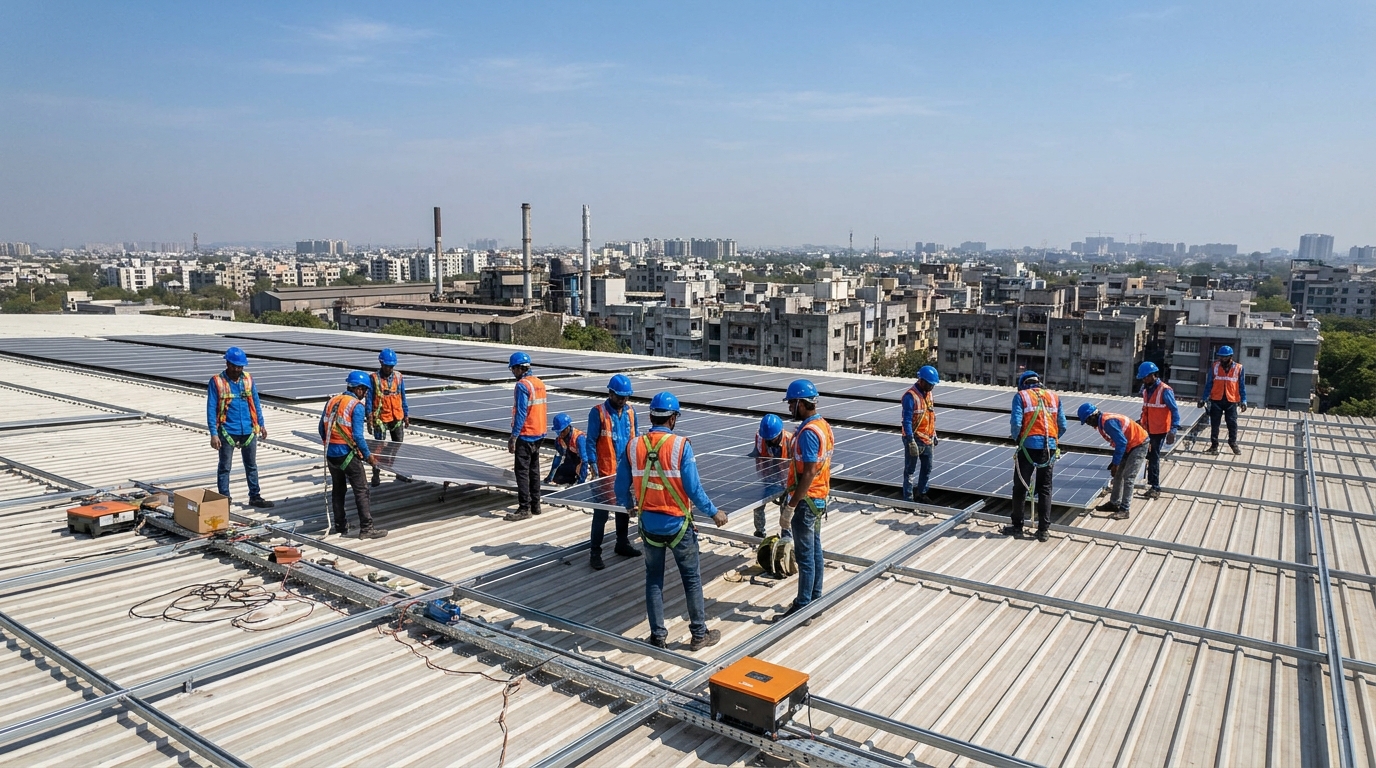
Key Criteria for Selecting a Solar EPC Company
- MNRE empanelment: Only MNRE-empanelled vendors can install systems eligible for the PM Surya Ghar subsidy. Always verify empanelment status before signing any contract.
- Local experience in Gujarat: Solar installation in Gujarat involves specific considerations, extreme summer heat, monsoon wind loads, and DISCOM-specific net metering procedures. A company with deep local experience navigates these factors far more effectively than a national player with no regional presence.
- Turnkey EPC capability: Look for a company that handles everything from site assessment and system design to procurement, installation, commissioning, and net metering application. This reduces coordination complexity and accountability gaps.
- After-sales service and solar maintenance: Solar systems have a 25-year lifespan. Ongoing solar maintenance in Gujarat, including panel cleaning, inverter health checks, and performance monitoring, is essential to sustaining output over time. Choose a company with a clear service and maintenance commitment.
- Track record and references: Ask for references from completed projects in Ahmedabad or nearby areas. A company with a strong portfolio of residential, commercial, and industrial solar Gujarat installations demonstrates the breadth of expertise needed for complex projects.
How Heaven Green Energy Serves Ahmedabad
Heaven Green Energy Limited has been delivering solar energy solutions across Gujarat since 2017. With a dedicated branch office in Ahmedabad, the company brings the same turnkey EPC expertise it has applied across thousands of installations in Gujarat directly to Ahmedabad property owners. Whether you are a homeowner in Bopal looking for a 3 kW residential system, a business owner on SG Highway evaluating a 50 kW commercial installation, or an industrial operator in Naroda GIDC exploring large-scale solar, Heaven Green Energy provides end-to-end support, from initial site assessment and system design through subsidy application, installation, commissioning, and long-term solar maintenance in Gujarat.
The company’s expertise in government schemes including PM Surya Ghar and PM-KUSUM means Ahmedabad consumers can navigate the subsidy application process with confidence, maximizing the financial benefits available to them. For a comprehensive overview of what a full solar EPC engagement involves, read our guide on what solar EPC services include.
Frequently Asked Questions About Solar in Ahmedabad
How long does a solar installation take in Ahmedabad?
For a standard residential solar Ahmedabad installation (3 to 10 kW), the physical installation typically takes 1 to 3 days. The net metering application and DISCOM approval process can take an additional 2 to 6 weeks depending on the DISCOM’s current workload. Your EPC company should manage this process on your behalf.
Can I install solar on a rented property in Ahmedabad?
Technically yes, but it requires the property owner’s written consent since the solar system is mounted on the building structure. The subsidy and net metering connection are typically registered in the name of the electricity consumer, which may be the tenant. It is advisable to have a clear agreement with the property owner about ownership of the system and what happens at the end of the tenancy.
What happens to my solar system during Ahmedabad’s monsoon season?
Solar panels are designed to withstand rain, wind, and humidity. During monsoon months (June to September), generation will be lower due to cloud cover, but the system will continue to produce electricity on partially cloudy days. A well-designed system accounts for seasonal variation in its annual generation estimates. Mounting structures should be rated for the wind speeds typical of Gujarat’s monsoon season.
Is net metering available for all Ahmedabad consumers?
Net metering is available to residential, commercial, and industrial consumers connected to UGVCL or DGVCL in Ahmedabad, subject to the system size limits set by GERC. As of 2026, net metering is permitted for systems up to 500 kW for most consumer categories. Consumers with systems above this threshold may be eligible for gross metering arrangements. Your solar EPC partner can advise on the applicable policy for your specific connection type.
What solar brands are best suited for Ahmedabad’s climate?
Ahmedabad’s high temperatures can affect solar panel efficiency, a phenomenon known as temperature coefficient degradation. Monocrystalline PERC and TOPCon panels from reputable manufacturers generally perform better in high-temperature environments than older polycrystalline technology. For a detailed comparison of panel brands available in Gujarat, see our guide on top solar brands in Gujarat.
How do I know if my rooftop is structurally suitable for solar panels?
A qualified solar EPC company will conduct a structural assessment as part of the site survey. Most flat concrete rooftops in Ahmedabad’s residential and commercial buildings are suitable for solar installation. The key factors assessed include the age and condition of the roof slab, available shadow-free area, and the orientation and tilt angle achievable for the panels.
Take the Next Step Toward Solar in Ahmedabad
The case for solar Ahmedabad has never been stronger. High solar irradiance, rising electricity tariffs, generous government subsidies, and a supportive net metering framework combine to deliver some of the best solar ROI available anywhere in India. Whether you own a home in Bopal, a commercial property on SG Highway, or an industrial facility in Naroda GIDC, the financial and environmental benefits of going solar in Ahmedabad are clear and compelling.
The key is choosing the right partner, one with deep local knowledge of Ahmedabad’s DISCOM procedures, subsidy application processes, and installation environment. Heaven Green Energy’s Ahmedabad branch is ready to help you assess your rooftop potential, design the right system for your needs, and manage the entire process from start to finish. According to the Ministry of New and Renewable Energy (MNRE), India’s rooftop solar capacity is growing rapidly, and Ahmedabad property owners who act now will lock in today’s panel prices and subsidy rates before they change.
Ready to find out exactly how much you can save with solar Ahmedabad? Speak directly with our solar experts today. Call us at +91 63904 05060, our team will walk you through a customized ROI analysis for your specific property, explain the subsidies you qualify for, and give you a clear picture of your payback timeline. Take the first step toward energy independence in Ahmedabad today.
This blog post was written using thestacc.com