


Junagadh district sits at the heart of Gujarat’s agricultural belt, where thousands of farmers depend on electricity-hungry pump sets to irrigate their fields — and where electricity bills eat deep into already thin margins. At the same time, homeowners across the district face rising power tariffs with little relief in sight. Solar Junagadh is no longer just a buzzword; it is a practical, government-backed pathway to energy independence that is transforming farms and households across the region. With India’s PM-KUSUM scheme offering substantial subsidies and Gujarat’s exceptional solar irradiance averaging over 5.5 peak sun hours per day, 2026 is the right time to act.
This guide walks you through everything you need to know about adopting solar energy in Junagadh — from understanding the PM-KUSUM scheme and checking your eligibility, to calculating your return on investment and finding a trusted local installation partner. Whether you are a farmer looking to replace a diesel pump or a homeowner ready to cut your electricity bill, this step-by-step resource has you covered.
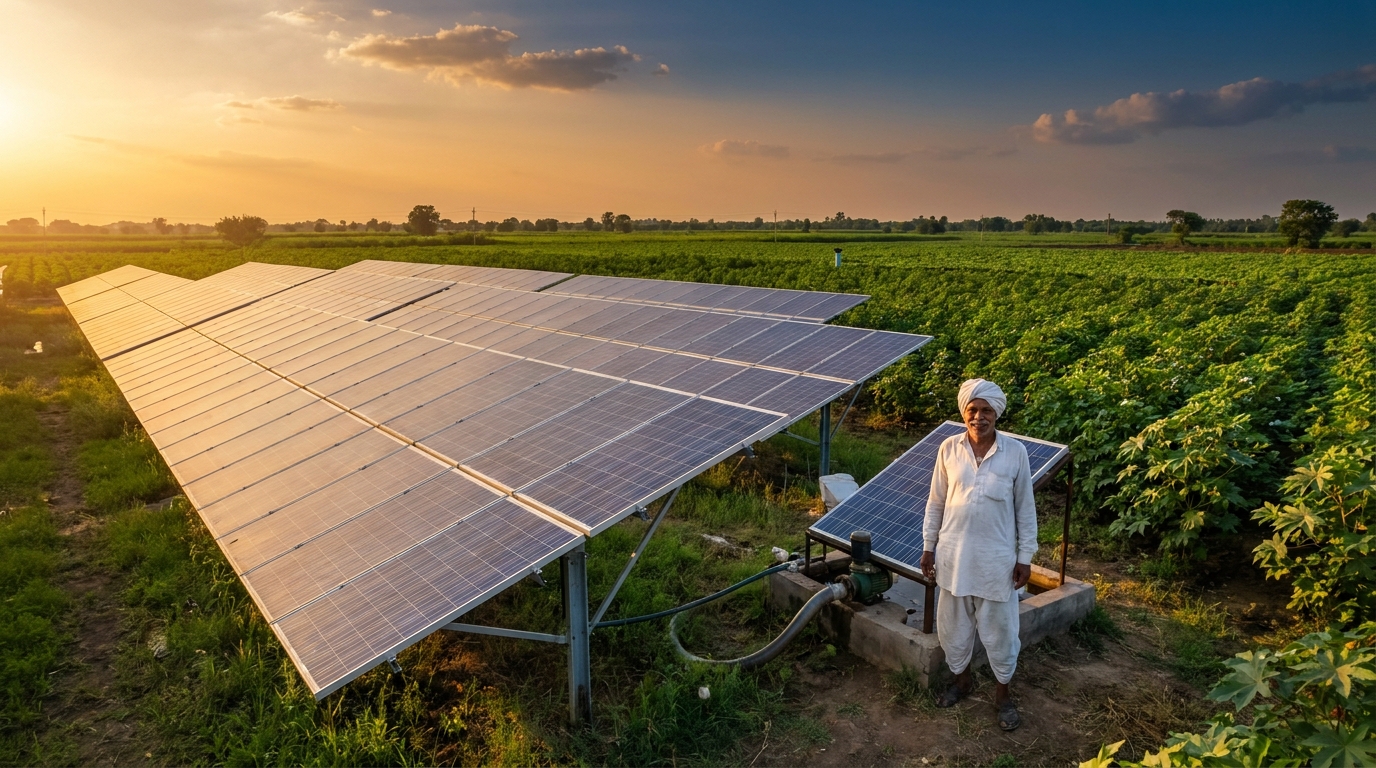
Why Solar Junagadh Is a Game-Changer for Farmers and Homeowners
Junagadh’s economy is deeply rooted in agriculture. Groundnut, mango, cotton, and wheat cultivation dominate the landscape, and reliable irrigation is non-negotiable for a good harvest. Traditionally, farmers have relied on diesel pumps or subsidised grid electricity — both of which carry hidden costs. Diesel prices are volatile, and grid power for agriculture is often available only during off-peak hours, disrupting irrigation schedules.
Solar Junagadh addresses these pain points directly. A solar-powered pump set runs on free sunlight, operates during peak daylight hours (which align naturally with irrigation needs), and requires minimal maintenance once installed. For homeowners, rooftop solar in Junagadh means generating your own electricity, reducing monthly bills, and even earning income by selling surplus power back to the grid through net metering.
Gujarat’s state government, through the Gujarat Energy Development Agency (GEDA), has been one of the most proactive in implementing PM-KUSUM and rooftop solar schemes. Junagadh district has seen growing adoption, but a large portion of eligible farmers and homeowners have yet to apply, meaning significant subsidy funds remain unclaimed. The opportunity is real, and it is available right now.
Understanding PM-KUSUM: The Solar Subsidy Scheme for Solar Junagadh
PM-KUSUM stands for Pradhan Mantri Kisan Urja Suraksha evam Utthaan Mahabhiyan. Launched by the Ministry of New and Renewable Energy (MNRE), it is India’s flagship scheme to bring solar energy to the agricultural sector. The scheme has three components, each relevant to different types of solar Junagadh adopters.
Component A: Decentralised Ground-Mounted Solar Plants
Under Component A, farmers can install small solar power plants (500 kW to 2 MW) on barren or uncultivable land and sell the electricity generated to the local distribution company (DISCOM). This creates a steady income stream from land that was previously unproductive. For Junagadh farmers with spare land, this is a compelling opportunity.
Component B: Standalone Solar Pump Sets
This is the most popular component for individual farmers. Component B provides subsidies for replacing diesel or grid-connected pumps with standalone solar pump sets ranging from 3 HP to 10 HP. The financial structure is straightforward: the central government contributes 30% of the benchmark cost, the Gujarat state government contributes 30%, and the farmer pays only the remaining 40%. In many cases, solar financing options can cover even this farmer contribution, making the upfront cost near zero.
Component C: Solarisation of Grid-Connected Pumps
Component C allows farmers who already have grid-connected pumps to add a solar panel system on top. The solar energy generated powers the pump first; any surplus is exported to the grid and the farmer earns revenue. This component is ideal for farmers in Junagadh who have existing electric pumps and want to reduce their electricity bills while generating additional income.
According to the Ministry of New and Renewable Energy, PM-KUSUM aims to add 30.8 GW of solar capacity through agricultural applications across India. Gujarat has been allocated a significant share, and Junagadh district is well within the active implementation zone.
1. Check Your Eligibility for Solar Junagadh PM-KUSUM Benefits
Before you begin the application process, confirm that you meet the eligibility criteria. Applying without the right documents or qualifications is the most common reason for delays in solar Junagadh PM-KUSUM approvals.
Eligibility for Farmers (Component B and C)
- Land ownership: You must own agricultural land in your name or have a valid lease agreement recognised by the revenue department.
- Existing pump capacity: For Component B, you should not already have a functioning solar pump. For Component C, you must have a registered grid-connected pump with a valid electricity connection.
- Water source: A borewell, open well, or canal connection must be present on the land.
- Bank account: A bank account linked to your Aadhaar card is mandatory for subsidy disbursement.
Eligibility for Residential Rooftop Solar in Junagadh
- You must own the property where the solar system will be installed.
- A valid electricity connection (consumer number) from the local DISCOM is required.
- The rooftop must have adequate shadow-free space (typically 10 sq. metres per kW of capacity).
- Systems up to 3 kW receive a 40% central subsidy; systems between 3 kW and 10 kW receive 20% subsidy on the portion above 3 kW.
Documents Required
- Aadhaar card (farmer/homeowner)
- Land ownership documents (7/12 extract or property deed)
- Latest electricity bill
- Bank passbook copy
- Passport-size photograph
- Mobile number linked to Aadhaar
Gathering these documents before you start the online application will save you significant time. Missing even one document is a common reason applications stall at the verification stage.
2. Calculate Your Solar Panel Cost and Expected ROI
One of the first questions every solar Junagadh prospect asks is: “How much will this cost me, and when will I get my money back?” The answers are more encouraging than most people expect, especially after subsidies are applied.
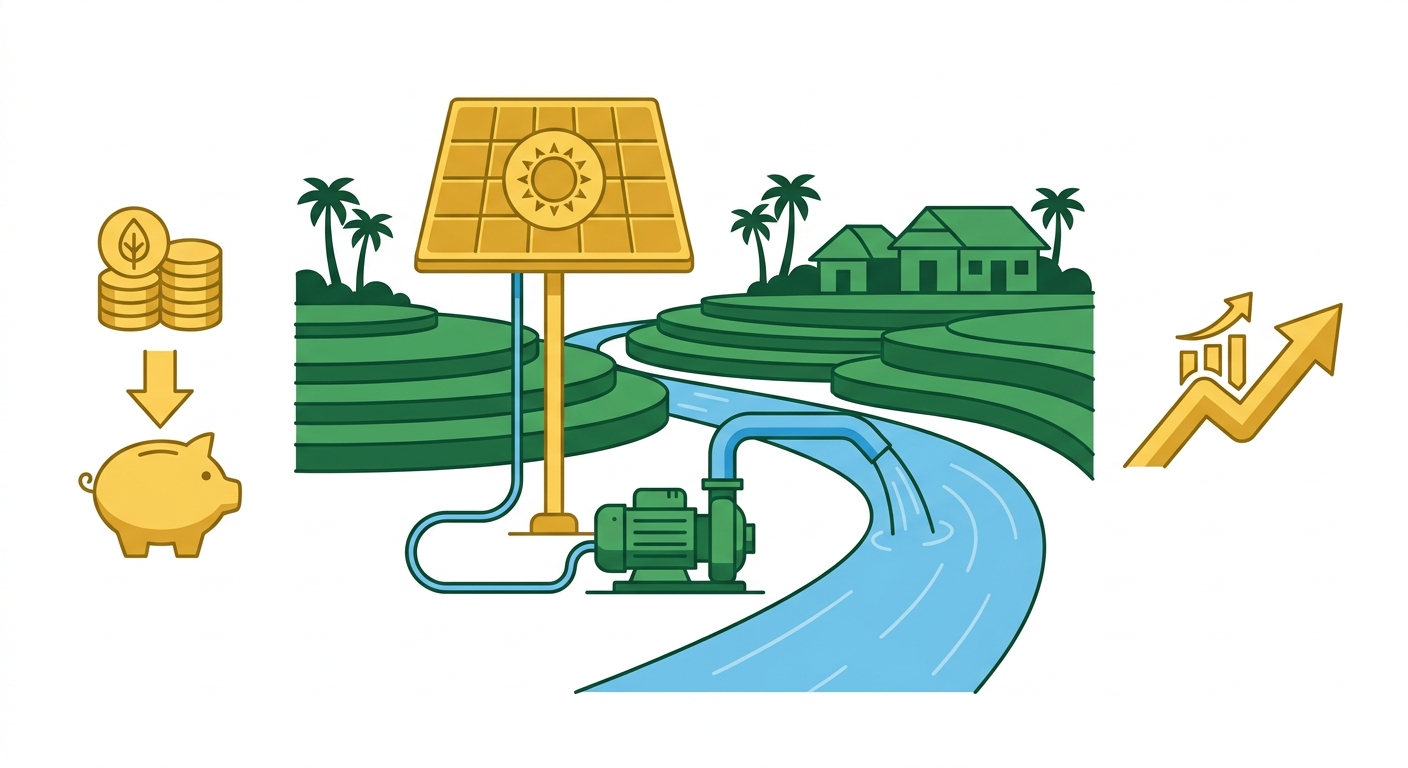
Solar Pump Set Costs After PM-KUSUM Subsidy
The benchmark costs set by MNRE for solar pump sets vary by capacity. After the combined 60% subsidy (30% central + 30% state), the farmer’s net contribution is typically as follows:
- 3 HP Solar Pump: Farmer contribution approximately ₹30,000–₹40,000
- 5 HP Solar Pump: Farmer contribution approximately ₹50,000–₹65,000
- 7.5 HP Solar Pump: Farmer contribution approximately ₹75,000–₹95,000
- 10 HP Solar Pump: Farmer contribution approximately ₹1,00,000–₹1,30,000
These figures are approximate and subject to GEDA’s current benchmark rates. Contact a local solar EPC Gujarat partner for an accurate quote based on your specific site conditions.
Rooftop Solar System Costs for Junagadh Homeowners
For a typical 3 kW residential rooftop solar system in Junagadh, the gross cost before subsidy is in the range of ₹1.5–₹1.8 lakh. After the 40% central subsidy under the PM Surya Ghar scheme, the net cost drops to approximately ₹90,000–₹1.1 lakh. A 5 kW system, suitable for a larger home with air conditioning, costs proportionally more but still benefits from partial subsidy on the additional capacity.
Solar ROI and Payback Period
Junagadh’s high solar irradiance means your system generates more units per kW installed compared to many other parts of India. A 3 kW rooftop system in Junagadh can generate approximately 13, 15 units per day, translating to annual savings of ₹25,000–₹35,000 depending on your tariff slab. The solar payback period for most residential systems in Junagadh falls between 4 and 6 years after subsidy. For agricultural pump sets, the payback is even faster when you factor in eliminated diesel costs and reduced electricity bills. To understand payback calculations in detail, read our guide on Solar Payback Period Explained: Break-Even Timeline 2026.
Solar Financing Options
If the farmer’s contribution or homeowner’s net cost is still a barrier, solar financing is available through nationalised banks, cooperative banks, and NABARD-linked schemes. Many solar EPC Gujarat companies, including Heaven Green Energy, can help you connect with financing partners who offer low-interest loans specifically for PM-KUSUM and rooftop solar projects.
3. Apply for the PM-KUSUM Scheme: Step-by-Step Process
The application process for solar Junagadh PM-KUSUM benefits is managed through GEDA’s online portal. Here is the complete step-by-step journey from registration to commissioning.
Step 1: Register on the GEDA Portal
Visit the official GEDA website and navigate to the PM-KUSUM section. Create an account using your Aadhaar-linked mobile number. Fill in your personal details, land details, and pump requirements accurately. Any mismatch with your land records will cause delays.
Step 2: Submit Required Documents Online
Upload scanned copies of all required documents (listed in the eligibility section above). Ensure scans are clear and legible. Blurry or incomplete uploads are a leading cause of application rejection at the initial screening stage.
Step 3: Await Approval and Demand Note
GEDA reviews your application and, upon approval, issues a demand note specifying the farmer’s contribution amount. This typically takes 4, 8 weeks depending on the volume of applications being processed in your district.
Step 4: Make the Farmer’s Contribution Payment
Pay the specified farmer contribution amount through the portal’s payment gateway. Keep the payment receipt safe, you will need it for subsequent steps.
Step 5: Select an Empanelled Solar EPC Gujarat Partner
GEDA maintains a list of empanelled solar EPC Gujarat companies authorised to execute PM-KUSUM projects. You must choose from this list. Selecting a non-empanelled vendor will disqualify your subsidy claim. Heaven Green Energy is an experienced solar EPC services provider with a local presence in Junagadh, making coordination straightforward. Learn more about what EPC services involve in our detailed guide: What is Solar EPC? Complete Service Guide 2026.
Step 6: Site Survey and Installation
Your chosen EPC partner conducts a site survey, designs the system, procures the solar modules, solar inverter, pump controller, and mounting structure, and carries out the installation. The installation itself typically takes 2, 5 days for a pump set and 1, 3 days for a rooftop system.
Step 7: Commissioning and Net Metering (Component C)
After installation, the system is tested and commissioned. For Component C (grid-connected solarisation), a net meter is installed by the DISCOM, allowing you to export surplus power and earn credits on your electricity bill. The entire process from application to commissioning typically takes 3, 6 months.
4. Choose the Right Solar Installation Partner in Junagadh
Your choice of solar installation partner is arguably the most important decision in your solar Junagadh journey. A poorly executed installation can underperform for 25 years. A well-executed one will deliver reliable returns with minimal hassle.
Why Empanelment Matters
For PM-KUSUM projects, only GEDA-empanelled companies can execute the work and claim the subsidy on your behalf. Always verify empanelment status before signing any agreement. For rooftop solar under PM Surya Ghar, similarly, only registered vendors can process the subsidy application through the national portal.
What to Look for in a Solar EPC Partner
- Local presence: A company with a branch office in Junagadh can respond quickly to site surveys, installation queries, and after-sales service requests.
- Track record: Look for verifiable project references in Gujarat, particularly in agricultural and residential segments.
- Quality of solar modules and inverters: Ask specifically which brands of solar modules and solar inverter they use. Tier-1 panels from reputable manufacturers ensure long-term performance. Our guide on Solar Brands Gujarat: Top Panel Manufacturers Compared 2026 can help you evaluate your options.
- After-sales solar maintenance Gujarat support: Confirm that the company offers Annual Maintenance Contracts (AMC) and has local technicians who can respond within 24, 48 hours.
- Transparent pricing: A trustworthy partner provides a detailed, itemised quotation, not a lump-sum figure.
Heaven Green Energy’s Junagadh Presence
Heaven Green Energy Limited, established in 2017 and headquartered in Surat, operates a branch office in Junagadh specifically to serve the district’s growing solar Junagadh demand. With experience across residential, commercial, industrial, and ground-mounted solar projects throughout Gujarat, the company brings turnkey EPC expertise and a deep understanding of GEDA’s processes. Their team handles everything from documentation support and site surveys to installation, commissioning, and ongoing solar maintenance Gujarat services, so you are never navigating the process alone.
5. What to Expect During Solar Installation in Junagadh
Understanding the installation journey helps you plan around it and set realistic expectations. Here is what a typical solar Junagadh project looks like from start to finish.
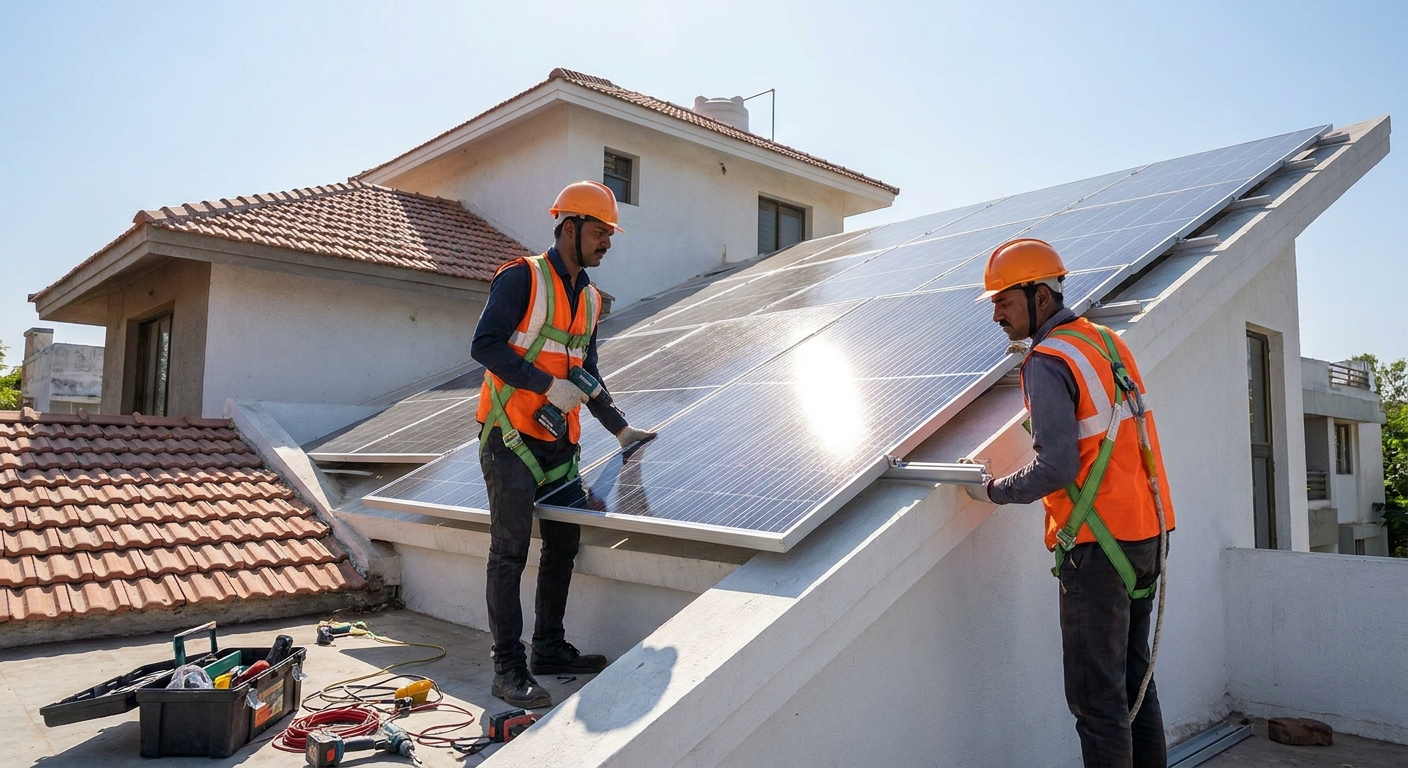
Week 1: Site Survey and System Design
Your EPC partner visits the site to assess roof orientation, shading, structural integrity (for rooftop systems), or land topography and water source location (for pump sets). Based on this survey, they design a system optimised for your specific conditions. You receive a detailed proposal including the number of solar modules, solar inverter specifications, mounting structure type, and expected energy generation.
Week 2, 3: Procurement
The EPC company procures all components, solar panels, solar inverter, pump controller (for agricultural systems), mounting structures, wiring, and safety equipment. Using quality solar modules from established brands ensures your system performs at rated capacity for its full 25-year lifespan.
Week 3, 4: Installation
The installation team arrives on site. For rooftop systems, mounting structures are fixed to the roof, panels are installed and wired, and the solar inverter is connected to your home’s electrical panel. For pump sets, the solar array is mounted on a ground structure near the pump, and the pump controller is configured. The physical installation typically takes 1, 5 days depending on system size.
Week 4, 6: Grid Connection and Net Metering (Rooftop)
For rooftop solar systems connected to the grid, your EPC partner submits the net metering application to the local DISCOM. The DISCOM inspects the installation and installs a bidirectional meter. This step can take 2, 4 weeks depending on DISCOM workload.
Commissioning and Handover
Once all connections are verified and safety checks are complete, the system is commissioned. You receive a handover kit including system documentation, warranty cards for solar modules and solar inverter, and contact details for the solar maintenance Gujarat support team. Your EPC partner should walk you through the monitoring app or display panel so you can track daily generation.
Ongoing Solar Maintenance Gujarat Support
Solar systems require minimal maintenance, but periodic cleaning of panels (especially in dusty Junagadh conditions) and annual electrical inspections are recommended. A good AMC from your solar EPC Gujarat partner covers these visits and ensures any performance issues are caught early.
Financial Benefits and Long-Term Savings for Solar Junagadh Adopters
The financial case for solar Junagadh adoption is compelling across both agricultural and residential segments. Here is a realistic picture of what you can expect over the life of your system.
For Farmers: Eliminating Diesel and Reducing Grid Dependency
A farmer running a 5 HP diesel pump for 6 hours a day spends approximately ₹1,500–₹2,000 per month on diesel alone. A solar pump set eliminates this cost entirely. Over 25 years (the typical life of solar panels), the cumulative savings on diesel can exceed ₹5–₹6 lakh, far outweighing the initial farmer contribution of ₹50,000–₹65,000. For Component C adopters, surplus solar power exported to the grid generates additional income credited against future electricity bills.
For Homeowners: Monthly Bill Reduction and Net Metering Income
A 3 kW rooftop solar system in Junagadh generating 13, 15 units per day can offset 390, 450 units per month. For a household consuming 300, 400 units monthly, this can reduce the electricity bill to near zero. Any surplus exported earns net metering credits. Over 25 years, the total savings on electricity bills for a typical Junagadh household can range from ₹8–₹15 lakh depending on tariff escalation.
Solar Payback Period in Junagadh
Given Junagadh’s strong solar resource and the significant subsidies available, the solar payback period for most systems falls between 4 and 6 years for residential installations and as low as 2, 3 years for agricultural pump sets (when diesel savings are factored in). After payback, the remaining 19, 23 years of system life represent pure financial gain. Solar panels carry a 25-year performance warranty, and quality solar inverters typically last 10, 15 years.
Environmental Impact
Beyond the financial returns, every solar Junagadh installation contributes to reducing Gujarat’s carbon footprint. A 3 kW rooftop system offsets approximately 3, 4 tonnes of CO₂ per year. A 5 HP solar pump set replaces diesel combustion that would otherwise emit significant greenhouse gases. These environmental benefits align with India’s national commitment to achieving 500 GW of renewable energy capacity by 2030.
Frequently Asked Questions About Solar Junagadh
Can tenant farmers apply for PM-KUSUM Component B?
In most cases, PM-KUSUM Component B requires the applicant to be the owner of the agricultural land. Tenant farmers may face challenges unless they have a registered lease agreement recognised by the revenue department. It is advisable to consult with GEDA or a local solar EPC Gujarat partner to assess your specific situation.
How long does the PM-KUSUM application process take in Gujarat?
From initial registration to system commissioning, the typical timeline is 3, 6 months. The approval and demand note stage (Steps 1, 3) usually takes 4, 8 weeks. Installation and commissioning (Steps 5, 7) take an additional 4, 8 weeks. Delays can occur if documents are incomplete or if DISCOM net metering approvals take longer than expected.
What happens if my solar pump breaks down after installation?
Under PM-KUSUM, the empanelled EPC company is required to provide a minimum 5-year comprehensive maintenance warranty on the solar pump set. This means repairs and replacements during this period are covered. After the warranty period, an AMC with your solar EPC Gujarat partner ensures continued support. Heaven Green Energy’s solar maintenance Gujarat team is based locally in Junagadh for fast response times.
Is rooftop solar available for commercial properties in Junagadh?
Yes. While PM-KUSUM is specifically for agricultural applications, commercial and industrial rooftop solar in Junagadh is supported under separate GEDA schemes and the national PM Surya Ghar programme (for smaller commercial establishments). Industrial solar Gujarat projects above certain capacities may not qualify for residential subsidies but can still benefit from accelerated depreciation and other fiscal incentives. Contact Heaven Green Energy to discuss the right scheme for your commercial property.
Can I get solar financing for the farmer contribution amount?
Yes. Several nationalised banks, cooperative banks, and NABARD-linked financial institutions offer loans specifically for the farmer’s contribution under PM-KUSUM. The loan amounts are small relative to the total system cost, and repayment is often structured to align with agricultural income cycles. Your solar EPC Gujarat partner can help connect you with suitable financing options.
Which solar brands are used in PM-KUSUM installations in Gujarat?
GEDA specifies minimum quality standards for solar modules and inverters used in PM-KUSUM projects. Empanelled EPC companies typically use Tier-1 solar modules from manufacturers listed on the MNRE’s approved list. For a detailed comparison of solar brands available in Gujarat, refer to our guide on Solar Brands Gujarat: Top Panel Manufacturers Compared 2026.
Take the Next Step Toward Solar Junagadh Today
The combination of PM-KUSUM subsidies, Gujarat’s exceptional solar resource, and rising electricity costs makes 2026 the ideal year to go solar in Junagadh. Whether you are a farmer looking to eliminate diesel pump costs, a homeowner ready to slash your electricity bill, or a commercial property owner exploring industrial solar Gujarat options, the opportunity is right in front of you. Solar Junagadh is not a future aspiration, it is a present-day financial decision that pays for itself in years, not decades.
Heaven Green Energy’s Junagadh branch is ready to guide you through every step: from checking your PM-KUSUM eligibility and preparing your application documents, to designing your system, handling installation, and providing long-term solar maintenance Gujarat support. With over a decade of solar EPC Gujarat experience and a proven track record across residential, agricultural, and industrial solar projects, the team brings the expertise and local knowledge your project deserves.
Ready to find out exactly how much you can save with solar in Junagadh? Speak directly with a solar expert who understands the local landscape, GEDA processes, and the best solar panel cost options for your budget. Call Heaven Green Energy at +91 63904 05060 today and take the first step toward energy independence for your farm or home.
This blog post was written using thestacc.com